Import Gaming Chairs China to Mexico Customs [2026 Guide]
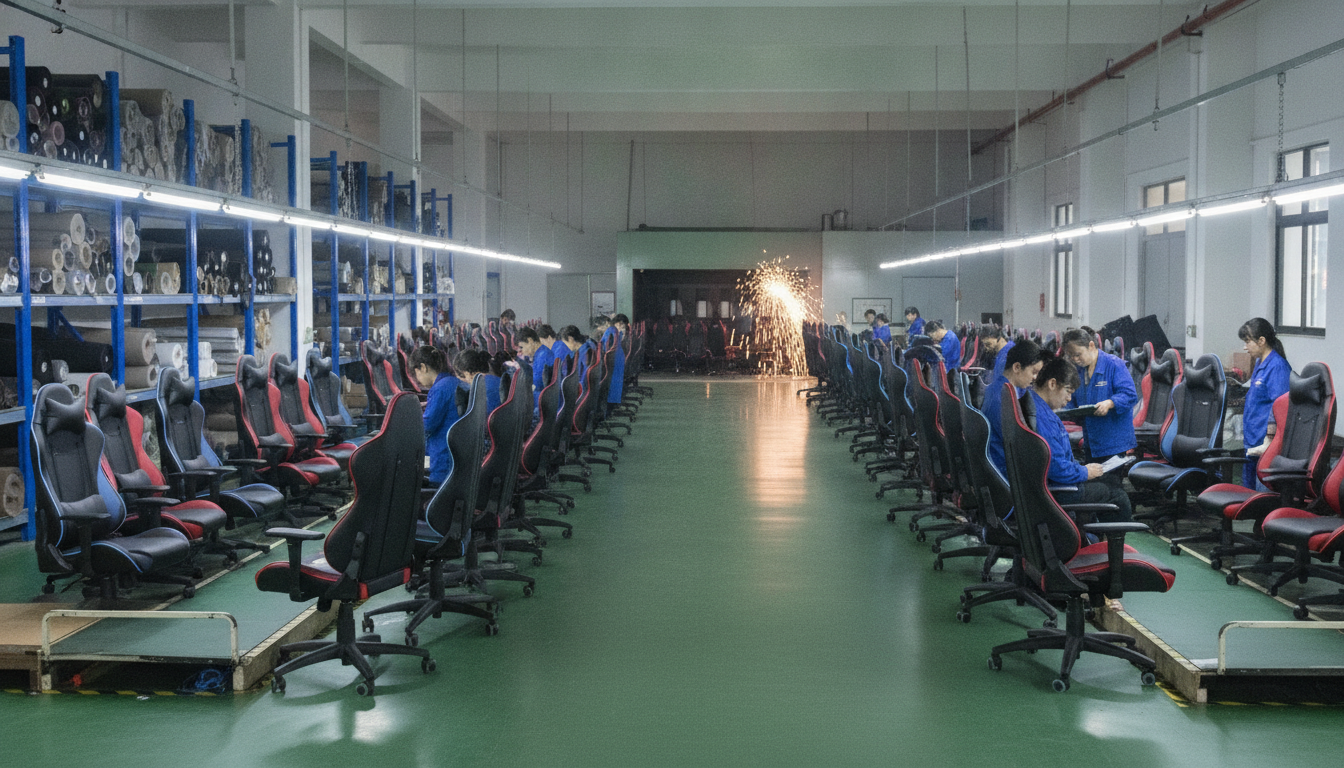
To import gaming chairs China to Mexico customs, you need an RFC tax ID, Padrón de Importadores registration, and a customs broker authorized by SAT. Gaming chairs typically classify under TIGIE tariff fraction 9401.80.01 (seats for motor vehicles and aircraft) or 9401.71.01 (upholstered seats with metal frames), attracting 5% to 20% IGI duty plus 16% IVA calculated on CIF value plus duty. Total landed cost includes product FOB, ocean freight ($800-$1,200 per 20ft container Shenzhen-Veracruz), insurance, import duty, DTA handling fee, IVA, customs broker fee ($150-$300 per shipment), and last-mile delivery to your warehouse.
📋 Table of Contents
- Executive Summary
- What Tariff Classification Applies to Gaming Chairs?
- Mexico Importer Registration and Legal Requirements
- How Are Customs Duty and IVA Calculated?
- Complete Landed-Cost Example for One Container
- Supplier Verification and Quality Control Workflow
- Shipping and Customs Clearance Process
- Key Takeaways
- Frequently Asked Questions
Executive Summary
- Tariff classification: Gaming chairs fall under TIGIE 9401.80.01 or 9401.71.01 depending on recliner mechanism, upholstery and electronic features, with IGI duty ranging 5% to 20%.
- IVA calculation: Mexico applies 16% IVA on the sum of CIF customs value, IGI duty and DTA handling fee, adding 18-22% to your total landed cost.
- Importer registration: You must hold an RFC tax ID, register in the Padrón de Importadores, obtain e.firma digital signature, and appoint a licensed customs broker before your first shipment clears.
- Landed-cost components: Product FOB, ocean freight, marine insurance, IGI, DTA, IVA, customs broker fee, port handling, and inland delivery to your warehouse or fulfillment center.
- Supplier verification: Verify business licence production scope, request third-party factory audit, inspect pre-production samples, and run during-production QC to separate real manufacturers from trading companies.
What Tariff Classification Applies to Gaming Chairs?
Gaming chairs imported into Mexico are classified under Mexico’s TIGIE (Tarifa de la Ley de los Impuestos Generales de Importación y de Exportación) system, which mirrors the international Harmonized System (HS) at the six-digit level and extends to eight or ten digits for national specificity. The correct tariff fraction determines your IGI (Impuesto General de Importación) duty rate, so misclassification can trigger customs delays, penalty assessments, or shipment holds at Veracruz, Manzanillo, or Lázaro Cárdenas port.
Common TIGIE Fractions for Gaming Chairs
Most gaming chairs fall into one of two TIGIE categories, depending on construction and features:
- 9401.80.01 (Seats for motor vehicles and aircraft): Applies when the chair includes a recliner mechanism, adjustable armrests, and a base designed for swivel or tilt, similar to automotive seating. IGI duty typically 10-15%.
- 9401.71.01 (Upholstered seats with metal frames): Covers chairs with steel or aluminum frames, foam padding, and fabric or PU leather upholstery, without electronic components. IGI duty typically 5-10%.
- 9401.80.99 (Other seats): Catch-all fraction for chairs that do not fit the above, including those with integrated speakers, RGB lighting, or massage motors. IGI duty 15-20%.
According to QC Advisor (2026), Mexico’s 2026 tariff changes include rates from 5% to 50% across 1,463 tariff fractions under the TIGIE. Gaming chairs originating in China without preferential treatment under a trade agreement face the general MFN (Most Favored Nation) rate, which for furniture and seating products ranges 5% to 20% depending on the fraction.
How Recliner Mechanisms and Electronics Affect Classification
A gaming chair with a gas-lift cylinder, tilt-lock mechanism, and adjustable lumbar support but no electronic components typically classifies under 9401.80.01. Adding built-in speakers, USB charging ports, or vibration motors shifts classification to 9401.80.99, attracting a higher duty band. Your customs broker will request a detailed product specification sheet, including materials breakdown (steel frame weight, foam density, upholstery type), mechanism description, and any electrical components with voltage and wattage ratings, to determine the correct fraction before filing the pedimento (customs declaration).
Requesting an Advance Ruling
If your gaming chair design is complex or hybrid, request an advance tariff ruling (consulta de clasificación arancelaria) from SAT (Servicio de Administración Tributaria) before placing your factory order. The ruling binds SAT for future shipments of the same product, eliminating classification disputes at the port. Turnaround time is 60-90 days, so submit early in your sourcing timeline.
Mexico Importer Registration and Legal Requirements
Mexico requires every commercial importer to complete a three-step registration process before customs will release your first shipment. Skipping any step results in your goods sitting in bonded warehouse, accruing storage fees of $50-$150 per day until compliance is achieved.
RFC Tax ID Registration
The RFC (Registro Federal de Contribuyentes) is your Mexican tax identification number, issued by SAT. If you are a Mexican company, your RFC was assigned at incorporation. If you are a foreign buyer importing into Mexico, you must register a permanent establishment or appoint a Mexican legal representative who holds an RFC and will act as importer of record. The representative files your pedimento and assumes liability for duties, taxes, and compliance. Obtain RFC registration at any SAT office or online via the SAT portal, providing your company formation documents, proof of address, and legal representative ID.
Padrón de Importadores Enrollment
The Padrón de Importadores is SAT’s registry of authorized importers. Enrollment requires an active RFC, e.firma digital signature (see below), proof of domicile in Mexico, and a clean tax-compliance record. SAT reviews your application within 10-15 business days. Once enrolled, your RFC number is flagged in the customs system as authorized to import, and your broker can file pedimentos under your name. Failure to enroll means your shipment cannot clear, regardless of duty payment.
e.firma Digital Signature
The e.firma (formerly FIEL) is a cryptographic certificate issued by SAT, used to sign electronic customs declarations and tax filings. Your customs broker cannot submit your pedimento without a valid e.firma linked to your RFC. Obtain e.firma by visiting a SAT office with your RFC certificate, official ID, and proof of address. The certificate is valid for four years and must be renewed before expiration to avoid clearance interruptions.
Customs Broker Appointment (Encargo Conferido)
Mexican law requires a licensed customs broker (agente aduanal) to file your pedimento and represent you before customs. You cannot self-clear commercial shipments. The broker must hold a current license from SAT and be authorized to operate at the port of entry (Veracruz, Manzanillo, Lázaro Cárdenas, or Nuevo Laredo for overland from the US). You grant the broker authority via an encargo conferido (power of attorney), notarized and registered with SAT. Broker fees range $150-$300 per shipment, plus a percentage of CIF value (typically 0.5-1%) for high-value or complex declarations.
How Are Customs Duty and IVA Calculated?
Mexico calculates import duty (IGI) and value-added tax (IVA) using a multi-step formula based on the CIF (Cost, Insurance, Freight) customs value. Understanding each component prevents surprise costs at clearance and allows accurate landed-cost modeling before you commit to a supplier.
CIF Customs Value
Customs value is the sum of product FOB price, international freight, and marine insurance. If your supplier quotes $15 per gaming chair FOB Shenzhen, and you ship 500 chairs in a 20ft container with ocean freight $1,000 and insurance $200, your CIF value is ($15 × 500) + $1,000 + $200 = $8,700. This figure is declared on the pedimento and forms the base for all duty and tax calculations.
IGI (Import Duty) Calculation
IGI is calculated as a percentage of CIF value, determined by the TIGIE tariff fraction. For a gaming chair classified under 9401.80.01 with a 10% IGI rate, duty is $8,700 × 10% = $870. According to HYT Logistics (2026), Mexico’s 2026 tariff changes apply 5% to 50% import duties to 1,463 tariff lines for goods originating in countries without a Mexican trade agreement. Gaming chairs from China fall under the general MFN rate, typically 5-20% depending on features and construction.
DTA (Derecho de Trámite Aduanero)
DTA is a flat customs processing fee of 8 pesos per thousand pesos of CIF value, or 0.8%. For the $8,700 CIF example above, DTA is $8,700 × 0.008 = $69.60. DTA is added to the duty base before calculating IVA.
IVA (Value-Added Tax) Calculation
According to LookupTax (2026), Mexico’s standard import IVA is 16%, calculated on the customs value plus applicable import duty and other import amounts. The formula is: IVA = (CIF + IGI + DTA) × 16%. For our example: IVA = ($8,700 + $870 + $69.60) × 16% = $9,639.60 × 16% = $1,542.34. According to SuanSupply (2026), Mexico’s import IVA formula is 16% multiplied by customs value plus IGI plus DTA, which matches the calculation above.
Cuotas Compensatorias (Anti-Dumping Duties)
Mexico occasionally imposes cuotas compensatorias (countervailing or anti-dumping duties) on specific Chinese products found to be sold below fair market value. Gaming chairs are not currently subject to these duties, but SAT publishes an updated list quarterly. Your customs broker checks the list before filing the pedimento to avoid surprise assessments.
Complete Landed-Cost Example for One Container
A complete landed-cost model includes every expense from factory gate in China to your warehouse in Mexico City, Guadalajara, or Monterrey. Importers who model only FOB price and ocean freight discover hidden costs at clearance, eroding margin and delaying cash flow.
Product and Freight Costs
- Product FOB Shenzhen: 500 gaming chairs at $15 per unit = $7,500. Includes factory production, carton packaging, and delivery to Shenzhen port CY (container yard).
- Ocean freight: 20ft container Shenzhen to Veracruz, 18-22 day transit, $1,000-$1,200 depending on carrier and season. Includes THC (terminal handling charge) at origin.
- Marine insurance: 0.3% of cargo value, covering total loss and general average. For $8,500 cargo value, premium is $200-$250.
Customs Duties and Taxes
- IGI duty: 10% of $8,700 CIF = $870.
- DTA processing fee: 0.8% of $8,700 = $70.
- IVA: 16% of ($8,700 + $870 + $70) = $1,542.
Port and Clearance Fees
- Customs broker fee: $200-$300 per pedimento, depending on complexity and broker. Includes pedimento filing, document review, and SAT representation.
- Port handling and storage: $100-$200 for container unloading, inspection facilitation, and short-term storage (first 3-5 free days, then $50-$150 per day).
- Inspection fee: If SAT or SENASICA (agriculture inspection) flags your shipment for physical inspection, add $150-$300 for container devanning, repacking, and inspector time.
Inland Delivery
- Veracruz to Mexico City: 20ft container drayage $400-$600, 1-2 day transit.
- Veracruz to Guadalajara: $600-$800, 2-3 day transit.
- Veracruz to Monterrey: $500-$700, 2 day transit.
Total landed cost for 500 gaming chairs delivered to Mexico City warehouse: $7,500 (FOB) + $1,000 (freight) + $200 (insurance) + $870 (IGI) + $70 (DTA) + $1,542 (IVA) + $250 (broker) + $150 (port handling) + $500 (inland delivery) = $12,082, or $24.16 per chair. Add your markup, storage, and fulfillment costs to determine retail or wholesale pricing.
Supplier Verification and Quality Control Workflow
Importers who skip supplier verification discover quality defects, shipment shortages, or outright fraud after payment clears. A structured verification workflow separates real manufacturers from trading companies, confirms production capacity, and catches defects before goods leave China.
Business Licence and Production Scope Verification
Every Chinese manufacturer holds a business licence (营业执照) issued by the local Administration for Industry and Commerce, listing the company’s registered name, legal representative, registered capital, and business scope. The scope section specifies which product categories the company is legally authorized to produce. A supplier whose licence lists “furniture wholesale and retail” but not “furniture manufacturing” is a trading company, not a factory. Request a scanned copy of the licence, verify the registered name matches the company seal on quotations and contracts, and cross-check the scope against the gaming chair category. Our supplier management team runs this check on every new factory before requesting samples.
Factory Audit and Capacity Assessment
A third-party factory audit verifies the supplier’s physical location, production equipment, workforce, and quality-control systems. The audit report includes photos of the factory floor, machinery list (cutting machines, sewing lines, foam-molding equipment, assembly stations), worker count, and annual output capacity. For gaming chairs, confirm the factory owns upholstery sewing lines, metal-frame welding and powder-coating equipment, foam-cutting machines, and final assembly and packaging areas. A factory claiming 10,000 chairs per month capacity but showing only 20 sewing machines and 5 assembly workers cannot meet that volume. Our quality control service includes on-site factory audits with detailed capacity verification before you place a production order.
Pre-Production Sample Inspection
Request a pre-production sample (PPS) before approving mass production. The PPS is assembled using the exact materials, components, and construction methods planned for your bulk order. Inspect the sample for frame strength (steel gauge, weld quality, powder-coat finish), upholstery stitching (seam strength, thread type, pattern alignment), foam density and rebound, mechanism operation (recline angle, tilt-lock function, gas-lift smooth travel), and packaging (carton strength, corner protection, assembly instructions clarity). Approve the PPS in writing, and require the factory to retain a golden sample on the production floor as the quality reference for your order.
During-Production and Pre-Shipment Inspection
A during-production inspection (DPI) catches defects while 30-50% of your order is complete, allowing time to correct issues before the full run finishes. The inspector checks raw materials against your approved sample, measures critical dimensions (seat width, backrest height, armrest spacing), tests mechanism function on random units, and verifies carton markings and labeling. A pre-shipment inspection (PSI) occurs when 100% of goods are finished and 80% packed, confirming final quality, quantity, and packaging before the factory loads the container. Both inspections generate a photo-rich report with pass/fail verdict and defect breakdown by type and severity. Buyers who skip PSI discover shortages, damage, or off-spec goods only after customs clearance in Mexico, when recourse is expensive and slow.
Shipping and Customs Clearance Process
Shipping gaming chairs from China to Mexico involves booking ocean freight, preparing export and import documentation, coordinating customs clearance at the Mexican port, and arranging inland delivery to your warehouse or fulfillment center. Each step has specific timing and documentation requirements that, if missed, trigger delays and demurrage fees.
Ocean Freight Booking and Container Loading
Book ocean freight 2-3 weeks before your production finish date to secure container space and competitive rates. Gaming chairs ship in 20ft or 40ft containers, with 500-600 chairs per 20ft and 1,100-1,300 per 40ft depending on carton dimensions and stacking. Request FOB Shenzhen, Ningbo, or Shanghai terms, where the supplier delivers goods to the port CY and you arrange the ocean leg. Alternatively, request CIF Veracruz or Manzanillo terms, where the supplier books freight and insurance and you pay the all-in landed cost. Our freight and shipping service consolidates orders from multiple suppliers into a single container, reducing per-unit freight cost and simplifying customs clearance.
Export Documentation from China
The factory or freight forwarder prepares China export documents, including commercial invoice (itemized product description, unit price, total value, Incoterms), packing list (carton count, gross and net weight, dimensions), bill of lading (B/L, issued by the carrier, proves ownership and serves as the receipt for cargo), and certificate of origin (if required for preferential duty treatment, though China-Mexico has no FTA). The shipper files an export declaration with China customs, and the container is loaded and sealed at the port. Transit time Shenzhen to Veracruz is 18-22 days, Ningbo to Manzanillo 20-24 days, Shanghai to Lázaro Cárdenas 22-26 days.
Import Documentation for Mexico Customs
Your customs broker files the pedimento electronically via the SAAI (Sistema Automatizado Aduanero Integral) system, attaching scanned copies of the commercial invoice, packing list, bill of lading, and your RFC and Padrón de Importadores certificates. The pedimento declares the TIGIE tariff fraction, CIF value, country of origin, and calculated duties and taxes. SAT’s automated selectivity system (semáforo fiscal) assigns each pedimento a red or green light: green means immediate release, red triggers physical inspection. Inspection rate varies by port and product category, typically 10-30% of shipments. If red, the container is moved to the inspection area, opened, and a sample of cartons is examined to verify the declared description, quantity, and value match the actual goods. Inspection adds 1-3 days to clearance time.
Payment of Duties, Taxes, and Fees
Your broker calculates total duties and taxes (IGI + DTA + IVA) and invoices you for payment before filing the pedimento. Payment is made electronically to SAT via the broker’s bonded account. Once SAT confirms payment and the selectivity light is green (or inspection is complete and passed), the broker receives the validated pedimento and presents it to the port terminal to release the container. Total clearance time is 1-2 days for green light, 3-5 days for red light with inspection.
Inland Delivery and Warehouse Receipt
The released container is picked up by a drayage carrier and delivered to your warehouse or fulfillment center. Unload and inspect the goods within 24 hours of delivery, checking carton count against the packing list, opening a sample of cartons to verify product condition, and documenting any damage or shortage with photos. File a claim with the carrier or insurance company within 48 hours if damage is discovered. Store gaming chairs in a dry, climate-controlled warehouse to prevent foam degradation, upholstery fading, and mechanism corrosion before sale or distribution.
Key Takeaways
- Tariff classification drives duty cost: Gaming chairs classify under TIGIE 9401.80.01 or 9401.71.01, with IGI rates of 5-20% depending on recliner mechanism, upholstery, and electronic features. Request an advance ruling from SAT if your design is complex.
- IVA adds 16% to the duty-inclusive base: Mexico calculates IVA on CIF value plus IGI plus DTA, typically adding 18-22% to your total landed cost. Model this before committing to a supplier to protect margin.
- Importer registration is mandatory: You must hold an RFC, enroll in the Padrón de Importadores, obtain e.firma, and appoint a licensed customs broker before your first shipment clears. Start registration 60-90 days before your planned import date.
- Landed cost includes hidden fees: Product FOB, ocean freight, insurance, IGI, DTA, IVA, customs broker fee, port handling, inspection fee, and inland delivery all contribute to per-unit cost. Budget 25-35% above FOB for total landed cost.
- Supplier verification prevents fraud and defects: Verify business licence production scope, run a third-party factory audit, inspect pre-production samples, and conduct during-production and pre-shipment inspections to separate real manufacturers from trading companies and catch defects before goods leave China.
- Customs clearance timing depends on selectivity: Green light releases in 1-2 days, red light with inspection takes 3-5 days. Plan inventory arrival dates with buffer time to avoid stockouts or demurrage fees.
Frequently Asked Questions
Do I need a Mexican company to import gaming chairs from China?
You do not need to incorporate a Mexican company, but you must have a Mexican RFC tax ID and Padrón de Importadores registration to clear commercial shipments. Foreign buyers typically appoint a Mexican legal representative or fiscal address service that holds an RFC and acts as importer of record, filing pedimentos and assuming liability for duties and compliance. Alternatively, incorporate a Mexican subsidiary (S.A. de C.V. or S. de R.L.) if you plan recurring imports or local sales, which simplifies tax filings and banking but adds legal and accounting overhead.
What NOM standards apply to gaming chairs imported into Mexico?
Gaming chairs without electrical components (no built-in speakers, USB ports, or motors) are not subject to mandatory NOM (Norma Oficial Mexicana) certification. Chairs with integrated electronics fall under NOM-001-SCFI (electrical safety) and require testing by an accredited laboratory and certification by an approved body (ANCE, NYCE, or UVIE) before import. The certification process takes 8-12 weeks and costs $2,000-$5,000 depending on product complexity. Flammability and materials standards (NOM-004-SCFI for textiles, NOM-050-SCFI for labeling) apply to upholstery and foam, but enforcement is limited to spot checks during customs inspection rather than pre-import certification.
Can I use a freight forwarder instead of a customs broker?
A freight forwarder arranges ocean or air transport, books container space, and coordinates pickup and delivery, but cannot file a pedimento or clear customs on your behalf. Mexican law requires a licensed customs broker (agente aduanal) to submit the pedimento and represent you before SAT. Most freight forwarders partner with a customs broker and offer a combined service, quoting a single all-in rate for freight, customs clearance, and inland delivery. Verify the broker’s SAT license number and port authorization before appointing them, and confirm the encargo conferido (power of attorney) is properly notarized and registered.
Written by the Goodcantrading Sourcing Team
Ready to import gaming chairs China to Mexico customs with full transparency and quality assurance?
Request Your Free Supplier Audit →