Sea Freight vs Air Freight Fragile Glassware China [2026 Guide]
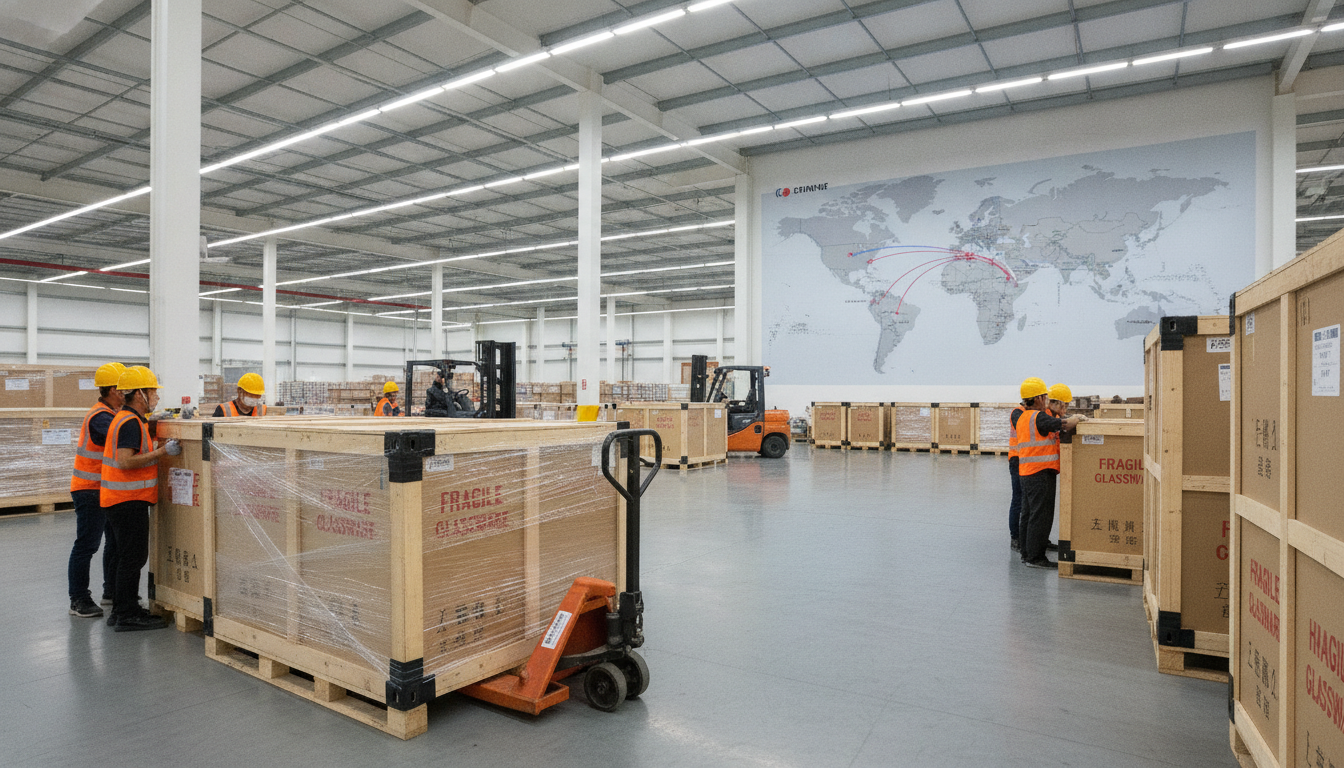
When deciding between sea freight vs air freight fragile glassware China, sea freight is the cost-effective choice for shipments above 100-150 kg or full pallets, typically costing $150-$250 per 100 kg with transit times of 25-45 days, while air freight suits urgent or sample orders under 100 kg, costing $600-$900 per 100 kg with delivery in 5-12 days. Your decision hinges on three factors: shipment weight and volume, delivery urgency, and your tolerance for handling risk during the longer sea journey.
📋 Table of Contents
- Executive Summary
- Cost Comparison: Sea vs Air for Glassware
- Transit Time and Urgency Considerations
- Breakage Risk: Handling Differences Between Modes
- Packaging Requirements for Fragile Glassware
- Decision Matrix: Which Mode for Your Order?
- Landed Cost Calculation for Latin America and Europe
- Key Takeaways
- Frequently Asked Questions
Executive Summary
- Cost threshold: According to Shipvida (2026), a 100 kg China-to-Canada shipment costs approximately $600-$900 by air versus $150-$250 by sea, making sea freight four to six times cheaper for bulk glassware orders.
- Transit speed: According to Daystar Glassware (2026), sea freight for glass packaging takes approximately 15-45 days after loading, while air freight delivers in 5-12 days, a critical difference for seasonal launches or urgent replenishment.
- Breakage exposure: Sea freight subjects glassware to longer vibration cycles, higher stacking loads, and multiple transloading events, while air freight reduces handling frequency but imposes stricter dimensional weight penalties that can inflate costs for low-density protective packaging.
- Volume break-even: According to Freight (2026), the practical sea-air break-even range is often described as approximately 100-300 kg, depending on commodity density and current freight rates, with sea freight becoming mandatory above one full pallet.
- Landed-cost components: Importers into Mexico, Colombia, Argentina, Chile, Brazil, and Europe must add customs duties, VAT, destination port fees, inland trucking, and insurance to the base freight quote to compare true door-to-door costs between modes.
Cost Comparison: Sea vs Air for Glassware
The base freight rate is only the starting point. Glassware importers face a layered cost structure that differs fundamentally between sea and air, driven by how each mode calculates chargeable weight and applies surcharges.
Sea Freight Pricing Structure
Sea freight charges by cubic meter (CBM) for LCL (less than container load) shipments or by full container (20ft or 40ft FCL) for larger orders. A standard 20ft container holds approximately 28-30 CBM and costs between $1,200 and $2,800 from major Chinese ports to Latin American or European destinations, depending on route and season. Glassware packed with adequate protective material typically achieves 200-350 kg per CBM, meaning a 1,000 kg order occupies 3-5 CBM and costs $400-$700 in base ocean freight under LCL rates.
Air Freight Pricing Structure
Air freight applies the higher of actual weight or volumetric weight (length × width × height in cm ÷ 6,000). Glassware requires substantial cushioning, which inflates volumetric weight. A 100 kg shipment in protective cartons measuring 120 × 80 × 100 cm yields a volumetric weight of 160 kg, and the carrier bills the higher figure. According to Shipvida (2026), this results in air costs of approximately $600-$900 for a 100 kg China-to-Canada shipment, with similar rates applying to Mexico, Colombia, and Europe.
Hidden Surcharges and Fees
Both modes add surcharges that buyers frequently overlook when comparing quoted rates. Sea freight includes bunker adjustment factor (BAF), currency adjustment factor (CAF), and peak-season surcharges during Chinese New Year and pre-Christmas periods. Air freight adds fuel surcharges, security fees, and handling charges at both origin and destination airports. Importers working with a trusted China sourcing agent receive consolidated invoices that break out every line item, eliminating the surprise fees that erode budgets when buyers book directly with freight forwarders.
Transit Time and Urgency Considerations
Transit duration shapes inventory planning, cash flow, and the ability to respond to market demand shifts. The sea freight vs air freight fragile glassware China decision often hinges on whether your launch date or replenishment window can absorb the longer ocean voyage.
Sea Freight Transit Windows
According to Xinghuo Glass (2026), ocean transit for glassware from Nanjing or Shanghai to Rotterdam or Hamburg is presented as approximately 25-32 days, excluding additional customs and inland-delivery time. Routes to Latin America vary widely: Shanghai to Manzanillo (Mexico) takes 18-24 days, to Cartagena (Colombia) 22-28 days, to Buenos Aires (Argentina) 28-35 days, and to Santos (Brazil) 24-30 days. Add 3-7 days for customs clearance and inland trucking to your final warehouse, bringing door-to-door totals to 30-50 days depending on destination efficiency.
Air Freight Transit Windows
According to Freight (2026), air freight is commonly estimated at 3-7 days door to door for international China routes. Direct flights from Guangzhou or Shanghai to Mexico City, Bogotá, São Paulo, or major European hubs deliver in 2-3 days, with customs clearance and last-mile trucking adding another 2-4 days. This compressed timeline suits sample shipments sent to buyers for approval before bulk production, urgent restocks during peak retail seasons, and product launches tied to fixed event dates.
Planning Buffer for Seasonal Peaks
Chinese New Year (late January to mid-February) and Golden Week (early October) add 7-14 days to both sea and air schedules as factories close and port congestion builds. Pre-Christmas export peaks in September through November create capacity crunches that extend sea transit by 5-10 days and inflate air rates by 20-40%. Importers ordering glassware for holiday retail windows book ocean containers by late July or switch to air freight in October, accepting the cost premium to guarantee shelf availability.
Breakage Risk: Handling Differences Between Modes
Fragile glassware faces distinct physical stresses under sea and air transport, and understanding these differences allows importers to specify appropriate packaging and set realistic breakage expectations.
Sea Freight Handling Exposure
Ocean containers endure continuous low-frequency vibration over weeks, stacking loads up to five containers high on deck, and transloading at multiple ports. Glassware packed in the bottom tier of a container bears the weight of upper tiers, creating compression stress on carton walls and internal dividers. Humidity inside sealed containers during tropical crossings can weaken corrugated cartons and adhesive bonds in molded pulp inserts. Port crane operators lift and set containers abruptly, generating impact shocks that propagate through inadequately cushioned cargo.
Air Freight Handling Exposure
Air cargo moves through fewer touchpoints but experiences higher-intensity handling events. Forklifts load pallets onto narrow-body aircraft with tight clearances, and baggage handlers sometimes tilt or drop cartons during sorting. Cabin pressure changes during ascent and descent can stress sealed packaging, though this rarely affects glassware directly. The primary air-freight advantage for fragile goods is speed: fewer days in transit means fewer opportunities for mishandling, and temperature-controlled cargo holds reduce humidity exposure that weakens packaging materials.
Real-World Breakage Rates
Importers report breakage rates of 0.5-2% for properly packaged glassware via sea freight and 0.2-1% via air freight, though these figures vary with packaging quality and carrier handling standards. The lower air-freight breakage rate rarely justifies the cost premium for bulk orders, but it becomes decisive for high-value art glass, custom-etched corporate gifts, or limited-edition collections where even a 1% loss erodes margin unacceptably.
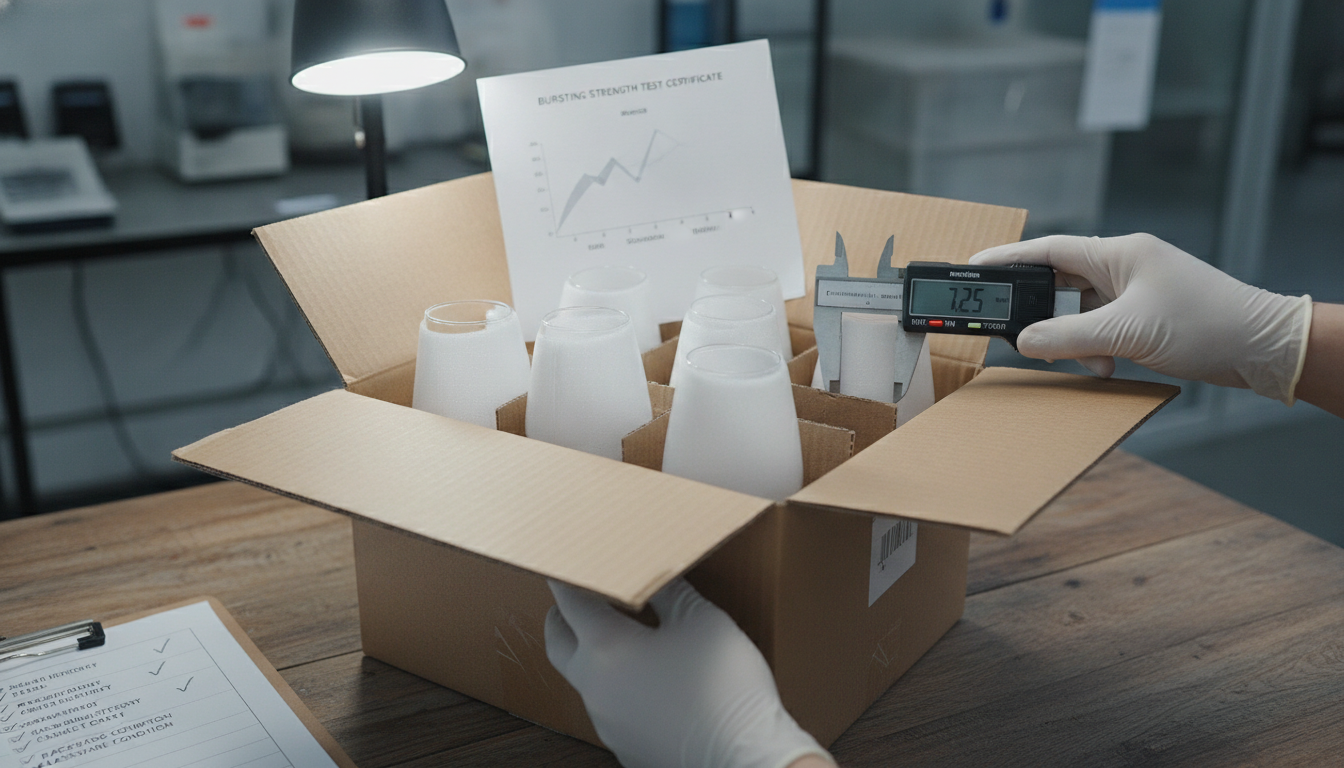
In practice: A supplier’s export carton specification listed 200 kg bursting strength, adequate for domestic trucking but insufficient for stacked ocean containers, which is why our QC team verifies carton test certificates against the actual stacking height and transit duration before approving any glassware shipment.
Packaging Requirements for Fragile Glassware
Packaging quality determines whether your glassware arrives intact or becomes an insurance claim. The sea freight vs air freight fragile glassware China decision must account for the different protective standards each mode demands.
Individual Item Protection
Every glass piece requires individual wrapping in foam sheet, bubble wrap, or tissue paper, with a minimum 3 mm cushion thickness for stemware and 5 mm for heavy tumblers or vases. Nested stacking (placing one glass inside another with a foam separator) saves space but transfers impact force directly between pieces, increasing breakage risk during rough handling. Our quality inspection team rejects nested packing for sea freight unless each piece has a molded pulp or foam insert that isolates it from its neighbor.
Carton and Divider Specifications
Export cartons for glassware must meet a minimum bursting strength of 250 kg for air freight and 300 kg for sea freight, tested per the Mullen or Cobb method. Internal cell dividers, whether corrugated honeycomb or molded pulp, must extend the full height of the carton and lock into the base to prevent lateral shifting during transport. Corner protectors and edge guards distribute stacking loads away from the carton’s weakest points, reducing collapse risk when containers are stacked five high on deck.
Palletization and Crating
Palletized shipments reduce handling frequency and allow forklift operators to move multiple cartons as a single unit, cutting the number of lift-and-set events that cause breakage. Standard export pallets (1200 × 1000 mm or 1200 × 800 mm) must be heat-treated and stamped with ISPM-15 certification for most destination countries. A-frame wooden crates add a second layer of protection for high-value glassware, with internal bracing that prevents carton shifting and external skids that facilitate safe crane lifting. Our freight coordination team specifies crating for any sea-freight glassware order valued above $10,000 or containing items with replacement costs exceeding $50 per unit.
- Foam density: Polyethylene foam inserts should be 30-40 kg/m³ density for stemware, 50-60 kg/m³ for heavy bottles or decanters, providing adequate cushioning without adding excessive volumetric weight.
- Carton sealing: Use water-activated reinforced tape (minimum 70 mm width) on all seams, applied in an H-pattern across top and bottom flaps, never rely on pressure-sensitive tape alone for export shipments.
- Drop testing: Reputable suppliers drop-test sample cartons from 80 cm height (simulating typical handling) and inspect for internal damage before approving the packaging design for production runs.
- Labeling: Apply “Fragile” and “This Side Up” labels on all four vertical sides in both English and the destination country’s language, using high-contrast colors that remain visible under warehouse lighting.
Decision Matrix: Which Mode for Your Order?
Choosing between sea freight vs air freight fragile glassware China requires matching your order profile to the mode that optimizes cost, speed, and risk. The matrix below guides buyers through common scenarios.
Hybrid Strategies
Experienced importers split orders across modes to balance cost and flexibility. A common pattern sends 80% of an order via sea freight for cost efficiency and 20% via air freight as a buffer against demand spikes or sea-transit delays. Another approach ships initial inventory by air to capture early sales, then replenishes via sea once demand patterns stabilize. These hybrid strategies require coordination between your supplier, freight forwarder, and customs broker to ensure both shipments clear under the same import declaration and tariff classification.
Landed Cost Calculation for Latin America and Europe
The true cost comparison between sea freight vs air freight fragile glassware China extends beyond the freight invoice to include every charge between the Chinese factory gate and your warehouse door. Importers who calculate only base freight rates consistently underestimate total landed cost by 30-50%.
Duty and Tax Components
Glassware typically falls under HS codes 7013 (tableware) or 7010 (containers), with duty rates varying by destination. Mexico applies 10-20% ad valorem duty under general MFN rates, Colombia 15-20%, Argentina 20-35%, Chile 6%, Brazil 20-35%, and EU countries 6.5-11%. Value-added tax (IVA or VAT) adds another layer: Mexico 16%, Colombia 19%, Argentina 21%, Chile 19%, Brazil 17-20% depending on state, and EU countries 19-27%. These percentages apply to the CIF value (cost + insurance + freight), meaning higher air-freight costs inflate the tax base and compound the mode-cost difference.
Destination Fees and Inland Transport
Port or airport handling fees, customs brokerage, document processing, and container drayage add $200-$600 per shipment depending on destination and mode. Sea freight incurs terminal handling charges (THC) of $150-$300 per container or $40-$80 per CBM for LCL, plus drayage from port to your warehouse at $1.50-$3.00 per kilometer. Air freight adds airport handling fees of $80-$150, customs examination fees where applicable, and last-mile trucking at similar per-kilometer rates. Importers in landlocked cities like Mexico City, Bogotá, or São Paulo pay higher inland transport costs that partially offset sea freight’s base-rate advantage.
Insurance and Claims
Cargo insurance costs 0.3-0.8% of shipment value for sea freight and 0.2-0.5% for air freight, reflecting the different risk profiles. All-risk policies cover breakage, theft, and general average (a maritime-specific risk where cargo owners share losses from vessel emergencies). Buyers frequently discover that their supplier’s factory insurance ends at the Chinese port, leaving a coverage gap during international transit. Our team arranges continuous door-to-door coverage and handles claims documentation when breakage occurs, photographing damaged cartons, retaining all packaging materials, and filing within the insurer’s 7-14 day notification window.
Landed cost example: A 500 kg glassware order valued at $5,000 FOB Shanghai to Mexico City costs approximately $1,200 via sea (freight + fees) or $4,500 via air, but after adding 15% duty, 16% VAT, and inland trucking, the landed totals become $7,900 sea versus $11,800 air, a $3,900 difference that determines whether the product remains profitable at retail.
Key Takeaways
- Cost break-even: Sea freight becomes cost-effective above approximately 100-150 kg, with the gap widening dramatically for full-pallet or container loads, while air freight suits samples and urgent orders under 100 kg where speed justifies the premium.
- Transit planning: Ocean transit from China to Latin America or Europe requires 30-50 days door to door including customs clearance, while air freight delivers in 7-12 days, making mode selection inseparable from your inventory planning and launch-date constraints.
- Breakage mitigation: Properly specified export cartons with 300 kg bursting strength, molded pulp cell dividers, and ISPM-15 heat-treated pallets reduce sea-freight breakage to 0.5-2%, a level that rarely justifies switching to air freight for bulk orders.
- Landed-cost discipline: Importers must calculate the full CIF value plus destination duties, VAT, handling fees, and inland trucking to compare modes accurately, as the higher air-freight CIF base inflates the tax burden and compounds the cost difference.
- Hybrid flexibility: Splitting orders across sea and air modes balances cost efficiency with demand responsiveness, allowing importers to capture early sales via air while replenishing inventory via lower-cost ocean containers.
- Claims readiness: Transparent damage responsibility requires photographing all packaging, retaining cartons, and filing insurance claims within 7-14 days, a process that buyers working with experienced sourcing agents navigate successfully while direct importers frequently miss deadlines and forfeit coverage.
Frequently Asked Questions
Can I mix sea and air freight in a single order to balance cost and speed?
Yes, splitting an order across modes is common practice. Importers typically ship 70-80% of inventory via sea freight for cost efficiency and send 20-30% by air as a buffer against demand spikes or transit delays. This requires coordinating two separate customs entries unless your freight forwarder consolidates both shipments under a single master bill of lading, which some carriers offer for an administrative fee. The key is ensuring both portions use identical product specifications and HS codes to avoid customs classification disputes.
What packaging changes are needed when switching from air to sea freight for the same glassware?
Sea freight demands stronger cartons (300 kg bursting strength versus 250 kg for air), thicker foam inserts to absorb prolonged vibration, and full-height cell dividers that lock into the carton base to prevent shifting during weeks of transit. Palletization becomes mandatory for sea LCL to reduce handling events, and wooden crates are recommended for high-value items. Air-freight packaging optimized for speed often fails under the stacking loads and humidity exposure of ocean containers, so buyers must specify export-grade materials when ordering for sea transport.
How do I prove whether glassware breakage occurred during packing, transit, or final delivery?
Photograph the exterior of every carton before opening, noting any visible damage, crushed corners, or torn tape. Open cartons on video, showing the internal condition of dividers and foam inserts. Retain all packaging materials until the insurance claim is settled. Breakage with intact exterior packaging and undisturbed dividers suggests factory packing defects, while crushed cartons with displaced inserts indicate transit or handling damage. Insurance adjusters require this documentation within 7-14 days of delivery, and claims filed without photographic evidence are routinely denied. Buyers working with a supplier management service receive pre-shipment QC reports that document packaging quality before goods leave the factory, establishing a clear baseline for claims assessment.
Written by the Goodcantrading Sourcing Team.
Ready to ship your glassware order with the right freight mode and packaging protection?
Get a freight comparison quote →