Freight Forwarder Shenzhen to Barcelona Furniture Route [2026 Guide]

The freight forwarder Shenzhen to Barcelona furniture route primarily uses sea LCL consolidation or FCL containers departing from Yantian or Shekou ports, transiting 25-32 days for direct sailings and 30-38 days for transshipment via Singapore or Tangier. Most furniture shipments travel in 40HQ containers to maximize volumetric efficiency, clear Spanish customs under HS code 9403, and incur 21% Spanish VAT plus 0-6.7% duty depending on material composition and country of origin.
📋 Table of Contents
- Executive Summary
- Which Shenzhen Port: Yantian or Shekou?
- FCL Versus LCL for Furniture Shipments
- Transit Time and Routing Options
- Barcelona Port Operations and Alternatives
- Spanish Customs Clearance for Furniture
- Landed Cost Model and Hidden Charges
- Furniture-Specific Packaging and Damage Prevention
- Forwarder Evaluation and Service-Level Verification
- Key Takeaways
- Frequently Asked Questions
Executive Summary
- Port selection: Yantian handles deep-sea direct sailings with shorter transit, while Shekou offers lower terminal handling charges and better consolidation access for mixed-cargo buyers.
- Container choice: A 40HQ container holds 67-76 cubic meters and suits bulky furniture better than a 20GP, reducing per-unit freight cost by 30-40% when volume exceeds 30 CBM.
- Routing: Direct Shenzhen-Barcelona sailings take 25-32 days; transshipment via Singapore or Tangier adds 5-10 days but may lower rates during low-season periods.
- Customs and duty: Spanish furniture imports face 21% VAT, 0-6.7% duty depending on material, and require EUR.1 or Form A certificates to claim preferential rates under trade agreements.
- Landed-cost transparency: Beyond ocean freight, budget for Barcelona port THC, customs brokerage, demurrage risk, inland trucking, and final-mile delivery to avoid surprise charges at destination.
Which Shenzhen Port: Yantian or Shekou?
Shenzhen operates two major container terminals serving the freight forwarder Shenzhen to Barcelona furniture route: Yantian International Container Terminal and Shekou Container Terminal. Yantian is the larger deep-water facility, handling most direct Europe sailings from major carriers including Maersk, MSC, and CMA CGM. Shekou, located closer to the city center and the Hong Kong border, serves feeder routes, consolidation operators, and smaller vessel strings.
Yantian Port Advantages
Yantian offers more frequent direct sailings to Barcelona, typically two to three weekly departures during peak season. Direct routing eliminates transshipment risk, shortens transit time by 5-8 days, and reduces the chance of container rollovers when space is tight. Terminal handling charges at Yantian range higher than Shekou, but the premium buys schedule reliability and faster vessel turnaround.
Furniture exporters working with trusted China sourcing agents often consolidate inland from Foshan, Dongguan, and Shenzhen factories to Yantian for a single container stuffing, minimizing drayage legs and customs declaration complexity.
Shekou Port Advantages
Shekou’s lower terminal handling charges make it attractive for LCL consolidation and mixed-cargo shipments. Many forwarders maintain bonded warehouses near Shekou, allowing buyers to combine furniture orders from multiple suppliers into one consolidated shipment without paying VAT on the China side until export.
Shekou also connects efficiently to Hong Kong’s Kwai Tsing container terminals via barge, offering an alternative routing option when Shenzhen port congestion or trucking restrictions apply. Buyers shipping smaller furniture volumes under 15 cubic meters typically find better LCL rates departing from Shekou consolidation warehouses.
FCL Versus LCL for Furniture Shipments
Furniture’s bulky nature and low weight-to-volume ratio make container selection critical to controlling freight costs on the Shenzhen to Barcelona route. A full container load gives the buyer exclusive use of the equipment, while less-than-container-load shares space with other shippers’ cargo.
When FCL Makes Sense
A 40-foot high-cube container measures 12.03 meters long, 2.35 meters wide, and 2.69 meters high internally, yielding 67-76 cubic meters of usable space depending on how efficiently cartons stack. Furniture shipments exceeding 30 cubic meters almost always justify FCL booking, because the per-CBM rate drops below LCL once the container is more than 45% full.
FCL also eliminates consolidation and deconsolidation handling, reducing damage risk for fragile items such as glass-top tables, upholstered chairs, and veneer-finished cabinets. The container is stuffed once at the factory or consolidation warehouse, sealed, and opened only at the Barcelona destination warehouse, minimizing touch points.
When LCL Works Better
Shipments under 15 cubic meters typically cost less via LCL, because the buyer pays only for space used rather than renting an entire container. LCL consolidators charge per cubic meter or per revenue ton (whichever is greater), with rates varying by season, destination port, and forwarder volume commitments.
LCL introduces additional handling at the origin consolidation warehouse and the destination deconsolidation facility, increasing damage risk and adding 3-7 days to total transit time. Buyers shipping high-value or fragile furniture should request corner protectors, stretch wrap, and pallet strapping as part of the quality control and packing supervision process.
Transit Time and Routing Options
Ocean transit time on the freight forwarder Shenzhen to Barcelona furniture route depends on whether the sailing is direct or involves transshipment, the carrier’s vessel schedule, and seasonal port congestion. Direct sailings offer the fastest and most predictable delivery, while transshipment routes may reduce cost during off-peak periods.
Direct Shenzhen to Barcelona Sailings
Major carriers operate weekly direct services from Yantian to Barcelona, with port-to-port transit averaging 25-32 days. Maersk, MSC, CMA CGM, and COSCO maintain regular strings on this route, with vessel capacity ranging from 8,000 to 14,000 TEU. Direct sailings eliminate the risk of missed connections and reduce the chance of container damage during crane transfers at intermediate ports.
Buyers booking direct sailings should confirm the vessel’s actual rotation, because some advertised direct services make intermediate calls at Port Said, Algeciras, or Valencia before reaching Barcelona, adding 2-4 days to the published schedule.
Transshipment Routing via Singapore or Tangier
Transshipment routes connect Shenzhen to Barcelona via hub ports in Southeast Asia, the Middle East, or North Africa. Singapore, Port Klang, Jebel Ali, and Tangier are common transshipment points, with total transit extending to 30-38 days including dwell time at the hub.
Transshipment introduces rollover risk when the connecting vessel is full or delayed, but rates can run 10-20% lower than direct sailings during low-season months (February, March, September, October). Buyers with flexible delivery windows and lower-value furniture orders often accept the trade-off to reduce landed cost.
Seasonal Congestion and Blank Sailings
Peak shipping season from August through October coincides with Christmas inventory buildup in Europe, driving up rates and increasing the chance of container rollovers. Carriers may impose peak-season surcharges ranging from USD 300 to USD 800 per container, and space allocation tightens for spot bookings.
Blank sailings, where carriers skip scheduled port calls to manage capacity, occur more frequently during Chinese New Year (late January to mid-February) and during periods of weak demand. Buyers should build 7-10 days of buffer into their delivery timelines to absorb schedule disruptions.
Barcelona Port Operations and Alternatives
Barcelona Port operates two main container terminals: Terminal de Contenidors de Barcelona (TCB) and Best Terminal, handling combined throughput exceeding 3 million TEU annually. The port sits 15 kilometers from Barcelona city center, with good road and rail connections to inland distribution hubs across Catalonia and southern France.
Barcelona Terminal Handling and Clearance
Container discharge at Barcelona typically completes within 24-48 hours of vessel arrival, with terminal handling charges (THC) ranging from EUR 150 to EUR 250 per container depending on size and whether the shipment qualifies for any volume discounts. Customs clearance for furniture imports averages 1-3 business days when documentation is complete and the shipment does not trigger physical inspection.
Barcelona customs applies risk-based inspection protocols, with furniture shipments from China facing physical examination rates around 5-8% for established importers with clean compliance history. First-time importers or shipments with incomplete origin documentation see higher inspection rates, adding 3-5 days and EUR 200-400 in inspection and storage fees.
Valencia as an Alternative Gateway
Valencia Port, located 350 kilometers south of Barcelona, serves as Spain’s largest container gateway and offers more frequent sailings from Asia. Some buyers route furniture shipments to Valencia and arrange inland trucking to Barcelona, Zaragoza, or Madrid, trading 1-2 days of additional inland transit for better vessel schedule options and potentially lower ocean freight rates.
Valencia’s terminal handling charges run slightly lower than Barcelona, and the port’s larger scale provides more competitive rates for ancillary services such as container storage, customs brokerage, and inland drayage. Buyers importing furniture for distribution across multiple Spanish regions often find Valencia’s central location and logistics infrastructure more cost-effective than Barcelona for volumes exceeding three containers per month.
Spanish Customs Clearance for Furniture
Spanish customs classifies furniture imports under HS chapter 9403, with duty rates varying by material composition, country of origin, and whether the importer claims preferential treatment under a trade agreement. Proper classification and documentation preparation directly affect landed cost and clearance speed.
HS Code Classification and Duty Rates
Wooden furniture typically falls under HS 9403.30 to 9403.60, with MFN duty rates ranging from 0% to 6.7% depending on whether the item is office furniture, kitchen furniture, or bedroom furniture. Metal furniture (HS 9403.10 to 9403.20) generally faces 2.7% to 4.7% duty, while upholstered furniture (HS 9401) may attract rates up to 4.7%.
China does not have a preferential trade agreement with the EU, so furniture imports from China pay full MFN rates unless the buyer can demonstrate substantial processing in a country that does hold an agreement. Misclassification, even if unintentional, triggers penalties, duty adjustments, and potential shipment holds, making accurate HS code determination critical before the container departs Shenzhen.
Required Import Documentation
Spanish customs requires the following documents for furniture clearance:
- Commercial invoice: itemized list of goods with unit prices, quantities, total value, and Incoterms clearly stated.
- Packing list: carton-by-carton breakdown showing dimensions, weights, and contents, matching the container loading plan.
- Bill of lading: ocean carrier’s receipt and title document, issued as either an original or telex release depending on payment terms.
- Certificate of origin: Form A for GSP-eligible developing countries or EUR.1 for countries with EU trade agreements; China-origin furniture does not qualify for preferential rates but the certificate is still required for customs processing.
- EORI number: Economic Operators Registration and Identification number, mandatory for all EU importers; the Spanish tax authority (AEAT) issues EORI numbers tied to the importer’s NIF tax ID.
Incomplete or inconsistent documentation is the leading cause of customs delays on the freight forwarder Shenzhen to Barcelona furniture route. Buyers working with verified suppliers should request draft documents for review before shipment, ensuring invoice descriptions match HS codes and that all values reconcile across the commercial invoice, packing list, and bill of lading.
VAT and Import Processing
Spain applies a standard 21% VAT rate to furniture imports, calculated on the CIF value plus duty. The importer must register for Spanish VAT and file monthly or quarterly returns depending on turnover thresholds. Non-EU businesses importing into Spain typically appoint a fiscal representative to handle VAT compliance, adding EUR 800 to EUR 2,000 annually in service fees.
Import VAT is due at the time of customs clearance, creating a cash-flow burden for buyers who cannot immediately recover the VAT through sales. Some importers use customs warehousing or bonded storage to defer VAT payment until goods are released for sale, but this adds storage costs and restricts the ability to inspect or repack goods before final delivery.
Landed Cost Model and Hidden Charges
Calculating true landed cost for furniture shipped via the Shenzhen to Barcelona route requires accounting for every charge from factory gate to final delivery address. Buyers who budget only for FOB price and ocean freight consistently underestimate total cost by 15-25%, leading to cash-flow surprises and margin erosion.
Ocean Freight and Surcharges
Base ocean freight for a 40HQ container from Shenzhen to Barcelona ranges from USD 2,800 to USD 4,500 depending on season, carrier, and contract versus spot booking. This base rate excludes numerous surcharges that carriers add:
- Bunker adjustment factor (BAF): fuel surcharge recalculated monthly based on global bunker prices, typically USD 300-600 per container.
- Currency adjustment factor (CAF): exchange-rate hedge, usually USD 50-150 per container.
- Peak season surcharge (PSS): applied August through October, ranging USD 300-800 per container.
- Port congestion surcharge: temporary fee when destination ports face delays, USD 200-400 per container.
- Equipment imbalance surcharge: charged when empty containers are scarce at origin, USD 100-300 per container.
Buyers should request an all-in ocean freight quotation that itemizes every surcharge, and confirm which charges are fixed for the contract period versus subject to monthly adjustment.
Destination Charges at Barcelona
Barcelona port and customs charges add EUR 800 to EUR 1,500 per container to the landed cost:
Demurrage and Detention Risk
Carriers and terminals grant 5-7 days of free time for the buyer to pick up the container after discharge. Once free time expires, demurrage charges accrue daily, starting at EUR 80-100 per day and escalating to EUR 150-200 per day after the first week. Buyers who lack warehouse capacity or face customs delays can quickly accumulate EUR 1,000+ in unexpected demurrage fees.
Detention charges apply when the buyer holds the carrier’s container beyond the allowed free period for unpacking. Furniture shipments requiring careful deconsolidation, inspection, and repacking may need 3-5 days, so buyers should negotiate extended free time or arrange immediate container return with live unloading at the warehouse.
Inland Delivery and Final-Mile Costs
Furniture’s bulk and fragility make final-mile delivery more expensive than standard palletized cargo. Trucking from Barcelona port to a warehouse in the city center costs EUR 150-250 per container, while delivery to inland cities such as Madrid, Zaragoza, or Valencia adds EUR 300-600 depending on distance and whether the truck requires a tail-lift for unloading.
Buyers selling furniture to retail customers or operating e-commerce channels must budget for white-glove delivery, assembly, and packaging disposal, which can add EUR 50-150 per unit for large items such as sofas, wardrobes, and dining sets.
Furniture-Specific Packaging and Damage Prevention
Furniture damage during ocean transit and handling is one of the most common buyer complaints on the Shenzhen to Barcelona route. Proper packaging, container loading supervision, and insurance coverage are essential to protect investment and maintain product quality.
Packaging Standards for Ocean Freight
Furniture packaging must withstand the stresses of container stuffing, ocean swell, crane lifts, and warehouse handling. Standard packaging includes:
- Carton protection: double-wall corrugated cartons with minimum 200gsm kraft paper, corner protectors, and internal foam or EPE padding for fragile components.
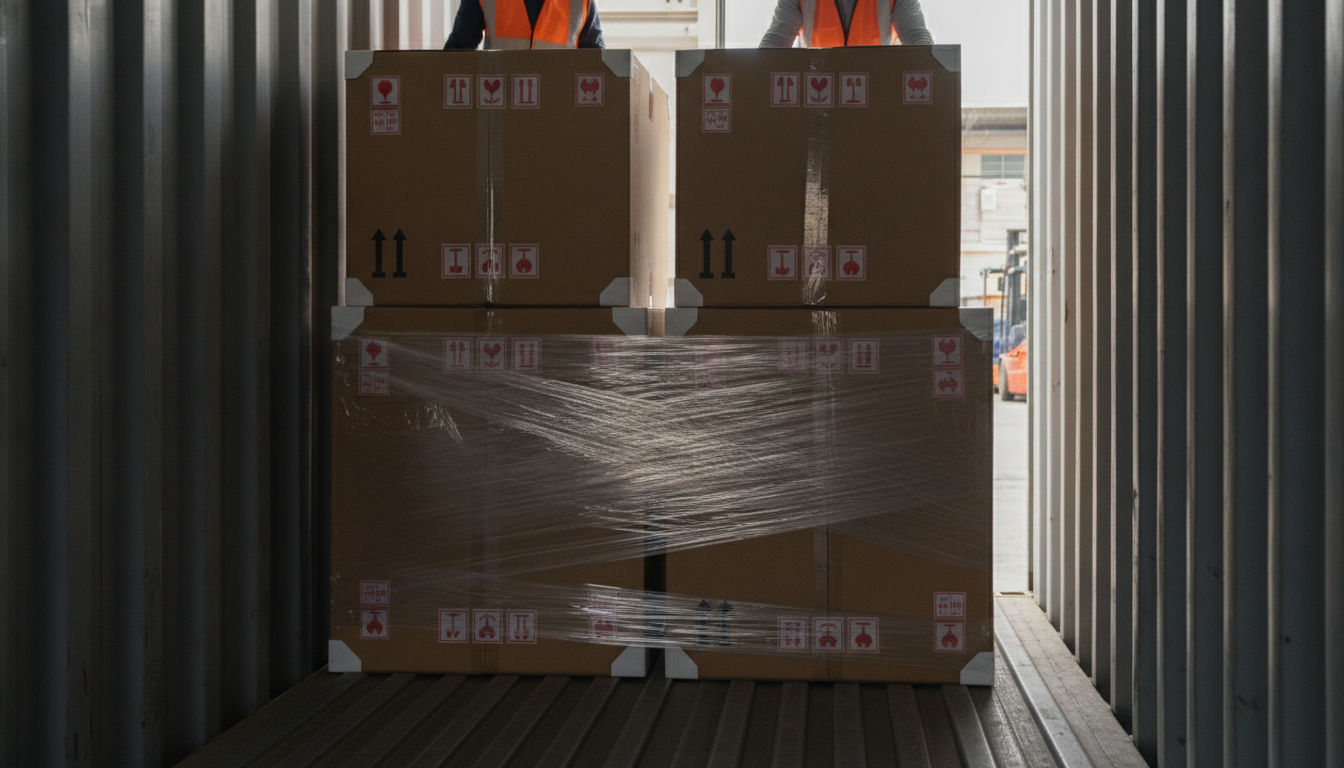
- Stretch wrap: multiple layers of stretch film around each carton to prevent shifting and moisture ingress.
- Pallet mounting: heavy or irregularly shaped items should be strapped to wooden or plastic pallets to facilitate forklift handling and reduce tipping risk.
- Desiccant packs: silica gel or clay desiccants inside cartons to absorb moisture during the 30-day ocean voyage, preventing mold and warping in wooden furniture.
- Labeling: fragile stickers, this-way-up arrows, and carton numbering on all six sides to guide warehouse staff during loading and unloading.
Buyers should specify packaging requirements in the purchase order and request photos or video of the packing process as part of pre-shipment inspection. Inadequate packaging is difficult to remedy once the container is sealed, and carriers exclude packaging defects from cargo insurance coverage.
Container Loading Supervision
Proper container loading maximizes space utilization while minimizing damage risk. Heavy items such as solid-wood dining tables and metal filing cabinets should be loaded first, positioned against the container walls and floor. Lighter, bulkier items such as upholstered sofas and office chairs are loaded last, filling the upper portion of the container.
Loading supervisors should verify that cartons are not stacked beyond their rated compression strength, that no single stack exceeds 2.2 meters to prevent toppling, and that all voids are filled with dunnage or airbags to prevent shifting during transit. A poorly loaded container can result in 10-30% damage rates, even when individual cartons are well-packaged.
In practice: A container loaded without proper weight distribution arrived in Barcelona with the rear stack collapsed, damaging 18 of 60 cartons because the heavy items were placed at the top rather than the bottom, violating basic loading principles.
Cargo Insurance and Claims Handling
Standard carrier liability under the Hague-Visby Rules limits compensation to approximately USD 500 per package or customary freight unit, far below the actual value of furniture shipments. Buyers should purchase all-risk cargo insurance covering the full CIF value plus 10%, with premiums typically ranging 0.3% to 0.8% of insured value depending on commodity, route, and claims history.
Insurance policies exclude damage caused by inadequate packaging, inherent vice (such as wood warping due to moisture content), and delay. Buyers must document damage with photos, obtain a survey report from an independent marine surveyor, and file claims within the policy’s notification period, usually 30-60 days from delivery.
Forwarder Evaluation and Service-Level Verification
Selecting a reliable freight forwarder for the Shenzhen to Barcelona furniture route requires evaluating operational capabilities, financial stability, and documented service performance. Many forwarders advertise competitive rates but lack the infrastructure, insurance, or customer-service capacity to handle complex furniture shipments.
Operational Capability Checklist
A qualified forwarder should demonstrate:
- Direct carrier contracts: volume commitments with major ocean carriers ensure space allocation during peak season and access to better rates than spot-market bookings.
- Own or bonded warehouse: consolidation facilities near Yantian or Shekou allow the forwarder to inspect, repack, and consolidate cargo before container stuffing, reducing damage risk and improving space utilization.
- Customs brokerage network: in-house or partner customs brokers in Barcelona who understand Spanish furniture import regulations, HS classification, and VAT procedures.
- Cargo insurance access: ability to arrange all-risk marine insurance with reputable underwriters, not just offering carrier liability.
- Track-and-trace systems: real-time container tracking, milestone notifications, and document-management portals that allow buyers to monitor shipment status without chasing emails.
Buyers should request the forwarder’s NVOCC license number, verify business registration with the Shenzhen Administration for Market Regulation, and check whether the company maintains professional indemnity insurance covering errors and omissions.
Service-Level Verification
Forwarder marketing claims often exceed actual performance. Buyers should request:
- Verifiable customer references: contact details for three recent clients who shipped furniture from Shenzhen to Spain, with permission to discuss service quality, claims handling, and hidden charges.
- On-time delivery statistics: documented percentage of shipments delivered within the quoted transit window over the past 12 months, broken down by direct versus transshipment routing.
- Claims resolution record: how many cargo claims were filed in the past year, what percentage were resolved in the buyer’s favor, and average resolution time.
- Financial stability indicators: years in business, ownership structure, and whether the forwarder is a member of recognized industry associations such as FIATA, WCA, or JCTRANS.
Buyers working with experienced sourcing teams benefit from pre-vetted forwarder networks, transparent pricing, and consolidated buying power that reduces per-container costs while maintaining service quality.
Rate Quotation Transparency
A detailed freight quotation should itemize every charge from factory gate to Barcelona delivery address, including:
- Origin inland trucking (factory to port)
- Origin terminal handling and documentation
- Ocean freight and all surcharges (BAF, CAF, PSS, etc.)
- Destination terminal handling
- Customs clearance and brokerage
- Destination inland trucking
- Any additional services (insurance, inspection, storage)
Quotations that lump charges into a single all-in rate make it impossible to verify whether the buyer is paying fair market prices for each service. Transparent, itemized quotations allow buyers to compare forwarders on an apples-to-apples basis and identify where cost savings are achievable.
Key Takeaways
- Yantian Port offers more frequent direct sailings to Barcelona with 25-32 day transit, while Shekou provides lower terminal charges and better LCL consolidation access for smaller furniture volumes.
- A 40HQ container holds 70-73 cubic meters of usable space and reduces per-unit freight cost by 30-40% compared to LCL once furniture volume exceeds 30 CBM.
- Spanish customs classifies furniture under HS chapter 9403, with MFN duty rates ranging 0-6.7% depending on material, plus 21% VAT calculated on CIF value plus duty.
- Landed cost includes ocean freight, terminal handling, customs brokerage, demurrage risk, inland trucking, and final-mile delivery, which together add 15-25% to the FOB factory price.
- Furniture packaging must include double-wall cartons, corner protectors, stretch wrap, desiccant packs, and proper container loading supervision to prevent the 10-30% damage rates common on poorly prepared shipments.
- Forwarder evaluation should verify direct carrier contracts, bonded warehouse access, customs brokerage capability, verifiable customer references, and transparent itemized quotations covering every charge from origin to destination.
Frequently Asked Questions
What is the cheapest way to ship furniture from Shenzhen to Barcelona?
LCL consolidation offers the lowest cost for furniture shipments under 15 cubic meters, because buyers pay only for space used rather than renting an entire container. Rates vary by season and forwarder, but LCL typically costs USD 80-150 per cubic meter from Shenzhen to Barcelona, including origin handling and ocean freight. Buyers should budget an additional EUR 800-1,200 for destination charges, customs clearance, and inland delivery. For volumes exceeding 30 cubic meters, a 40HQ container becomes more cost-effective, reducing the per-CBM rate to USD 40-70 depending on season and routing.
How long does sea freight from Shenzhen to Barcelona take for furniture?
Direct sailings from Yantian to Barcelona average 25-32 days port-to-port, while transshipment routes via Singapore, Jebel Ali, or Tangier extend transit to 30-38 days including dwell time at the hub. Total door-to-door delivery time includes inland trucking from the furniture factory to Shenzhen port (1-3 days), customs clearance at Barcelona (1-3 days), and final-mile delivery to the buyer’s warehouse or retail location (1-2 days). Buyers should budget 35-45 days total from factory gate to Barcelona delivery address, with an additional 7-10 days of buffer during peak season or when customs inspection is triggered.
Do I need a Spanish VAT number to import furniture from China?
Yes, Spanish customs requires importers to hold a valid EORI number linked to a Spanish NIF tax ID before releasing furniture shipments. Non-EU businesses must appoint a fiscal representative in Spain to obtain the VAT registration and handle monthly or quarterly VAT filings. Import VAT at 21% is due at the time of customs clearance, calculated on the CIF value plus duty, creating a cash-flow burden that buyers must plan for. Some importers defer VAT payment by using customs warehousing or bonded storage, but this restricts the ability to inspect or sell goods until VAT is paid and the shipment is released.
Ready to ship furniture from Shenzhen to Barcelona with transparent pricing, verified forwarders, and end-to-end support?
Request Your Freight Quote →
Written by the Goodcantrading Sourcing Team.