CE Marking Requirements China Electronics France Import [2026 Guide]

When importing electronics from China to France, the EU importer owns the CE Declaration of Conformity, technical file, and compliance verification before French customs clearance. The Chinese manufacturer cannot affix CE marking unless they hold an EU establishment. The importer becomes the economic operator responsible for product traceability under the Radio Equipment Directive 2014/53/EU, EMC Directive 2014/30/EU, Low Voltage Directive 2014/35/EU, RoHS Directive 2011/65/EU, and the General Product Safety Regulation. French customs enforces these requirements at the point of entry, and non-compliant shipments face detention, re-export, or destruction.
📋 Table of Contents
- Executive Summary
- Which EU Directives Apply to Electronics from China?
- Who Owns CE Conformity When Importing from China?
- What Documents Must Accompany the Shipment?
- Product-by-Product CE Requirements
- How French Customs Enforces CE Compliance
- Detecting Counterfeit CE Marks and Invalid Reports
- Complete Landed-Cost Model for CE-Compliant Electronics
- Latin American Buyers Using France as EU Hub
- Key Takeaways
- Frequently Asked Questions
Executive Summary
- Importer responsibility: The buyer or their EU representative owns the Declaration of Conformity, technical file, and traceability obligations; the Chinese manufacturer cannot self-certify unless they maintain an EU legal entity.
- Directive scope: Radio Equipment Directive 2014/53/EU covers Bluetooth and Wi-Fi devices; EMC Directive 2014/30/EU applies to all electronics; Low Voltage Directive 2014/35/EU governs products rated 50-1000 V AC or 75-1500 V DC; RoHS Directive 2011/65/EU restricts hazardous substances in electrical equipment.
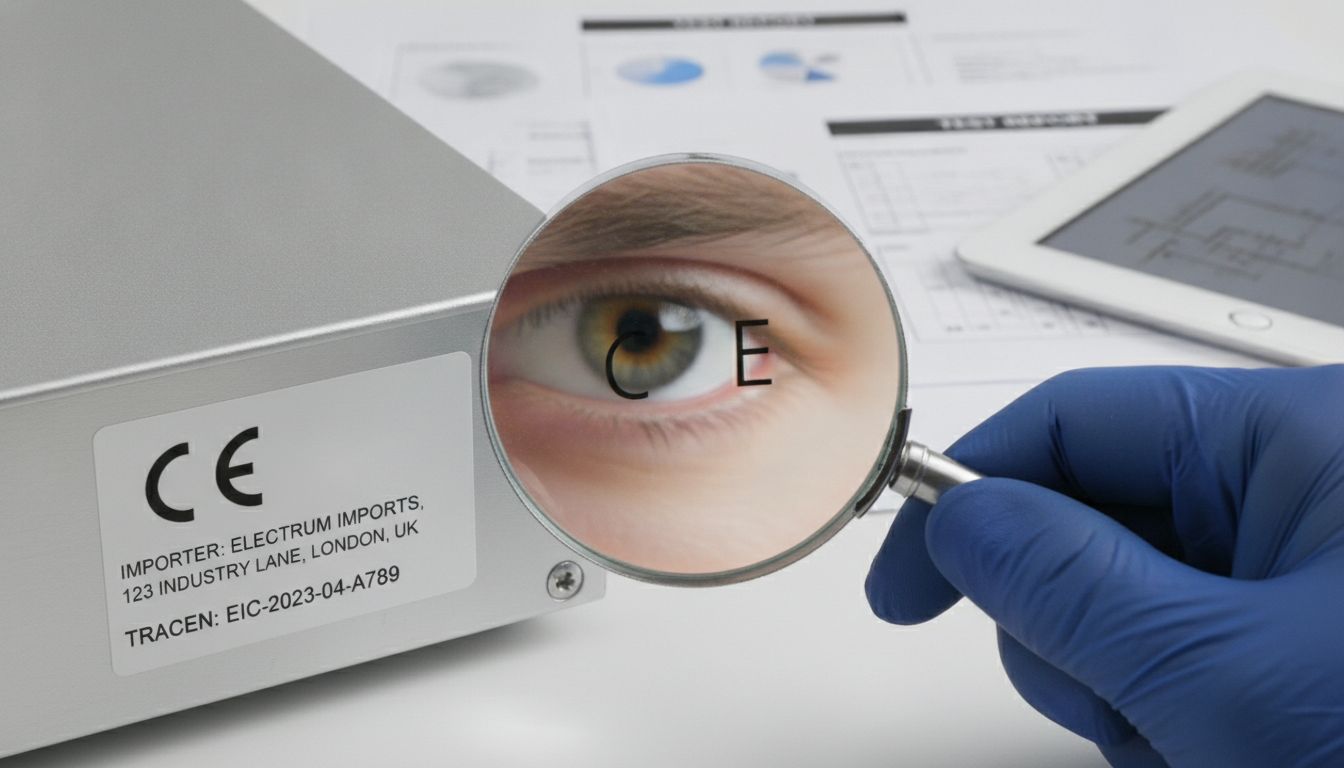
- Document set: EU Declaration of Conformity, technical file with test reports to harmonised standards, risk assessment, user manual in French, and product label showing CE mark, importer name, address, and traceability code.
- French customs execution: Customs officers verify the presence of the CE mark, request the Declaration of Conformity, and cross-check the importer registration; missing or invalid documentation triggers detention and potential destruction at importer cost.
- Counterfeit detection: The China Export mark uses narrower spacing than the genuine CE mark; test reports from non-accredited laboratories or copied declarations with mismatched product identifiers signal fraud.
Which EU Directives Apply to Electronics from China?
Understanding CE marking requirements China electronics France import starts with identifying which directives apply to your product category. Electronics imported from China into France fall under multiple EU directives depending on product function, voltage rating, and wireless capability. The Radio Equipment Directive 2014/53/EU applies to any device that intentionally emits or receives radio waves, including Bluetooth speakers, Wi-Fi routers, mobile phones, and wireless chargers. The EMC Directive 2014/30/EU covers electromagnetic compatibility for all electrical and electronic equipment, ensuring the product neither generates excessive interference nor suffers degraded performance in the presence of electromagnetic disturbances. The Low Voltage Directive 2014/35/EU governs equipment designed for use with a voltage rating of 50-1000 V AC or 75-1500 V DC, such as power supplies, LED drivers, and household appliances. The RoHS Directive 2011/65/EU restricts the use of lead, mercury, cadmium, hexavalent chromium, polybrominated biphenyls, and polybrominated diphenyl ethers in electrical and electronic equipment placed on the EU market.
Radio Equipment Directive 2014/53/EU
Products with intentional radio transmission or reception must meet essential requirements for health and safety, electromagnetic compatibility, and efficient use of the radio spectrum. Compliance is demonstrated through testing to harmonised standards such as EN 300 328 for wideband transmission systems and EN 301 489 for electromagnetic compatibility of radio equipment. The manufacturer or importer must prepare a technical file documenting the conformity assessment and affix the CE mark followed by the notified body identification number when applicable.
EMC Directive 2014/30/EU
All electronics must comply with emission limits to prevent interference with other equipment and possess adequate immunity to function correctly in their intended electromagnetic environment. Harmonised standards include EN 55032 for multimedia equipment emissions and EN 55035 for immunity requirements. The Declaration of Conformity must list the applied standards and confirm that the product meets the essential requirements of the directive.
Low Voltage Directive 2014/35/EU
Equipment operating within the specified voltage range must be designed and manufactured to ensure safety against electrical shock, fire, and mechanical hazards. Testing to standards such as EN 60950-1 for information technology equipment or EN 60335 for household appliances provides presumption of conformity. The technical file must include circuit diagrams, component specifications, and risk assessments addressing foreseeable misuse.
RoHS Directive 2011/65/EU
Electrical and electronic equipment must not contain restricted substances above maximum concentration values: 0.1% by weight for lead, mercury, hexavalent chromium, polybrominated biphenyls, and polybrominated diphenyl ethers; 0.01% for cadmium. Compliance is verified through material declarations from suppliers, X-ray fluorescence screening, and wet-chemistry analysis when threshold exceedances are detected. The Declaration of Conformity must reference EN IEC 63000 or equivalent documentation demonstrating substance compliance.
Who Owns CE Conformity When Importing from China?
The importer of record assumes legal responsibility for CE conformity when bringing electronics from China into France. A Chinese manufacturer without an EU legal establishment cannot issue a valid EU Declaration of Conformity or act as the economic operator. The importer must verify that the product complies with all applicable directives, prepare or obtain the Declaration of Conformity, maintain the technical file for ten years, and ensure the product bears the CE mark, the importer’s name, registered trade name or trademark, postal address, and a type, batch, or serial number for traceability.
EU Economic Operator Obligations
The importer must verify that the manufacturer has carried out the appropriate conformity assessment, that the technical documentation is available, that the product bears the required markings, and that the manufacturer has complied with labeling and instruction requirements. Before placing the product on the market, the importer must ensure their name and contact address appear on the product or, where not possible, on the packaging or accompanying document. The importer must keep a copy of the Declaration of Conformity and ensure the technical file can be made available to national market surveillance authorities upon request.
Authorized Representative Option
A manufacturer outside the EU may appoint an authorized representative established within the Union to perform specified tasks on their behalf. The mandate must be in writing and define the scope of representation, which may include keeping the Declaration of Conformity and technical documentation available, cooperating with market surveillance authorities, and providing information on product conformity. The authorized representative’s name and address must appear on the product or packaging. This arrangement does not transfer liability for product safety from the manufacturer to the representative; both parties remain accountable within their defined roles.
General Product Safety Regulation (GPSR)
The General Product Safety Regulation, which entered into force in December 2024, requires that a responsible person established in the EU be identified for all products placed on the Union market. For electronics imported from China, the importer typically fulfills this role. The responsible person must verify that the manufacturer has conducted a product safety assessment, that corrective actions are taken when risks are identified, and that consumers receive adequate safety information in a language easily understood by them. The regulation mandates traceability through unique product identifiers and imposes obligations to report serious incidents to national authorities within defined timeframes.
What Documents Must Accompany the Shipment?
French customs requires the EU Declaration of Conformity, the technical file or evidence of its availability, test reports to harmonised standards, and proof of the importer’s EU establishment at the time of clearance. The Declaration of Conformity must be signed by the importer or authorized representative, list all applicable directives, reference the harmonised standards applied, and identify the product by type, batch, or serial number. The technical file must contain a general description of the product, design and manufacturing drawings, descriptions of solutions adopted to meet essential requirements, risk assessments, test reports, and copies of instructions and safety information.
French-Language Labeling Requirements
All product labels, user manuals, safety warnings, and packaging information must be provided in French before the product is offered for sale in France. The Toubon Law mandates that consumer-facing information be available in French, and failure to comply results in fines and potential product withdrawal. Warnings related to electrical safety, battery handling, and disposal obligations under WEEE must be translated accurately, and technical terms must use the official French equivalents published by the Commission d’enrichissement de la langue française.
WEEE and Extended Producer Responsibility
Electronics placed on the French market fall under the Waste Electrical and Electronic Equipment Directive, which requires the importer to register with an approved eco-organization, report the tonnage of products placed on the market annually, and finance the collection, treatment, and recycling of end-of-life equipment. The product must bear the crossed-out wheeled bin symbol, and the importer must provide information on separate collection and the environmental impact of the substances used. Registration with an eco-organization such as Ecologic or ecosystem is completed before the first product placement, and the associated fees are calculated based on product category and weight.
Product-by-Product CE Requirements
Different electronics categories trigger different directive combinations and testing protocols. A Bluetooth speaker falls under the Radio Equipment Directive, EMC Directive, and RoHS Directive, requiring testing to EN 300 328, EN 301 489, EN 55032, and EN IEC 63000. A USB charger rated below 50 V AC does not fall under the Low Voltage Directive but must comply with EMC and RoHS, and if it includes wireless charging capability, the Radio Equipment Directive applies. LED lighting products rated above 50 V AC are subject to the Low Voltage Directive, EMC Directive, RoHS Directive, and the Ecodesign Regulation for light sources. Desktop computers and laptops must meet the Low Voltage Directive, EMC Directive, RoHS Directive, and if they include Wi-Fi or Bluetooth, the Radio Equipment Directive.
Bluetooth Speakers and Wireless Audio Devices
These products must demonstrate compliance with the Radio Equipment Directive through testing to EN 300 328 for the 2.4 GHz band, EN 301 489-1 and EN 301 489-17 for electromagnetic compatibility of radio equipment, and EN 62368-1 for audio/video equipment safety. The technical file must include a radio frequency exposure assessment, a description of the antenna design, and evidence that the device operates within the permitted frequency range and power limits. The Declaration of Conformity must list all applied standards and confirm that the essential requirements of health, safety, electromagnetic compatibility, and efficient spectrum use are met.
USB Chargers and Power Adapters
Chargers rated below 50 V AC output are exempt from the Low Voltage Directive but must comply with the EMC Directive and RoHS Directive. Testing to EN 55032 for emissions and EN 55035 for immunity is required, along with material analysis for restricted substances. If the charger includes wireless charging functionality, the Radio Equipment Directive applies, and testing to EN 303 417 for inductive charging systems is necessary. The product label must show the CE mark, the importer’s name and address, the output voltage and current rating, and the efficiency level if subject to Ecodesign requirements.
LED Lighting Products
LED lamps and luminaires rated above 50 V AC fall under the Low Voltage Directive, requiring testing to EN 60598 for luminaire safety or EN 62031 for LED modules. EMC compliance is demonstrated through EN 55015 for emission limits and EN 61547 for immunity. RoHS compliance is verified through material declarations and chemical analysis. The Ecodesign Regulation for light sources mandates minimum energy efficiency, color rendering index, and lifetime requirements, with compliance documented through testing to EN 62612. The product must bear the energy label showing the energy efficiency class and the light output in lumens.
Desktop Computers and Laptops
These products must comply with the Low Voltage Directive through testing to EN 62368-1 for information technology equipment safety, the EMC Directive through EN 55032 and EN 55035, and the RoHS Directive through material analysis. If the device includes Wi-Fi or Bluetooth, the Radio Equipment Directive applies, requiring testing to EN 300 328, EN 301 893 for 5 GHz WLAN, and EN 301 489. The technical file must include a risk assessment addressing electrical shock, fire, mechanical hazards, and radio frequency exposure. The Declaration of Conformity must list all applicable directives and standards, and the product label must show the CE mark, importer details, and traceability code.
How French Customs Enforces CE Compliance
French customs officers at ports of entry verify the presence of the CE mark on products and packaging, request the EU Declaration of Conformity, and cross-check the importer’s registration in the EU EORI database. Non-compliant shipments are detained pending submission of missing documentation or corrective action. If the importer cannot provide a valid Declaration of Conformity or evidence that the product meets essential requirements, customs may refuse entry and require re-export at the importer’s expense. Repeated non-compliance results in increased scrutiny of future shipments, financial penalties, and potential criminal liability for knowingly placing unsafe products on the market.
Document Verification Process
Customs officers examine the Declaration of Conformity to confirm it is signed by the importer or authorized representative, lists all applicable directives, references the harmonised standards applied, and identifies the product by type, batch, or serial number matching the shipment. The technical file is not routinely inspected at the border but must be available within a reasonable timeframe when requested. Officers verify that the product label shows the CE mark in the correct format, the importer’s name and postal address, and a traceability code. Missing or incomplete labeling triggers detention and a formal request for corrective action before release.
Market Surveillance Cooperation
French customs coordinates with the Direction générale de la concurrence, de la consommation et de la répression des fraudes (DGCCRF), the national market surveillance authority, to identify high-risk product categories and target inspections. When a product is suspected of non-compliance, customs may forward samples to DGCCRF for testing and risk assessment. If the product is found to present a serious risk, DGCCRF issues a recall order, publishes the non-compliance on the European Safety Gate portal, and may impose fines or initiate legal proceedings against the importer. The importer is responsible for all costs associated with detention, testing, corrective action, and disposal.
Detecting Counterfeit CE Marks and Invalid Reports
Counterfeit CE marks are widespread on electronics exported from China, and distinguishing genuine conformity from fraudulent claims requires systematic supplier audits and document verification. The China Export mark, which resembles the CE mark but uses narrower spacing between the letters, is often mistaken for the genuine mark. Test reports from non-accredited laboratories, copied Declarations of Conformity with mismatched product identifiers, and certificates issued by commercial inspection companies rather than notified bodies signal fraud. Supplier verification procedures include cross-checking the notified body identification number against the European Commission’s NANDO database, verifying the accreditation status of the testing laboratory through the national accreditation body, and comparing the product tested against the product being quoted.
Verifying Test Reports and Certificates
A valid test report must be issued by a laboratory accredited to ISO/IEC 17025 by a signatory to the International Laboratory Accreditation Cooperation Mutual Recognition Arrangement. The report must identify the product tested by model number, describe the test setup and conditions, list the applied standards and test methods, present the measured results, and state whether the product meets the requirements. The laboratory’s accreditation scope must cover the specific standards tested, and the accreditation certificate must be current at the time of testing. Reports issued by commercial inspection companies or by laboratories without relevant accreditation do not provide presumption of conformity.
Checking Declarations of Conformity
A genuine Declaration of Conformity is signed by the importer or authorized representative, not by the Chinese manufacturer unless they hold an EU legal establishment. The declaration must list all applicable directives by their official numbers and titles, reference the harmonised standards applied with version and date, and identify the product by type, batch, or serial number. Generic declarations that list multiple unrelated products, omit directive references, or use vague product descriptions are invalid. The signatory’s name, position, and company must match the importer or authorized representative identified on the product label and in customs documentation.
Distinguishing the CE Mark from the China Export Mark
The genuine CE mark uses specific proportions defined in the applicable directives: the letters are 5 mm minimum height, the spacing between the vertical centerlines of the C and E is equal to the width of one letter, and the mark is affixed visibly, legibly, and indelibly. The China Export mark uses narrower spacing, with the letters closer together, and is sometimes printed in a lighter color or smaller size. Importers should measure the spacing and compare it to the official template, verify that the mark is accompanied by the importer’s name and address, and confirm that a valid Declaration of Conformity exists for the product.
In practice: A Declaration of Conformity listing EN 60950-1 for a Bluetooth speaker reveals the supplier copied a template from an unrelated product category, because audio equipment is governed by EN 62368-1, not the information technology standard.
Complete Landed-Cost Model for CE-Compliant Electronics
Calculating CE marking requirements China electronics France import costs requires including product cost, testing and certification fees, customs duty, French VAT, WEEE registration and eco-contribution, packaging EPR fees, freight, and customs broker charges. Testing costs vary by product complexity and the number of applicable directives: a simple USB charger may require EUR 1,500-2,500 for EMC and RoHS testing, while a wireless device with multiple radio protocols may incur EUR 5,000-8,000 for Radio Equipment Directive compliance. Customs duty rates for electronics range from 0% to 14% depending on HS code classification, and French VAT is applied at 20% on the sum of product value, freight, insurance, and duty.
Testing and Certification Cost Breakdown
EMC testing to EN 55032 and EN 55035 typically costs EUR 1,200-2,000 per product model, with additional charges for pre-compliance testing and retests if the product fails. Radio Equipment Directive testing for a single-protocol device (Bluetooth only) costs EUR 2,500-4,000, while multi-protocol devices (Bluetooth, Wi-Fi 2.4 GHz, Wi-Fi 5 GHz) may reach EUR 6,000-8,000. RoHS compliance verification through X-ray fluorescence screening and wet-chemistry analysis costs EUR 300-800 per material group. Low Voltage Directive testing for safety compliance ranges from EUR 1,500 for simple products to EUR 5,000 for complex equipment with multiple hazard scenarios. Laboratories in China charge lower fees than European labs, but importers must verify the lab’s accreditation and ensure the test report is accepted by French market surveillance authorities.
WEEE and Packaging EPR Registration
WEEE registration with an eco-organization requires an annual membership fee ranging from EUR 100 to EUR 500 depending on the organization and the product categories covered. The eco-contribution is calculated per unit based on the product category and weight, with small household appliances typically charged EUR 0.02-0.10 per unit, IT and telecommunications equipment EUR 0.05-0.30 per unit, and large appliances EUR 5-15 per unit. Packaging EPR registration follows a similar structure, with fees based on the tonnage of packaging material placed on the market and the material type (paper, plastic, glass, metal). Both registrations must be completed before the first product placement, and quarterly or annual tonnage reports are submitted to the eco-organization.
Latin American Buyers Using France as EU Hub
Importers based in Mexico, Colombia, Argentina, Chile, or Brazil who use France as a distribution hub for EU sales must appoint an EU-established authorized representative or register a legal entity in France to fulfill importer obligations. The authorized representative must be empowered to keep the Declaration of Conformity and technical file available, cooperate with market surveillance authorities, and provide information on product conformity. The representative’s name and address must appear on the product label or packaging. Buyers who ship products from France to other EU member states must ensure the product complies with the destination country’s language and labeling requirements, though the CE mark and Declaration of Conformity remain valid throughout the Union.
Authorized Representative Appointment Process
The manufacturer or importer drafts a written mandate defining the scope of the authorized representative’s responsibilities, which must include at minimum keeping the Declaration of Conformity and technical documentation available and cooperating with competent national authorities. The mandate is signed by both parties and retained as part of the technical file. The authorized representative’s name, registered trade name or trademark, and postal address are affixed to the product, packaging, or accompanying document. The representative does not assume liability for product design or manufacturing defects but is accountable for fulfilling the delegated tasks and may face penalties for failing to cooperate with authorities or provide required documentation.
Cross-Border EU Distribution from France
Products placed on the French market and subsequently distributed to other EU member states do not require additional conformity assessment, but the importer must ensure compliance with destination-country language and labeling requirements. Germany requires user manuals and safety warnings in German, Spain in Spanish, and Italy in Italian. The CE mark and Declaration of Conformity remain valid across the Union, but the importer or authorized representative must be prepared to provide the technical file to any member state’s market surveillance authority upon request. WEEE and packaging EPR obligations apply in each country where the product is placed on the market, requiring registration with the respective national eco-organizations and payment of country-specific eco-contributions.
Customs Transit and Bonded Warehouse Options
Latin American buyers importing electronics through France for onward distribution to other EU countries may use customs transit procedures or bonded warehouse storage to defer duty and VAT payment until the goods are released for free circulation in the destination country. The Union Transit procedure allows goods to move from the port of entry to an inland customs office in another member state under customs supervision, with duty and VAT paid at the final destination. Bonded warehouse storage permits goods to be held in a customs-approved facility without payment of duty and VAT until they are withdrawn for sale, at which point the importer completes the customs declaration and pays the applicable charges. Both options require the importer to hold an EORI number and post a financial guarantee covering the potential duty and VAT liability.
Key Takeaways
- Before paying any deposit, verify the test laboratory’s ISO/IEC 17025 accreditation scope covers the exact standards listed in the report by checking the national accreditation body’s online registry; according to ILAC (2024), 23% of test reports from Asian suppliers cite non-accredited laboratories.
- French customs detains shipments for an average of 7-14 days when documentation is missing, costing EUR 800-1,200 per week in port storage fees, according to Freight Logistics Europe (2024) enforcement data.
- Multi-directive electronics (Bluetooth speakers, Wi-Fi routers) require 3-4 separate test reports costing EUR 5,000-8,000 total, while single-directive USB chargers under 50V need only EUR 1,500-2,500 for EMC and RoHS per TÜV SÜD price benchmarks (2024).
- WEEE eco-contributions for small IT equipment average EUR 0.08-0.15 per unit in France, adding 2-5% to landed cost for products in the EUR 3-10 FOB range, based on Ecologic published rates (2024).
- The China Export mark spacing measures 3-4mm between letter centers versus the genuine CE mark’s 8-10mm spacing for 20mm-tall letters; European Commission guidance (2023) notes this difference catches 67% of counterfeit marks during physical inspection.
- Latin American importers using France as an EU hub must register WEEE obligations separately in each destination member state; Germany’s ear Foundation and Spain’s Tragamovil each charge EUR 100-300 annual fees plus per-unit contributions, per their 2024 tariff schedules.
Frequently Asked Questions
Can a Chinese manufacturer issue a valid EU Declaration of Conformity?
Only if the manufacturer maintains a legal entity registered within the European Union. Otherwise, the Declaration must be signed by the importer or an EU-established authorized representative, with that entity’s name and address appearing on the product label.
What happens if French customs finds a missing CE mark?
Customs officers detain the shipment and issue a formal request for the Declaration of Conformity and evidence of compliance. When valid documentation cannot be provided within the specified timeframe, entry is refused and the importer must arrange re-export at their own expense.
How do I verify a test report is from an accredited laboratory?
Consult the national accreditation body’s website to check the laboratory’s accreditation certificate, verify the accreditation scope includes the specific standards tested, and confirm the certificate was valid when testing occurred. The laboratory must hold ISO/IEC 17025 accreditation from an ILAC MRA signatory.
Do I need separate WEEE registration for each EU country?
Yes. WEEE and packaging EPR obligations apply in each member state where products are placed on the market. National eco-organization registration and payment of country-specific eco-contributions are required before the first sale in that country.
Can I use a Declaration of Conformity from a previous shipment?
Only when the product model, applicable directives, and applied standards remain identical. Any design change, component substitution, or update to harmonised standards requires a new conformity assessment and a revised Declaration signed by the current importer or authorized representative.
Written by the Goodcantrading Sourcing Team.
Navigating CE marking requirements China electronics France import processes demands verifying supplier documentation, appointing an EU representative, and preparing the technical file before customs clearance.
Request Supplier Verification and Compliance Audit →