NOM Certification Bluetooth Headphones China Mexico Process [2026 Guide]

The NOM certification bluetooth headphones china mexico process requires three parallel compliance tracks: product safety evaluation under Mexico’s Norma Oficial Mexicana framework, telecom homologation for the Bluetooth radio module, and Spanish-language commercial labeling that matches the technical file. Bluetooth headphones typically fall under HS code 8518.30 and require both a NOM certificate from an accredited certification body and a separate telecom approval from the Instituto Federal de Telecomunicaciones (IFT) before customs clearance.
📋 Table of Contents
- Executive Summary
- Which NOM Standards Apply to Bluetooth Headphones?
- Do Bluetooth Headphones Require Telecom Homologation?
- China-to-Mexico Certification Workflow
- What Documentation Does Mexican Customs Require?
- Spanish Labeling and Marking Compliance
- Cost, Timeline, and Certificate Ownership
- What Are the Six Critical Steps in the NOM Certification Process for Bluetooth Headphones?
- Frequently Asked Questions
Executive Summary
- Bluetooth headphones need both a NOM product-safety certificate and a separate IFT telecom homologation for the wireless radio module before Mexican customs will release the shipment.
- Importers must verify their product against Mexico’s Annex 2.4.1, which lists HS codes and NICO codes requiring NOM certification; Bluetooth headphones under HS 8518.30 typically fall under this scope, triggering mandatory conformity assessment.
- The importer of record must hold the certificate in their name or have a legally binding assignment from the manufacturer; a Chinese factory’s certificate alone does not satisfy Mexican customs unless properly transferred.
- Samples may be tested at accredited laboratories in China, Mexico, or any ISO 17025 facility recognized by Mexico’s Entidad Mexicana de Acreditación, reducing shipping costs and lead times for China-based suppliers.
- Every unit must carry a Spanish-language label showing the model number, country of origin, warranty details, and the NOM certificate number exactly as registered in the technical file.
Which NOM Standards Apply to Bluetooth Headphones?
Understanding the NOM certification bluetooth headphones china mexico process begins with identifying which standards apply to your specific product configuration. Bluetooth headphones imported from China into Mexico fall under product-safety and electromagnetic-compatibility standards, not a single universal NOM code. The exact standard depends on whether the headphones include a rechargeable battery, a USB charging circuit, or only passive audio components. Most wireless models with integrated lithium batteries require evaluation under electrical-safety norms that address battery protection, thermal cutoffs, and charger compatibility.
Product Classification and Annex 2.4.1
Mexico’s Secretaría de Economía publishes Annex 2.4.1, a regulatory list detailing which tariff fractions and NICO codes trigger mandatory NOM certification. Bluetooth headphones typically classify under HS code 8518.30 (headphones and earphones, whether or not combined with a microphone). Importers must verify the exact NICO code assigned to their product model, because not every item under 8518.30 requires the same conformity procedure. A customs broker or trusted China sourcing agent can cross-reference the tariff fraction against the current Annex to confirm applicability.
Electrical Safety and Battery Standards
Wireless headphones with rechargeable batteries are evaluated for electrical safety, focusing on charger design, battery-cell protection, and thermal runaway prevention. The certification body will request a technical file that includes the battery specification sheet, the charger circuit diagram, and test reports demonstrating compliance with short-circuit and overcharge protection requirements. Passive wired headphones without batteries or charging circuits may fall outside this scope, but the importer must still obtain a written determination from an accredited certification body.
Electromagnetic Compatibility
Bluetooth radio modules emit radiofrequency energy, which triggers electromagnetic-compatibility testing separate from product-safety evaluation. The certification body measures conducted and radiated emissions to verify the device does not interfere with other wireless equipment. This test is performed in an anechoic chamber using the same sample units submitted for electrical-safety evaluation, so importers should plan for a single sample shipment to cover both test protocols.
Do Bluetooth Headphones Require Telecom Homologation?
Yes. Any product that transmits or receives radiofrequency signals in Mexico requires telecom homologation from the Instituto Federal de Telecomunicaciones, regardless of whether it also needs a NOM product-safety certificate. The NOM certification bluetooth headphones china mexico process is incomplete without this second approval, and Mexican customs will not release a shipment that carries only a product-safety certificate.
IFT Homologation Process
The IFT evaluates the Bluetooth module’s compliance with Mexico’s radiofrequency spectrum regulations, including transmit power limits, frequency stability, and spurious-emission levels. The importer or their authorized representative submits the radio-module test report, the product user manual, and a technical description of the antenna design. The IFT reviews the file and issues a homologation certificate that lists the approved model number and the frequency bands the device is permitted to use.
Coordination with NOM Certification
Importers often run the NOM product-safety certification and the IFT telecom homologation in parallel to save time. Both processes require sample testing, but the test protocols are different and must be performed by separate accredited bodies. A supplier management workflow that coordinates sample shipment, test scheduling, and document submission across both tracks prevents delays at customs clearance.
Certificate Validity and Model Changes
The IFT homologation certificate remains valid as long as the radio module and antenna design do not change. If the Chinese factory updates the Bluetooth chipset, modifies the antenna placement, or changes the enclosure material in a way that affects radiofrequency performance, the importer must notify the IFT and submit a new test report. This is a common issue for private-label buyers who source from multiple factories under a single brand name, because each factory’s radio module may have a different design even if the external appearance is identical.
China-to-Mexico Certification Workflow
The certification process begins before the first production order and involves coordination between the Chinese factory, an accredited testing laboratory, a Mexican certification body, and the importer of record. Breaking the NOM certification bluetooth headphones china mexico process into discrete steps reduces the risk of sample rejection, re-testing costs, and customs holds.
Step 1: Product Classification and Standard Determination
The importer provides the product specification sheet, including the HS code, the battery capacity, the charger input voltage, and the Bluetooth module model number. A Mexican customs broker or certification consultant cross-references this information against Annex 2.4.1 and confirms which NOM standards and IFT requirements apply. This determination must be documented in writing before any sample shipment, because a misclassified product will fail the conformity assessment and require a second round of testing.
Step 2: Sample Shipment and Laboratory Testing
The Chinese factory ships test samples to an accredited laboratory with recognized ISO 17025 credentials from Mexico’s Entidad Mexicana de Acreditación (EMA). The laboratory performs electrical-safety testing, electromagnetic-compatibility measurement, and radiofrequency-emission testing on the same sample units. Testing in China reduces shipping costs and allows the factory to observe the test procedure, but importers must verify the laboratory’s accreditation scope covers the exact standards required by Mexican customs.
Step 3: Certification Body Review and Certificate Issuance
The certification body reviews the test report, the technical file, and the product drawings. If the test results meet the applicable standards, the body issues a NOM certificate of conformity that lists the importer of record, the product model number, and the certificate validity period. The certificate is registered in the Mexican government’s public database, and customs brokers query this database during import clearance to verify the certificate is active and matches the commercial invoice.
Step 4: IFT Homologation Submission
In parallel with the NOM certification, the importer submits the radiofrequency test report and the product user manual to the IFT. The IFT reviews the file and issues a homologation certificate that includes a unique registration number. This number must appear on the product label alongside the NOM certificate number, and both must match the customs declaration exactly.
In practice: A business licence lists the exact production scope a company is legally permitted to manufacture, which is why verifying that scope against the product category being quoted catches a trading company reselling another factory’s output before any deposit is paid.
What Documentation Does Mexican Customs Require?
Mexican customs clearance for Bluetooth headphones requires a complete file that links the physical shipment to the NOM certificate, the IFT homologation, and the commercial transaction. Missing or mismatched documents trigger an automatic hold, and the importer must provide corrected paperwork before the shipment is released.
NOM Certificate of Conformity
The certificate must list the importer of record’s name and RFC tax ID exactly as they appear in the Padrón de Importadores registry. If the certificate was issued to the Chinese manufacturer, the importer must provide a legally binding assignment letter that transfers the certificate rights to the Mexican importer. Customs brokers verify the certificate number in the government database and reject shipments where the certificate holder does not match the consignee on the bill of lading.
IFT Homologation Certificate
The homologation certificate lists the approved model number and the frequency bands the device is permitted to use. The model number on the certificate must match the model number on the commercial invoice and the product label. A common error occurs when the factory changes the model designation after certification, requiring a new homologation submission and delaying customs clearance.
Commercial Invoice and Packing List
The commercial invoice must show the product description, the HS code, the unit price, the total value, and the country of origin. The packing list must show the quantity per carton, the gross weight, and the net weight. Both documents must match the information in the NOM certificate technical file, because customs officers cross-check the declared product against the certified model to prevent substitution.
Pedimento and Customs Broker Declaration
The customs broker prepares the pedimento, a detailed import declaration that includes the tariff classification, the applicable duty rate, the NOM certificate number, and the IFT homologation number. The broker submits the pedimento electronically to Mexican customs, and the system automatically validates the certificate numbers against the government database. If the validation fails, the shipment is flagged for physical inspection and document review.
Spanish Labeling and Marking Compliance
Every Bluetooth headphone unit sold in Mexico must carry a permanent Spanish-language label that provides the information required by Mexico’s commercial labeling regulations. The label content must match the information in the NOM certificate technical file, and any discrepancy between the label and the certificate triggers a customs hold.
Mandatory Label Information
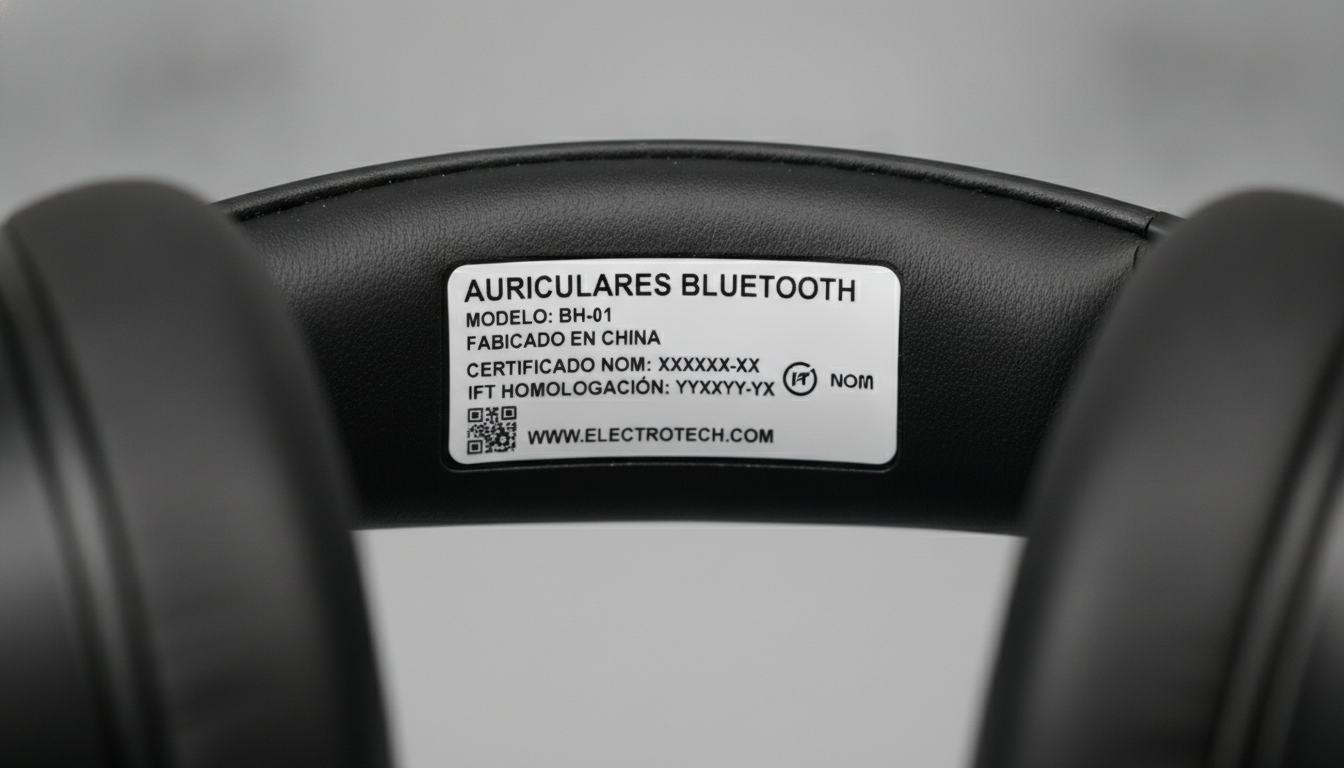
The label must show the product model number, the country of origin, the importer’s name and address, the warranty terms, and the NOM certificate number. The IFT homologation number must also appear on the label, typically adjacent to the NOM number. All text must be in Spanish, and the font size must be large enough to read without magnification. A quality control inspection at the factory verifies the label content before production begins, preventing a situation where the entire batch must be relabeled after arrival in Mexico.
Label Placement and Permanence
The label must be permanently affixed to the product or its packaging in a location visible to the end user. For headphones, the label is typically placed on the inner surface of the headband, the charging case, or the retail box. Adhesive labels are acceptable if they cannot be removed without tearing, but customs officers may reject labels that peel off easily or show signs of tampering.
Retail Packaging and User Manual
The retail packaging must include a Spanish-language user manual that explains the product’s features, the charging procedure, the Bluetooth pairing process, and the warranty terms. The manual must match the version submitted to the certification body during the NOM application, and any deviation requires a certificate amendment before the shipment can clear customs.
Cost, Timeline, and Certificate Ownership
The NOM certification bluetooth headphones china mexico process involves testing fees, certification-body charges, IFT application fees, and ongoing compliance costs. Understanding these expenses and the timeline for each step helps importers budget accurately and avoid delays.
Testing and Certification Costs
Laboratory testing for electrical safety, electromagnetic compatibility, and radiofrequency emissions typically requires separate fee schedules. The certification body charges a review fee, a certificate issuance fee, and an annual surveillance fee. The IFT charges a homologation application fee and a certificate registration fee. Total costs depend on the product complexity, the number of models being certified, and whether the importer uses a certification consultant to manage the process.
Lead Time from Sample Submission to Certificate Issuance
The testing phase takes between two and four weeks, depending on the laboratory’s workload and whether the samples pass on the first attempt. The certification body’s review and certificate issuance add another two to three weeks. The IFT homologation process runs in parallel and typically takes three to five weeks from submission to approval. Importers should plan for a total lead time of eight to twelve weeks from sample shipment to receiving both the NOM certificate and the IFT homologation.
Certificate Ownership and Transfer
The NOM certificate and the IFT homologation are issued to a specific legal entity, which must be the importer of record or a Mexican company authorized to act on the importer’s behalf. If the Chinese factory holds the certificate, the importer cannot use it for customs clearance unless the factory provides a legally binding assignment letter. This creates a dependency on the factory and prevents the importer from switching suppliers without repeating the entire certification process. Importers who plan to source from multiple factories under a single brand should apply for the certificate in their own name and provide the factory with the certificate number for labeling purposes.
Annual Surveillance and Re-Certification
Most NOM certificates require annual surveillance audits, where the certification body reviews production records, inspects finished goods, and verifies the factory has not changed the product design without notification. The importer pays an annual surveillance fee and must coordinate factory access for the auditor. If the factory fails the surveillance audit, the certificate is suspended, and the importer cannot clear new shipments until the non-conformity is resolved.
What Are the Six Critical Steps in the NOM Certification Process for Bluetooth Headphones?
- NOM and IFT represent two distinct regulatory approvals: the NOM product-safety certificate requires 2-4 weeks of electrical testing plus 2-3 weeks of certification-body review, while the IFT telecom homologation runs in parallel and takes 3-5 weeks for radiofrequency compliance verification.
- Mexico’s Secretaría de Economía updates Annex 2.4.1 annually (most recently in January 2025), which lists which HS codes and NICO codes require NOM certification, so importers must verify their product’s classification before each shipment to avoid retroactive compliance obligations.
- Accredited ISO 17025 laboratories recognized by Mexico’s Entidad Mexicana de Acreditación (EMA) can perform testing in China, reducing sample shipping costs by an estimated 40-60% compared to sending units to Mexico City or Guadalajara testing facilities.
- A NOM certificate issued to the Chinese factory cannot be used by the importer unless the factory provides a legally binding assignment letter, creating supplier lock-in where the importer must repeat the entire 8-12 week certification process if they switch manufacturers.
- Spanish-language labels must display the model number, country of origin, warranty details, NOM certificate number, and IFT homologation number in fonts no smaller than 2mm height according to Mexico’s NOM-050-SCFI-2004 commercial information standard.
- Annual surveillance audits mandated by most NOM certification bodies cost between USD 800-1,500 per audit cycle and require factory site access within 30 days of the auditor’s request, so importers must maintain active communication with Chinese suppliers to schedule compliance reviews.
Frequently Asked Questions
Can a Chinese manufacturer’s existing NOM certificate be used for my shipment?
Only if the certificate lists you as the importer of record or the manufacturer provides a legally binding assignment letter that transfers the certificate rights to your company. Mexican customs verifies the certificate holder matches the consignee on the bill of lading, and a mismatch triggers an automatic hold. Importers who source from multiple factories under a single brand should apply for the certificate in their own name to avoid supplier dependency and enable factory switching without re-certification.
What happens if the Bluetooth module changes after certification?
Any change to the Bluetooth chipset, antenna design, or enclosure material that affects radiofrequency performance requires a new IFT homologation submission with updated test reports demonstrating continued compliance with Mexico’s spectrum regulations. The NOM product-safety certificate may also need amendment if the electrical characteristics change. Private-label buyers who source from multiple factories face this risk because each factory’s radio module may use a different Bluetooth chipset even when the external appearance is identical. A supplier management process that verifies the Bluetooth module specification before each production order prevents this problem.
Do wired headphones without Bluetooth require NOM certification?
It depends on the tariff classification and whether the headphones include electrical components such as active noise cancellation, a rechargeable battery, or a USB charging circuit. Passive wired headphones with no electrical components may fall outside the NOM scope, but the importer must obtain a written determination from an accredited certification body or a customs broker before assuming certification is not required. Mexico’s Annex 2.4.1 is updated periodically, and a product that was exempt last year may require certification under the current rules.
Written by the Goodcantrading Sourcing Team.
Ready to navigate the NOM certification bluetooth headphones china mexico process with expert support?
Request a Certification Roadmap →