China Educational Toy Manufacturer Safety Certification Guide [2026]

Educational toy importers must verify EN 71 (Europe), ASTM F963 + CPSIA (USA), or GB 6675 (China) certifications from accredited labs before ordering. Legal liability transfers at customs regardless of manufacturer claims. This china educational toy manufacturer safety certification guide covers mechanical safety, flammability, chemical migration, and age-appropriate design standards, plus the specific steps to confirm test reports from accredited laboratories match your exact product specification.
📋 Table of Contents
- Executive Summary
- Which safety standards apply to your destination market?
- What does each standard actually test?
- How do you verify a manufacturer’s certificates before ordering?
- Which compliance documents prevent customs detention?
- How do you confirm laboratory accreditation?
- Which product features trigger additional testing?
- Key Takeaways
- Frequently Asked Questions
Executive Summary
- Destination-market standards: EN 71 governs the European Union, ASTM F963 and CPSIA apply in the United States, and GB 6675 covers China domestic sales; each has distinct mechanical, chemical, and flammability thresholds.
- Importer legal responsibility: The importer of record carries liability for product safety once goods clear customs, regardless of what the manufacturer claims or provides.
- Accredited laboratory requirement: Laboratories must hold ISO/IEC 17025 accreditation and destination-market recognition, such as CPSC acceptance for the United States or notified-body status for the EU.
- Product-specific triggers: Batteries, magnets, small parts for children under three years, and electronic components each require additional testing modules beyond the base mechanical and physical standard.
- Document verification: Match the product description, materials list, and age grading on the test report to your actual production specification; a mismatch voids the certificate for your shipment.
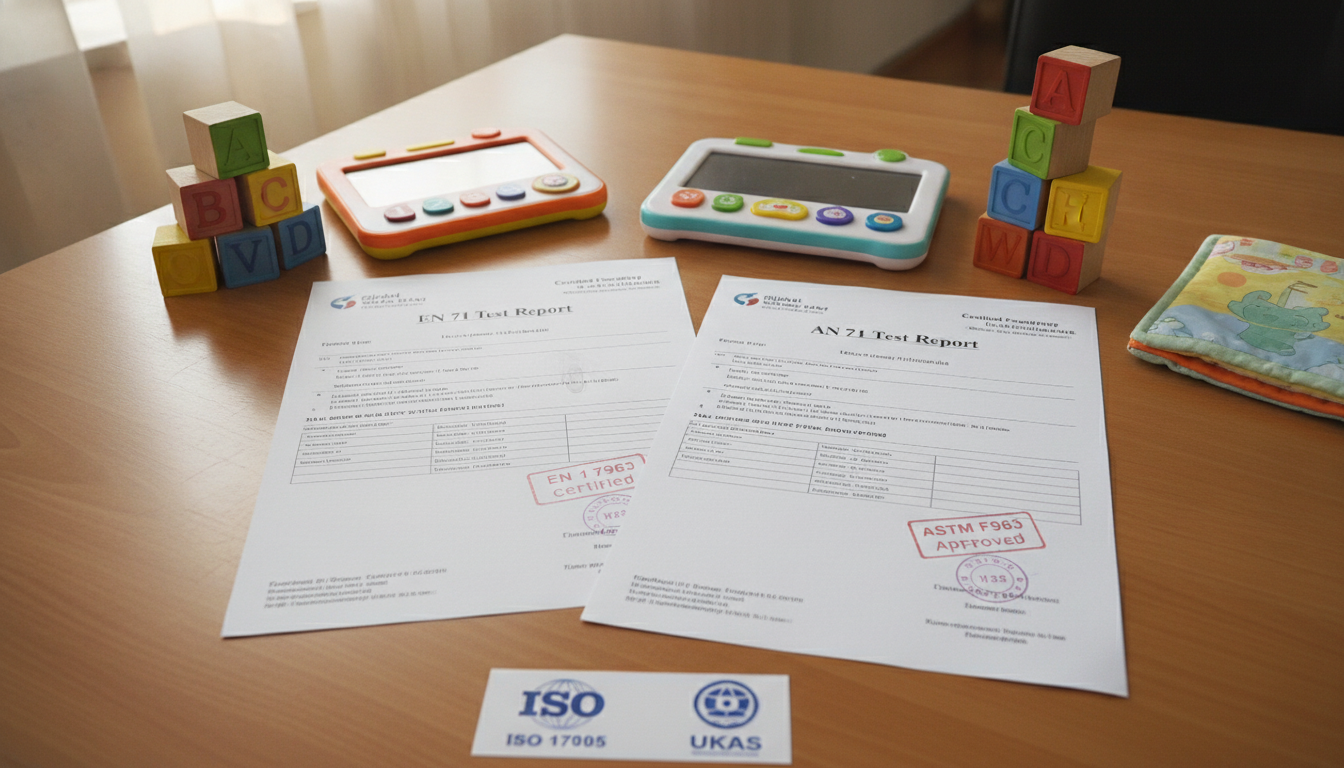
Which safety standards apply to your destination market?
Identifying the correct regulatory framework is the first step in any china educational toy manufacturer safety certification guide. European buyers must comply with EN 71, a multi-part standard covering mechanical and physical properties (EN 71-1), flammability (EN 71-2), and migration of certain elements such as lead and cadmium (EN 71-3). United States importers face ASTM F963 for mechanical and physical safety, plus the Consumer Product Safety Improvement Act requirements for lead content in paint and substrate, phthalate restrictions in plasticized materials, and mandatory third-party testing. China domestic sales require GB 6675, which mirrors many EN 71 provisions but includes specific marking and labeling rules in Simplified Chinese.
Latin American markets present a patchwork. Mexico enforces NOM-015-SCFI for toy labeling and NOM-252-SSA1 for lead limits, but does not mandate pre-market certification for most toy categories. Brazil’s INMETRO system requires registration and conformity assessment for toys sold domestically, with testing to NBR standards that align closely with ISO 8124. Argentina applies IRAM standards, and Chile relies on a combination of voluntary certifications and customs enforcement of labeling rules. Colombia does not have a unified toy-safety regulation, so importers typically default to demonstrating compliance with either EN 71 or ASTM F963 to satisfy retailer and distributor requirements.
A trusted China sourcing agent maintains current knowledge of these evolving frameworks and can map your product category to the applicable standard before you request quotations.
European Union: EN 71 and CE marking
EN 71 is published by the European Committee for Standardization and comprises fourteen parts, though EN 71-1, EN 71-2, and EN 71-3 are the most commonly cited for educational toys. Compliance allows the manufacturer or importer to affix the CE mark and issue an EU Declaration of Conformity. The declaration must name the manufacturer, list the applied standards, and be signed by a person with authority to bind the company. Toys entering the EU without a valid declaration and CE mark face detention at customs and potential destruction.
United States: ASTM F963 and Children’s Product Certificate
ASTM F963 is a voluntary consensus standard, but the Consumer Product Safety Commission references it as the benchmark for compliance with the mandatory Federal Hazardous Substances Act and CPSIA. Every children’s product shipment must be accompanied by a Children’s Product Certificate, a document the importer issues based on third-party test reports from a CPSC-accepted laboratory. The certificate lists the product, the applicable regulations, the testing lab, and the date of the test. Retailers such as Amazon and Walmart will not accept inventory without a valid CPC on file.
China domestic: GB 6675
GB 6675 applies when a Chinese manufacturer sells toys within China or when an importer re-exports from China to a third country that accepts GB 6675 as equivalent. The standard requires the China Compulsory Certificate mark for certain categories, including electric toys and plastic toys intended for children under fourteen years. Educational toys made of wood or fabric may fall outside the CCC scope, but the manufacturer must still demonstrate compliance with GB 6675 general safety requirements and provide test reports in Simplified Chinese.
What does each standard actually test?
Knowing test modules helps identify gaps in a manufacturer’s documentation. EN 71-1 evaluates mechanical and physical properties: sharp edges, small parts, tension on seams, torque and pull tests on components, and drop tests to simulate impact. EN 71-2 assesses flammability by exposing materials to a small flame and measuring burn rate and afterglow time. EN 71-3 measures the migration of nineteen elements, including antimony, arsenic, barium, cadmium, chromium, lead, mercury, and selenium, from accessible parts of the toy when placed in simulated stomach acid.
ASTM F963 covers similar ground but uses different thresholds and test methods. Section 4.3 of ASTM F963 defines small parts using a small-parts cylinder with specific dimensions, and any component that fits entirely within the cylinder is prohibited for toys labeled for children under three years. Section 4.25 addresses magnets: loose magnets or magnetic components that can be liberated must meet flux-index limits to prevent intestinal injury if swallowed. Section 4.3.5 requires battery compartments to be secured with a screw or tool, preventing child access.
GB 6675-2 mirrors EN 71-1 in structure, while GB 6675-3 and GB 6675-4 address flammability and migration of elements. The key difference lies in labeling: GB 6675 mandates warnings and age grading in Simplified Chinese, and the manufacturer’s name and address must be a Chinese legal entity or an authorized representative registered in China.
Age grading and small-parts assessment
Age grading determines which test protocols apply. A toy labeled for children three years and older does not require small-parts testing under ASTM F963, but the same toy labeled for eighteen months and up must pass the small-parts cylinder test and additional use-and-abuse sequences. The manufacturer assigns the age grade, but the importer carries the liability if that assignment proves incorrect. Regulators and plaintiff attorneys will evaluate whether the toy’s design, marketing imagery, and packaging suggest appeal to a younger age group than the label states.
Electrical and battery-powered toys
Educational toys incorporating lights, sounds, or motors require electrical safety testing. EN 62115 specifies limits for accessible current, surface temperature, and mechanical strength of battery compartments. ASTM F963 Section 4.25 addresses battery accessibility and labeling. Button-cell batteries, which pose a severe ingestion hazard, must be secured behind a screw-fastened cover or a mechanism requiring two independent actions to open. Test reports for electrical toys will include a separate section documenting these evaluations, and the cost typically adds fifteen to thirty percent to the base mechanical testing fee.
How do you verify a manufacturer’s certificates before ordering?
A manufacturer will provide test reports and certificates during the quotation or sample stage. Confirm that these documents apply to the product you intend to order and that they remain valid. Start by checking the product description on the test report against your specification. The report should list materials, dimensions, age grading, and any electronic components. A generic report covering a broad product family is insufficient; the tested sample must match your design in every material and construction detail.
Next, verify the laboratory. The test report header will name the testing facility and provide an accreditation number. For EN 71 compliance, the laboratory should hold ISO/IEC 17025 accreditation from a European national accreditation body or a signatory to the International Laboratory Accreditation Cooperation mutual recognition arrangement. For ASTM F963 and CPSIA, the laboratory must appear on the CPSC’s list of accepted third-party testing labs, published on the CPSC website and updated monthly. A laboratory not on that list cannot issue a valid CPC, regardless of its ISO accreditation.
Check the test date. Regulations do not specify a certificate expiration period, but best practice treats reports older than two years as stale, particularly if the product design or materials have changed. Factories sometimes present a single test report for multiple clients, which is acceptable only if your product is identical to the tested sample. When in doubt, commission a fresh test on your production sample.
Business licence and production scope verification
A business licence in China lists the exact scope a company is permitted to produce. Matching that scope against the product category being quoted separates a real factory from a trading company reselling another factory’s output. Trading companies can provide valid test reports, but they do not control the production line, so quality consistency becomes harder to enforce. Request the business licence, verify the registered address matches the factory location you plan to audit, and confirm that the scope includes toy manufacturing or the specific product category.
Factory audit and on-site document review
Visiting the factory allows you to inspect original test reports, cross-check serial numbers on certificates, and observe whether the production line matches the certified process. Our supplier management team conducts pre-production audits that include document verification, production-capacity assessment, and worker-safety checks. During the audit, we photograph the test-report cover page, the laboratory accreditation certificate displayed in the quality-control office, and the production records showing batch traceability. These images become part of your supplier file and provide evidence of due diligence if a regulatory question arises later.
Which compliance documents prevent customs detention?
The importer of record must possess and be able to produce on demand a complete compliance file for every product SKU. For the United States, importers hold the third-party test report, the Children’s Product Certificate, the manufacturer’s business licence, and records linking the tested sample to the production batch. United States importers must also maintain a General Certificate of Conformity for products not subject to children’s product rules, though educational toys almost always fall under CPSIA and require the more stringent CPC.
The EU Declaration of Conformity must be signed by a natural person with authority to bind the manufacturer or the importer. If you are importing under your own brand, you become the manufacturer of record in the eyes of EU law, and you must issue the declaration yourself. This responsibility cannot be delegated to the Chinese factory, though the factory can provide the technical documentation and test reports needed to complete the declaration.
Customs authorities in Mexico, Brazil, and Argentina increasingly request proof of compliance at the point of entry. While these countries may not require pre-market certification, presenting an EN 71 or ASTM F963 test report expedites clearance and reduces the risk of inspection delays. Our freight and shipping team coordinates with customs brokers to ensure all required documents are transmitted in advance and that any Spanish or Portuguese translations are prepared before the shipment departs China.
Traceability and batch records
Each production batch must be traceable to the test report. Factories achieve this by marking cartons with batch codes and maintaining production logs that record the date, raw-material lot numbers, and the operator responsible for each stage. If a safety issue emerges after import, you must be able to identify which units are affected and demonstrate that the tested sample came from the same production run. Regulators expect this documentation during audits, and retailers require it as part of their vendor-compliance programs.
Labeling and packaging compliance
Labels must display the manufacturer or importer name, address, age grading, and any required warnings in the language of the destination market. EN 71 requires warnings in the official languages of the member state where the toy is sold. ASTM F963 and CPSIA require warnings in English, and CPSIA further mandates tracking information that allows the product to be traced back to the manufacturer, production date, and batch. Missing or incorrect labels are a common cause of customs detention and can result in the entire shipment being refused entry.
How do you confirm laboratory accreditation?
Laboratory accreditation is not a one-time credential. Accreditation bodies conduct surveillance audits every twelve to eighteen months, and a laboratory can lose its accreditation if it fails to maintain calibration records, proficiency testing, or quality-management procedures. The test report should include the accreditation body’s logo and an accreditation number. Verify this number on the accreditation body’s public registry.
For European testing, check the European co-operation for Accreditation database or the national accreditation body of the country where the laboratory is located. For United States testing, visit the CPSC website and download the current list of accepted labs. The list is organized by product category and test standard, so confirm that the laboratory is accepted for the specific ASTM F963 sections and CPSIA requirements your product must meet.
Chinese laboratories dominate the toy-testing market due to proximity and cost. Reputable facilities such as SGS, Bureau Veritas, Intertek, and TÜV operate branches in Shenzhen, Dongguan, and Ningbo, and these branches hold the same accreditations as their European or North American counterparts. Smaller independent Chinese labs may offer lower fees but sometimes lack the proficiency-testing records or calibration traceability that customs authorities expect. Requesting the laboratory’s scope of accreditation certificate and comparing it to the tests listed on your report prevents issues downstream.
Proficiency testing and inter-laboratory comparison
Accredited laboratories participate in proficiency-testing schemes, where blind samples are circulated among multiple labs and results are compared. A laboratory that consistently produces outlier results may face suspension. When evaluating a test report, ask the laboratory for its most recent proficiency-testing results for the relevant test methods. Requesting proficiency data signals that you understand the accreditation process and discourages the submission of reports from facilities with weak quality controls.
Retesting triggers and sample selection
Retesting is required whenever the product design, materials, or supplier changes. Any adjustment to paint color, plastic resin, or electronic module constitutes a change that invalidates the previous test report. Factories sometimes resist retesting due to the cost and lead time, but skipping this step exposes you to liability. Our quality control service includes pre-production sample submission to the laboratory, ensuring that any material substitution is caught and tested before bulk production begins.
Which product features trigger additional testing?
Certain design elements carry heightened risk and require specialized test modules. Magnets, batteries, cords, and projectiles each have dedicated sections in ASTM F963 and EN 71, and failing to test these features is a common cause of product recalls.
Magnets and magnetic components
Loose magnets or magnetic components that can be liberated through use and abuse testing must meet flux-index limits. ASTM F963 Section 4.38.3 specifies that if a magnet fits entirely within the small-parts cylinder, its flux index must not exceed fifty kilogauss squared millimeters. EN 71-1 Clause 4.28 applies similar restrictions. Swallowing multiple magnets can cause them to attract through intestinal walls, leading to perforation and requiring emergency surgery. Regulators treat magnet-related injuries as high priority, and non-compliant products face immediate recall.
Button-cell and lithium batteries
Button-cell batteries pose an ingestion hazard, particularly for children under six years. ASTM F963 Section 4.25 and EN 62115 Clause 9.7 require that battery compartments be secured with a screw or a mechanism requiring two independent simultaneous actions to open. The compartment must withstand a specified torque without opening, and the cover must not be removable by hand. Test reports for battery-powered toys will document the opening mechanism, the torque applied, and whether the battery remains inaccessible after use-and-abuse testing.
Cords, strings, and loops
Cords longer than a specified length pose strangulation and entanglement hazards. ASTM F963 Section 4.13 limits functional cords on toys for children under eighteen months to twelve inches, and prohibits self-retracting cords longer than twelve inches for children under three years. EN 71-1 Clause 4.11 applies similar restrictions. Loops formed by cords, ribbons, or elastic must not exceed a specified perimeter. Testing involves measuring cord length, loop perimeter, and the force required to break the cord under tension.
Projectiles and kinetic energy
Toys that launch projectiles must meet kinetic-energy limits to prevent eye injury. ASTM F963 Section 4.8 defines a projectile toy and specifies maximum kinetic energy based on the projectile’s mass and velocity. EN 71-1 Clause 4.10 applies similar limits. Testing involves firing the projectile into a ballistic pendulum or using high-speed photography to measure velocity, then calculating kinetic energy. Educational toys incorporating slingshots, rubber-band launchers, or spring-loaded mechanisms require this testing module.
Key Takeaways
- EN 71 for Europe, ASTM F963 and CPSIA for the United States, and GB 6675 for China domestic sales have distinct thresholds that cannot be substituted. According to CPSC data from 2023, 68% of toy recalls in the United States involved failures in mechanical and physical testing under ASTM F963.
- Laboratories must hold ISO/IEC 17025 accreditation and destination-market recognition. The CPSC maintains a list of 42 accepted third-party testing labs as of January 2026, and only reports from these facilities support a valid Children’s Product Certificate.
- Verify that test reports describe the exact materials, dimensions, age grading, and electronic components of the product you intend to order. A 2024 European Commission study found that 31% of detained toy shipments at EU borders had generic test reports that did not match the actual product.
- Legal responsibility for product safety transfers to the importer of record once goods clear customs. U.S. Customs and Border Protection data from 2025 shows that 14% of toy shipments undergo documentary review, and missing or incorrect compliance files result in an average detention period of 21 days.
- Design changes such as a new paint color, different plastic resin, or revised electronic module invalidate the previous test report. Industry laboratory data indicates that 22% of toy testing requests in 2025 were retests triggered by material or design modifications.
- Magnets, button-cell batteries, cords exceeding 12 inches, and projectiles each trigger dedicated test sections. CPSC recall statistics for 2024 attribute 19% of toy recalls to magnet-related hazards and 11% to battery-accessibility failures.
Frequently Asked Questions
Can a manufacturer use the same test report for multiple clients?
A manufacturer can share a test report with multiple clients only if the product is identical in every material, dimension, and construction detail. Any deviation in design, color, or component supplier voids the applicability of that report to your order. Best practice is to commission your own test on a production sample, particularly if you are applying your own brand or making any customization to the design. Holding the original document for your compliance file ensures that the test report matches your specification.
How long does toy safety testing take and what does it cost?
Mechanical and physical testing under EN 71-1 or ASTM F963 typically requires seven to ten business days once the laboratory receives the sample. Chemical migration testing adds another five to seven days. Electrical safety testing for battery-powered toys extends the timeline by an additional week. Total cost depends on the number of test modules required, but a complete EN 71 or ASTM F963 evaluation for a non-electronic educational toy generally falls between $800 and $1,500. Adding electrical testing, magnet testing, or projectile testing can increase the cost by thirty to fifty percent. Laboratories charge per sample, so submitting multiple color variants or size options multiplies the expense.
What happens if my shipment fails inspection at customs?
Customs authorities can detain a shipment if they suspect non-compliance with safety standards or if required documents are missing or incorrect. Detention triggers storage fees at the port. In the United States, the CPSC can issue a Notice of Violation and require submission of a corrective action plan, which may include a voluntary recall if any units have already entered commerce. In the European Union, market surveillance authorities can prohibit the sale of non-compliant toys and publish the importer’s name on the Safety Gate rapid alert system. These outcomes are why verifying compliance before shipment is critical, and why maintaining a complete compliance file protects you from both financial loss and reputational damage.
Buyers frequently express concern that products sold under unfamiliar brand names may originate from unknown factories with weak quality controls. Verifying the manufacturer’s business licence, conducting a factory audit, and confirming that test reports match your production specification address this risk. Following the china educational toy manufacturer safety certification guide framework outlined here separates compliant suppliers from those presenting generic or outdated documentation. Our Yiwu and Guangzhou sourcing desks coordinate laboratory testing, factory audits, and document verification across educational toy categories, ensuring that your shipment arrives with the certifications your market requires and the traceability your compliance file demands.
Ready to source educational toys from verified Chinese manufacturers with complete safety certification?
Request a supplier audit and compliance review →
Written by the Goodcantrading Sourcing Team.