CE Marking China Bluetooth Speakers France Import [2026 Guide]
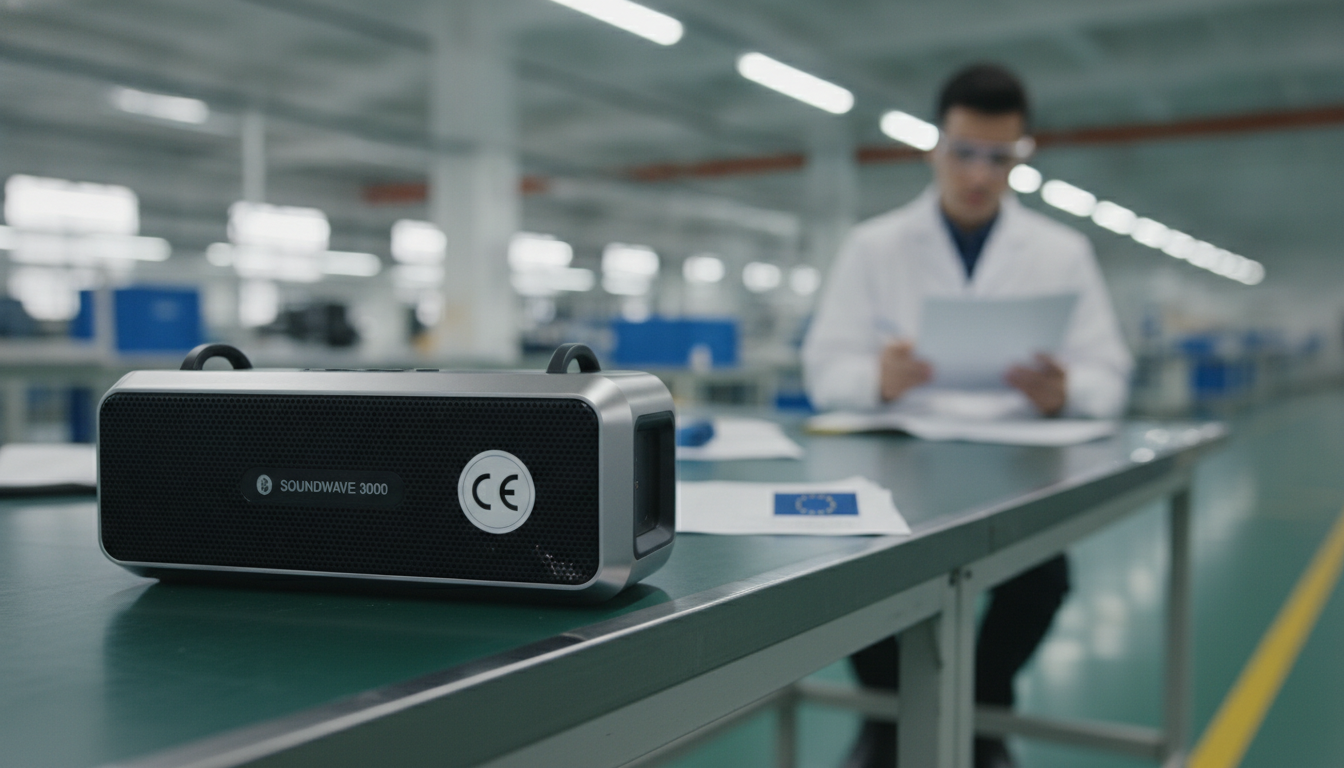
CE marking China Bluetooth speakers France import requires compliance with the Radio Equipment Directive 2014/53/EU, the Electromagnetic Compatibility Directive, and RoHS. The importer of record must hold an EU Declaration of Conformity, technical documentation and accredited test reports before the first unit clears French customs. A responsible person established in France or the EU is mandatory under the General Product Safety Regulation.
📋 Table of Contents
- Executive Summary
- Which EU Directives Apply to Bluetooth Speakers?
- What Documents Must the Importer Hold Before Customs Clearance?
- How to Verify Supplier CE Compliance Before Ordering
- France-Specific Import Requirements: EORI, VAT and Responsible Person
- Customs Classification, Duties and VAT for Bluetooth Speakers
- Pre-Shipment Verification Checklist
- Key Takeaways
- Frequently Asked Questions
Executive Summary
- Radio Equipment Directive 2014/53/EU: Bluetooth speakers transmit radio signals and fall under RED, requiring conformity assessment against harmonized standards EN 300 328 and EN 301 489 before CE marking is affixed.
- Importer obligations: The entity placing the product on the French market holds legal responsibility for compliance, must verify the Declaration of Conformity and technical file, and ensure the manufacturer’s name and address appear on the product or packaging.
- Pre-shipment verification: Request model-specific test reports from an ISO/IEC 17025 accredited laboratory, confirm the Declaration of Conformity lists the exact model number and manufacturing batch, and check that product labels include the CE mark, type designation and importer contact details.
- France customs execution: Register an EORI number with French customs, classify the speaker under HS code 8518.21 or 8518.22, calculate import VAT at twenty percent and apply any applicable duties before clearance.
- Responsible person requirement: GPSR mandates a natural or legal person established in the EU to maintain technical documentation and act as the contact point for market surveillance authorities; the importer may fulfill this role or appoint a third-party representative.
Which EU Directives Apply to Bluetooth Speakers?
Bluetooth speakers combine radio transmission, electromagnetic compatibility and battery power, triggering multiple EU directives. Understanding which legislation applies determines the conformity-assessment pathway and the documents customs will request at the French border.
Radio Equipment Directive 2014/53/EU
Any product that intentionally transmits or receives radio waves falls under RED. Bluetooth operates in the 2.4 GHz ISM band, so every Bluetooth speaker requires conformity assessment against harmonized standards EN 300 328 (radio spectrum efficiency) and EN 301 489 (electromagnetic compatibility for radio equipment). The manufacturer or importer must demonstrate compliance through technical documentation and testing before affixing the CE mark.
Electromagnetic Compatibility Directive 2014/30/EU
The speaker’s audio amplifier, power supply and internal wiring generate electromagnetic emissions. EMC Directive requirements overlap with RED for radio equipment, but the technical file must address both conducted and radiated emissions to prevent interference with other household devices. Harmonized standard EN 55032 covers emission limits, while EN 55035 addresses immunity.
RoHS Directive 2011/65/EU
Restriction of Hazardous Substances limits lead, mercury, cadmium, hexavalent chromium, polybrominated biphenyls and polybrominated diphenyl ethers in electrical and electronic equipment. Bluetooth speakers fall under category 3 (IT and telecommunications equipment) or category 4 (consumer equipment), depending on marketing. The supplier must provide a RoHS Declaration of Conformity and material-composition test reports for circuit boards, solder, cables and plastic housings.
General Product Safety Regulation (EU) 2023/988
GPSR replaces the General Product Safety Directive and introduces stricter traceability and responsible-person obligations. Every product placed on the EU market after December 2024 must carry a unique product identifier, manufacturer contact details and a responsible person established in the Union. Importers must verify that the Chinese supplier has prepared the required documentation and labeling before shipment.
What Documents Must the Importer Hold Before Customs Clearance?
French customs and market surveillance authorities can request compliance documentation at any time. The importer of record must hold these documents in accessible form for ten years after the last unit is placed on the market.
EU Declaration of Conformity
The Declaration of Conformity is a signed statement by the manufacturer listing the exact product model, applicable directives, harmonized standards applied, and the name and address of the signatory. A generic certificate covering multiple unrelated products or a template with blank fields is not valid. The document must specify the manufacturing batch or serial-number range, the date of issue, and the location where technical documentation is held. Importers should request a model-specific declaration for each speaker variant, including different colors, battery capacities or Bluetooth versions.
Technical Documentation and Test Reports
Technical documentation includes circuit diagrams, bill of materials, risk assessment, user manual and test reports from an accredited laboratory. For Bluetooth speakers, the test reports must cover radio-frequency performance (EN 300 328), electromagnetic compatibility (EN 301 489), electrical safety if mains-powered (EN 62368-1), and battery safety if rechargeable (EN 62133 or IEC 62368-1 Annex Q). The laboratory must hold ISO/IEC 17025 accreditation for the specific test methods applied. Importers should verify the accreditation certificate and confirm that the test report lists the exact product model, not a similar reference sample.
User Manual and Safety Instructions in French
French consumer law requires user manuals, safety warnings and product labels in French. The manual must include operating instructions, battery-handling warnings, disposal information under the WEEE Directive, and the responsible person’s contact details. Machine-translated text with grammatical errors or missing diacritics can trigger a market-surveillance stop-sale order, so professional translation is necessary before the first shipment.
How to Verify Supplier CE Compliance Before Ordering
Generic CE certificates circulate widely among Chinese suppliers, often listing multiple product categories under a single document or showing test reports for unrelated speaker models. Importers who accept these documents at face value discover the fraud only when French customs or a market-surveillance inspector requests the technical file.
Request Model-Specific Test Reports
Ask the supplier for test reports that list the exact model number, Bluetooth version, battery capacity and enclosure material of the speaker being quoted. The report header must show the laboratory’s ISO/IEC 17025 accreditation certificate number and the test-method standard version applied. Cross-check the laboratory name against the accreditation body’s public register (CNAS in China, COFRAC in France, UKAS in the UK). A test report issued by a non-accredited laboratory or an internal company lab has no legal standing under RED.
Verify the Declaration of Conformity Signatory
The Declaration of Conformity must be signed by an authorized representative of the manufacturer, with the signatory’s name, title and contact details printed clearly. A scanned signature on a template document with no company seal or contact information is a red flag. Request the manufacturer’s business license and verify that the legal entity name on the license matches the name on the Declaration. A trading company reselling another factory’s product cannot issue a valid Declaration unless it assumes full manufacturer responsibility and holds the technical file.
Inspect Product Labels and Markings
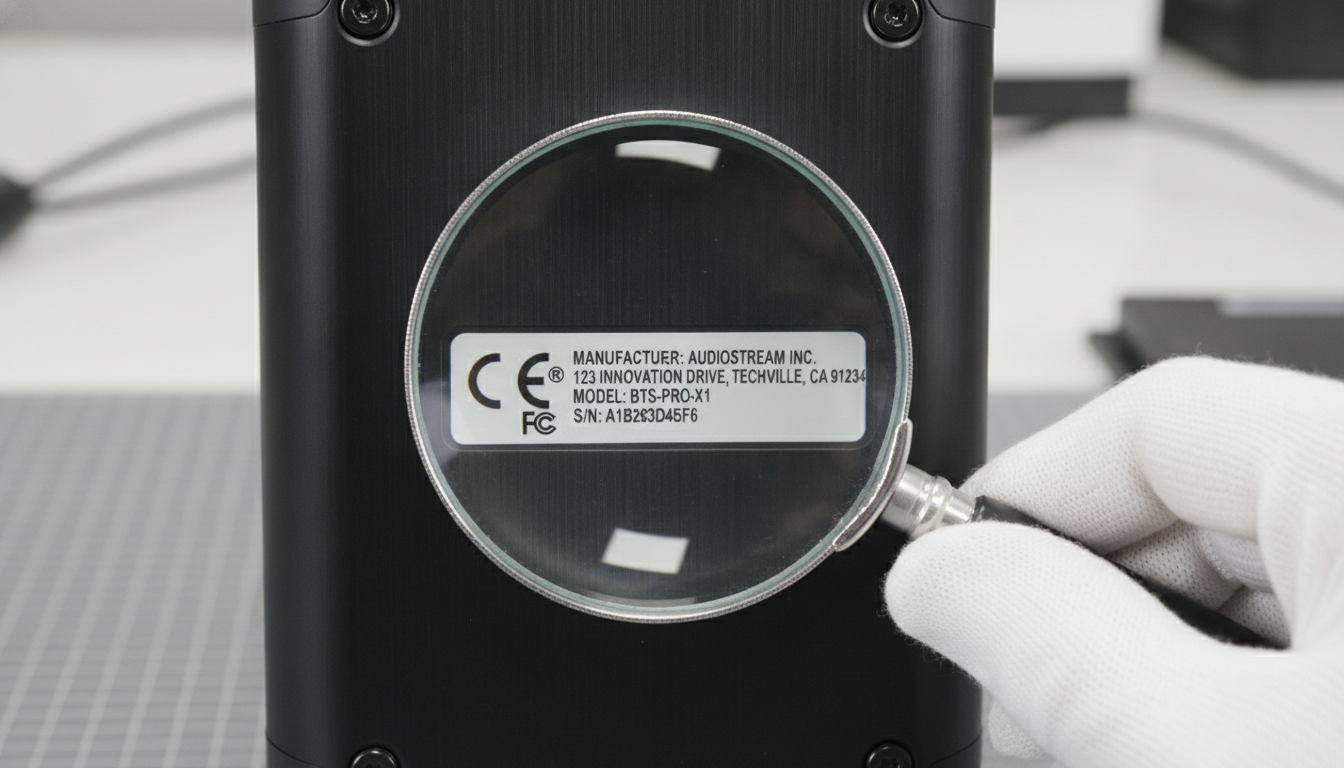
The CE mark must be affixed visibly, legibly and indelibly on the product or its packaging. The mark consists of the letters C and E in a specific proportional design; hand-drawn or distorted marks are non-compliant. The product label must also show the manufacturer’s name and postal address, the model or type designation, the serial number or batch code, and any warnings required by the applicable directives. If the manufacturer is outside the EU, the importer’s name and address must appear alongside the manufacturer’s details.
In practice: A business license lists the exact production scope a company is permitted to manufacture, which is why matching that scope against the product category being quoted separates a factory with in-house production capability from a trading company reselling another supplier’s output.
France-Specific Import Requirements: EORI, VAT and Responsible Person
Clearing Bluetooth speakers through French customs requires registration, tax calculation and appointment of a responsible person under GPSR. Missing any of these steps delays the shipment or triggers a customs hold.
EORI Number Registration
Every importer must hold an Economic Operators Registration and Identification number before filing a customs declaration. French EORI numbers begin with the prefix FR and are issued by the Direction Générale des Douanes et Droits Indirects. Registration is free and typically completed within three business days through the SOPRANO online portal. The EORI number links to the importer’s VAT identification number and company registration, so both must be active before applying.
Import VAT and Duty Calculation
France applies a standard VAT rate of twenty percent on the customs value plus any applicable duties. Bluetooth speakers are classified under HS code 8518.21 (single loudspeaker mounted in an enclosure) or 8518.22 (multiple loudspeakers in the same enclosure), depending on driver configuration. The EU applies a common customs tariff, with duty rates varying by country of origin and trade agreements. Speakers originating in China face a duty rate that depends on the specific HS subheading and any applicable preferential treatment. Importers should calculate the landed cost before ordering to avoid cash-flow surprises at clearance.
Responsible Person Under GPSR
The General Product Safety Regulation requires an EU-established natural or legal person to hold technical documentation, respond to market-surveillance requests and coordinate product recalls if necessary. The importer may act as the responsible person if registered in France or another EU member state. Alternatively, the importer may appoint a third-party compliance service or the manufacturer’s EU representative. The responsible person’s name and postal address must appear on the product label or packaging, and the appointment must be documented in writing before the first unit is placed on the market.
Customs Classification, Duties and VAT for Bluetooth Speakers
Accurate HS classification determines the duty rate, statistical reporting and any applicable trade-defense measures. Misclassification triggers post-clearance audits and penalty assessments.
HS Code 8518.21 vs 8518.22
HS code 8518.21 covers single loudspeakers mounted in an enclosure, typically mono speakers or satellite units. HS code 8518.22 covers multiple loudspeakers in the same enclosure, such as stereo speakers with separate woofer and tweeter drivers. The distinction depends on the number of drivers, not the number of audio channels. A stereo speaker with a single full-range driver per enclosure is classified under 8518.21, while a speaker with two drivers in one enclosure falls under 8518.22. Importers should confirm the driver configuration with the supplier and declare the correct subheading on the customs entry.
Duty Rates and Trade Agreements
The EU common customs tariff lists duty rates for each HS subheading, with preferential rates available under trade agreements. Speakers originating in China do not benefit from preferential treatment under current EU trade policy, so the most-favored-nation rate applies. Importers should consult the TARIC database for the current duty rate and any anti-dumping or countervailing measures in force. The duty is calculated on the CIF value (cost, insurance, freight) and added to the customs value before VAT is applied.
VAT and Deferred Payment
Import VAT is due at the time of customs clearance, unless the importer holds a deferred-payment authorization. French customs offers monthly VAT accounting for registered importers, allowing VAT to be reported and paid through the regular VAT return rather than at the border. This improves cash flow and simplifies accounting, but requires advance approval and compliance with reporting obligations. Importers should apply for deferred payment before the first shipment to avoid upfront VAT outlays.
CE Marking China Bluetooth Speakers France Import: Pre-Shipment Verification Checklist
Catching compliance gaps before the container leaves China prevents costly delays, re-labeling or product destruction at the French border. A systematic pre-shipment inspection covers documentation, labeling and physical product conformity.
Documentation Review
- EU Declaration of Conformity: Verify model number, batch range, signatory name and address, applicable directives and harmonized standards.
- Test reports: Confirm ISO/IEC 17025 accreditation, exact model tested, test-method standard version and pass result for all applicable tests.
- Technical file index: Request a list of documents held by the manufacturer, including circuit diagrams, bill of materials, risk assessment and user manual.
- RoHS Declaration: Verify material-composition test reports for circuit boards, solder, cables and plastic housings.
- French-language manual: Check professional translation quality, diacritics, WEEE disposal instructions and responsible-person contact details.
Product Label Inspection
- CE mark: Proportional design, minimum five millimeters height, affixed visibly and indelibly on product or packaging.
- Manufacturer details: Name and postal address of the manufacturer, or importer if manufacturer is outside the EU.
- Model and type designation: Exact model number matching the Declaration of Conformity and test reports.
- Serial number or batch code: Unique identifier linking the unit to the manufacturing batch and technical documentation.
- Warnings and symbols: Battery-handling warnings, WEEE crossed-out wheelie bin, any other symbols required by applicable directives.
Physical Product Checks
- Bluetooth pairing and range: Verify stable connection at the claimed range and confirm Bluetooth version matches the specification.
- Battery capacity and charging: Measure playback time against the claimed battery life and check charging port for secure fit and correct voltage.
- Audio output quality: Listen for distortion at maximum volume, verify frequency response matches the specification and check for electromagnetic interference with nearby devices.
- Build quality and materials: Inspect enclosure for sharp edges, loose components or poor-quality plastics that could fail safety testing.
Our quality inspection team conducts pre-shipment checks at the factory, covering documentation review, label verification and functional testing before the container is sealed. This catches non-conformities while the supplier can still correct them, avoiding the cost and delay of post-shipment rework.
Key Takeaways
- Radio Equipment Directive 2014/53/EU requires conformity assessment against harmonized standards EN 300 328 and EN 301 489 before CE marking is affixed to any Bluetooth speaker transmitting radio signals in the 2.4 GHz ISM band.
- An importer placing Bluetooth speakers on the French market holds legal responsibility for compliance and must verify the EU Declaration of Conformity lists the exact model number and manufacturing batch before customs clearance.
- French customs requires an EORI number issued by the Direction Générale des Douanes et Droits Indirects, accurate HS classification under 8518.21 or 8518.22, and calculation of import VAT at twenty percent on the customs value plus any applicable duties.
- GPSR mandates an EU-established natural or legal person to hold technical documentation for ten years and respond to market surveillance requests within forty-eight hours of official inquiry.
- Pre-shipment verification of model-specific test reports issued by ISO/IEC 17025 accredited laboratories, product labels meeting GPSR traceability rules and functional performance testing catches compliance gaps while the supplier can still correct them at no additional cost.
- Generic CE certificates listing multiple product categories or test reports for models other than the exact speaker being imported have no legal standing under Radio Equipment Directive 2014/53/EU Article 19 technical documentation requirements.
Frequently Asked Questions
Can the Chinese manufacturer affix the CE mark, or must the importer do it?
The manufacturer may affix the CE mark if it assumes full responsibility for conformity assessment, holds the technical documentation and issues the EU Declaration of Conformity. However, the importer remains legally responsible for verifying that the mark is correctly applied and that the product complies with all applicable directives. If the manufacturer is a trading company or lacks the technical file, the importer must obtain complete documentation from the actual producer and may need to re-label units before placing them on the French market.
What happens if French customs finds the CE documentation invalid?
French customs or market surveillance authorities can issue a stop-sale order, require withdrawal from the market, or destroy non-compliant units at the importer’s expense. Administrative fines may be imposed, and placement of further units is prohibited until valid documentation is provided. In serious cases, suspension of the importer’s EORI number blocks all future imports until compliance is restored. Correcting the issue requires obtaining valid test reports from ISO/IEC 17025 accredited laboratories, re-labeling products and submitting a new Declaration of Conformity, which can take weeks or months depending on supplier cooperation.
Does every color variant or battery capacity require separate test reports?
Color variants using identical circuit boards, batteries and enclosure materials can share test reports if the only difference is cosmetic finish. However, different battery capacities, Bluetooth versions or driver configurations are considered separate models and require individual conformity assessment. Test reports and Declarations of Conformity must list exact model designations, so a speaker with a three-thousand-milliamp-hour battery cannot use documentation issued for a five-thousand-milliamp-hour variant. Request model-specific documentation for each SKU to avoid customs disputes.
Navigating CE marking China Bluetooth speakers France import compliance requires coordination between supplier verification, documentation review and customs execution. Our China sourcing team verifies factory certifications, audits technical files and coordinates pre-shipment inspections to ensure every unit meets RED, EMC and RoHS requirements before leaving the factory. With offices in Yiwu and Guangzhou and multilingual support in English, Spanish and French, we manage the full compliance and logistics chain from supplier selection to French customs clearance.
Ready to source CE-compliant Bluetooth speakers from verified Chinese manufacturers?
Request a compliance audit →
Written by the Goodcantrading Sourcing Team.