China Essential Oil Manufacturer Private Label Process [2026 Guide]
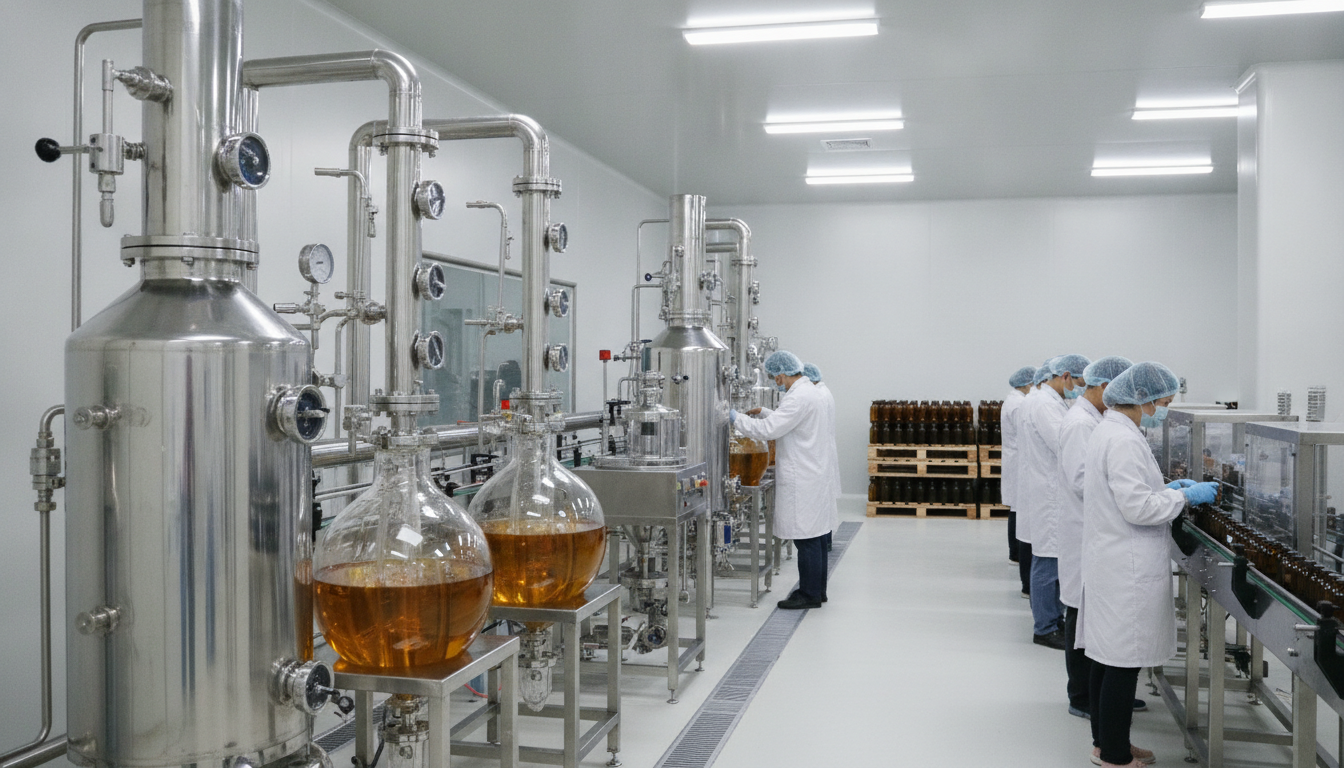
The china essential oil manufacturer private label process begins with formula selection and supplier verification, followed by MOQ negotiation (typically 50-5,000 pieces depending on complexity), sample approval, compliance testing for your target market, packaging and label customization, production monitoring, and final inspection before shipment. A complete cycle from first contact to container departure runs 45-90 days for standard formulas and 60-120 days for custom blends requiring stability testing.
📋 Table of Contents
- Executive Summary
- How Do You Select a Formula and Verify the Supplier?
- What MOQ and Pricing Should You Expect?
- How Do You Customize Packaging and Labels?
- What Compliance Testing Is Required for Your Market?
- How Do You Manage Production and Quality Control?
- What Are the Import Requirements for Latin America and Europe?
- Key Takeaways
- Frequently Asked Questions
Executive Summary
- A manufacturer’s business licence must list cosmetics or essential oil production in its registered scope; trading companies reselling factory output cannot provide batch traceability or formula ownership.
- Some Chinese private-label suppliers advertise MOQs starting at approximately 50 pieces for selected products, while bulk raw material orders may require 5 kilograms minimum at USD 31-35 per kilogram for eucalyptus oil.
- GC-MS analysis, heavy-metal screening, microbial limits, and allergen declaration are standard for EU cosmetics regulation; Mexico requires Spanish labeling and COFEPRIS registration for therapeutic claims.
- Standard private-label production commonly takes 30-60 days before shipping, with custom formulas adding 15-30 days for stability and compatibility testing.
- Essential oils classified under HS 3301 face varying tariffs across Latin America and Europe; landed-cost modeling must include tooling, artwork, testing, freight, insurance, customs brokerage, and destination taxes.
How Do You Select a Formula and Verify the Supplier?
Formula selection starts with deciding between stock formulas (lavender, peppermint, eucalyptus, tea tree) and custom blends. Stock formulas ship faster and cost less because the manufacturer already holds raw materials and has completed stability testing. Custom blends require ingredient sourcing, compatibility testing, and shelf-life validation, which adds 15-30 days and increases unit cost by 20-40%.
Stock Formula Advantages
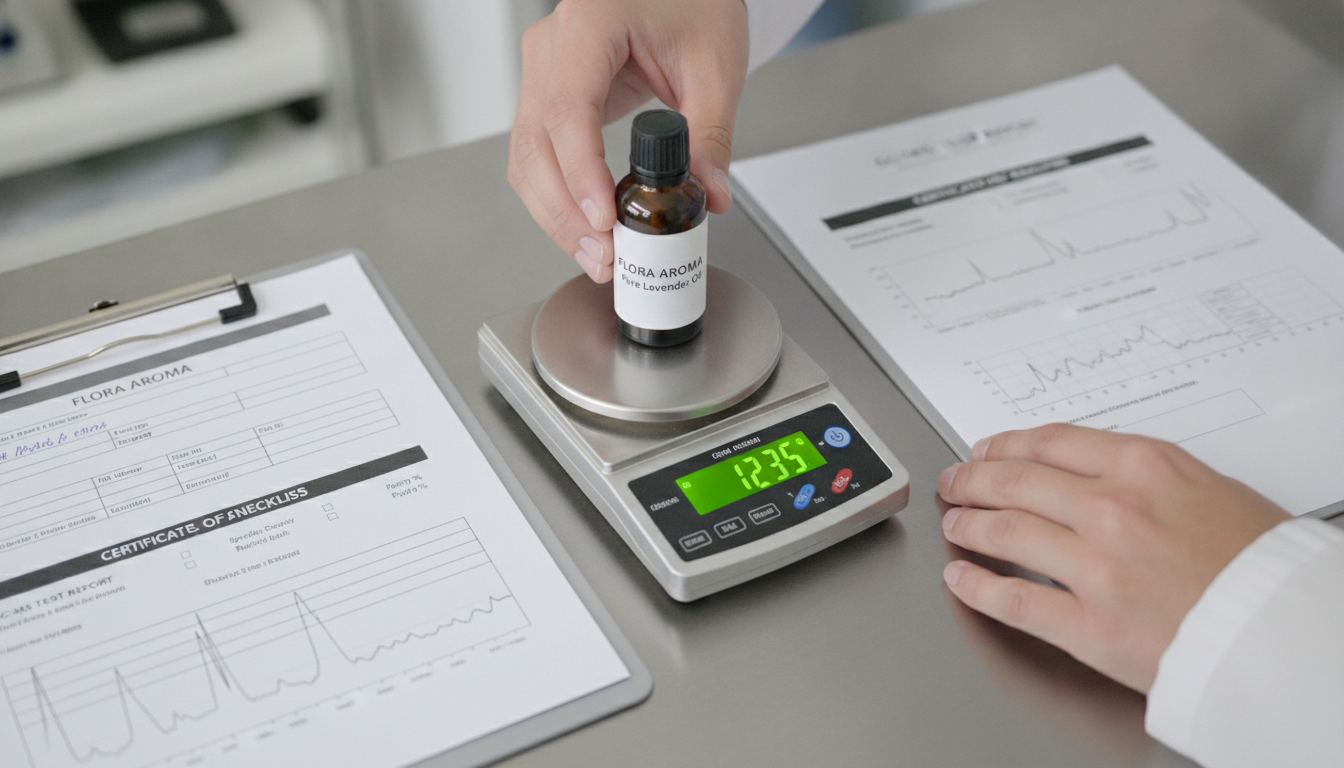
Manufacturers maintain inventory of popular single oils and common blends (sleep support, respiratory relief, muscle recovery). You receive a Certificate of Analysis (COA) showing GC-MS results, specific gravity, refractive index, and optical rotation. Production starts immediately after sample approval, and MOQs are lower because the factory amortizes raw-material purchases across multiple clients.
Custom Blend Requirements
Custom formulas require you to specify each ingredient by botanical name and percentage, or to describe the intended use and let the manufacturer propose a blend. The factory then sources raw materials, mixes a lab batch, tests for stability (no separation, color shift, or scent degradation over 90 days at 40°C), and validates compatibility with your chosen packaging material (glass, PET, aluminum). This process generates a unique COA and batch record that you own, preventing the supplier from selling the same formula to competitors.
Supplier Verification Steps
A trusted China sourcing agent checks the manufacturer’s business licence to confirm that cosmetics production or essential oil extraction appears in the registered business scope. Trading companies that buy finished oils from third-party distilleries lack direct access to production records or formula ownership. Request the factory’s GMP or ISO 22716 certificate, which proves that the facility follows Good Manufacturing Practices for cosmetics, including clean-room standards, batch documentation, and contamination controls.
Sample Evaluation Protocol
Order 3-5 samples of the same formula from different batches to check consistency. Smell each sample at room temperature and after heating to 50°C for 10 minutes; rancid or chemical odors indicate oxidation or synthetic adulteration. Perform a simple water-dispersion test: add one drop to 10 ml of water and stir; pure essential oils remain as floating droplets, while oils cut with vegetable carriers form cloudy emulsions. Send one sample to an independent lab for GC-MS analysis to confirm the botanical source and detect synthetic extenders.
What MOQ and Pricing Should You Expect?
Minimum order quantities and unit prices depend on whether you order bulk oil for bottling in your home country or finished retail units with your private label. Bulk orders have lower MOQs measured in kilograms, while finished-unit orders have higher MOQs measured in pieces because the factory must set up bottling lines, print labels, and assemble secondary packaging.
Bulk Oil Pricing Factors
Lavender oil typically costs USD 40-70 per kilogram, eucalyptus USD 25-40, and tea tree USD 30-55, depending on origin (Chinese-grown vs. imported Australian or French raw material) and extraction method (steam distillation vs. solvent extraction). Organic certification adds 30-50% to the base price, and ECOCERT or USDA Organic labels require annual audits of the entire supply chain from farm to bottling facility.
Finished-Unit Cost Components
A private-label 10 ml glass bottle with dropper cap, printed label, and folding carton includes the essential oil itself (20-40% of total cost), the glass bottle and closure (15-25%), the printed label and carton (10-15%), labor for filling and assembly (8-12%), and factory overhead including quality control and batch documentation (15-20%). Tooling costs for custom bottle molds or label dies are amortized across the first production run, adding USD 0.10-0.30 per unit for orders below 5,000 pieces.
Negotiating MOQ Reductions
Factories lower MOQs when you accept stock packaging (standard amber glass bottles, generic white boxes) instead of custom shapes or colors. Ordering multiple SKUs in a single production run also reduces per-SKU minimums because the factory sets up bottling equipment once and switches only the oil and label between batches. Our supplier management team negotiates combined-order MOQs for buyers launching product lines with 3-6 scents.
How Do You Customize Packaging and Labels?
Packaging customization for the china essential oil manufacturer private label process involves selecting bottle material and shape, designing labels that comply with your target market’s cosmetics regulations, and choosing secondary packaging (folding cartons, shrink sleeves, display boxes). Each decision affects unit cost, lead time, and regulatory approval in Mexico, Brazil, Argentina, Chile, Colombia, or the European Union.
Bottle Material and Closure Options
- Amber glass: Blocks UV light to prevent oxidation, preferred for citrus and conifer oils that degrade quickly; adds USD 0.15-0.30 per unit vs. clear glass.
- Cobalt blue glass: Premium aesthetic for retail shelves, same UV protection as amber; adds USD 0.20-0.35 per unit.
- PET plastic: Shatterproof and lightweight, reducing shipping costs by 20-30%; some oils (d-limonene in citrus, menthol in peppermint) leach plasticizers from PET over 12-18 months, shortening shelf life.
- Aluminum bottles: Complete light barrier and chemical inertness; adds USD 0.40-0.60 per unit but extends shelf life to 3-5 years.
- Dropper caps vs. orifice reducers: Euro-dropper caps with rubber bulbs cost USD 0.08-0.12 each; orifice reducers (plastic inserts that control flow) cost USD 0.02-0.04 and are preferred for viscous oils.
Label Design and Regulatory Text
Labels must display the INCI (International Nomenclature of Cosmetic Ingredients) name of each oil, the net volume in milliliters, the manufacturer’s name and address, batch number, production date or best-before date, and any required warnings (keep out of reach of children, for external use only, avoid contact with eyes). Mexico requires all text in Spanish, Brazil requires Portuguese, and the EU requires text in the language of the country where the product is sold. Argentina mandates IRAM certification marks for cosmetics, and Chile requires registration with the Instituto de Salud Pública before importation.
Artwork and Printing Setup
Provide label artwork as vector files (AI, EPS, or PDF with embedded fonts) at 300 dpi resolution. The factory produces a digital proof within 3-5 days, followed by a physical printed sample on the actual label stock (paper, vinyl, or metallized film). Approve the sample before the factory orders the full label run; changes after printing incur reprinting fees of USD 150-300 per SKU. Our customized service team coordinates artwork revisions with the factory’s graphic department to ensure color accuracy and text legibility at 10 ml bottle scale.
Secondary Packaging Choices
Folding cartons protect bottles during shipping and provide additional branding space. Standard white cardboard costs USD 0.08-0.15 per carton, while coated art paper with full-color printing costs USD 0.20-0.35. Shrink sleeves wrap around the bottle and carton together, creating tamper-evidence; they add USD 0.05-0.10 per unit. Display boxes holding 6-12 units are common for wholesale buyers and cost USD 0.80-1.50 each, depending on corrugated thickness and printing complexity.
What Compliance Testing Is Required for Your Market?
Compliance testing confirms that your private-label essential oils meet safety, purity, and labeling standards in the destination country. Testing requirements differ between cosmetic use (applied to skin), aromatherapy use (inhaled or diffused), and therapeutic use (claiming health benefits). Skipping required tests delays customs clearance and risks product seizure or fines.
European Union Cosmetics Regulation
The EU Cosmetics Regulation 1223/2009 requires a Safety Assessment conducted by a qualified safety assessor, a Product Information File (PIF) containing formula, manufacturing method, stability data, and toxicological evaluation, and a Cosmetic Product Safety Report (CPSR). Essential oils must comply with Annex II (prohibited substances), Annex III (restricted substances with concentration limits), and Annex VI (labeling requirements). Allergens listed in Annex III (linalool, limonene, citral, geraniol, eugenol) must be declared on the label if present above 0.001% in leave-on products or 0.01% in rinse-off products.
Testing for EU Compliance
- GC-MS analysis: Identifies and quantifies all volatile compounds, confirming botanical source and detecting synthetic adulterants; costs USD 150-300 per sample.
- Heavy-metal screening: Tests for lead, arsenic, cadmium, and mercury; limits are 10 ppm lead, 3 ppm arsenic, 5 ppm cadmium, 1 ppm mercury; costs USD 80-150 per sample.
- Microbial limits: Total aerobic count <100 CFU/g, yeast and mold <10 CFU/g, absence of Pseudomonas aeruginosa, Staphylococcus aureus, Candida albicans; costs USD 120-200 per sample.
- Allergen quantification: Measures the 26 allergens listed in EU Annex III; costs USD 200-350 per sample.
- Stability testing: Stores samples at 40°C for 90 days and measures color, odor, pH, and microbial growth; costs USD 300-500 per formula.
Mexico COFEPRIS Requirements
Mexico’s Federal Commission for Protection against Sanitary Risks (COFEPRIS) classifies essential oils as cosmetics if labeled for topical use or as sanitary supplies if claiming therapeutic effects. Cosmetics require notification through the COFEPRIS online portal, including formula disclosure, manufacturing-site registration, and a responsible person in Mexico. Therapeutic claims trigger full drug registration, which takes 6-12 months and costs USD 5,000-15,000 in legal and testing fees. All labels must be in Spanish, and the net content must be stated in metric units.
Brazil ANVISA Registration
Brazil’s National Health Surveillance Agency (ANVISA) requires cosmetics to be registered or notified depending on risk classification. Essential oils for aromatherapy (Grade 1, low risk) require notification with formula, manufacturing data, and safety information. Oils for topical application (Grade 2, higher risk) require full registration with toxicological data, stability studies, and efficacy proof. A local representative (responsible legal entity) in Brazil must submit the application and maintain post-market surveillance records. Registration costs USD 2,000-8,000 and takes 4-8 months.
Argentina and Chile Import Permits
Argentina requires cosmetics to be registered with ANMAT (Administración Nacional de Medicamentos, Alimentos y Tecnología Médica) before importation. The process includes submitting the formula, manufacturing certificate, and a certificate of free sale from the country of origin. Chile requires registration with the Instituto de Salud Pública (ISP) and a sanitary authorization number printed on the label. Both countries require Spanish labeling and a local importer of record with tax registration.
How Do You Manage Production and Quality Control?
Production management for the china essential oil manufacturer private label process includes pre-production sample approval, during-production inspection, and pre-shipment final inspection. Each stage catches defects before they multiply across the full order, reducing the risk of receiving off-spec product that cannot be sold in your market.
Pre-Production Sample Approval
The factory produces a golden sample using the exact raw materials, packaging components, and labels planned for bulk production. The sample is photographed from multiple angles, weighed to confirm net fill volume, and tested for scent accuracy and label adhesion. You approve the golden sample in writing, and the factory retains it as the quality benchmark for the production run. Changes requested after approval restart the sampling cycle and delay production by 7-14 days.
During-Production Inspection
A quality control inspector visits the factory when 30-50% of the order is complete and checks raw-material COAs, bottling-line calibration, fill-weight accuracy (measured on 20 random units with a precision scale), label placement (centered within 2 mm), and carton assembly (no crushed corners or torn flaps). The inspector photographs the production floor, reviews batch records, and issues a report within 24 hours. Defects caught at this stage allow the factory to adjust equipment settings or replace defective components before completing the order.
Pre-Shipment Final Inspection
When 100% of the order is finished and packed, the inspector returns to verify carton counts, measure a statistical sample (AQL 2.5 standard: 80 units inspected for a 5,000-piece order), perform drop tests on 5 cartons from 1 meter height to check packaging durability, and confirm that batch numbers on bottles match the COAs and shipping documents. The inspector seals approved cartons with numbered security tape and issues a pass/fail certificate. Failed inspections trigger rework or replacement at the factory’s cost, delaying shipment by 10-20 days.
Batch Traceability and Documentation
Each production batch receives a unique lot number printed on the bottle label and carton. The factory maintains a batch record listing the raw-material lot numbers, production date, fill weight, inspector name, and test results. You receive copies of the batch record, raw-material COAs, and finished-product test reports with each shipment. Documentation is required for customs clearance in the EU and for ANVISA or COFEPRIS post-market audits in Brazil and Mexico.
What Are the Import Requirements for Latin America and Europe?
Importing private-label essential oils from China into Latin America or Europe requires understanding HS classification, calculating landed costs including duties and VAT, appointing an importer of record, and preparing customs documentation. Each destination country applies different tariff rates, regulatory approvals, and labeling languages.
HS Classification and Tariff Rates
Essential oils are classified under HS code 3301, with subcategories for specific oils (3301.12 for orange oil, 3301.13 for lemon oil, 3301.19 for other citrus, 3301.24 for peppermint, 3301.25 for other mints, 3301.29 for other oils). Tariff rates vary: the EU applies 0-6.5% depending on the oil type and origin, Mexico applies 0-15% under MFN (Most Favored Nation) rates, Brazil applies 10-18%, Argentina 0-16%, and Chile 6%.
Landed-Cost Modeling
Landed cost includes the FOB (Free On Board) factory price, international freight (ocean or air), marine insurance (0.3-0.5% of cargo value), customs brokerage fees (USD 150-400 per shipment), import duties (calculated on CIF value: Cost + Insurance + Freight), VAT or IVA (applied after duties), and destination handling charges (port fees, terminal handling, delivery to warehouse). A USD 10,000 FOB shipment to Mexico with 10% duty and 16% IVA, plus USD 800 freight and USD 200 brokerage, results in a landed cost of approximately USD 13,150, a 31.5% increase over the factory price.
Importer of Record Responsibilities
The importer of record is the legal entity responsible for customs compliance, duty payment, and post-import regulatory obligations. In Mexico, the importer must hold an RFC (tax ID) and be registered with the SAT (tax authority). In Brazil, the importer needs a CNPJ (corporate tax ID) and a RADAR (import/export authorization) from Receita Federal. In the EU, the importer must appoint a Responsible Person under the Cosmetics Regulation and maintain the Product Information File at an EU address. Our freight and shipping service coordinates with customs brokers in each destination to ensure correct classification and documentation.
Customs Documentation Checklist
- Commercial invoice: Lists the buyer, seller, product description, HS code, unit price, total value, and Incoterms (FOB, CIF, or DDP).
- Packing list: Details carton count, gross weight, net weight, and dimensions for each SKU.
- Bill of lading (ocean) or air waybill: Proves ownership and allows cargo release at destination.
- Certificate of origin: States the country where the goods were manufactured; required for preferential tariff treatment under trade agreements.
- Certificate of Analysis (COA): Confirms product purity and compliance with safety standards; required by EU and Brazilian customs.
- MSDS (Material Safety Data Sheet): Describes hazards, handling, and emergency procedures; required for flammable essential oils (flash point below 60°C).
- Sanitary certificate or free-sale certificate: Issued by Chinese authorities or a third-party lab, confirming the product meets destination-country health standards; required by ANVISA, COFEPRIS, and ISP.
Incoterms and Payment Protection
Incoterms define who pays for freight, insurance, and customs duties. FOB (Free On Board) means the buyer arranges and pays for ocean freight and insurance; the factory delivers goods to the Chinese port. CIF (Cost, Insurance, Freight) means the factory arranges ocean freight and insurance to the destination port; the buyer pays import duties and handles customs clearance. DDP (Delivered Duty Paid) means the factory pays all costs including import duties and delivers to the buyer’s warehouse; DDP is rare for the china essential oil manufacturer private label process because the factory cannot easily navigate foreign customs regulations. Payment terms range from 30% deposit + 70% before shipment (T/T wire transfer) to Letter of Credit (L/C) for larger orders, which protects both parties by releasing payment only when shipping documents are presented to the bank.
Key Takeaways
- Check that a manufacturer’s business licence lists cosmetics or essential oil production in its registered scope rather than general trading, because only direct manufacturers can provide the batch traceability and formula ownership required for regulatory compliance and quality control across 100% of production runs.
- Stock formulas in standard packaging start at 500-1,000 pieces with 30-45 day lead times, while custom blends require 1,000-3,000 pieces and 60-90 days; ordering 3-6 SKUs simultaneously reduces per-SKU minimums by 20-35% because the factory amortizes setup costs.
- EU cosmetics regulation mandates GC-MS analysis (USD 150-300 per sample), heavy-metal screening (USD 80-150), microbial limits testing (USD 120-200), and allergen quantification (USD 200-350) before the first shipment clears customs or reaches retail shelves.
- Amber or cobalt glass bottles block UV light and prevent oxidation, extending shelf life to 2-3 years for citrus and conifer oils, while PET plastic reduces shipping weight by 20-30% but shortens shelf life to 12-18 months due to plasticizer leaching from d-limonene and menthol.
- Import duties, VAT, freight, insurance, customs brokerage, and destination handling add 25-40% to the FOB factory price when landing essential oils in Mexico (10% duty + 16% IVA), Brazil (10-18% duty + 17-20% ICMS), or the EU (0-6.5% duty + 19-25% VAT).
- During-production inspections catch defects when 30-50% of the order is complete, allowing the factory to adjust bottling-line calibration, label placement, or carton assembly before producing the remaining 50-70% of units and avoiding full-batch rework delays of 10-20 days.
Frequently Asked Questions
How do you verify that a Chinese supplier actually manufactures essential oils instead of reselling them?
Request the supplier’s business licence and confirm that cosmetics production or essential oil extraction appears in the registered business scope. Visit the facility or hire a third-party auditor to photograph distillation equipment, raw-material storage tanks, and bottling lines. Ask for batch records from recent production runs, which list raw-material lot numbers, distillation dates, and yield percentages. Trading companies cannot provide these documents because they purchase finished oils from third-party distilleries without access to production records.
What is the difference between FOB and DDP pricing for essential oil shipments?
FOB (Free On Board) pricing covers the product cost and delivery to the Chinese port; buyers arrange and pay for ocean freight, marine insurance, customs clearance, import duties, and delivery to the final warehouse. DDP (Delivered Duty Paid) pricing includes all costs through to the buyer’s warehouse, with suppliers handling freight, insurance, customs, and duties. DDP remains uncommon for essential oils because Chinese manufacturers lack expertise in navigating foreign customs regulations and calculating destination-country VAT. Most transactions use FOB or CIF (Cost, Insurance, Freight), where suppliers arrange ocean freight and insurance but buyers handle customs and duties.
Can you import essential oils into Mexico without COFEPRIS registration?
Essential oils labeled for cosmetic use (topical application, massage, skincare) require COFEPRIS notification before importation, involving submission of the formula, manufacturing-site data, and a responsible person in Mexico through the online portal. Oils labeled solely for aromatherapy (diffusion, inhalation, room fragrance) without therapeutic claims may clear customs as general merchandise under HS 3301, but Mexican customs officers exercise discretion to request COFEPRIS documentation when labels suggest health benefits. Importing without proper classification risks cargo detention, fines, or product destruction at the port of entry.
Written by the Goodcantrading Sourcing Team.
Ready to launch your private-label essential oil line with verified Chinese manufacturers and full compliance support?
Request a Supplier Audit and Quote →