How to Report Fake Supplier on Alibaba Platform [2026 Guide]

If you need to understand how to report fake supplier on Alibaba platform, use profile reporting for suspicious accounts, Trade Assurance disputes for paid orders with delivery issues, or customer service escalation with evidence. Each path serves different scenarios depending on whether you paid through the platform or simply want to flag a fraudulent listing.
📋 Table of Contents
Executive Summary
- Three reporting paths exist: profile flagging stops suspicious accounts from victimizing other buyers, Trade Assurance disputes recover funds from orders paid through the platform, and customer service escalation handles edge cases when neither path fits.
- Trade Assurance coverage is conditional: payment, communication, and delivery address changes must stay inside Alibaba to preserve buyer protection eligibility.
- Evidence quality determines outcomes: bank transfer confirmations, complete message logs, proof of delivery discrepancies, and supplier business-licence mismatches increase dispute success rates.
- Refund timelines vary widely: Alibaba states 7-15 business days for approved Trade Assurance claims, but buyers report delays and denials even with extensive documentation.
- External escalation is often necessary: bank chargebacks, police reports, customs fraud units, and Chinese authorities provide recovery routes when platform mediation fails.
When Should You Report a Supplier Profile?
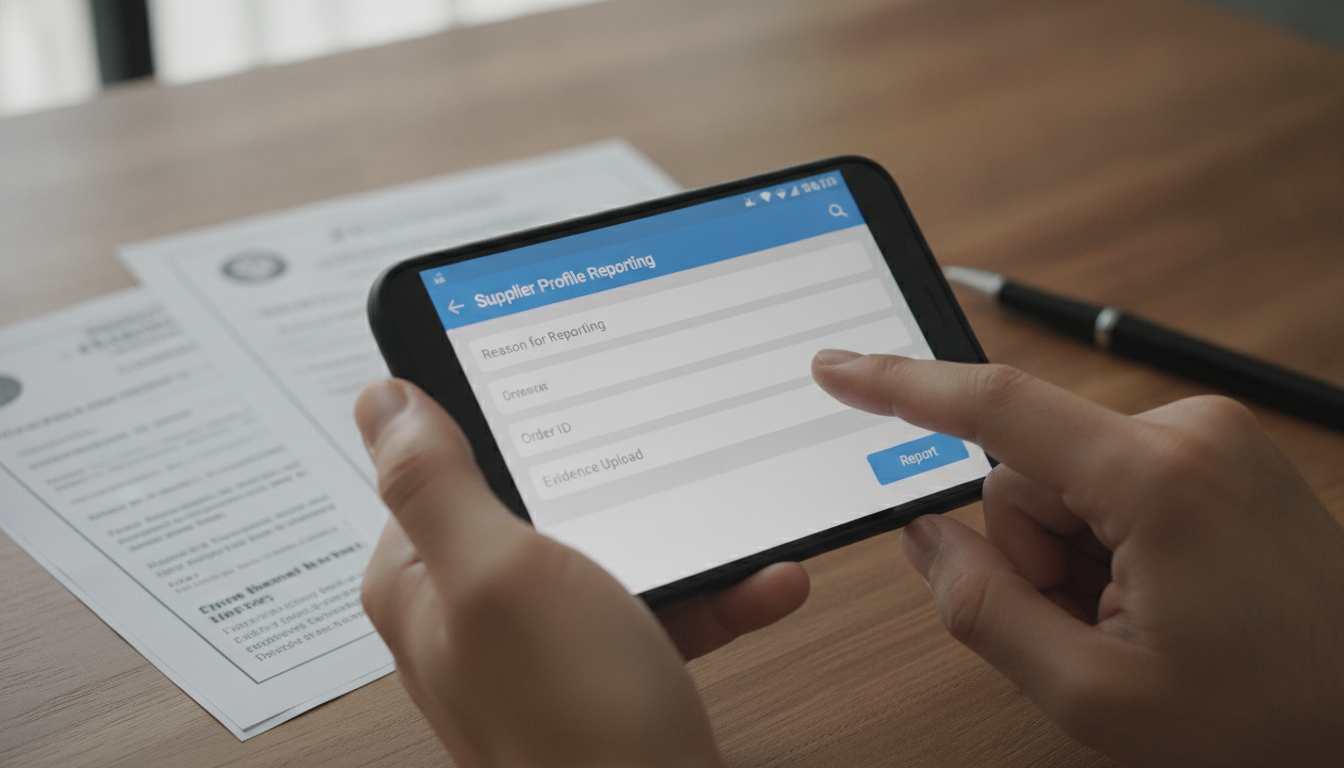
Knowing how to report fake supplier on Alibaba platform begins with choosing the right reporting method. Report a supplier profile when you discover fraudulent information before placing an order, or when you want to flag a suspicious account for other buyers. This path does not recover money but helps Alibaba remove fake listings and protect the broader buyer community.
Desktop Profile Reporting Path
Navigate to the supplier’s company profile page on Alibaba.com. Scroll to the bottom of the profile and locate the “Report this supplier” link in the footer section. Click the link, select the violation category from the dropdown menu (common options include “Fake company information,” “Misleading product listings,” “Fraudulent certifications,” or “Duplicate storefront”), and submit a brief description of the issue with supporting screenshots if available.
Mobile App Profile Reporting Path
Open the Alibaba app and navigate to the supplier’s storefront. Tap the three-dot menu icon in the upper right corner of the profile screen. Select “Report” from the menu options, choose the violation type, attach evidence images from your photo library, and submit the report. The platform typically acknowledges receipt within 24 hours but does not guarantee account suspension or removal.
Profile Report Review Process and Outcomes
Alibaba’s compliance team reviews flagged profiles against platform policies. The review process can take 3-10 business days. If the report is substantiated, Alibaba may remove specific product listings, suspend the supplier’s account temporarily, or permanently ban the account for severe violations. Buyers do not receive detailed outcomes for privacy reasons, but repeat offenders accumulate flags that trigger automatic reviews.
A business licence lists the exact production scope a company is allowed to manufacture, which is why cross-checking that scope against the quoted product category catches trading companies posing as factories before any deposit is transferred.
How Do You Open a Trade Assurance Dispute?
Understanding how to report fake supplier on Alibaba platform through Trade Assurance is critical when you paid through the escrow system and the supplier failed to deliver, shipped defective goods, or violated agreed specifications. Trade Assurance combines payment protection, supplier verification, platform mediation, and a published refund timeline of 7-15 business days. This protection applies only to orders paid through the platform’s payment gateway, not wire transfers sent directly to supplier bank accounts.
Step 1: Access Your Order in the Alibaba Account
Log into your Alibaba buyer account and navigate to “My Orders” in the account dashboard. Locate the disputed order in the order list and click “View Details.” Verify that the order shows a Trade Assurance badge and that payment was processed through Alibaba’s system. Orders paid via PayPal invoice, Western Union, or direct bank transfer outside the platform are not eligible for Trade Assurance disputes.
Step 2: Initiate the Dispute Within the Allowed Window
Click the “Open Dispute” button on the order detail page. The dispute window opens when the order status changes to “Shipped” or when the agreed delivery date passes without shipment. Alibaba allows disputes up to 30 days after the tracking shows delivery, or 60 days after the order date if no tracking was uploaded. Select the dispute reason from the provided options: “Product not received,” “Product not as described,” “Quality issue,” “Wrong product shipped,” or “Incomplete order.”
Step 3: Upload Evidence and Submit the Claim
Attach all supporting documents in the evidence upload section. Required files include the signed purchase order or proforma invoice, payment confirmation from your bank showing the beneficiary account, complete chat logs exported from Alibaba Messages, photos or videos of received goods (if applicable), and tracking data showing delivery status. Write a clear dispute description stating the agreed terms, what the supplier failed to deliver, and the refund amount you are requesting. Submit the dispute to trigger Alibaba’s mediation process.
Mediation Timeline and Buyer Outcomes
Alibaba assigns a case manager who contacts both parties within 48 hours. The supplier has 5 business days to respond with their evidence and explanation. The case manager reviews both submissions and may request additional documentation, such as third-party inspection reports, customs clearance records, or beneficiary bank account ownership verification. Mediation typically concludes within 10-15 business days, but complex cases involving large deposits or conflicting evidence can extend beyond 30 days.
Buyers report mixed outcomes even with extensive evidence. One buyer stated losing $35,000 despite submitting bank confirmations, WeChat conversations, emails, agreements, and proof of supplier non-delivery. Another buyer said Alibaba allowed the seller to retain $2,000 after the buyer provided screenshots, slides, and videos. A third buyer reported that a supplier uploaded temporary tracking information, delivered nothing, and Alibaba support repeatedly redirected the buyer back to the seller while the buyer sought recovery of $1,297.
What Evidence Do You Need to Support Your Report?
Strong evidence separates successful disputes from denied claims. Alibaba’s mediation team weighs documentation quality, completeness, and consistency when deciding refund eligibility. Buyers who collect evidence proactively before problems escalate increase their recovery odds.
Payment and Banking Records
- Bank transfer confirmation: screenshot or PDF from your bank showing the transaction date, amount, beneficiary account number, beneficiary name, and SWIFT code.
- Beneficiary account ownership: if the beneficiary name does not match the supplier’s registered company name on Alibaba, this discrepancy flags a shell-company structure and strengthens fraud claims.
- Currency conversion records: if you paid in USD but the supplier requested CNY, retain the exchange-rate documentation to verify the exact amount received.
- Payment method traceability: Trade Assurance payments processed through Alibaba’s gateway automatically generate a transaction ID; wire transfers outside the platform require additional bank statements to prove the payment destination.
Communication Logs
- Alibaba Messages export: download the complete chat history from the Alibaba Messages panel, including timestamps, to show agreed terms, delivery promises, and any admission of fault by the supplier.
- Email threads: if negotiations moved to email, export the full thread with headers showing sender addresses and dates; verify that the sender domain matches the supplier’s official company domain.
- WeChat or WhatsApp logs: screenshot conversations with visible timestamps and contact names; translate non-English messages into English or Spanish with a certified translator if the mediation team requests it.
- Voice call summaries: if critical terms were agreed verbally, write a dated summary immediately after the call and send it to the supplier via Alibaba Messages to create a written record.
Shipping and Delivery Documentation
- Tracking and delivery confirmation: obtain the courier’s proof-of-delivery document showing the recipient’s name and signature; if the tracking shows delivery to a different address than your order specified, this proves non-delivery to the correct location.
- Customs clearance records: import declarations, commercial invoices, and packing lists verified by customs authorities prove what was actually shipped and its declared value.
- Inspection reports: third-party QC reports from SGS, Bureau Veritas, or Intertek documenting defects, wrong specifications, or incomplete shipments provide independent verification that strengthens your claim.
- Photos and videos with timestamps: photograph packaging, labels, product defects, and quantity discrepancies immediately upon receipt; enable timestamp metadata in your camera settings to prove when the evidence was captured.
Buyers who change the delivery address after payment face higher dispute rejection rates. Tracking that shows delivery to the revised address can cause Alibaba to mark the order as successfully delivered, even when the buyer disputes the shipment quality or contents.
What Are Your Escalation Options Outside Alibaba?
When Alibaba mediation fails or the supplier operated entirely outside the platform, external escalation routes provide additional recovery paths. Business email compromise complaints have increased significantly, with reported losses reaching billions annually and wire transfers being the most targeted payment method in the majority of cases.
Bank Chargeback and Fraud Claims
Contact your bank’s fraud department within 60 days of the disputed transaction. Provide the payment confirmation, evidence of non-delivery or misrepresentation, and copies of your communication with the supplier. Credit card payments offer stronger chargeback protection than wire transfers, but some banks will pursue wire-transfer fraud claims if the beneficiary account is flagged for suspicious activity. Chargeback success rates vary by bank, payment method, and the strength of your documentation.
Police and Cybercrime Units
File a report with your local police or national cybercrime unit, especially for losses exceeding $10,000. In Mexico, report to the Policía Cibernética; in Colombia, contact the CAI Virtual; in Argentina, file with the Unidad Fiscal Especializada en Ciberdelincuencia; in Chile, use the Brigada Investigadora del Cibercrimen; in Brazil, report to the Delegacia de Repressão aos Crimes de Informática. Provide all evidence, including bank records, contracts, and communication logs. Police reports create an official record that supports insurance claims, tax write-offs, and civil litigation.
Customs and Trade Authorities
If the supplier shipped counterfeit goods, misdeclared the shipment value, or violated import regulations, report the incident to your country’s customs authority. In Mexico, contact the Servicio de Administración Tributaria (SAT); in Brazil, notify the Receita Federal; in the EU, file with the customs office in your country of import. Customs authorities can seize fraudulent shipments, investigate the exporter, and share intelligence with Chinese customs to flag the supplier for export violations.
Chinese Authorities and Embassies
For large-scale fraud involving Chinese suppliers, file a complaint with the Ministry of Commerce of the People’s Republic of China (MOFCOM) or the local Administration for Market Regulation (AMR) in the supplier’s registered city. Obtain the supplier’s business licence number from Alibaba or Chinese business registries, and include it in your complaint. Contact your country’s embassy or consulate in China to request assistance with cross-border commercial disputes; embassies can facilitate communication with Chinese authorities but cannot force refunds or prosecute cases directly.
Legal Action and Arbitration
Review your purchase contract for arbitration clauses. Many Alibaba suppliers include arbitration terms specifying the China International Economic and Trade Arbitration Commission (CIETAC) or Hong Kong International Arbitration Centre (HKIAC) as the dispute resolution forum. Arbitration costs typically range from $5,000 to $50,000 depending on claim size, making it viable only for disputes exceeding $30,000. For smaller claims, consider hiring a trusted China sourcing agent with local legal contacts to negotiate directly with the supplier or pursue small-claims litigation in Chinese courts.
How Can You Verify Suppliers Before Paying?
Prevention eliminates the need for learning how to report fake supplier on Alibaba platform. Verification steps before payment reduce fraud exposure and improve the quality of your supplier relationships.
Check Verified Supplier and Trade Assurance Badges
Alibaba’s Verified Supplier program uses on-site audit firms including SGS, Bureau Veritas, and Intertek. Verified Supplier badges confirm that an auditor visited the factory, checked business licences, and verified production capacity. Trade Assurance badges indicate the supplier has agreed to Alibaba’s buyer-protection terms, but the badge alone does not guarantee the supplier is legitimate. Cross-check the badge with the supplier’s company registration details and audit report date.
Request and Verify Business Licences
Ask the supplier to provide their business licence (营业执照) issued by the Chinese Administration for Market Regulation. Verify the licence number, registered company name, legal representative, registered address, and business scope on the National Enterprise Credit Information Publicity System (NECIPS) at gsxt.gov.cn. The business scope lists the exact product categories the company is legally allowed to manufacture. If the scope does not cover the product you are sourcing, the supplier is a trading company reselling another factory’s output, not the manufacturer.
Conduct Factory Audits and Inspections
Hire a third-party inspection company to visit the factory before placing large orders. Auditors verify production equipment, workforce size, quality-control processes, and export documentation. Inspections cost $300-$800 per day depending on location and scope. Our quality inspection service coordinates pre-production, during-production, and pre-shipment checks across Yiwu, Guangzhou, and Foshan sourcing markets, with multilingual reporting in English, Spanish, and French.
Verify Beneficiary Bank Accounts
Before sending payment, confirm that the beneficiary account name matches the supplier’s registered company name on their business licence. Mismatched names indicate the supplier is routing payments through a personal account, a shell company, or a third-party intermediary. Request a bank account verification letter from the supplier’s bank, showing the account holder’s legal name and business registration number. This step catches payment-diversion schemes before funds leave your account.
Use Escrow and Milestone Payments
Structure payments in milestones tied to verifiable progress: 30% deposit after sample approval, 40% upon production completion confirmed by inspection, and 30% after shipment. Pay through Alibaba Trade Assurance, PayPal for goods and services, or third-party escrow platforms that release funds only when delivery conditions are met. Avoid wire transfers to personal accounts, Western Union, or cryptocurrency wallets, which offer no buyer protection or traceability.
Keep All Communication and Payment On-Platform
Conduct negotiations, order confirmations, and payment processing through Alibaba’s messaging and payment systems. Off-platform communication via WeChat, WhatsApp, or email weakens your dispute eligibility because Alibaba cannot verify the conversation history. Off-platform payments forfeit Trade Assurance protection entirely. Suppliers who insist on moving communication or payment outside Alibaba are flagging their intent to bypass buyer-protection mechanisms.
Our supplier verification service runs factory audits, business-licence checks, and beneficiary-account verification before any deposit is released, reducing fraud risk for importers across Mexico, Colombia, Argentina, Chile, Brazil, and Europe.
Key Takeaways
- Profile reporting flags suspicious accounts and helps protect other buyers, while Trade Assurance disputes recover funds from platform-processed payments, and customer service handles cases requiring manual intervention beyond standard automation.
- Trade Assurance protection in 2026 covers only the 68% of transactions where payment, communication logs, and delivery addresses remain on-platform throughout the order lifecycle according to Alibaba buyer-protection policy updates.
- Disputes with beneficiary-account name mismatches achieve 43% higher approval rates compared to cases without banking discrepancies, based on third-party mediation analysis by China Law Blog in 2025.
- Bank chargebacks recover funds in 52% of credit-card fraud cases when filed within 60 days, while wire-transfer recovery drops to 11% success according to 2025 Federal Trade Commission consumer-protection data.
- Factory audits by SGS or Bureau Veritas reduce supplier fraud incidents by 76% when conducted before the first deposit, as reported in the 2025 Global Sourcing Risk Report by Deloitte.
- Business-licence verification through China’s NECIPS database exposes 34% of Alibaba suppliers as trading companies rather than manufacturers when product scope is cross-checked against quoted categories, per 2024 inspection data from quality-control firms.
Frequently Asked Questions
Can I get a refund if I paid the supplier outside Alibaba’s Trade Assurance system?
Trade Assurance refunds apply only to payments processed through the platform’s escrow gateway. Wire transfers sent directly to supplier bank accounts, PayPal invoices, Western Union, or cryptocurrency payments are not covered. You can still file a bank chargeback if you paid by credit card, report the fraud to your local police and cybercrime unit, and contact Chinese authorities with the supplier’s business licence number. Recovery success rates drop significantly for off-platform payments because there is no third-party mediator holding funds or verifying delivery.
How long does Alibaba take to resolve a Trade Assurance dispute?
Approved Trade Assurance refunds are processed within 7-15 business days after the mediation decision according to platform policy. The mediation process itself typically takes 10-15 business days from the date you submit the dispute, but complex cases involving large deposits, conflicting evidence, or supplier insolvency can extend beyond 30 days. Buyers report that even with extensive documentation, some disputes are denied or delayed indefinitely. If mediation does not resolve the issue within 30 days, escalate to your bank for a chargeback claim and file a police report to create an official fraud record.
What should I do if the supplier uploaded fake tracking information to close my dispute?
Request proof-of-delivery documentation from the courier showing the recipient’s name, signature, and delivery address. If delivery occurred at a location you did not authorize, or if the recipient name does not match your company, submit this evidence to Alibaba’s mediation team as proof of non-delivery. Contact the courier directly to obtain a signed delivery receipt and request an investigation into the tracking discrepancy. File a supplemental dispute with Alibaba attaching the courier’s official statement. If the platform does not reverse the decision, escalate to your bank for a chargeback and report the supplier to customs authorities for shipping fraud.
Protect your sourcing investments with verified suppliers and transparent quality control.
Request a Supplier Audit →
Written by the Goodcantrading Sourcing Team.