Private Label Clothing Manufacturers China [2026 Guide]
![Private Label Clothing Manufacturers China [2026 Guide]](https://goodcantrading.com/wp-content/uploads/2026/10/featured-private-label-clothing-manufacturers-china.png)
To find private label clothing manufacturers China, start by defining your product specifications, garment type, fabric weight, color codes, and branding requirements, then search verified factory directories, request business licenses to confirm production scope, and audit samples against your tech pack before placing orders. Minimum order quantities typically range from 300 to 1,000 pieces per style, and lead times span 30 to 45 days after sample approval.
📋 Table of Contents
Executive Summary
- Factory vs. trading company: A supplier’s business license lists the exact production scope it is allowed to quote on, which separates a real factory from a reseller.
- MOQ reality: Typical minimums range from 300 to 1,000 pieces per style for private label apparel orders in China.
- Tech pack importance: Factories quote accurately only when you provide a complete technical package showing measurements, stitching, fabric GSM, and Pantone color codes.
- Sampling timeline: Expect 7 to 14 days for pre-production samples, with bulk orders starting after written approval.
- Branding services: Private label includes woven labels, hang tags, custom packaging, embroidery, screen printing, and heat-transfer logos, each with its own setup cost and MOQ.
What Does Private Label Mean for Clothing Manufacturing?
Private label means a factory produces garments to your specifications and applies your brand name, logo, and packaging, while you own the design and market the finished product. The manufacturer does not sell the same item under its own brand or to competing buyers. This model differs from OEM, where the factory owns the design and you simply place your logo, and from ODM, where the factory offers a catalog of existing styles you can customize.
Core Private Label Services
A complete private label partnership covers fabric sourcing, pattern grading, sample development, bulk production, quality inspection, and branding application. Factories handle woven labels, printed hang tags, poly-bag packaging, and carton marking. Some offer design consultation, but most expect you to supply a tech pack with all construction details.
Typical Customization Options
- Fabric selection: Cotton, polyester, blends, knits, wovens, denim, and performance fabrics with specified GSM weight and stretch percentage.
- Color matching: Pantone TPX or TCX codes ensure consistent dye lots across production runs.
- Branding methods: Embroidery for logos, screen printing for large graphics, heat transfer for detailed images, woven labels for care instructions, and hang tags for retail presentation.
- Fit grading: Size charts from XS to 3XL, with tolerance ranges for chest, waist, hip, and sleeve measurements.
- Packaging: Individual poly bags, tissue paper, branded boxes, and shipping cartons with your logo and SKU codes.
Why Buyers Choose Private Label
Brand ownership lets you control pricing, positioning, and customer experience without investing in your own production facility. You avoid the capital cost of machinery, labor management, and compliance overhead. Factories in Guangdong, Zhejiang, and Fujian provinces offer cut-and-sew expertise across activewear, casualwear, outerwear, and fashion categories, with production lines scaled to handle 10,000 to 500,000 pieces per month.
Where Can I Find Verified Private Label Clothing Factories in China?
Finding private label clothing manufacturers China starts with sourcing directories, trade shows, and agent networks that pre-screen suppliers for production capability and export compliance. According to SupplySpark (2026), 784 custom clothing manufacturers operate in China, with 656 offering OEM, 631 providing sampling, 549 capable of ODM, and 400 specializing in private-label services. The challenge is separating real factories from trading companies that lack in-house production.
Online Directories and Platforms
- Alibaba and Global Sources: Filter by Gold Supplier status, trade assurance, and on-site inspection reports, but verify every claim independently because listings are self-reported.
- Made-in-China.com: Focuses on manufacturers with export licenses and includes factory photos, but contact multiple suppliers to compare capabilities.
- SupplySpark and Thomasnet: Aggregate verified suppliers with capability tags, making it easier to shortlist factories that match your product category.
- LinkedIn and industry forums: Search for factory managers in Guangdong or Zhejiang, read buyer reviews, and ask for referrals from importers in your network.
Trade Shows and Sourcing Events
Canton Fair, held twice yearly in Guangzhou, brings together apparel manufacturers across 15 exhibition halls. Intertextile Shanghai and CHIC (China International Fashion Fair) focus specifically on textiles and garments. Walking the floor lets you inspect sample quality, discuss MOQ in person, and collect business cards from decision-makers rather than sales agents.
Sourcing Agents and Third-Party Verification
A trusted China sourcing agent maintains a network of pre-audited factories, runs factory visits on your behalf, and negotiates pricing in Mandarin. Our Yiwu and Guangzhou sourcing desks verify business licenses, production capacity, and export compliance before introducing any supplier, which eliminates the risk of paying deposits to shell companies. Agents also coordinate sampling, QC inspections, and shipping consolidation, reducing the operational burden on buyers who lack a permanent China office.
How Do You Verify a Factory Before Ordering?
Verification separates real manufacturers from trading companies and confirms that a supplier can deliver the quality, volume, and timeline you need. Buyers report frustration when suppliers quote private label apparel but become vague on sampling, fabrics, size tolerances, and production lead times after the first contact. A structured verification process prevents problems before deposits are paid.
Request and Review the Business License
Every Chinese company holds a business license issued by the State Administration for Market Regulation, listing the legal name, registered address, and business scope. The scope section states which products the company is allowed to manufacture and export. If the license lists “textile trading” but not “garment manufacturing,” the supplier is a trading company, not a factory. Request a scanned copy and cross-check the registration number on the National Enterprise Credit Information Publicity System.
Conduct a Factory Audit
An on-site audit confirms production capacity, machinery condition, worker count, and quality-control procedures. Walk the cutting room, sewing floor, finishing area, and warehouse. Count the number of sewing machines, check fabric storage conditions, and ask to see QC checklists from recent orders. Factories with ISO 9001 certification or BSCI social compliance audits demonstrate established management systems, though certification alone does not guarantee quality.
Verify Export and Compliance Records
- Customs registration: Confirm the supplier holds an import-export license and a customs code, both required to ship goods internationally.
- Previous export markets: Ask which countries the factory currently exports to and request reference contacts from buyers in your region.
- Compliance certifications: Depending on your destination market, verify OEKO-TEX Standard 100 for textile safety, GOTS for organic cotton, or bluesign for chemical management.
- Product testing: Request lab reports for colorfastness, tensile strength, pilling resistance, and formaldehyde content, tested to AATCC or ISO standards.
Sample Quality and Consistency
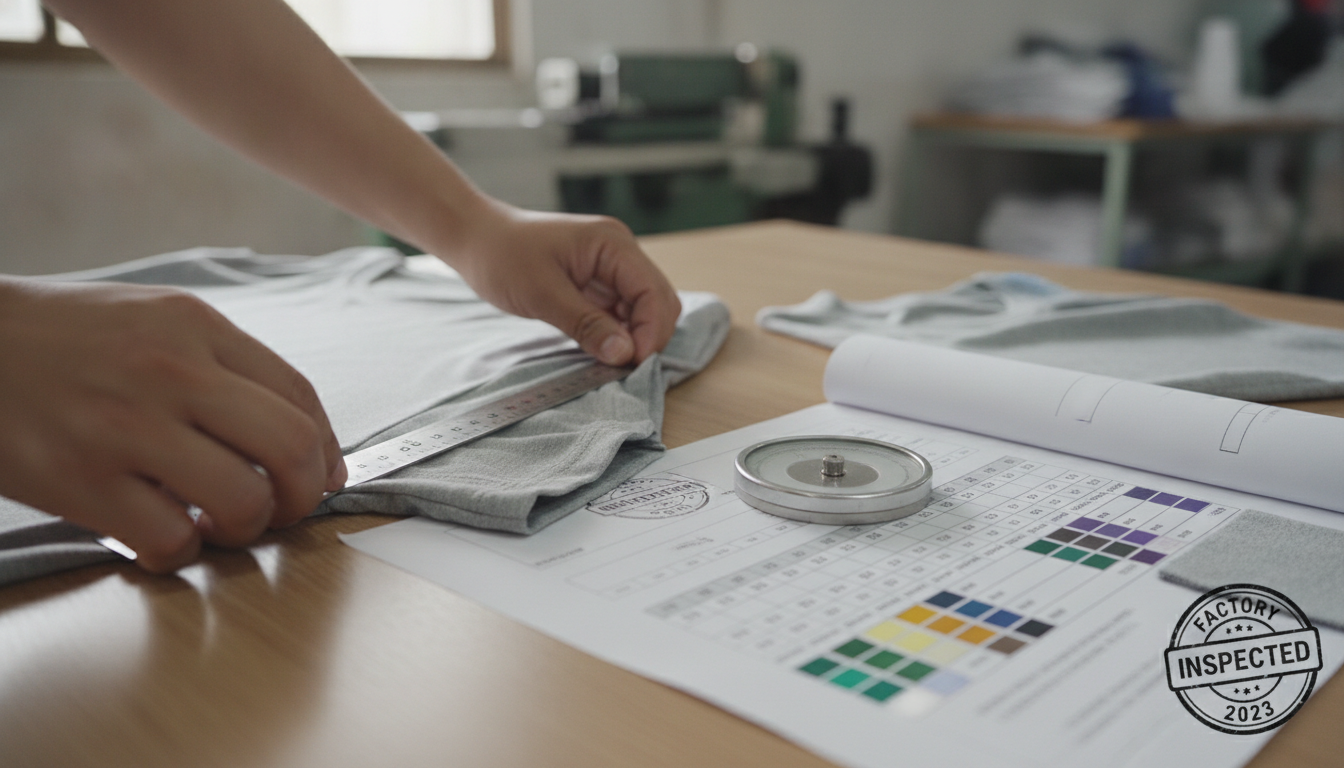
Order a pre-production sample before committing to bulk. The sample should match your tech pack in every detail: fabric weight, stitch density, seam allowance, button placement, and label positioning. Measure each dimension with a tape measure and compare against your size chart. If the sample passes, request a second sample from a different production batch to confirm consistency. Factories that rush samples or skip fit approvals often deliver bulk orders with visible defects.
What to Prepare Before First Contact
Suppliers among private label clothing manufacturers China quote accurately only when you provide complete specifications. Vague inquiries receive vague answers, and buyers waste weeks clarifying details that should have been stated upfront. Prepare a technical package, target pricing, and order timeline before reaching out.
Build a Detailed Tech Pack
A tech pack is a multi-page document showing every construction detail a factory needs to produce your garment. It includes front and back sketches, measurement charts for all sizes, fabric specifications, color codes, stitching instructions, label placement, and packaging requirements. Use Adobe Illustrator or a template from TechPacker or Techpack Ready. The more precise your tech pack, the fewer revisions you will need during sampling.
Define Your Target MOQ and Budget
Most private label clothing manufacturers China require 300 to 1,000 pieces per style, with higher minimums for complex construction or premium fabrics. A basic T-shirt may have a 500-piece MOQ per color, while a tailored jacket with multiple panels and linings may need more. Calculate your landed cost by adding factory price, shipping, duties, and warehousing, then compare against your retail price to ensure margin. Share your target unit price and order volume upfront so suppliers can confirm feasibility.
Establish a Realistic Timeline
- Sampling phase: 7 to 14 days for the first sample, plus 3 to 5 days for revisions.
- Bulk production: 30 to 45 days after sample approval, depending on order size and fabric lead time.
- Quality inspection: 1 to 2 days for AQL inspection before shipment.
- Shipping: 20 to 35 days by sea to Latin America or Europe, 5 to 7 days by air for urgent orders.
Prepare Your Branding Assets
Supply high-resolution logo files in vector format (AI, EPS, or SVG) for embroidery digitization and screen-printing film. Provide hang tag artwork with bleed margins, care-label text in the destination language, and packaging design mockups. Factories charge setup fees for each branding method: embroidery digitization runs $30 to $80 per design, screen-printing screens cost $20 to $50 per color, and custom woven labels require a 500 to 1,000 piece minimum per design.
Draft Your Inquiry Message
A professional inquiry includes product description, target MOQ, desired delivery date, and a request for factory photos and certifications. Attach your tech pack or reference images. State whether you need sampling, what branding services you require, and which payment terms you prefer. Suppliers respond faster to buyers who demonstrate preparation and seriousness.
Key Takeaways
- Business licenses list exact production scope. Verify the document to separate real factories from trading companies.
- Expect MOQs of 300 to 1,000 pieces per style. Complex garments or premium fabrics push minimums higher.
- Complete tech packs include measurements, stitching specs, fabric GSM, and Pantone codes. Without them, quotes remain vague.
- Sampling requires 7 to 14 days. Bulk production starts only after written approval of fit and color.
- Branding options cost extra. Embroidery digitization runs $30 to $80, screen screens $20 to $50 per color.
- Factory audits reveal capacity and QC procedures. Count sewing machines and inspect fabric storage before committing.
Frequently Asked Questions
What is the difference between private label and OEM clothing?
Private label means you own the design, provide the tech pack, and the factory produces garments exclusively for your brand, applying your logo and packaging. OEM means the factory owns the design and you simply place your brand name on an existing product. Private label offers full control over fit, fabric, and branding, while OEM is faster and requires lower minimums because the factory reuses proven patterns.
How do I verify a Chinese clothing factory is legitimate?
Request a scanned copy of the business license and cross-check the registration number on the National Enterprise Credit Information Publicity System. Conduct an on-site audit to count sewing machines, inspect fabric storage, and review QC checklists. Confirm the supplier holds an import-export license and customs code, and ask for reference contacts from buyers in your region. A supplier management service can run these checks on your behalf if you lack a China office.
What is the typical MOQ for private label apparel in China?
Minimum order quantities range from 300 to 1,000 pieces per style, depending on garment complexity and fabric type. Basic T-shirts and hoodies may accept 300 to 500 pieces per color, while tailored jackets, performance activewear, or garments with multiple panels often need more. Factories set MOQs based on fabric roll lengths, cutting efficiency, and production-line setup time, so negotiate based on your volume and timeline.
How long does it take to produce a private label clothing order?
Pre-production samples take 7 to 14 days, and bulk production begins only after written approval of fit, color, and construction. Expect 30 to 45 days for bulk orders, depending on size and fabric lead time. Add 1 to 2 days for AQL inspection before shipment, and 20 to 35 days for sea freight to Latin America or Europe. Air freight shortens shipping to 5 to 7 days but costs significantly more per kilogram.
What branding services do private label factories provide?
Factories apply woven labels for care instructions, printed hang tags for retail presentation, embroidery for logos, screen printing for large graphics, and heat transfer for detailed images. Custom packaging includes poly bags, tissue paper, branded boxes, and shipping cartons with your logo and SKU codes. Embroidery digitization runs $30 to $80 per design, screen-printing screens cost $20 to $50 per color, and custom woven labels need a 500 to 1,000 piece minimum per design.
Ready to connect with verified private label clothing manufacturers China and streamline your apparel sourcing?
Request a Factory Audit →
Written by the Goodcantrading Sourcing Team.