Construction Materials from China: Complete Spec Import Guide [2026]
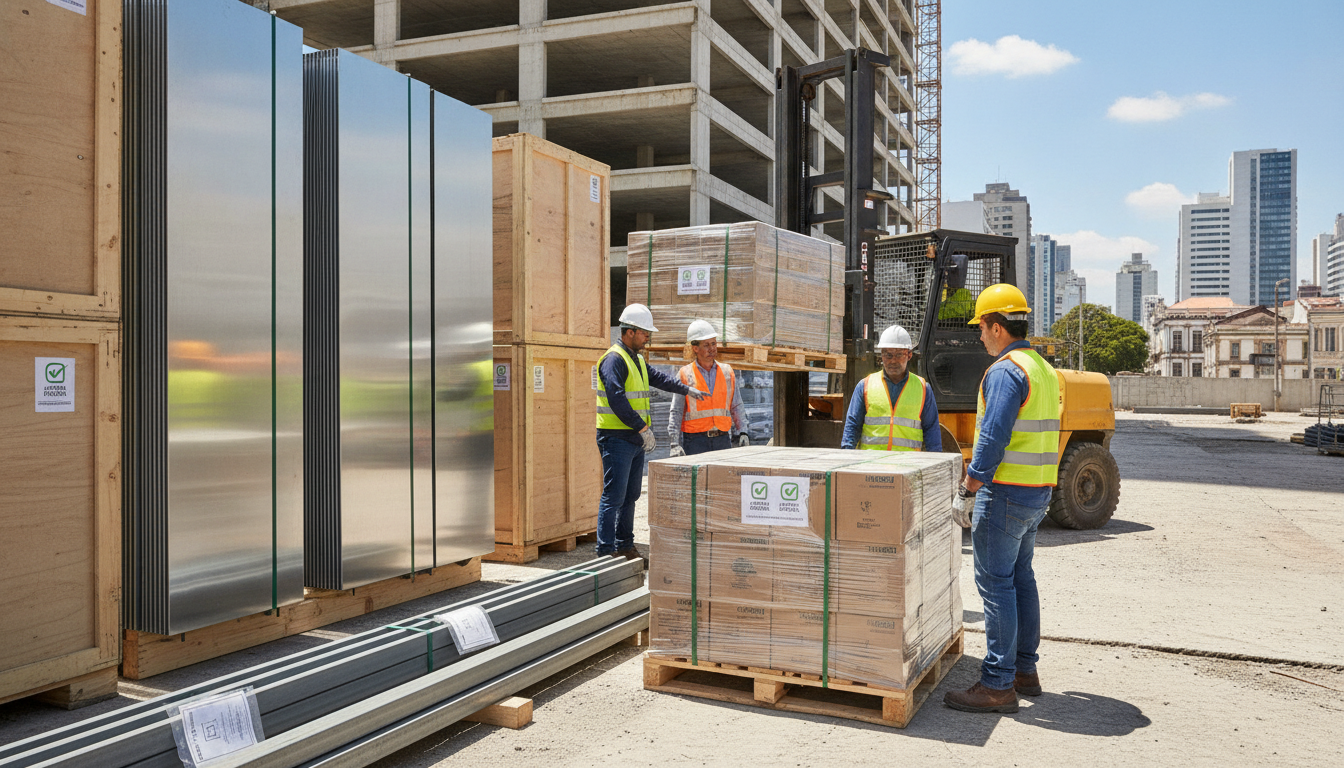
Importing construction materials from China to spec requires converting architectural drawings and performance requirements into supplier RFQs, verifying factory production scope against the bill of quantities, coordinating third-party testing for destination-country compliance, and running pre-shipment inspection against approved samples. The process differs fundamentally from consumer-goods sourcing because a single non-conforming batch can halt an entire construction schedule, and remediation costs often exceed the original order value.
📋 Table of Contents
- Executive Summary
- How do you translate architectural specs into supplier RFQs?
- How do you verify a factory’s production scope matches your materials?
- What compliance testing is required before shipment?
- How do you calculate the true landed cost?
- What does a construction-material pre-shipment inspection cover?
- How do you handle non-conforming or damaged materials?
- Key Takeaways
- Frequently Asked Questions
Executive Summary
- Architectural drawings, bills of quantities, and performance requirements must be converted into supplier-readable RFQs that include tolerances, test methods, finish codes, and approved-equivalent clauses.
- A supplier’s business licence states the exact production categories it is legally permitted to manufacture, which separates real factories from trading companies reselling third-party output.
- Destination-country regulations for fire rating, structural performance, seismic codes, and labeling require third-party testing before shipment, with lead times that can extend production schedules by several weeks.
- Import duties, VAT or IVA, brokerage fees, port charges, inland transport, inspection costs, breakage allowances, and financing charges typically add significant overhead to the FOB price.
- Non-conforming materials require photographic evidence, third-party inspection reports, and documented deviation from approved samples to trigger replacement or credit, with remediation logistics often more complex than the original shipment.

How do you translate architectural specs into supplier RFQs?
Construction specifications arrive as architectural drawings, bills of quantities, and performance requirements written for contractors, not manufacturers. A supplier in Foshan or Guangzhou needs dimensional tolerances, finish codes, test-method references, and material composition spelled out in a format their production team can quote against. The gap between what a project spec says and what a factory RFQ requires is where most import failures start.
Extract dimensional and performance data
When importing construction materials from China, dimensional tolerances and performance thresholds must be pulled from architectural drawings and project specifications. A floor-tile spec might state “600×600mm porcelain, slip resistance R11, water absorption <0.5%, breaking strength ≥1300N". That becomes the RFQ baseline. Include the test method for each performance claim: slip resistance per DIN 51130, water absorption per ISO 10545-3, breaking strength per ISO 10545-4. Suppliers quote more accurately when they know which standard governs acceptance.
Define approved equivalents and substitution rules
Project specs often name a reference brand or product code. Chinese suppliers rarely manufacture exact replicas of European or North American branded products, so the RFQ must state what constitutes an acceptable equivalent. Specify which parameters are fixed (fire rating, structural load capacity, dimensional tolerance) and which allow substitution (brand of adhesive backing, packaging format, minor aesthetic variations). A clear approved-equivalent clause prevents the supplier from proposing a cheaper alternative that fails compliance after production.
Attach reference samples and finish swatches
Photographs and written descriptions of color, texture, and finish rarely translate accurately. Ship a physical reference sample to the supplier before quoting. For materials with visible finishes (flooring, cladding, countertops), include a swatch showing acceptable color variation and surface texture. The reference sample becomes the contractual standard: the supplier’s pre-production sample must match it, and bulk production must match the approved pre-production sample. Our quality control team photographs reference samples under controlled lighting and stores them for comparison during inspection.
Specify packaging, labeling, and documentation requirements
Construction materials from China often require batch numbers, production dates, test certificates, and country-of-origin labels printed on each carton. Mexico requires NOM compliance marking for certain electrical and plumbing components. Brazil mandates INMETRO certification labels for structural steel and fire-rated materials. The EU requires CE marking and a Declaration of Performance for construction products covered by harmonized standards. State these labeling requirements in the RFQ so the supplier budgets for custom printing and includes certification costs in the quote.
How do you verify a factory’s production scope matches your materials?
Verifying production scope through the business licence separates real factories from trading companies that resell third-party output. Trading companies add margin, reduce traceability, and introduce a layer of communication delay that construction schedules cannot absorb.
Request the business licence and production scope
Every registered Chinese manufacturer holds a business licence issued by the local Administration for Market Regulation. The licence lists the product categories the company is authorized to produce. Request a copy of the licence and verify that the scope includes your material category. A company licensed for “metal furniture manufacturing” can quote on steel-frame partitions. A company licensed only for “import and export trade” is a trading company, not a factory.
Cross-check the factory address with the licence
The business licence states the company’s registered address. A factory audit verifies that production equipment is present at that address. Trading companies often register a commercial office address and outsource production to unaudited workshops. Our supplier management team photographs the factory entrance sign, the business licence displayed inside the office, and the production floor during the same visit to confirm the registered entity operates the manufacturing site.
Verify production equipment matches the material type
A factory quoting on ceramic floor tiles must operate kilns, glazing lines, and pressing equipment. A factory quoting on aluminum curtain walls must operate extrusion lines, powder-coating booths, and CNC cutting machines. Photograph the production equipment during the factory audit and match it against the material you are sourcing. A workshop with only assembly benches and hand tools cannot manufacture structural components or fire-rated panels.
Check third-party certifications and test reports
Factories that export construction materials to regulated markets hold third-party certifications for the products they manufacture. A supplier of fire-rated doors should hold test reports from a CNAS-accredited lab showing compliance with GB fire-resistance standards. A supplier of structural steel should hold ISO 9001 certification and mill test certificates for each batch. Request copies of certifications and verify the certificate holder name matches the business licence. Certificates issued to a different company name indicate the supplier is reselling another factory’s products.
What compliance testing is required before shipment?
Destination-country regulations for fire rating, structural performance, seismic codes, acoustic values, and environmental safety require third-party testing before customs clearance. Test lead times range from two to six weeks depending on the material type and the testing lab’s schedule. Coordinating testing before production starts prevents shipment delays and customs holds.
Identify destination-country regulatory requirements
Mexico requires NOM certification for electrical conduit, plumbing fixtures, and certain building hardware. Brazil mandates INMETRO certification for structural steel, fire-rated doors, and glass panels. The EU requires CE marking and a Declaration of Performance for construction products covered by harmonized EN standards. Argentina requires IRAM certification for cement, rebar, and certain insulation materials. Chile enforces seismic-performance standards for structural components. Identify which regulations apply to your material and destination country before requesting quotes.
Select a testing lab accredited for your destination market
Testing labs must hold accreditation recognized by the destination country’s regulatory authority. For EU CE marking, the lab must be notified under the Construction Products Regulation. For Mexico NOM certification, the lab must be accredited by EMA (Entidad Mexicana de Acreditación). For Brazil INMETRO, the lab must hold CGCRE accreditation. For the United States, labs accredited by IAS or A2LA are widely accepted. Request the lab’s accreditation certificate and verify the scope covers the test methods required for your material.
Coordinate sample submission and test scheduling
Third-party testing requires the supplier to ship samples to the testing lab before production starts. Fire-resistance testing, structural-load testing, and seismic-performance testing are destructive, so the supplier must produce extra samples. Acoustic testing and water-penetration testing require full-scale mock-ups. Coordinate sample production, shipping to the lab, and test scheduling so the test report is ready before bulk production finishes. A delayed test report holds the shipment at the factory and incurs demurrage charges if the container booking cannot be postponed.
Review test reports and certificates before shipment
Test reports state the tested sample description, test method, measured performance values, and pass/fail determination. Verify that the tested sample description matches the material you ordered. Check that the test method matches the destination-country regulation. Confirm that measured performance values meet or exceed the project specification thresholds. Request a copy of the test report and the compliance certificate before authorizing shipment. Customs authorities in Mexico, Brazil, and the EU routinely request test reports and certificates during clearance.
How do you calculate the true landed cost?
The FOB price is the starting point, not the final cost. Import duties, VAT or IVA, customs brokerage, port handling, inland transport, inspection fees, breakage allowances, and financing charges add layers that construction budgets must account for before issuing a purchase order. A complete landed-cost model prevents budget overruns and allows accurate comparison between Chinese suppliers and local alternatives.
Add import duties and VAT or IVA
Import duties depend on the HS code classification and the destination country’s tariff schedule. Ceramic tiles entering Mexico under HS 6907 face different duty rates than porcelain tiles under HS 6908. Steel structural components entering Brazil are subject to IPI (federal excise tax) in addition to import duty and ICMS (state VAT). The EU applies standard VAT rates to construction materials, with reduced rates for certain energy-efficient or accessibility products. Verify the HS code with your customs broker and calculate duty and VAT as a percentage of the CIF value (cost, insurance, freight).
Include freight, insurance, and port charges
Freight rates vary by shipment volume, container type, and routing. A 20-foot container of floor tiles from Foshan to Veracruz costs less per cubic meter than a 40-foot high-cube container of lightweight insulation panels. Marine cargo insurance typically costs a small percentage of the CIF value and covers loss or damage during ocean transit. Port charges include terminal handling, documentation fees, and container demurrage if clearance is delayed. Our freight and shipping team provides CIF quotes that bundle ocean freight, insurance, and destination port charges into a single line item.
Account for customs brokerage and inland transport
Customs brokers charge fees for preparing import declarations, coordinating inspections, and clearing shipments through customs. Brokerage fees are typically a flat rate per shipment or a percentage of the customs value. Inland transport from the port to the construction site adds per-kilometer charges and may require specialized equipment for oversized or heavy materials. A shipment of curtain-wall panels requires flatbed trucks and crane offloading. A shipment of bagged cement requires covered trucks and forklift access at the destination.
Budget for inspection, breakage, and contingency
Pre-shipment inspection fees, third-party testing costs, and quality-control travel expenses are direct costs that the landed-cost model must capture. Breakage allowances account for materials damaged during loading, transit, or offloading. Construction materials shipped in bulk (tiles, panels, glass) typically experience higher breakage rates than palletized or crated goods. A contingency buffer covers exchange-rate fluctuations, unexpected customs delays, and minor specification changes during production. Buyers working with a trusted China sourcing agent receive landed-cost estimates that include all these variables before the purchase order is signed.
Landed-cost components: FOB price + ocean freight + insurance + import duty + VAT/IVA + brokerage + port charges + inland transport + inspection + breakage + contingency. Each layer adds overhead that construction budgets must account for before comparing Chinese suppliers to local alternatives.
What does a construction-material pre-shipment inspection cover?
Pre-shipment inspection verifies that bulk production matches the approved pre-production sample, meets the dimensional tolerances and performance thresholds stated in the purchase order, and is packaged and labeled correctly for customs clearance. The inspection happens after production finishes but before the supplier loads the container, so non-conforming materials can be reworked or rejected without incurring shipping costs.
Verify dimensions and tolerances against the approved sample
Measure a random sample of finished units and compare dimensions to the approved pre-production sample and the purchase-order specification. Floor tiles are measured for length, width, thickness, and diagonal to check squareness. Structural steel is measured for beam depth, flange width, web thickness, and hole spacing. Curtain-wall panels are measured for overall dimensions, glass-rabbet depth, and drainage-slot positions. Record measurements in an inspection report and flag any unit that falls outside the stated tolerance.
Test performance parameters where field testing is possible
Some performance parameters can be tested on-site during inspection. Water absorption of ceramic tiles can be checked with a simple water-drop test. Slip resistance can be verified with a portable tribometer. Paint adhesion on powder-coated aluminum can be tested with cross-hatch tape. Hardness of countertop materials can be checked with a Mohs pencil set. Field tests do not replace third-party lab testing but provide a quick verification that the material behaves as specified.
Check packaging, labeling, and documentation
Verify that each carton is labeled with the product description, batch number, production date, quantity, and destination-country compliance marking. Check that test certificates, mill certificates, and Declarations of Performance are printed and packed with the shipment. Confirm that the packing list matches the purchase order and that carton counts, weights, and cube measurements are accurate. Incorrect labeling or missing documentation causes customs delays that can halt construction schedules.
Photograph non-conformances and request corrective action
Photograph any dimension deviation, finish defect, packaging error, or labeling mistake discovered during inspection. Share photographs with the supplier immediately and request corrective action before container loading. Minor issues (smudged labels, missing batch numbers) can often be corrected on-site. Major issues (out-of-tolerance dimensions, wrong finish, missing test certificates) require production rework or batch rejection. The inspection report becomes the evidence base for any claim or dispute.
How do you handle non-conforming or damaged materials?
Non-conforming or damaged materials require photographic evidence, third-party inspection reports, and documented deviation from approved samples to trigger replacement or credit. Remediation logistics are often more complex than the original shipment because the construction schedule cannot wait for a replacement container, and partial shipments incur disproportionate freight costs.
Document the non-conformance immediately upon discovery
Photograph the non-conforming material, the packaging it arrived in, and the shipping labels. Measure the deviation from specification and record it in writing. If the material was damaged during transit, photograph the container condition and note any visible damage on the delivery receipt before signing. Request a third-party inspection if the supplier disputes the claim. The inspection report provides independent evidence that the material does not match the approved sample or the purchase-order specification.
Notify the supplier and request a remediation proposal
Send the photographic evidence, measurements, and inspection report to the supplier within the claim window stated in the purchase order. Request a written remediation proposal that specifies whether the supplier will replace the non-conforming material, issue a credit, or offer a discount for the buyer to rework the material locally. Clarify who pays for return shipping, replacement production, expedited freight, and any construction delays caused by the non-conformance.
Coordinate replacement logistics and schedule impact
Replacement materials require a new production run, a new pre-shipment inspection, and a new shipment. If the construction schedule cannot absorb the delay, the buyer may need to source a temporary alternative locally and claim the cost difference from the supplier. Partial replacements (a few pallets instead of a full container) incur higher per-unit freight costs. Coordinate replacement logistics with your freight forwarder and update the construction schedule to reflect the revised delivery date.
Retain evidence and escalate unresolved disputes
Retain all photographs, inspection reports, email correspondence, and shipping documents in case the dispute escalates to arbitration or legal action. If the supplier refuses to replace non-conforming materials or delays remediation beyond the agreed timeline, escalate through the payment method (letter of credit, trade assurance, escrow) or the sourcing agent who coordinated the order. Buyers working through a sourcing agent with on-the-ground presence in China have faster resolution because the agent can visit the factory, verify the replacement batch, and coordinate expedited shipping.
Key Takeaways
- Architectural drawings and bills of quantities must be converted into supplier RFQs that include dimensional tolerances, test-method references, finish codes, and approved-equivalent clauses so the factory can quote accurately.
- Verifying that the supplier’s business licence includes your material category in its production scope separates real factories from trading companies reselling third-party output.
- Third-party testing for fire rating, structural performance, and destination-country regulations requires sample submission and test scheduling before bulk production finishes to avoid shipment delays.
- Import duties, VAT or IVA, brokerage fees, port charges, inland transport, inspection costs, breakage allowances, and financing charges add significant overhead to the FOB price and must be budgeted before the purchase order.
- Verifying that bulk production matches the approved sample, meets dimensional tolerances, and is labeled correctly for customs clearance prevents non-conforming materials from reaching the construction site.
- Non-conforming materials require photographic evidence, third-party inspection reports, and documented deviation from approved samples to trigger replacement, with remediation logistics often more complex than the original shipment.
Frequently Asked Questions
What is the typical lead time for importing construction materials from China?
Lead time depends on material complexity, compliance testing requirements, and production capacity. Standard materials like ceramic tiles or aluminum profiles typically require four to six weeks for production, plus two to four weeks for ocean freight to Latin America or Europe. Materials requiring third-party testing (fire-rated doors, structural steel, seismic-rated components) add two to six weeks for sample submission, testing, and report issuance. Custom or engineered materials may require eight to twelve weeks for tooling, prototyping, and production. Buyers should request a detailed production and shipping timeline during the RFQ stage and build buffer time into the construction schedule.
How do you verify that a Chinese supplier can meet seismic or wind-load requirements?
Request test reports from a CNAS-accredited structural testing lab showing that the supplier’s product has been tested to the seismic or wind-load standard required by your destination country. Chile enforces NCh433 for seismic design, Mexico follows CFE standards, and the EU applies Eurocode 8 for seismic zones. Verify that the test report states the tested sample description, the test method, the applied load or acceleration, and the measured performance. Cross-check the tested sample description against the material you are ordering. If the supplier has not previously tested to your destination standard, coordinate a new test using samples from the pre-production batch and delay bulk production until the test report confirms compliance.
Can you negotiate payment terms for large construction-material orders?
Payment terms depend on order value, trading history, and the supplier’s cash-flow requirements. First-time orders typically require a deposit upon order confirmation and balance payment before shipment. Repeat buyers with established trading history may negotiate progress payments tied to production milestones or extended payment terms after delivery. Some sourcing agents offer open-account settlement terms to qualifying buyers, allowing payment within a specified period after shipment. Letter of credit arrangements provide security for both parties but add bank fees and documentation requirements. Discuss payment terms during the RFQ stage and confirm them in the purchase order before production starts.
Importing construction materials from China to spec requires converting project documentation into supplier-readable RFQs, verifying factory production scope, coordinating compliance testing, calculating landed cost, running pre-shipment inspection, and managing claims when materials do not conform. Each step demands technical knowledge, regulatory awareness, and on-the-ground coordination that construction schedules cannot absorb delays from.
Ready to source construction materials that meet your project specifications and arrive on schedule?
Request a supplier audit and compliance review →
Written by the Goodcantrading Sourcing Team.