How to Source Biodegradable Packaging from China [2026 Guide]
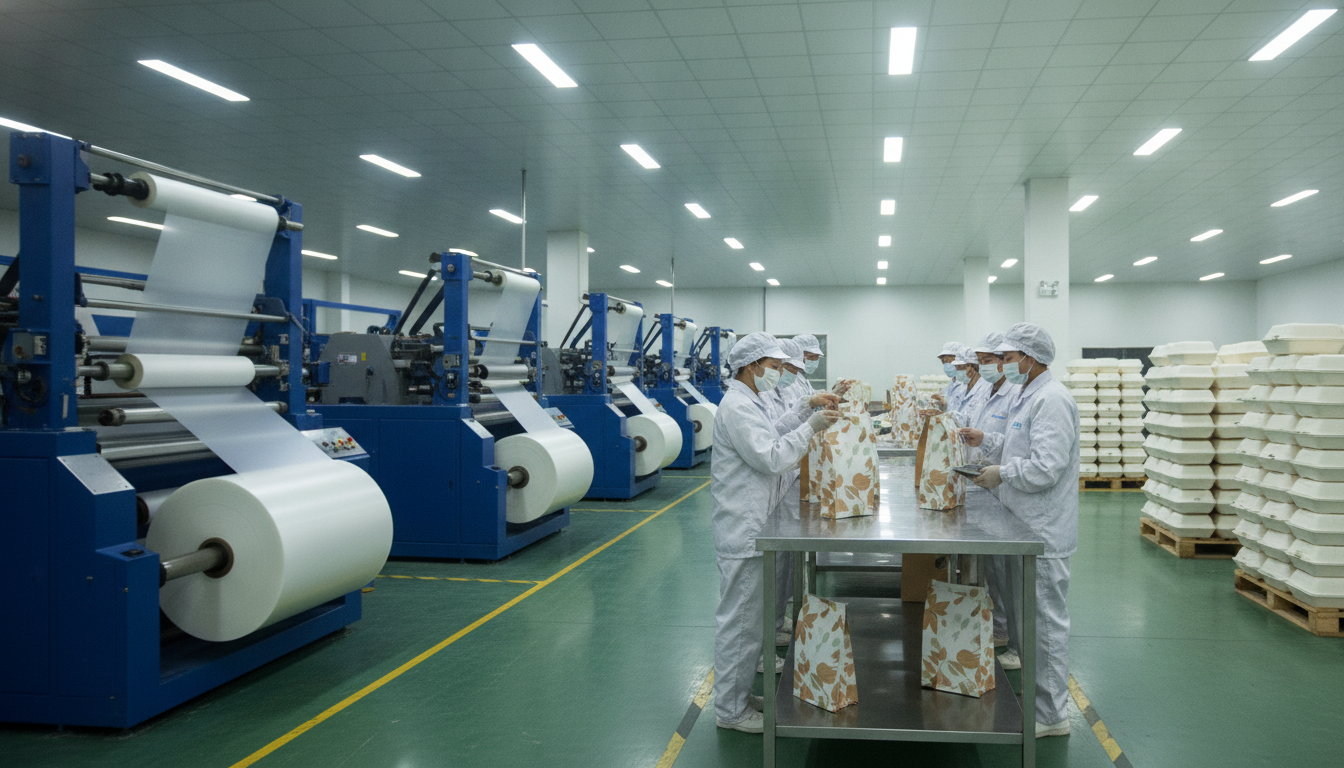
To source biodegradable packaging from China, start by defining your packaging format, material type (PLA, PBAT, bagasse, kraft paper), dimensions, and required certifications (EN 13432, OK Compost, ASTM D6400). Next, identify verified suppliers through audited B2B directories, request samples with third-party lab test reports, and conduct factory audits to confirm production scope and material sourcing. Finally, negotiate Incoterms, arrange pre-shipment quality inspections, and plan customs clearance including import duties and labeling compliance for your destination market.
📋 Table of Contents
- Executive Summary
- Define Your Packaging Specifications First
- Which Biodegradable Materials and Certifications Matter?
- How Do You Find and Verify Suppliers in China?
- Sample Request and Independent Testing
- Production Monitoring and Quality Inspection
- Import Logistics and Customs Compliance
- What Are the Essential Steps to Source Biodegradable Packaging from China?
- Frequently Asked Questions
Executive Summary
- Specification clarity: Define packaging format, material composition, thickness, dimensions, closure mechanism, printing requirements, and end-use application before contacting any supplier to receive comparable quotations.
- Certification verification: Request original EN 13432, OK Compost, ASTM D6400, or ISO 14855 test reports from accredited laboratories, not supplier-issued certificates, to confirm genuine compostability claims.
- Supplier due diligence: Verify business licence production scope, conduct factory audits to confirm equipment and raw-material sourcing, and check ownership structure to distinguish real manufacturers from trading companies.
- Sample and lab testing: Order samples with batch traceability, submit to independent third-party labs for biodegradability and food-contact testing, and approve specifications in writing before bulk production starts.
- Import planning: Calculate landed cost including Incoterms, ocean or air freight, customs duties, VAT, and destination-country labeling requirements for Mexico, Brazil, Argentina, Chile, Colombia, or EU markets.
Define Your Packaging Specifications First
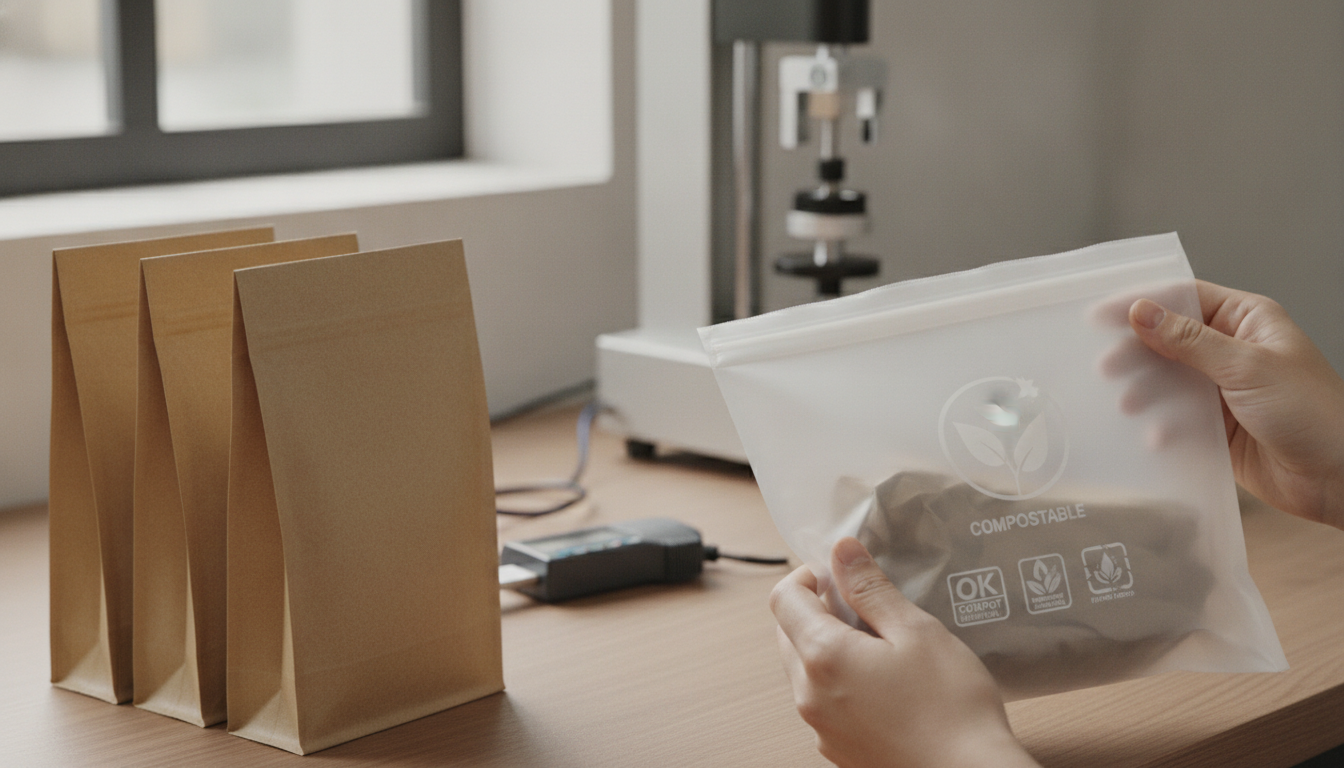
Biodegradable packaging suppliers in China manufacture thousands of SKU variations across bags, containers, films, and trays. Without a written specification document, you will receive quotations that differ in material blend, thickness, closure type, and printing method, making price comparison impossible. Start by answering these questions in a single-page brief.
Packaging Format and Dimensions
Specify whether you need stand-up pouches, flat mailers, clamshell containers, or roll film. Include exact dimensions in millimeters (width, length, gusset depth), closure mechanism (zipper, heat seal, adhesive strip), and any handle or vent requirements. Suppliers quote by the square meter of material plus tooling cost for custom sizes, so dimensional accuracy directly affects unit price.
Material Composition and Thickness
State your preferred base material: PLA (polylactic acid from corn starch), PBAT (polybutylene adipate terephthalate), starch-based film, bagasse (sugarcane pulp), or kraft paper with aqueous coating. Include target thickness in microns for films or GSM (grams per square meter) for paper-based products. Thicker materials cost more but offer better puncture resistance and barrier properties.
Printing and Branding Requirements
Detail your artwork specifications: number of colors, print method (flexographic, gravure, digital), pantone codes, and whether you need inside or outside printing. Minimum order quantities increase with color count because each color requires a separate printing plate. If you plan to apply labels post-production instead of direct printing, state that clearly to avoid unnecessary plate charges.
End-Use Application and Compliance Scope
Identify whether the packaging will contact food, cosmetics, or general merchandise. Food-contact applications trigger additional migration testing and material-safety requirements in most destination markets. Specify your target market (Mexico, Brazil, EU, USA) so the supplier can recommend materials and additives that meet regional food-safety regulations.
Which Biodegradable Materials and Certifications Matter?
Biodegradable and compostable are not interchangeable terms. Biodegradable means the material breaks down over time under unspecified conditions, while compostable means it degrades within a defined timeframe (typically 180 days) in an industrial composting facility at controlled temperature and humidity. Buyers who learn how to source biodegradable packaging from China must verify which standard their destination market recognizes.
Industrial Compostability Standards
EN 13432 is the European standard for industrial compostability, requiring 90% biodegradation within 180 days at 58°C with no toxic residue. OK Compost Industrial certification from TÜV Austria confirms EN 13432 compliance. ASTM D6400 is the equivalent USA standard, and ISO 14855 measures aerobic biodegradation rate. Request original EN 13432 test reports from SGS, Intertek, or TÜV SÜD laboratories showing your exact material formulation, not generic certificates that suppliers can replicate.
Home Compostability and Soil Biodegradability
OK Compost Home certification requires degradation at lower temperatures (20-30°C) within 12 months, suitable for backyard composting. This standard is stricter and fewer materials qualify. Soil biodegradability standards like ISO 17556 measure breakdown in soil rather than compost, relevant for agricultural mulch films but not for consumer packaging in most markets.
Food-Contact Compliance
PLA and PBAT blends used for food packaging must meet FDA 21 CFR 177 (USA), EU Regulation 10/2011, or China GB 4806 food-contact standards. Migration testing measures whether substances leach from the packaging into food under specific temperature and contact-time conditions. Suppliers often hold food-contact certificates for their raw materials but not for the finished printed packaging, so specify whether you need migration testing on the final product.
Greenwashing Risks and Verification
Importers frequently discover that suppliers claim biodegradability based on adding starch or calcium carbonate to conventional polyethylene, which fragments the plastic into microplastics but does not achieve true biodegradation. A business licence that lists only plastic-bag production, not bioplastic compounding, signals the supplier is buying pre-made biodegradable resin rather than controlling the formulation. Request the raw-material supplier name and resin batch certificates to trace material origin.
How Do You Find and Verify Suppliers in China?
Biodegradable packaging factories cluster in Guangdong (Dongguan, Shenzhen), Zhejiang (Yiwu, Hangzhou), and Fujian provinces. Identifying manufacturers rather than trading companies requires checking business registration documents and conducting factory audits before any deposit payment. Understanding how to source biodegradable packaging from China begins with distinguishing genuine manufacturers from intermediaries.
B2B Marketplace Filtering
Platforms like Alibaba, Made-in-China, and Global Sources list thousands of biodegradable packaging suppliers. Use the audited-supplier filter (Gold Supplier, Verified Manufacturer, Trade Assurance) as a starting screen, but understand these badges confirm the company exists and paid a membership fee, not that it owns a factory. Search for suppliers with on-site check reports, which include photos of production equipment and business licence verification.
Business Licence and Production Scope Verification
Every Chinese company holds a Unified Social Credit Code business licence that lists its registered business scope. A genuine packaging manufacturer will list production activities such as plastic product manufacturing, bioplastic compounding, or paper product processing. A trading company lists wholesale and import-export services but no manufacturing scope. Request a copy of the business licence and check that the production scope matches the product you intend to buy.
Factory Audit and Equipment Inspection
A factory audit conducted by a third-party inspection agency or a trusted China sourcing agent verifies physical production capacity, raw-material storage, quality-control procedures, and worker conditions. The audit report should include photos of extrusion lines for film production, thermoforming machines for containers, or pulp-molding equipment for bagasse products. Confirm that the supplier owns or leases the equipment rather than outsourcing production to a subcontractor.
Raw Material Sourcing and Traceability
Ask the supplier to name their PLA, PBAT, or starch-blend resin supplier and provide batch certificates. Major bioplastic resin producers include NatureWorks (USA), TotalEnergies Corbion (Europe), and BASF. If the supplier cannot name the resin source or provide batch traceability, they may be mixing conventional plastic with additives and labeling it biodegradable. Request a sample of the raw resin pellets alongside the finished packaging sample.
Sample Request and Independent Testing
Samples reveal material quality, print accuracy, and structural integrity before you commit to a bulk order. Requesting samples is standard practice, but many buyers skip independent laboratory testing and rely on supplier-provided test reports, which may not reflect the actual production batch you will receive.
Sample Specification and Batch Traceability
Order samples that match your final specification: same material blend, thickness, dimensions, printing, and closure mechanism. Request that the supplier mark each sample with a batch number and production date. This traceability allows you to reference the exact sample if quality issues arise during bulk production. Samples produced on a small-scale pilot line may differ from mass-production output, so ask whether the sample comes from the same equipment that will produce your order.
Independent Laboratory Testing
Submit samples to an accredited third-party lab (SGS, Intertek, TÜV SÜD, Bureau Veritas) for biodegradability testing under EN 13432, ASTM D6400, or your target market standard. Testing costs range from USD 800 to USD 2,500 per material formulation depending on the standard and turnaround time. If the packaging will contact food, add migration testing under FDA 21 CFR 177 or EU 10/2011. Lab reports take two to four weeks and provide legally defensible proof of compliance.
Physical and Mechanical Testing
Beyond compostability, test tensile strength, puncture resistance, seal strength, and moisture-vapor transmission rate (MVTR) to confirm the packaging protects your product during shipping and storage. Flexible films should meet minimum tensile strength of 20-30 MPa (megapascals) depending on application. Seal strength testing ensures heat-sealed edges do not separate under stress. Request these mechanical test results from the supplier or conduct them independently.
Artwork Approval and Pre-Production Sample
After sample approval, finalize your artwork and request a pre-production sample (also called a golden sample) that includes final printing, color matching, and any finishing such as lamination or embossing. Approve this sample in writing and retain a physical copy as the quality benchmark for bulk production. Any deviation from the approved pre-production sample during mass production is grounds for rejection or rework.
Production Monitoring and Quality Inspection
Biodegradable packaging production involves extrusion, printing, lamination, cutting, and sealing steps where defects can occur. Quality control during production and before shipment prevents costly rejections at the destination port. Buyers learning how to source biodegradable packaging from China often underestimate the importance of independent inspection.
During-Production Inspection
A during-production inspection (DUPRO) occurs when 20-40% of the order is complete and allows you to catch material or printing defects early enough to correct them without delaying the shipment. The inspector checks raw-material batch numbers against approved specifications, measures film thickness with a micrometer, verifies print color against the approved artwork, and tests seal strength on random samples. Inspection findings are documented with photos and measurements.
Pre-Shipment Inspection
A pre-shipment inspection (PSI) takes place when 100% of the order is finished and packed. The inspector randomly selects cartons, counts quantities, measures dimensions, checks labeling and barcodes, and performs functional tests such as drop tests or seal-integrity checks. The inspection report includes a pass/fail recommendation based on the AQL (Acceptable Quality Level) standard you specify, typically AQL 2.5 for major defects and AQL 4.0 for minor defects.
Container Loading Supervision
Container loading supervision ensures the correct quantity and product are loaded into the shipping container and that cartons are stacked properly to prevent crushing during ocean transit. The inspector verifies container condition (clean, dry, no holes), checks that carton markings match the packing list, and photographs the loading process. This step is especially important for high-value shipments or when consolidating multiple product types into one container.
Specification Lock and Change Control
Once you approve the pre-production sample, document every specification in a written quality agreement signed by both parties. Any change to material, thickness, printing, or dimensions requires written approval and a new pre-production sample. Suppliers sometimes substitute materials or reduce thickness to cut costs without informing the buyer. A locked specification with change-control procedures prevents unauthorized substitutions.
Import Logistics and Customs Compliance
Landed cost includes not only the FOB factory price but also freight, insurance, customs duties, VAT, customs brokerage, and destination handling. Biodegradable packaging may qualify for reduced tariffs under environmental trade programs, but labeling and certification requirements vary by country. Planning logistics and compliance before production starts avoids delays and unexpected costs. Knowing how to source biodegradable packaging from China means understanding total landed cost, not just supplier pricing.
Incoterms and Freight Options
FOB (Free On Board) is the most common Incoterm for China imports, meaning the supplier delivers goods to the departure port and you arrange ocean or air freight. CIF (Cost, Insurance, Freight) includes freight and insurance to the destination port but still requires you to handle customs clearance. DDP (Delivered Duty Paid) means the supplier handles everything including customs and delivery to your warehouse, but few Chinese suppliers offer DDP because they lack customs-brokerage licenses in destination countries.
Ocean freight from China to Mexico (Manzanillo, Veracruz) takes 18-25 days, to Brazil (Santos) 30-40 days, to Argentina (Buenos Aires) 35-45 days, and to Europe (Rotterdam, Hamburg) 28-35 days. Air freight reduces transit to 5-8 days but costs four to six times more than ocean. For biodegradable packaging, ocean freight is standard unless you need urgent replenishment.
Customs Duties and Import Taxes
Biodegradable packaging typically falls under HS codes 3923 (plastic packaging) or 4819 (paper packaging), with duty rates varying by material and destination country. Mexico applies 5-15% import duty depending on NAFTA/USMCA origin rules. Brazil charges 10-20% import duty plus ICMS state tax and PIS/COFINS federal taxes, totaling 35-50% of CIF value. Argentina uses a similar structure with 10-20% duty plus IVA (VAT). EU countries apply 0-6.5% duty plus 19-25% VAT depending on the member state.
Some countries offer reduced tariffs for certified compostable or recycled-content packaging under environmental trade programs. Check with a customs broker whether your product qualifies and what documentation (EN 13432 certificate, material composition declaration) is required to claim the lower rate.
Labeling and Marking Requirements
Mexico requires Spanish-language labeling with importer name, address, and product description under NOM-050-SCFI. Brazil requires Portuguese labeling, INMETRO registration for certain product categories, and NCM code declaration. Argentina requires Spanish labeling and IRAM certification for food-contact materials. EU markets require CE marking for certain packaging types, multilingual recycling symbols, and compliance with the Packaging and Packaging Waste Directive.
Compostability claims on packaging must be substantiated with certification. The EU Green Claims Directive (in force from 2026) prohibits unsubstantiated environmental claims and requires third-party verification. Printing “compostable” or “biodegradable” on packaging without EN 13432 or equivalent certification can result in customs detention or fines in EU markets.
Customs Clearance and Documentation
Customs clearance requires a commercial invoice, packing list, bill of lading (ocean) or airway bill (air), certificate of origin, and any product-specific certificates (EN 13432, food-contact compliance, phytosanitary certificate for plant-based materials). Hire a licensed customs broker in the destination country to handle tariff classification, duty calculation, and document submission. Clearance takes 2-5 days in most countries if documentation is complete.
Our freight and shipping coordination team works with customs brokers in Mexico, Colombia, Argentina, Chile, Brazil, and EU countries to ensure smooth clearance and delivery to your warehouse or fulfillment center.
What Are the Essential Steps to Source Biodegradable Packaging from China?
- Specification precision: Write a one-page brief covering format, material type, dimensions, thickness, printing, and end-use application before requesting quotations, ensuring supplier responses remain comparable across 15-25 initial contacts according to typical China Customs Trade Database (2024) import buyer behavior.
- Certification authenticity: Request original EN 13432 test reports from SGS, Intertek, or TÜV SÜD laboratories showing your exact material formulation, as the European Bioplastics Association (2023) reports that 42% of tested “biodegradable” packaging fails third-party verification.
- Supplier verification: Check the business licence production scope to distinguish manufacturers from trading companies, and conduct on-site factory audits within 20-30 days of initial contact to confirm equipment ownership and raw-material sourcing documented in China National Enterprise Credit Information Publicity System records.
- Independent testing: Submit your samples to independent third-party laboratories for biodegradability and food-contact testing before approving bulk production, with typical testing investment of USD 800-2,500 per material formulation preventing defect costs averaging 18-22% of order value (Intertek Quality Assurance Report 2023).
- Quality inspection: Arrange during-production and pre-shipment inspections to catch material or printing defects before goods leave the factory, using AQL 2.5 standards that reduce rejection rates by 65-70% according to SGS China Manufacturing Audit Data (2024).
- Landed-cost planning: Calculate total cost including Incoterms, ocean or air freight (averaging USD 2,800-4,200 per 20ft container to Latin America per Shanghai Shipping Exchange 2024 rates), customs duties (5-20%), VAT (16-25%), and brokerage fees (USD 150-350) before placing the order.
Frequently Asked Questions
What is the typical minimum order quantity for biodegradable packaging from China?
Minimum order quantities vary by product type and customization level. Stock-design flexible bags typically require 10,000-50,000 units per SKU, while custom-printed bags with your artwork start at 50,000-100,000 units because of printing-plate setup costs. Rigid containers like bagasse clamshells or PLA cups have lower MOQs of 20,000-50,000 units due to simpler tooling. If you need smaller quantities, some suppliers offer stock designs with generic printing at 5,000-10,000 units, though unit cost increases. Always confirm MOQ during the initial inquiry and negotiate based on your order frequency and total annual volume.
How long does production take for a bulk order of biodegradable packaging?
Production lead time depends on order complexity and factory workload. Standard flexible bags with existing printing plates take 15-25 days from deposit payment to factory shipment. Custom designs requiring new printing plates or molds add 7-10 days for tooling preparation. Rigid containers like bagasse clamshells or thermoformed PLA trays take 20-30 days. Peak seasons (September-November for holiday orders) extend lead times by one to two weeks. Always add buffer time for sample approval, pre-production sample review, and quality inspection before shipment. Total time from first contact to goods arriving at your warehouse is typically 60-90 days for first orders, reducing to 45-60 days for repeat orders with approved specifications.
Can I use the same biodegradable packaging for both food and non-food products?
Material suitability depends on regulatory requirements in your destination market, not just the product inside. Food-contact packaging must pass migration testing under FDA 21 CFR 177 (USA), EU Regulation 10/2011 (Europe), or equivalent standards in Latin America. PLA and PBAT blends used for food require additional testing to confirm that no harmful substances leach into food under temperature and contact-time conditions. Non-food packaging (apparel, electronics, general merchandise) does not require food-contact certification, which reduces testing cost and allows broader material choices. If you plan to use the same packaging design for both food and non-food SKUs, specify food-contact compliance from the start to avoid dual-sourcing. Printing inks and adhesives must also meet food-contact standards, not just the base material.
Written by the Goodcantrading Sourcing Team.
Ready to source certified biodegradable packaging with full traceability and independent quality control?
Request a Supplier Audit →