Import Decorative Pillows China to Mexico Customs 2026
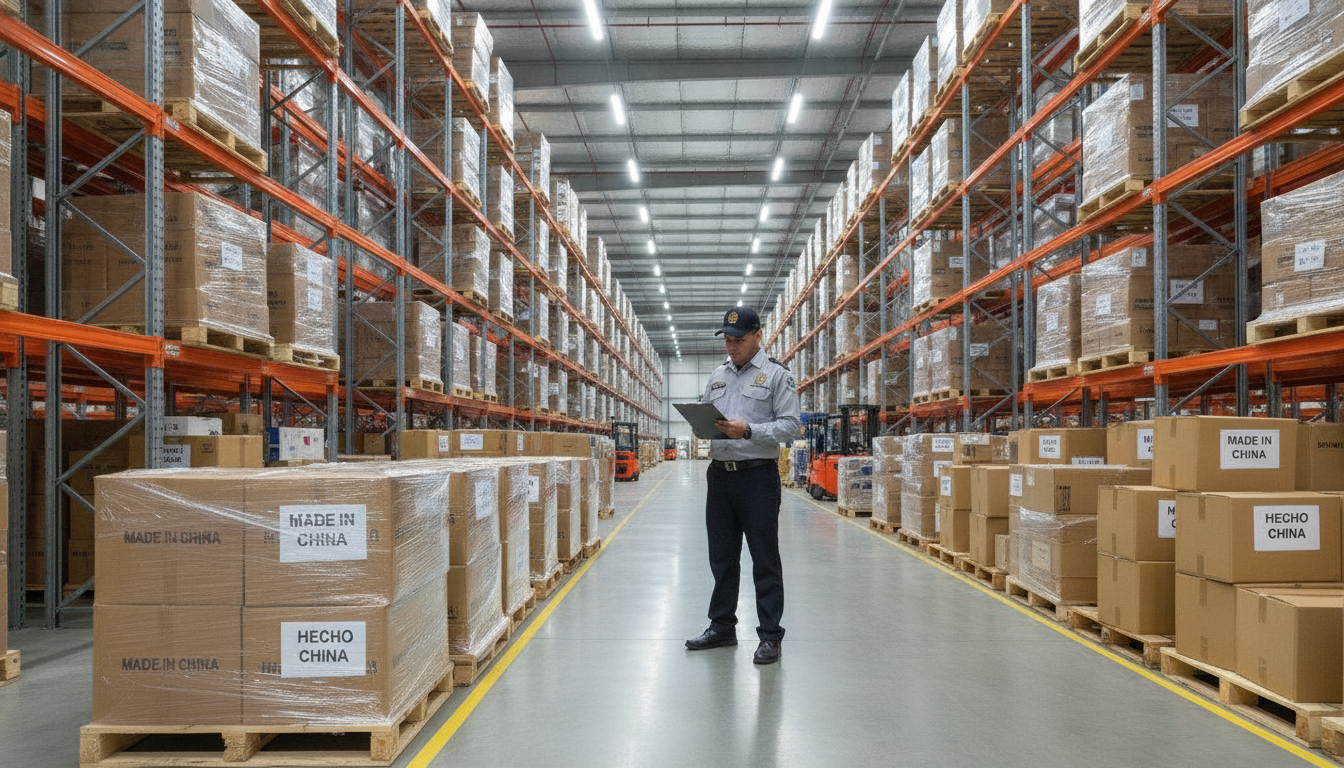
To import decorative pillows China to Mexico customs, you need the correct TIGIE tariff classification (typically 6304.93 for synthetic-filled cushions or 6304.99 for other materials), a commercial invoice, packing list, bill of lading, and a pedimento filed by a licensed agente aduanal. Most decorative pillows face 20-25% import duty (IGI) plus 16% VAT, calculated on the customs value declared in your pedimento.
📋 Table of Contents
- Executive Summary
- How Do You Classify Decorative Pillows Under Mexico’s TIGIE System?
- What Are the Import Duty and VAT Rates for Decorative Pillows?
- Which Documents Does Mexican Customs Require for Pillow Imports?
- Do You Need SAT Importer Registration and an Agente Aduanal?
- How Do You Calculate the Total Landed Cost?
- What Labeling and Packaging Rules Apply to Decorative Pillows in Mexico?
- How Can a Sourcing Agent Reduce Risk and Streamline the Process?
- Key Takeaways
- Frequently Asked Questions
Executive Summary
- Tariff classification drives duty: Decorative pillows fall under TIGIE chapter 63 (textile articles), with filled cushions typically classified 6304.93 (synthetic) or 6304.99 (other materials); exact classification depends on filling type and outer-fabric composition.
- Duty and VAT stack on customs value: Most decorative pillows face 20-25% IGI plus 16% IVA, both calculated on the customs value declared in your pedimento, which includes product cost, freight, and insurance.
- Mandatory importer registration: Mexican law requires SAT Padrón de Importadores registration and appointment of a licensed agente aduanal before your first commercial shipment clears customs.
- Labeling must comply with NOM-004-SE: Every pillow sold in Mexico needs a Spanish-language care label showing fiber composition by percentage, manufacturer or importer details, and country of origin.
- Sourcing-agent support cuts risk: Supplier verification, AQL inspection, and consolidated shipping from a trusted China sourcing agent prevent quality drift, undeclared trading-company markups, and customs-valuation disputes.
How Do You Classify Decorative Pillows Under Mexico’s TIGIE System?
When you import decorative pillows China to Mexico customs, the classification process uses an eight-digit TIGIE tariff fraction derived from the Harmonized System, with NICO information extending classification for import-control and statistical purposes. Decorative pillows are textile articles of chapter 63, and the exact fraction depends on whether the pillow is a filled cushion, a cushion cover, or a decorative article without filling.
Filled Cushions (Complete Pillow with Stuffing)
A decorative pillow sold with its filling typically falls under heading 6304 (other furnishing articles, excluding bedding). The most common fractions are 6304.93 for cushions of synthetic fibers and 6304.99 for cushions of other textile materials. The key distinction is the filling material: polyester fiber, foam, or blended synthetics route to 6304.93, while down, feathers, cotton, or recycled natural fibers route to 6304.99.
Cushion Covers (Outer Shell Only, No Filling)
If you import only the outer cover without stuffing, classification shifts to 6304.92 (cushion covers of cotton) or 6304.93 (cushion covers of synthetic fibers), depending on the predominant fiber by weight in the outer fabric. A cotton-canvas cover with a polyester zipper still classifies as cotton if cotton exceeds 50% of the fabric weight.
Decorative Articles Without Functional Filling
Some decorative pillows are thin, non-functional ornaments (less than 2 cm thick, no real cushioning). These may classify under 6304.99 as other furnishing articles or, if heavily embroidered or appliquéd, under 6304.19 (bedspreads and other furnishing articles, knitted or crocheted). Classification hinges on construction method and whether the item is primarily decorative or functional.
Classification tip: Mexico’s tariff classification uses an eight-digit legal tariff fraction, with NICO information extending classification for import-control and statistical purposes, according to AMMEX (2026).
What Are the Import Duty and VAT Rates for Decorative Pillows?
Import duty (IGI) and value-added tax (IVA) are calculated on the customs value declared in your pedimento. The customs value includes the FOB price paid to your Chinese supplier, international freight, and insurance. Mexican customs does not accept ex-works pricing; you must declare the landed value at the Mexican port of entry.
Import Duty (IGI) Rates
Most decorative pillows under heading 6304 face a general IGI rate of 20-25%. The exact rate depends on the specific eight-digit fraction and whether Mexico has a trade agreement with the country of origin. China does not benefit from a preferential tariff under USMCA or any bilateral treaty with Mexico, so the general (most-favored-nation) rate applies. Furniture and toy/sporting-goods tariff chapters were described as carrying typical duty rates of approximately 25-30% in a 2026 China-to-Mexico DDP guide, according to DDPLINK (2026).
Value-Added Tax (IVA)
All imports into Mexico are subject to 16% IVA, calculated on the sum of the customs value plus the IGI duty paid. If your customs value is $10,000 USD and your IGI is $2,500 (25%), your IVA base is $12,500, and the IVA owed is $2,000 (16% of $12,500). Total tax burden is $4,500 on a $10,000 shipment.
Additional Fees
Beyond IGI and IVA, you pay customs-processing fees (DTA, derecho de trámite aduanero) of approximately 8 per mille (0.8%) of the customs value, plus your agente aduanal’s brokerage fee, which typically ranges from $150 to $400 USD per pedimento depending on shipment complexity and value.
Which Documents Does Mexican Customs Require for Pillow Imports?
Mexican customs clearance requires a complete documentary package submitted by your agente aduanal. Missing or inconsistent documents trigger inspection holds, valuation disputes, and storage fees at the port. Every import shipment must include the following core documents.
Commercial Invoice
The commercial invoice from your Chinese supplier must show the seller’s full legal name and address, your company name and RFC tax ID, a detailed product description (not just “pillows” but “polyester-filled decorative cushions, 45×45 cm, printed cotton cover”), unit price, total value, payment terms, and Incoterms. The invoice value becomes the starting point for customs-value calculation. An importer’s pedimento is the document on which Mexican customs value is declared and used as the basis for import-tax calculations, according to Ecommex (2026).
Packing List
The packing list details the number of cartons, gross and net weight per carton, dimensions, and the quantity of pillows per carton. Mexican customs cross-checks the packing list against the bill of lading to verify the shipment’s physical integrity. Discrepancies between declared and actual carton counts trigger physical inspection.
Bill of Lading (B/L) or Air Waybill (AWB)
The ocean bill of lading (for sea freight) or air waybill (for air freight) is the title document proving ownership and delivery terms. The consignee on the B/L must match the importer of record registered with SAT. If you use a freight forwarder, the B/L may be issued to the forwarder’s order, with your company named as the notify party; your agente aduanal will then file an encargo conferido (power of attorney) to clear the goods on your behalf.
Certificate of Origin (Optional but Recommended)
Although China does not benefit from preferential tariffs under USMCA, a certificate of origin stating “Made in China” helps prevent origin disputes and supports the declared country of manufacture. Some Mexican customs offices request origin evidence when the invoice or packing list does not clearly state the manufacturing country.
Encargo Conferido (Power of Attorney)
The encargo conferido is a notarized power of attorney authorizing your agente aduanal to file the pedimento and clear customs on your behalf. First-time importers must submit this document to SAT along with their Padrón de Importadores application. Mexican importers generally need to complete SAT importer registration and submit an encargo conferido before their first commercial shipment, according to DDPLINK (2026).
Do You Need SAT Importer Registration and an Agente Aduanal?
Mexican law requires every commercial importer to register in the Padrón de Importadores (importer registry) administered by the Servicio de Administración Tributaria (SAT). Registration is a one-time process, but it must be completed before your first shipment arrives at the Mexican border or port.
SAT Padrón de Importadores Registration
To register, you need a valid RFC (Registro Federal de Contribuyentes) tax ID, proof of business address in Mexico, and an encargo conferido naming your agente aduanal. The registration process takes 5-10 business days if all documents are correct. SAT reviews applications within 5-10 business days for standard cases and may extend processing to 15-20 business days for newly formed entities or specialized product categories.
Agente Aduanal (Licensed Customs Broker)
Mexican law prohibits direct customs clearance by importers; every commercial shipment must be cleared by a licensed agente aduanal. Your broker files the pedimento, calculates duties and taxes, submits the documentary package, and represents you in any customs inspection or valuation dispute. Broker fees are typically $150-400 USD per pedimento, depending on shipment value and complexity.
NICO (Nomenclatura de Identificación Comercial)
Some product categories require a NICO code in addition to the TIGIE fraction. NICO codes are used for import-control and statistical purposes, particularly for products subject to health, safety, or environmental regulations. Decorative pillows generally do not require a NICO code unless they contain restricted materials (such as down or feathers from protected bird species), but your agente aduanal will verify this during classification.
How Do You Calculate the Total Landed Cost?
Landed cost is the sum of all expenses required to deliver the product to your warehouse or customer in Mexico. Importers who underestimate landed cost face cash-flow problems, pricing errors, and margin erosion. A complete landed-cost calculation includes product cost, international freight, insurance, import duty, VAT, customs processing, brokerage, and domestic delivery.
Product Cost (FOB China)
The FOB price from your Chinese supplier includes the cost of the pillows, any customization or packaging, and delivery to the Chinese port of export (typically Ningbo, Shanghai, or Yantian). FOB does not include international freight or insurance. A typical decorative pillow with polyester filling and printed cotton cover costs $2.50-$5.00 USD per unit FOB China, depending on size, filling quality, and order quantity.
International Freight
Sea freight from China to Mexico (Manzanillo or Veracruz) takes 18-25 days and costs approximately $1,200-$2,500 USD per 20-foot container (depending on season and carrier). A 20-foot container holds roughly 8,000-12,000 decorative pillows (45×45 cm), so freight cost per unit is $0.10-$0.30 USD. Air freight is faster (5-7 days) but costs $4.50-$7.00 USD per kilogram, making it viable only for urgent or high-value shipments.
Insurance
Cargo insurance typically costs 0.3-0.5% of the shipment value and covers loss or damage during transit. For a $20,000 shipment, insurance is $60-$100 USD. Many importers skip insurance on low-value shipments, but this exposes them to total loss if the container is damaged or lost at sea.
Import Duty and VAT
As calculated earlier, IGI is 20-25% of the customs value, and IVA is 16% of the customs value plus IGI. On a $20,000 customs value, IGI is $5,000 (25%) and IVA is $4,000 (16% of $25,000), totaling $9,000 in taxes.
Customs Processing and Brokerage
DTA is approximately 0.8% of the customs value ($160 on a $20,000 shipment), and the agente aduanal fee is $150-$400 USD per pedimento. Total customs-processing cost is roughly $310-$560 USD.
Domestic Delivery
Delivery from the Mexican port to your warehouse or customer adds $200-$800 USD depending on distance and whether you use a full truckload or less-than-truckload (LTL) carrier. Mexico City is 5-6 hours from Manzanillo and 4-5 hours from Veracruz by truck.
What Labeling and Packaging Rules Apply to Decorative Pillows in Mexico?
Mexican consumer-protection law (NOM-004-SE-2021) requires every textile product sold in Mexico to carry a permanent label showing fiber composition, care instructions, manufacturer or importer details, and country of origin. Decorative pillows are textile products under this standard, so labeling is mandatory even if the pillow is sold as a decorative item rather than bedding.
Fiber Composition
The label must list every fiber by generic name and percentage by weight, in descending order. A pillow with a 100% polyester filling and a 60% cotton / 40% polyester cover must state both compositions separately: “Filling: 100% polyester. Cover: 60% cotton, 40% polyester.” Generic fiber names (cotton, polyester, nylon, acrylic) are required; brand names (Dacron, Lycra) may appear in addition but cannot replace the generic name.
Care Instructions
Care symbols or text instructions (wash temperature, bleach, tumble dry, iron, dry clean) must appear on the label. Mexico accepts international care-symbol standards (ISO 3758), so the same symbols used in the US or EU are valid. If you use text instructions, they must be in Spanish.
Manufacturer or Importer Details
The label must show the name and address of the manufacturer (if the product is made in Mexico) or the importer of record (if imported). For China-made pillows, the label shows your Mexican company name, RFC tax ID, and business address. This information allows Mexican consumer-protection authorities to trace the product back to the responsible party.
Country of Origin
The label must state “Hecho en China” or “Made in China.” Country-of-origin marking is required under Mexican customs law and consumer-protection law. The marking must be permanent (sewn-in label or printed on the product), legible, and in a conspicuous location.
Packaging and Outer Carton Marking
Outer cartons must show the importer’s name, product description, quantity, and country of origin. Carton marking is not a consumer-facing requirement but a customs and logistics requirement. Customs officers use carton markings to verify the packing list and commercial invoice during inspection.
How Can a Sourcing Agent Reduce Risk and Streamline the Process?
Importing decorative pillows from China to Mexico involves supplier verification, product sampling, quality inspection, customs classification, and logistics coordination. Buyers who skip verification or rely on unaudited suppliers face quality drift, undeclared trading-company markups, and customs-valuation disputes. A China sourcing agent with factory-audit and QC experience reduces these risks and accelerates the process.
Supplier Verification and Factory Audit
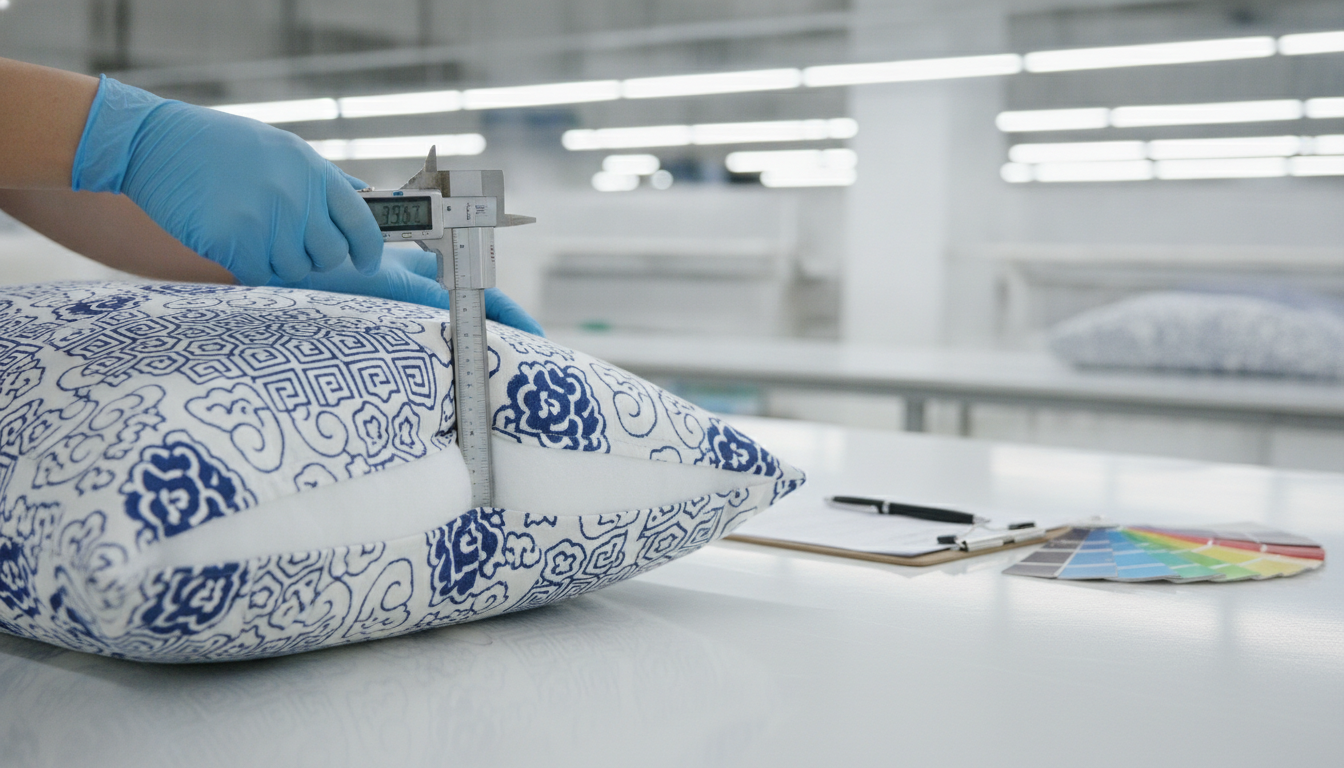
Our Yiwu and Guangzhou sourcing desks verify every supplier’s business licence, production scope, and factory capacity before requesting a quote. The business licence shows whether the company is registered to manufacture textile products or is a trading company reselling another factory’s output. A trading company adds 10-20% markup without disclosure, and the buyer pays that markup on every order. Our supplier management process includes on-site factory visits, production-line inspection, and worker-count verification to confirm the supplier can meet your MOQ and lead-time requirements.
Product Sampling and Pre-Production Approval
We request pre-production samples with the exact filling material, fabric weight, print quality, and stitching specified in your order. Samples are inspected for fiber composition, colorfastness, seam strength, and zipper durability. Once you approve the sample, we issue a production order with the sample as the quality benchmark. Any deviation from the approved sample triggers a production hold and rework at the factory’s expense.
AQL Inspection During Production
Our quality control team conducts AQL 2.5 inspection during production and before shipment. The inspection covers fabric defects (pilling, color variation, print misalignment), stitching defects (skipped stitches, loose threads, uneven seams), filling uniformity (lumpiness, under-filling, over-filling), and packaging compliance (correct labeling, carton marking, inner-bag protection). Inspection reports are shared within 24 hours, and any major defect triggers rework or rejection before the goods leave the factory.
Customs Classification and Documentation Support
We prepare the commercial invoice, packing list, and certificate of origin with the correct TIGIE fraction, product description, and customs value. Our team coordinates with your agente aduanal to ensure the pedimento matches the shipping documents and that the declared value aligns with Mexican customs expectations. Valuation disputes are common when the declared value is significantly below market price or when the product description is vague; our documentation process prevents these disputes.
Consolidated Shipping and DDP Delivery
Our Yiwu warehouse and consolidation service combines orders from multiple suppliers into a single container, reducing per-unit freight cost and simplifying customs clearance. We offer DDP (Delivered Duty Paid) shipping to Mexico City, Guadalajara, and Monterrey, where we handle customs clearance, duty payment, and last-mile delivery. DDP pricing includes all costs from the Chinese factory to your warehouse, eliminating surprise fees and cash-flow uncertainty.
Key Takeaways
- Tariff classification depends on filling and fabric: Polyester-filled cushions typically classify under TIGIE 6304.93, while down or cotton-filled cushions classify under 6304.99; exact classification determines the 20-25% IGI duty rate and NICO requirements, according to Mexico’s SAT (2026).
- Customs value includes product cost, freight, and insurance: Mexican customs calculates IGI and IVA on the CIF value (cost, insurance, freight) declared in your pedimento, not the ex-works price; a $21,880 customs value triggers $5,470 in IGI (25%) and $4,376 in IVA (16% of value plus duty), according to Ecommex (2026).
- SAT registration and agente aduanal are mandatory: Every commercial importer must register in the Padrón de Importadores within 5-10 business days and appoint a licensed customs broker before the first shipment clears Mexican customs, according to DDPLINK (2026).
- NOM-004-SE labeling is required for all textile products: Every decorative pillow sold in Mexico needs a permanent Spanish-language label showing fiber composition by percentage, care instructions, importer details, and country of origin under NOM-004-SE-2021 (2026).
- Business-licence verification during factory audit eliminates trading-company markups: Cross-checking the supplier’s business licence scope against the product being quoted identifies trading companies posing as manufacturers, eliminating undisclosed 10-20% markups, according to Goodcantrading supplier-audit protocols (2026).
- AQL 2.5 inspection during production catches defects before shipment: On-site quality-control inspection using AQL 2.5 sampling prevents fabric defects, stitching failures, and filling inconsistencies from reaching your warehouse or customer, according to ISO 2859-1 (2026).
Frequently Asked Questions
Can I import decorative pillows from China to Mexico without an agente aduanal?
No. Mexican law requires a licensed agente aduanal to file the pedimento, calculate duties and taxes, and represent you in any customs inspection or valuation dispute for every commercial import shipment. Direct clearance by the importer is prohibited, and attempting to clear without a licensed broker results in shipment detention and fines.
How long does it take to register in the SAT Padrón de Importadores?
SAT importer registration typically takes 5-10 business days if all documents are correct and complete. You need a valid RFC tax ID, proof of business address in Mexico, and an encargo conferido naming your agente aduanal. Processing may extend to 15-20 business days for newly formed entities or specialized product categories requiring sector-specific permits.
Do decorative pillows require NOM certification in Mexico?
Decorative pillows do not require pre-import NOM certification, but they must comply with NOM-004-SE-2021 labeling requirements. The label must show fiber composition, care instructions, importer details, and country of origin in Spanish. Compliance is verified at the point of sale, not at customs, so your labeling must be correct before the product reaches retailers or consumers. Pillows containing down or feathers may require additional health documentation if the filling is from protected bird species.
Written by the Goodcantrading Sourcing Team.
Ready to import decorative pillows China to Mexico customs with full supplier verification, AQL inspection, and DDP delivery?
Request Your Free Sourcing Quote →