Import Duty Calculator Sunglasses China to UK [2026 Guide]

When using an import duty calculator sunglasses China to UK, you calculate customs duty at 2.5% under HS code 9004 for fashion sunglasses, plus 20% import VAT on the total customs value (product cost + freight + insurance + duty). The customs value includes the FOB price, international shipping, and insurance to the UK border, and every shipment requires an EORI number for clearance.
📋 Table of Contents
Executive Summary
- HS code 9004: Fashion sunglasses from China face 2.5% customs duty under the UK Global Tariff, while corrective or protective eyewear may fall under different codes with varying rates.
- Customs value formula: Product FOB price plus international freight plus insurance to the UK border, then duty is applied to that total before calculating 20% import VAT.
- EORI registration: Every UK importer must hold an Economic Operator Registration and Identification number before clearing goods through customs, regardless of shipment value.
- DDP vs DDU: Delivered Duty Paid means the supplier pays duty and VAT before delivery, while Delivered Duty Unpaid leaves those costs to the buyer at the border.
- Postponed VAT accounting: VAT-registered UK businesses can defer import VAT payment to their next VAT return instead of paying upfront at customs, improving cash flow for regular importers.
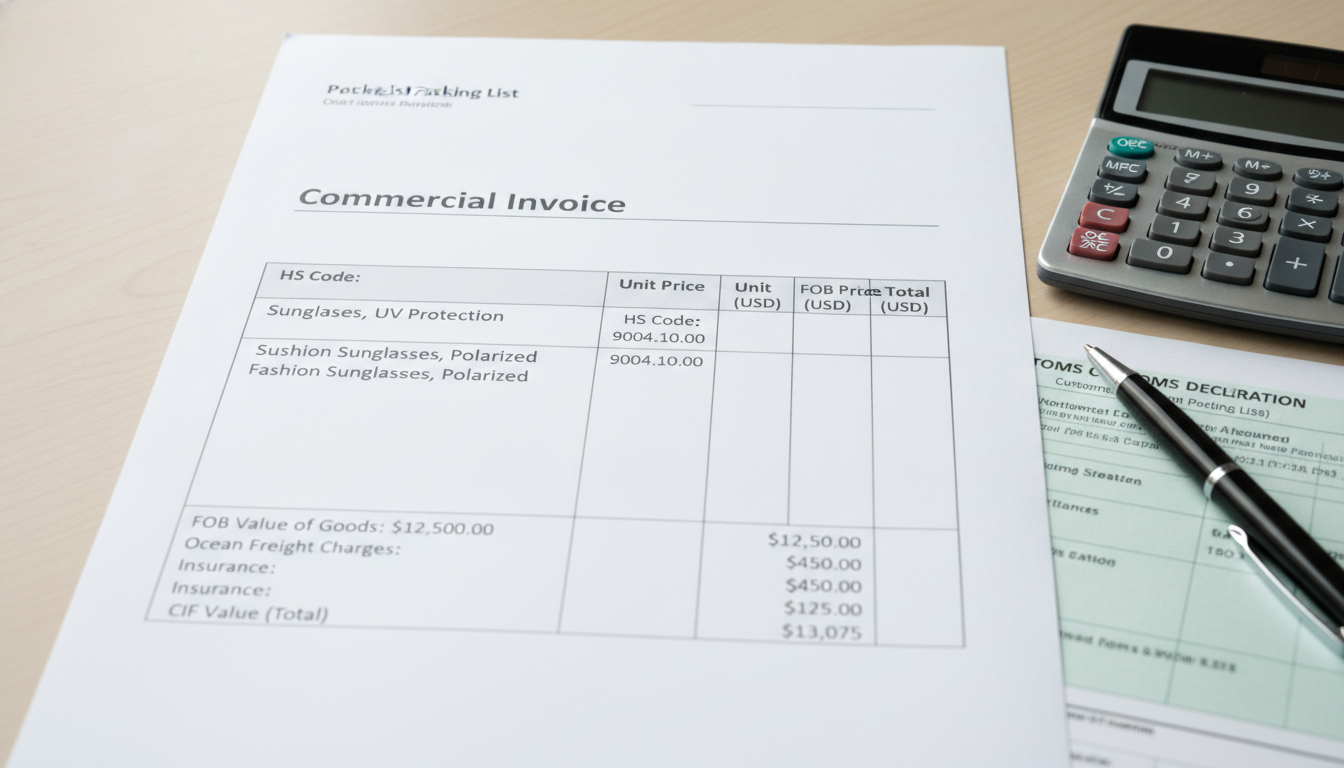
How to Classify Sunglasses for UK Import Duty?
Sunglasses classification determines the duty rate you pay. The UK Trade Tariff groups eyewear under Chapter 90, Optical Instruments, with HS code 9004 covering most non-corrective sunglasses. Fashion sunglasses with plastic or metal frames and tinted lenses typically fall under 9004.10 or 9004.90, attracting a 2.5% duty rate. Corrective sunglasses with prescription lenses may shift to 9001, which carries different rates, and protective eyewear for industrial use can move to 9004.90 with specific safety-standard requirements.
Fashion Sunglasses (HS 9004.10 / 9004.90)
Standard fashion sunglasses with UV-blocking tinted lenses and non-prescription optics sit under 9004.10 for plastic frames or 9004.90 for metal and mixed-material frames. Both codes attract 2.5% duty. The distinction between plastic and metal matters for tariff classification but produces the same duty outcome for most China-origin imports. When a trusted China sourcing agent requests a commercial invoice from the factory, the product description must match the physical construction to avoid reclassification delays at UK customs.
Corrective and Prescription Sunglasses
Sunglasses with prescription lenses fall under 9001.40 or 9001.50, depending on lens material. Glass prescription lenses use 9001.40, while plastic prescription lenses use 9001.50. Duty rates differ: 9001.40 attracts 2.5%, while 9001.50 can vary. If the supplier ships a mixed container with both fashion and corrective sunglasses, each type requires a separate tariff line on the customs declaration, and the customs value must be split accordingly.
Protective Eyewear and Safety Glasses
Industrial safety glasses and sports-protective eyewear meeting EN 166 or ANSI Z87.1 standards may classify under 9004.90 with a protective-eyewear subheading. These items still attract 2.5% duty, but the product description on the commercial invoice must reference the safety standard to justify the classification. Importers bringing protective eyewear for resale in the UK construction or sports markets should verify that the factory’s test reports match the declared standard, because customs officers can request evidence at clearance.
Calculating Customs Value for Sunglasses
According to GoodVAT (2026), the standard UK import VAT rate is 20% for most goods, and import VAT is calculated on the customs value plus duty and applicable transport-related costs. The customs value is not simply the product price. UK customs duty is calculated from the customs value, commonly described as the product price plus international freight and insurance to the border, as noted by Epic Sourcing (2026). This means you add the FOB factory price, the sea or air freight from China to the UK port, and the insurance premium, then apply the 2.5% duty to that total, and finally calculate 20% VAT on the sum of customs value plus duty.
FOB Price vs CIF Value
FOB (Free On Board) is the factory gate price before international shipping. CIF (Cost, Insurance, Freight) is FOB plus ocean freight plus marine insurance to the UK destination port. UK customs uses the CIF value as the baseline customs value. If your supplier quotes $3.50 per unit FOB Ningbo and the freight forwarder charges $0.40 per unit for sea freight plus $0.05 insurance, the CIF value per unit is $3.95. Duty is then 2.5% of $3.95, and VAT is 20% of ($3.95 + duty).
Freight and Insurance Allocation
When a single container holds multiple product types, freight and insurance must be allocated proportionally by weight or value. A 20-foot container carrying 10,000 sunglasses and 5,000 baseball caps requires the total freight cost to be split between the two product lines before calculating each line’s customs value. Most freight forwarders provide a per-kilogram rate, which simplifies allocation. If sunglasses weigh 50 grams each and caps weigh 80 grams, the sunglasses claim 500 kg and the caps 400 kg, so sunglasses bear 55.6% of the freight cost.
Under-Declaration Risk
Some suppliers offer to under-declare the invoice value to reduce duty and VAT. This practice is illegal and carries severe penalties: UK customs can seize the shipment, impose fines up to three times the evaded duty, and suspend the importer’s EORI number. A commercial invoice stating a $1.50 unit price when the real FOB is $3.50 creates a permanent audit trail, because the supplier’s export declaration in China and the buyer’s import declaration in the UK must match. Our supplier management process verifies that the factory’s quoted price matches the commercial invoice before shipment, eliminating the under-declaration risk that importers face when dealing directly with unfamiliar suppliers.
Worked Example: Landed Cost Calculation
A UK importer orders 5,000 plastic-frame fashion sunglasses from a Guangdong factory. The FOB Shenzhen price is $3.20 per unit. Sea freight to Felixstowe is $600 for the shipment, and marine insurance is $80. The importer holds a UK EORI number and is VAT-registered, planning to use postponed VAT accounting. The landed cost per unit includes product cost, freight, insurance, duty, and VAT.
The landed cost per unit is $4.10, compared to the $3.20 FOB price. Duty adds $0.083 per unit, VAT adds $0.684, and freight plus insurance adds $0.136. If the importer uses postponed VAT accounting, the $3,419 VAT is not paid at customs but instead declared on the next VAT return, where it can be reclaimed as input tax if the sunglasses are resold in the UK.
Currency Conversion and Exchange-Rate Risk
UK customs accepts declarations in GBP, USD, or EUR, but duty and VAT are always calculated and paid in GBP. If the commercial invoice is in USD, the customs agent applies HMRC’s published monthly exchange rate on the date of import. A $16,680 CIF value converts to approximately £13,100 at an exchange rate of 1.27 USD/GBP (November 2026 indicative rate). Importers paying suppliers in USD but selling in GBP face exchange-rate risk between order placement and customs clearance, which can shift the landed cost by 2-5% if the GBP weakens.
Additional Costs Beyond Duty and VAT
The table above covers statutory duty and VAT. Real-world landed cost includes customs-clearance fees (£50-150 per shipment), port handling charges (£80-200 for a pallet), and UK inland delivery from Felixstowe to the final warehouse. A full landed-cost model for 5,000 sunglasses should budget an additional £300-500 for clearance and handling, raising the per-unit cost by $0.08-0.13. Our freight and shipping service consolidates multiple suppliers’ goods in our Yiwu warehouse, then ships a single container to the UK, spreading clearance and handling costs across a larger shipment and reducing per-unit logistics overhead.
DDP vs DDU Shipping: Which Pays Duty?
Delivered Duty Paid (DDP) and Delivered Duty Unpaid (DDU) define who pays customs duty, import VAT, and clearance fees. DDP means the supplier or freight forwarder pays all duties and taxes before delivering the goods to the buyer’s door. DDU means the buyer pays duty and VAT at the UK border before the shipment is released. The choice affects cash flow, control over customs declarations, and the risk of clearance delays.
DDP: Supplier Pays Duty and VAT
Under DDP, the Chinese supplier arranges UK customs clearance, pays the 2.5% duty and 20% VAT, and delivers the sunglasses to the buyer’s warehouse. The buyer receives a single all-inclusive price. DDP suits buyers who lack a UK EORI number or prefer not to manage customs paperwork. The downside is loss of control: the supplier’s customs agent declares the HS code and customs value, and if the agent under-declares to save costs, the UK importer’s business is liable for the resulting penalties, even though the importer did not prepare the declaration.
DDU: Buyer Pays Duty and VAT
Under DDU, the supplier ships the goods to the UK port, and the buyer’s customs broker clears the shipment, paying duty and VAT on the buyer’s behalf. The buyer controls the customs declaration, ensuring the HS code, customs value, and product description are accurate. DDU is the standard choice for VAT-registered UK importers using postponed VAT accounting, because it allows them to defer the 20% VAT payment to their next VAT return instead of paying upfront. The buyer must hold a UK EORI number and engage a customs broker or freight forwarder to handle clearance.
Which Is Better for Regular Importers?
Regular importers bringing sunglasses from China monthly or quarterly should use DDU with postponed VAT accounting. This approach eliminates the upfront VAT cash outlay, gives the importer full control over customs declarations, and ensures the declared value matches the real transaction price. DDP makes sense for one-off shipments or buyers without UK VAT registration, but it introduces compliance risk because the importer cannot verify what the supplier’s agent declared to HMRC.
Practical insight: A UK EORI number takes 5-10 working days to obtain from HMRC and costs nothing. Any business importing goods into the UK must register for EORI before the first shipment clears customs, regardless of whether the shipment is DDP or DDU.
UK Compliance: EORI, VAT, Product Safety
Importing sunglasses from China to the UK requires more than calculating duty and VAT. Every importer must hold an EORI number, comply with UK product-safety regulations, and ensure the goods carry correct labelling and do not infringe trademarks. Non-compliance can result in shipment detention, destruction of goods, or financial penalties.
EORI Number Registration
The Economic Operator Registration and Identification (EORI) number is a unique identifier issued by HMRC to every business importing goods into the UK. You cannot clear a shipment through UK customs without an EORI number, even for a single sample order. Registration is free and takes 5-10 working days through the HMRC online portal. The EORI number appears on every customs declaration, and customs brokers cannot process clearance without it. If you plan to import sunglasses regularly, register for EORI before placing the first factory order.
Postponed VAT Accounting
Postponed VAT accounting allows VAT-registered UK businesses to defer import VAT payment to their next VAT return instead of paying upfront at customs. This improves cash flow significantly: instead of paying 20% VAT at the border and reclaiming it weeks later, the importer declares the VAT on their return and immediately reclaims it as input tax, resulting in zero net VAT cost. To use postponed VAT accounting, the importer must be VAT-registered in the UK, hold an EORI number, and instruct their customs broker to apply postponed accounting on the customs declaration.
UK Product Safety and CE/UKCA Marking
Sunglasses sold in the UK must comply with the General Product Safety Regulations 2005 and carry UKCA (UK Conformity Assessed) marking if they fall under regulated product categories. Fashion sunglasses are not a regulated product under UKCA, but they must meet general safety requirements: no sharp edges, non-toxic materials, and UV protection claims must be substantiated by test reports. If the sunglasses claim UV400 protection, the factory should provide a test report from an accredited lab showing transmittance below 1% for wavelengths under 400 nm. Our quality control team requests UV-protection test reports and material-safety data sheets from the factory before shipment, ensuring the product meets UK safety expectations and reducing the risk of market-surveillance enforcement action.
Trademark and Counterfeit Risk
UK Border Force seizes thousands of counterfeit sunglasses shipments annually. If the sunglasses bear a registered trademark without the brand owner’s authorization, customs will detain the shipment and notify the trademark holder. The importer faces destruction of the goods, legal action from the brand owner, and potential criminal prosecution. When sourcing sunglasses from China, verify that the factory is either producing under a licensed brand agreement or manufacturing unbranded or private-label goods. A factory offering Ray-Ban or Oakley-branded sunglasses at $3 per unit is selling counterfeits, and importing those goods into the UK is a criminal offense.
In practice: A supplier’s business licence listed ‘eyewear accessories’ but not ‘optical instruments’, which is why matching the licence scope against the HS code 9004 classification catches a trading company reselling factory output before any deposit is paid.
Country of Origin and Rules of Origin
According to Statrys (2026), UK imports from China are assessed using the commodity code and origin-based UK tariff treatment, with no China-to-UK free-trade preference identified in the ranking materials. Sunglasses manufactured in China are subject to the UK Global Tariff, which sets the 2.5% duty rate for HS 9004. The country of origin must be declared on the customs entry, and the commercial invoice must state ‘Made in China’ or ‘Country of Origin: China’. If the sunglasses are assembled in China using lenses from Taiwan and frames from Vietnam, the country of origin is determined by the location of the last substantial transformation, which is typically China if final assembly and quality inspection occur there.
Key Takeaways
- HS code 9004 classification: Fashion sunglasses with non-prescription tinted lenses fall under 9004.10 for plastic frames or 9004.90 for metal frames, both attracting 2.5% customs duty under the UK Global Tariff.
- Customs value includes freight and insurance: Duty is calculated on the CIF value, which is the FOB factory price plus international shipping plus marine insurance to the UK port, not just the product price alone.
- 20% import VAT applies after duty: VAT is calculated on the sum of customs value plus duty, and VAT-registered UK importers can use postponed VAT accounting to defer payment to their next VAT return.
- DDU gives control over customs declarations: Delivered Duty Unpaid allows the buyer to manage customs clearance, ensuring accurate HS codes and customs values, while DDP transfers that control to the supplier’s agent.
- EORI registration is mandatory: Every UK importer must obtain an EORI number from HMRC before clearing the first shipment, and the number is required on every customs declaration regardless of shipment value.
- Product safety and trademark compliance: Sunglasses must meet UK general safety requirements, UV-protection claims require test-report evidence, and importing counterfeit-branded goods is a criminal offense with shipment seizure and legal penalties.
Frequently Asked Questions
Do I pay customs duty on sunglasses from China if the shipment value is below £135?
According to UKTax.tools (2026), for goods entering Great Britain with a value of £135 or less, customs duty is generally not charged, while import VAT rules can still apply depending on the sales and import arrangement. If you are importing sunglasses for resale and the total customs value (product plus freight plus insurance) is below £135, you will not pay the 2.5% customs duty, but you must still account for 20% import VAT. If the supplier is registered for the UK VAT on e-commerce sales scheme and collects VAT at checkout, you do not pay import VAT at the border. If not, you pay import VAT when the shipment clears UK customs.
Can I use a free online import duty calculator for accurate sunglasses landed-cost estimates?
Free online calculators provide a rough estimate but often omit critical cost components such as customs-clearance fees, port-handling charges, and inland delivery from the UK port to your warehouse. A complete landed-cost calculation for sunglasses must include the FOB price, international freight, marine insurance, 2.5% customs duty, 20% import VAT, clearance fees, and UK inland transport. Online calculators also cannot verify the correct HS code for your specific product, and using the wrong code can result in underpaid duty and penalties. For regular imports, work with a customs broker or freight forwarder who can provide a detailed landed-cost breakdown and ensure the HS code classification is correct.
What happens if the supplier under-declares the invoice value to reduce my duty and VAT?
Under-declaration is illegal and creates serious compliance risk for the UK importer. HMRC cross-checks the declared customs value against the supplier’s export declaration in China, and discrepancies trigger audits. If customs discovers under-declaration, the importer faces penalties up to three times the evaded duty, seizure of the goods, and suspension of the EORI number, which blocks all future imports. The importer is legally responsible for the accuracy of the customs declaration, even if the supplier prepared the invoice. To avoid this risk, ensure the commercial invoice matches the real transaction price and that the supplier does not offer to ‘help’ by lowering the declared value.
Calculating the import duty for sunglasses from China to the UK requires accurate HS code classification, a complete customs-value formula including freight and insurance, and compliance with EORI registration and UK product-safety rules. Using an import duty calculator sunglasses China to UK gives you a baseline estimate, but real landed costs include clearance fees, handling charges, and inland delivery. Our Yiwu and Guangzhou sourcing teams verify factory invoices, request UV-protection test reports, and coordinate consolidated shipping to reduce per-unit logistics costs for regular importers.
Ready to calculate your exact landed cost and source sunglasses from verified factories?
Request a Detailed Quote →
Written by the Goodcantrading Sourcing Team.