True Cost Importing Pet Toys China to Spain [2026 Guide]
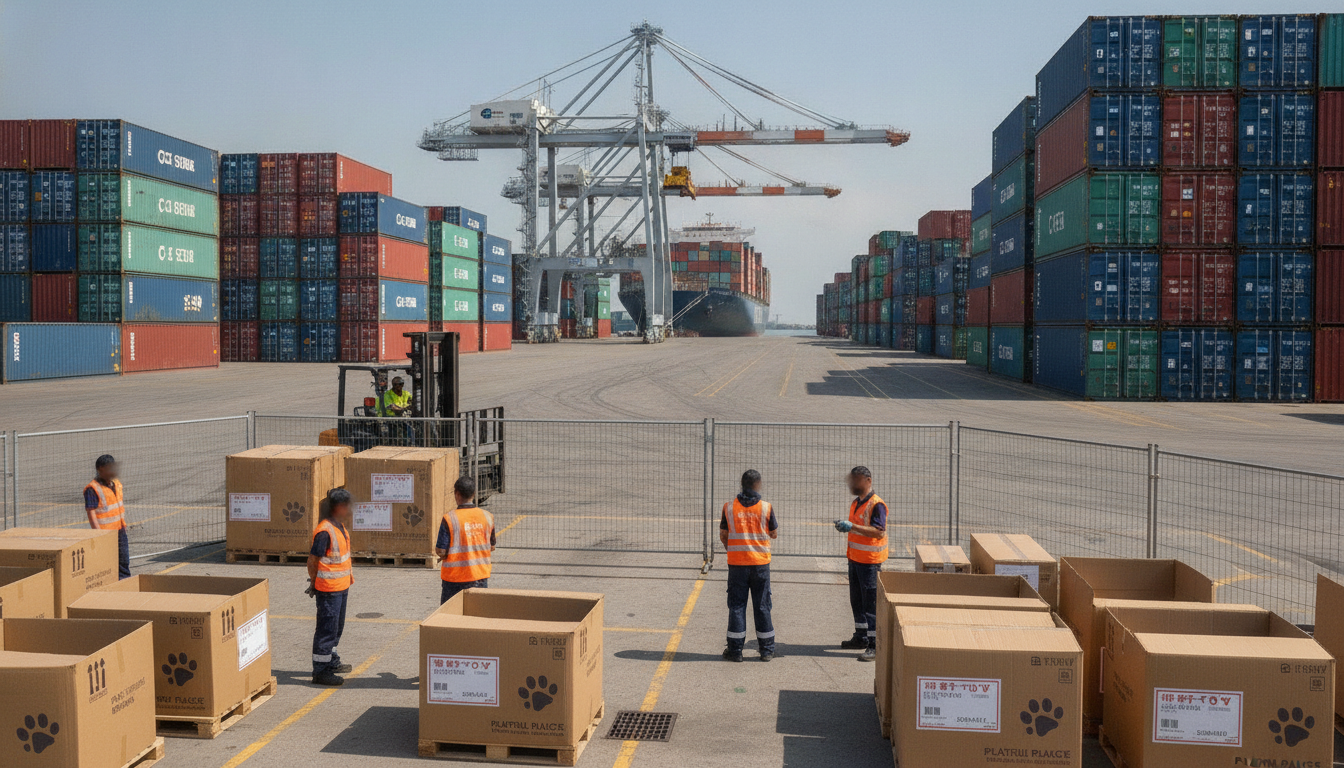
The true cost importing pet toys China to Spain typically adds 45-55% to the factory FOB price once you account for ocean freight, insurance, customs duty, Spain’s 21% import VAT, customs brokerage, SOIVRE inspection fees, port handling, inland delivery, and packaging-producer registration charges. A rubber chew toy quoted at €1.50 FOB Ningbo reaches your Madrid warehouse at approximately €2.20-2.30 per unit, with VAT representing the largest single add-on and freight costs varying by shipment volume and routing.
📋 Table of Contents
- Executive Summary
- What Is the Factory FOB Price Baseline for Pet Toys?
- How Much Do Ocean Freight and Insurance Add?
- What Customs Duty and TARIC Code Apply to Pet Toys?
- How Is Spain’s 21% Import VAT Calculated?
- What Do Customs Brokerage and Port Handling Cost?
- What Product Safety and Compliance Costs Apply?
- How Much Does Inland Delivery and Warehousing Add?
- Worked Example: 5,000-Unit Rubber Chew Toy Shipment
- What Hidden Costs Do First-Time Importers Miss?
- Key Takeaways
- Frequently Asked Questions
Executive Summary
- Total landed-cost markup: Expect 45-55% above the factory FOB price when importing pet toys from China to Spain, with VAT and freight representing the two largest components.
- Spain import VAT: Applied at 21% on the customs value, which includes the FOB price, freight, insurance, and any applicable customs duty.
- Customs duty range: Pet toys typically fall under TARIC codes 9503 00 (toys for pets or animals) or material-specific codes with duty rates between 0% and 4.7%, depending on construction.
- New low-value charges: From July 2026, shipments valued up to €150 incur a flat €3 customs duty per category, plus a €2 handling fee from November 2026.
- Compliance documentation: Spanish customs require a commercial invoice, packing list, bill of lading, EORI registration, and product-safety declarations covering chemical restrictions and labeling.
What Is the Factory FOB Price Baseline for Pet Toys?
The factory FOB price is your starting point and varies widely by toy type, material, complexity, and order volume. Rubber chew toys typically quote between $0.80 and $2.50 FOB per unit for orders of 3,000-10,000 pieces, while rope toys range from $0.50 to $1.80, plush squeaker toys from $1.20 to $3.50, and interactive puzzle feeders from $3.00 to $8.00. Prices drop 15-25% when you scale from 3,000 to 10,000 units, and another 10-15% when you reach 20,000-unit production runs.
Material and Construction Impact on FOB Price
Natural rubber and food-grade silicone toys command a 20-40% premium over standard TPR (thermoplastic rubber) because raw-material costs are higher and factory certifications stricter. Multi-material toys combining rope, rubber, and squeakers add assembly labor, pushing FOB prices up by 30-50% compared to single-material designs. Electronic or battery-powered toys require additional safety testing and component sourcing, typically doubling the FOB price of a comparable non-electronic item.
MOQ and Tooling Considerations
Most pet-toy factories in Guangdong and Zhejiang set minimum order quantities between 1,000 and 5,000 pieces per SKU. Custom molds for unique shapes or branded designs cost $800-$3,500 depending on complexity, amortized across the first production run. Stock molds with minor customization (color, logo printing) eliminate tooling fees but limit differentiation. Working with a trusted China sourcing agent helps you negotiate MOQ flexibility and verify that the factory’s business license scope covers pet-product manufacturing, not just general toy production.
How Much Do Ocean Freight and Insurance Add?
Ocean freight from major Chinese ports (Ningbo, Shanghai, Shenzhen, Yantian) to Spanish ports (Valencia, Barcelona, Algeciras) costs approximately $1,200-$2,800 per 20-foot container and $2,400-$5,200 per 40-foot container as of late 2026, depending on carrier, season, and fuel surcharges. A 20-foot container holds roughly 8,000-12,000 units of medium-density pet toys (rope toys, rubber chews), while a 40-foot high-cube container accommodates 18,000-25,000 units, making per-unit freight cost highly volume-sensitive.
Per-Unit Freight Calculation
For a 5,000-unit shipment of rubber chew toys occupying half a 20-foot container (shared consolidation), your freight portion runs approximately $600-$1,400, translating to $0.12-$0.28 per unit. Full-container loads (FCL) of 10,000+ units drop per-unit freight to $0.08-$0.15. Less-than-container-load (LCL) shipments under 2 cubic meters cost $80-$150 per cubic meter, often resulting in $0.30-$0.50 per unit for small test orders, making LCL economical only for initial samples or low-volume SKU trials.
Marine Insurance
Marine cargo insurance typically costs 0.3-0.6% of the CIF value (Cost, Insurance, Freight), covering loss or damage in transit. For a $7,500 FOB shipment with $1,000 freight, insurance runs approximately $25-$50. Most buyers purchasing FOB terms arrange their own insurance; buyers using CIF terms have the supplier include it, though verifying coverage limits and exclusions remains critical.
What Customs Duty and TARIC Code Apply to Pet Toys?
Pet toys imported into Spain fall under the EU’s TARIC (Integrated Tariff of the European Union) classification system, with the specific code and duty rate determined by material composition and intended use. The most common classification is TARIC 9503 00 (toys for pets or animals), which carries a 0% duty rate for most non-electronic items. However, toys classified by their primary material (rubber, textile, plastic) may attract duty rates between 2.7% and 4.7%.
Common TARIC Codes and Duty Rates
Classification Disputes and Binding Tariff Information
Spanish customs officers determine the final classification at the point of entry, and disputes arise when a toy’s construction spans multiple material categories. A rope toy with rubber end-caps might be classified as textile (6307 90, 2.7% duty) or rubber (4016 99, 2.7% duty) depending on which material predominates by weight. To eliminate uncertainty, importers can request a Binding Tariff Information (BTI) ruling from Spanish customs before the first shipment, locking in the classification for three years across all EU member states.
How Is Spain’s 21% Import VAT Calculated?
Spain applies a standard 21% import VAT to the customs value of goods entering from outside the EU. The customs value is not simply the FOB price; it is calculated as the CIF value (FOB price plus freight plus insurance) plus any applicable customs duty. This means VAT compounds on top of duty, and both compound on top of freight and insurance, creating a layered cost structure that catches first-time importers off guard.
Step-by-Step VAT Calculation
Start with your FOB invoice value, add ocean freight and insurance to reach the CIF value, then add customs duty (if applicable) to reach the customs value, and finally apply 21% VAT to that customs value. For example, a shipment with a €7,500 FOB value, €1,000 freight, €40 insurance, and a 2.7% duty rate produces a CIF value of €8,540, a duty charge of €230.58, a customs value of €8,770.58, and a VAT charge of €1,841.82, bringing the total border cost to €10,612.40 before brokerage and port fees.
According to SuanSupply (2026), a worked Spain example shows a €2,000 order plus €300 freight and a 4% duty rate producing approximately €594.32 in border taxes and charges.
VAT Recovery for Registered Businesses
Spanish businesses registered for VAT can reclaim the 21% import VAT as input tax on their quarterly VAT returns, making it a cash-flow issue rather than a true cost. However, the VAT must be paid upfront at customs clearance, typically within 3-5 business days of the goods arriving at the port. Non-EU businesses without Spanish VAT registration cannot recover this charge, turning it into a permanent 21% cost addition that must be factored into retail pricing or absorbed as margin erosion.
What Do Customs Brokerage and Port Handling Cost?
Customs brokerage covers the preparation and submission of your H1 customs declaration (the EU’s single administrative document), EORI registration verification, TARIC classification, duty and VAT calculation, and liaison with Spanish customs authorities. Brokers charge either a flat fee per shipment (€80-€250 for standard declarations) or a percentage of the customs value (0.5-1.5%), with the flat-fee model more common for routine pet-toy imports under €50,000.
Port Handling and Terminal Charges
Spanish ports (Valencia, Barcelona, Algeciras) levy terminal handling charges (THC) of approximately €120-€180 per 20-foot container and €180-€280 per 40-foot container, covering the unloading, stacking, and gate-out processing of your container. Documentation fees, customs scanning, and security surcharges add another €40-€80 per shipment. LCL shipments incur deconsolidation fees of €60-€120 per cubic meter at the consolidation warehouse, plus per-pallet or per-carton handling charges.
SOIVRE Inspection Fees
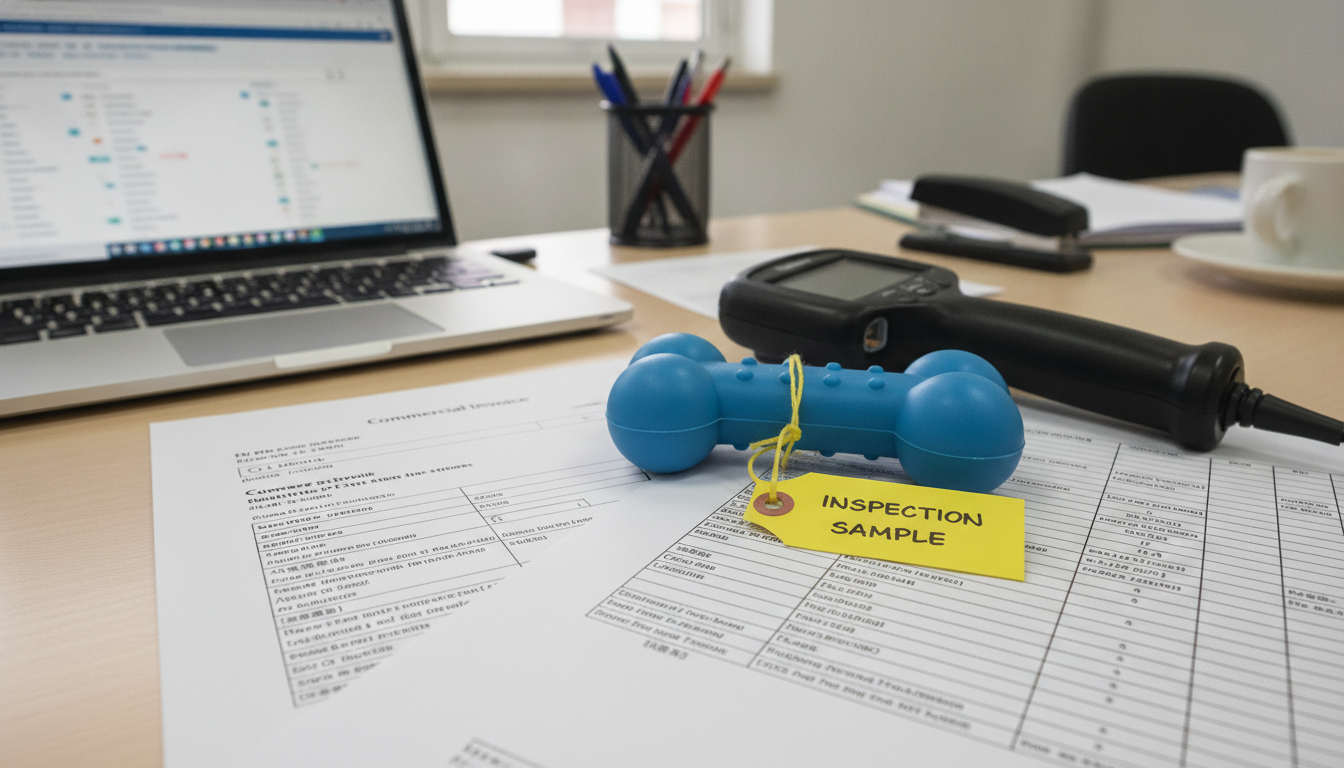
SOIVRE (Servicio Oficial de Inspección, Vigilancia y Regulación de las Exportaciones) is Spain’s official inspection service for certain product categories. Pet toys containing textiles, rubber, or plastics may trigger a SOIVRE inspection to verify compliance with EU chemical restrictions (REACH, phthalates, azo dyes). Inspection fees range from €80 to €200 per shipment depending on the number of SKUs and sample testing required, and the process adds 2-5 business days to clearance time.
What Product Safety and Compliance Costs Apply?
Pet toys entering Spain must comply with EU chemical safety regulations, labeling requirements, and traceability standards. While pet toys are not subject to the EU Toy Safety Directive (which applies to children’s toys), they must meet REACH Regulation (EC) No 1907/2006 restrictions on hazardous substances, particularly phthalates, heavy metals (lead, cadmium, mercury), and azo dyes in textile components.
Chemical Testing and Certification
Third-party laboratory testing for REACH compliance costs €300-€800 per material type, with multi-material toys requiring separate tests for rubber, textile, and plastic components. Testing turnaround runs 7-14 days, and certificates remain valid for the specific material formulation tested. Changing suppliers or material batches requires retesting. Many importers request test reports from the factory’s existing certifications, but Spanish customs may reject factory-issued reports and demand EU-accredited lab results, particularly for first-time importers or high-risk materials.
Labeling and Traceability Requirements
Every pet toy sold in Spain must carry a label identifying the manufacturer or EU importer, country of origin, material composition, and any applicable safety warnings. Labels must be in Spanish, permanently affixed or printed on the product or its retail packaging, and legible throughout the product’s expected lifespan. Non-compliance results in customs holds, fines of €600-€6,000 per violation, and potential product seizure. Our quality control team verifies labeling compliance during pre-shipment inspections, catching errors before goods leave China.
Packaging Producer Registration
Spain’s packaging waste regulations require importers to register with an authorized packaging-waste management system (SCRAP) and pay an annual fee based on the weight and type of packaging materials placed on the Spanish market. According to DDPLINK (2026), Spanish packaging obligations may include a €0.45-per-kilogram charge on non-reusable plastic packaging under the cited national packaging regime. Registration costs €150-€400 annually, plus the per-kilogram charges calculated quarterly based on your import volumes.
How Much Does Inland Delivery and Warehousing Add?
Once your shipment clears Spanish customs, inland delivery from the port to your warehouse or fulfillment center represents the final cost layer. Full-container loads delivered from Valencia port to Madrid (350 km) cost approximately €400-€700 per 20-foot container and €600-€1,100 per 40-foot container, depending on fuel prices, tolls, and whether the carrier provides tail-lift or pallet-jack unloading. Barcelona to Madrid (620 km) runs €600-€950 for a 20-foot container.
LCL and Pallet Delivery Costs
LCL shipments and smaller pallet loads use groupage (shared-truck) services, with rates calculated per pallet or per cubic meter. Valencia to Madrid groupage costs €45-€80 per pallet for standard 1.2m x 0.8m Euro pallets, with a typical 2-4 day transit time. Express courier services (DHL, UPS, FedEx) charge €8-€15 per kilogram for urgent small-parcel deliveries, practical only for samples or emergency restocks, not commercial shipments.
Warehousing and Fulfillment
Third-party logistics (3PL) providers in Spain charge €4-€12 per pallet per month for storage, plus pick-and-pack fees of €1.50-€3.50 per order and €0.40-€0.80 per item for e-commerce fulfillment. Amazon FBA inbound prep (labeling, polybagging, case packing to Amazon standards) adds €0.15-€0.40 per unit. Our Amazon FBA prep service handles these tasks in China before shipment, eliminating Spanish prep fees and reducing your per-unit landed cost by €0.20-€0.50.
Worked Example: 5,000-Unit Rubber Chew Toy Shipment
This worked example calculates the true cost importing pet toys China to Spain for a 5,000-unit order of rubber chew toys, showing how each cost layer compounds from the factory gate to your Madrid warehouse.
This example shows the true cost importing pet toys China to Spain adds €0.76 per unit (50.6%) to the factory price, with VAT alone contributing €0.37 (16.4% of the landed cost). Registered Spanish businesses reclaim the VAT, reducing the non-recoverable markup to 29.6%, or €0.39 per unit.
What Hidden Costs Do First-Time Importers Miss?
First-time importers consistently underestimate several cost categories that emerge only after the goods arrive in Spain, turning a profitable margin on paper into a break-even or loss-making shipment in reality. These hidden costs fall into three categories: compliance surprises, operational inefficiencies, and quality failures.
Demurrage and Storage Penalties
Spanish ports allow 5-7 free days for container pickup after the vessel docks. Beyond that window, demurrage charges accrue at €40-€80 per day for a 20-foot container and €60-€120 per day for a 40-foot container. Delays in customs clearance (missing documents, SOIVRE inspection holds, VAT payment processing) or inland-transport scheduling easily push pickup into the penalty period. A 10-day delay costs €400-€800, wiping out the margin on 200-400 units of a typical pet toy.
Product Rework and Relabeling
Spanish customs rejects shipments with non-compliant labeling (missing Spanish text, incorrect material declarations, absent importer contact details) and issues a notice to rework or re-export. Rework in Spain costs €2-€5 per unit for label replacement or repackaging, compared to €0.10-€0.30 per unit if caught during pre-shipment inspection in China. Our supplier management process includes label artwork review and sample approval before bulk production, eliminating this risk.
Returns and Disposal Costs
Pet toys that fail REACH testing after arrival face three options: re-export to China (freight cost plus Chinese import duty and VAT), disposal in Spain (€150-€400 per pallet for hazardous-waste handling if the product contains restricted chemicals), or rework to remove non-compliant components (often impossible for molded rubber or textile items). All three options cost more than the original shipment value, making pre-shipment chemical testing a non-negotiable step despite its €300-€800 upfront cost.
Currency Fluctuation and Payment Timing
Most Chinese suppliers quote FOB prices in US dollars, while Spanish costs (VAT, brokerage, inland delivery) are invoiced in euros. A 5% USD/EUR exchange-rate swing between the deposit payment and final balance can add or subtract €375 on a $7,500 order. Importers using open-account terms (payment 30-90 days after shipment) face additional exposure if the euro weakens during the credit period. Our Yiwu office offers 90-120 day open-account settlement terms to qualifying buyers, allowing you to match payment timing with your own sales cycle and reduce currency risk.
Key Takeaways
- Total landed-cost markup: Budget 45-55% above the factory FOB price when calculating the true cost importing pet toys China to Spain, with VAT and freight as the two largest add-ons.
- VAT compounds on duty: Spain’s 21% import VAT applies to the customs value (CIF plus duty), not just the FOB price, creating a layered cost structure that catches first-time importers unprepared.
- TARIC classification matters: Pet toys classified under 9503 00 carry 0% duty, while material-specific codes (rubber, textile, plastic) attract 2.7-4.7% duty, making accurate classification worth hundreds of euros per shipment.
- Pre-shipment testing prevents seizure: REACH compliance testing costs €300-€800 per material type in China but eliminates the risk of post-arrival rejection, rework fees of €2-€5 per unit, or disposal costs exceeding the shipment value.
- Volume drives per-unit freight: Full-container loads drop per-unit freight to €0.08-€0.15, while LCL shipments under 2 cubic meters cost €0.30-€0.50 per unit, making order volume the single largest lever for reducing landed cost.
- Hidden costs accumulate quickly: Demurrage, relabeling, packaging registration, and currency fluctuation add 5-12% to the landed cost when not planned for, turning a 30% gross margin into a 20% realized margin or worse.
Frequently Asked Questions
Do I need an EORI number to import pet toys from China to Spain?
Yes, every business or individual importing goods into Spain from outside the EU must register for an EORI (Economic Operators Registration and Identification) number before the first shipment clears customs. Spanish EORI numbers start with the prefix ES followed by your tax identification number (NIF or CIF). Registration is free and processed online through the Spanish Tax Agency (Agencia Tributaria) website, typically taking 3-5 business days. Your customs broker cannot file the H1 declaration without a valid EORI number, and attempting to clear goods without one results in automatic shipment holds and daily storage fees at the port.
Can I reduce the true cost importing pet toys China to Spain by using DDP shipping terms?
DDP (Delivered Duty Paid) terms shift customs clearance, duty payment, VAT payment, and inland delivery responsibility to the Chinese supplier, simplifying your logistics but typically increasing the total cost by 8-15% compared to FOB terms because the supplier adds a risk premium and markup on services they subcontract. According to DDPLINK (2026), a DDP example shows an $8,500 goods order becoming $12,917 delivered, or 52% above the goods value; excluding recoverable VAT, the increase is 26%. DDP makes sense for first-time importers unfamiliar with Spanish customs procedures or for small test orders under €5,000, but experienced buyers save money by arranging their own freight and customs clearance under FOB or CIF terms.
What is the new €3 customs duty charge for low-value imports to Spain?
From July 1, 2026, consumer imports valued at up to €150 from outside the EU incur a fixed €3 customs duty per category of goods, according to the Spanish Tax Agency (2026). A further €2 handling fee per category of item applies to qualifying low-value imports from November 1, 2026. These charges apply primarily to direct-to-consumer e-commerce parcels and do not replace the standard customs-duty calculation for commercial B2B shipments above €150, which continue to use TARIC-based duty rates and the CIF valuation method. The €3 flat duty simplifies clearance for online shoppers but offers no advantage to importers bringing in commercial quantities of pet toys.
Calculating the true cost importing pet toys China to Spain requires adding every layer from factory gate to your warehouse, not just the FOB price and freight. Spain’s 21% VAT, compounding duty calculations, SOIVRE inspections, packaging-producer fees, and hidden costs like demurrage and relabeling turn a quoted €1.50 toy into a €2.20-€2.30 landed unit. Our Yiwu-based sourcing team verifies factory certifications, negotiates FOB pricing across 1000+ verified suppliers, arranges pre-shipment REACH testing, confirms Spanish labeling compliance, and coordinates freight and shipping with transparent cost breakdowns at every step, eliminating surprises and protecting your margin.
Ready to calculate your exact landed cost and source compliant pet toys with full transparency?
Request Your Free Cost Breakdown →
Written by the Goodcantrading Sourcing Team.