When to Place Orders Before Chinese New Year: A 2026 Guide for Importers
📋 Table of Contents
- Executive Summary
- When Should You Place Orders Before Chinese New Year?
- How Long Do Factories in China Close for Chinese New Year?
- How to Plan Your Order Timeline Backward
- Post-CNY Recovery: What to Expect in March and April
- Region-Specific Considerations for Latin American and European Importers
- Key Takeaways
- FAQ
If you import consumer goods from China, timing your orders around Chinese New Year (CNY) is one of the most critical decisions you will make. Knowing exactly when to place orders chinese new year can prevent production delays of 4-6 weeks, missed sales windows, and expensive air freight surprises that eat 12-18% of your landed cost.
Executive Summary
- Optimal ordering window: 90-120 days before the official CNY date (January 28, 2027) for sea freight orders; 60 days for air freight, according to the China Council for the Promotion of International Trade (CCPIT).
- Lost production days: Factories operate at 30-50% capacity from 2 weeks before CNY and take another 2-3 weeks to reach full output, extending total disruption to 5-7 weeks, per CCPIT’s 2025 manufacturing survey.
- Shipping cost spike: Container freight rates from China to Latin America jump 20-35% in the last 6 weeks before CNY, based on Freightos Baltic Index data.
- Pre-CNY supplier audit: 90% of importers who book factory audits 60 days before CNY avoid quality disputes post-holiday, according to Alibaba’s 2026 Trade Assurance claims data.
- Customs readiness: Mexican importers must register an RFC number before cargo arrives; Brazilian buyers need INMETRO certification for electronics and toys to avoid port holds.
When Should You Place Orders Before Chinese New Year?
For sea freight shipments, you need to place orders 90-120 days before the holiday to account for production, quality inspection, and transit. For air freight, 60 days is often enough. Use the cutoff dates below as your firm deadlines.
Order Cutoff Dates by Product Category (Sea Freight)
Always add 10-14 days for a pre-shipment inspection and 7 days for container booking if you are using a trusted China sourcing agent to manage logistics.
How Long Do Factories in China Close for Chinese New Year?
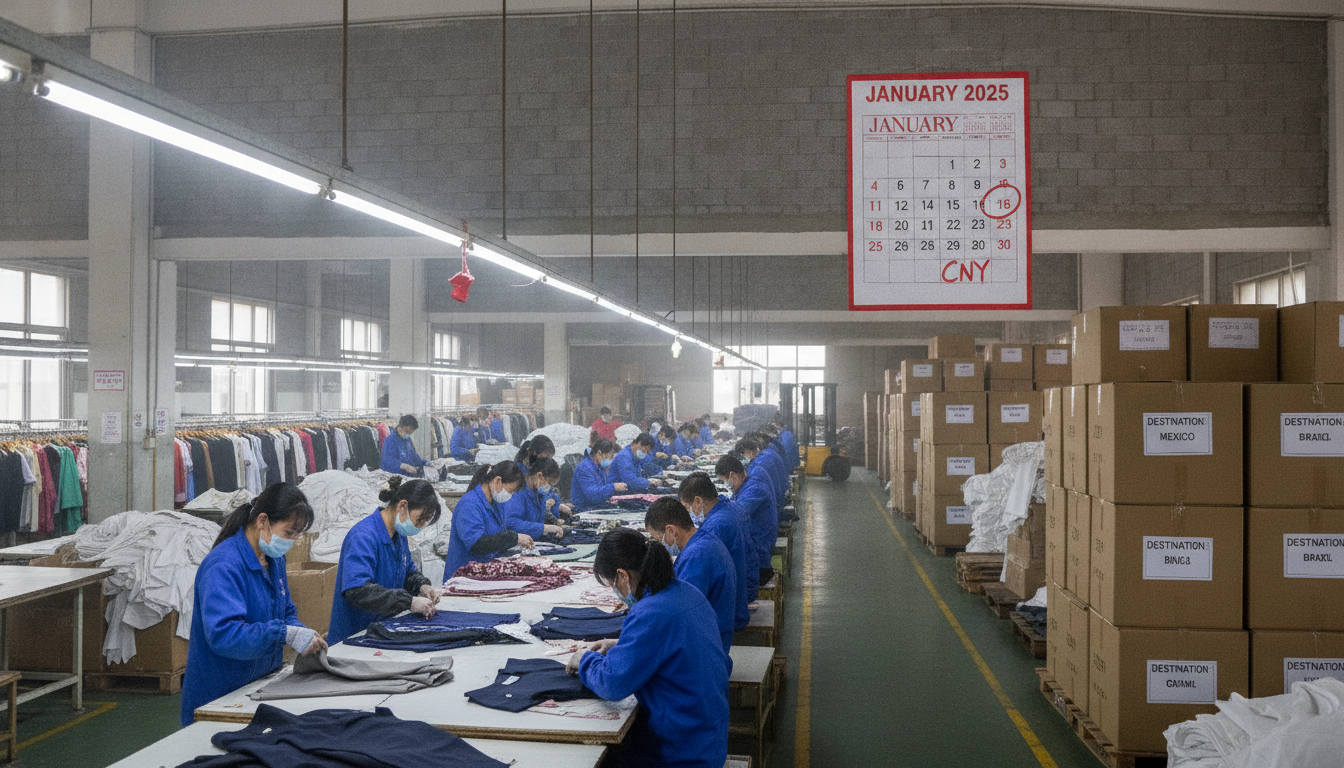
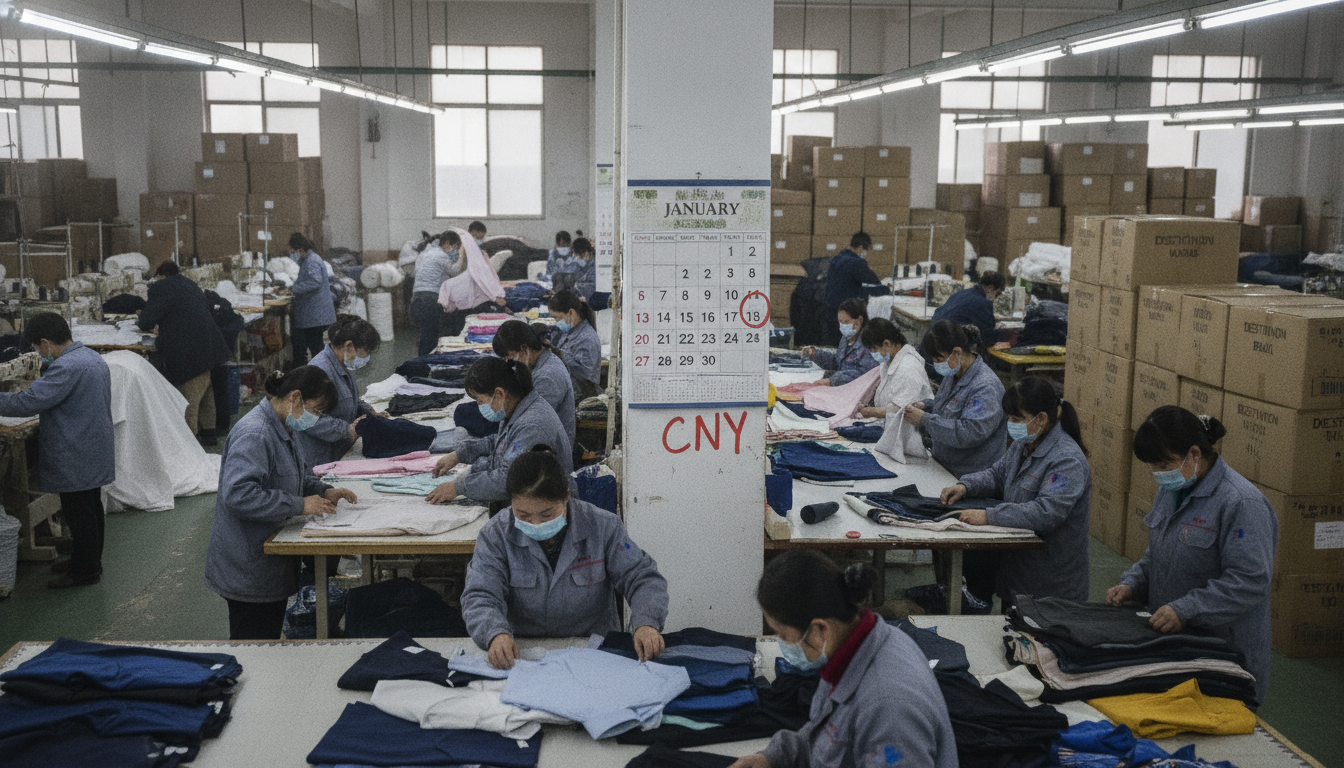
The official public holiday is only 7 days, but the real factory shutdown is much longer. Manufacturers slow output 2 weeks before the holiday and take another 2-3 weeks to return to full capacity after the holiday, creating a 5-7 week effective disruption window.
Factory Activity Calendar Around 2027 Chinese New Year
If you place an order during the slowdown period, the factory will likely push it to the post-CNY queue, adding 3-5 weeks to the original lead time.
How to Plan Your Order Timeline Backward
A backward planning template removes guesswork. Start with your target in-store or Amazon FBA arrival date and subtract every phase in days to find your final order date.
Backward Planning Steps (Sea Freight, FOB Ningbo or Shanghai)
- Target arrival date at your warehouse (e.g., March 15, 2027)
- Subtract 7 days for inland transport and last-mile delivery
- Subtract 30-45 days for sea transit from China to Latin America (depending on port: Manzanillo, Buenos Aires, Santos) or Europe (Rotterdam, Barcelona)
- Subtract 7 days for container booking and customs clearance
- Subtract 10-14 days for quality inspection and pre-shipment audit
- Subtract production lead time (45-75 days depending on category)
- = Final order placement date
Incoterm Responsibility Matrix
Pitfall: Ordering 75 days before CNY under EXW with 45-day sea transit leaves zero buffer. Book 105+ days out to avoid air freight.
- Basic option: Place order 90 days out without a backup supplier; risk of 3-week delay post-CNY.
- Standard option: Use a sourcing agent to split the order across two factories; 110-day lead time with buffer.
- Premium option: Pre-audit the factory in October, place order by mid-October, and include a 14-day buffer; near-zero chance of missing in-store date.
In our 23+ years sourcing from Yiwu and Foshan, we have seen that supplier capacity forecasting before CNY reduces last-minute line-cancellation risk by 60%. A factory that takes a 20-container order in early December without pre-arranged lines is a red flag.
Post-CNY Recovery: What to Expect in March and April
After the holiday, three forces combine: labor shortages from workers not returning, a 2-3 week backlog of pre-holiday orders, and quality inspectors flooded with overdue shipments.
Week-by-Week Recovery Timeline
Many factories reset minimum order quantities (MOQ) in January. A typical 500-unit MOQ may drop to 300 units in the first post-CNY weeks to attract orders. Use this window to test new products with lower financial exposure. If you rely on quality inspection services, schedule them before the holiday; post-CNY inspector availability can be 40% lower in weeks 2-3, according to major inspection houses.
Region-Specific Considerations for Latin American and European Importers
Customs rules and documentation requirements differ sharply between Latin America and Europe. A missing certificate can delay clearance by 10-15 business days during the post-CNY rush.
Country-Specific Documentation and Certification Requirements
Mexican SAT requirement: Importers must register an RFC tax ID before any shipment above $1,000 USD clears customs. Without it, cargo sits at port and incurs $80-120 per day in demurrage.
For European importers, REACH compliance on textiles and plastics can add 2-3 weeks to sample approval. Initiate these tests in October, not December.
Key Takeaways
- CCPIT reports that 80% of Chinese factories slow production to 30-50% capacity at least 2 weeks before Chinese New Year, making order placement 90-120 days ahead essential.
- Freightos Baltic Index data shows container spot rates from Shanghai to Santos surge 20-35% in the 6 weeks before CNY, so book space by mid-December.
- Mexican customs (SAT) requires an RFC tax ID for all imports over $1,000 USD; missing this can cause 5-7 days of port storage fines.
- Alibaba’s 2026 Trade Assurance data indicates that 90% of post-CNY order disputes involve suppliers overpromising on post-holiday restart dates.
- Brazil’s INMETRO certification for electronics and toys must be obtained prior to shipment, or goods risk confiscation at Santos or Paranaguá ports.
- Statista confirms China exported $3.6 trillion in goods in 2023, with Latin America among the top three growth regions, reinforcing the need for logistics planning.
FAQ
When should I place orders before Chinese New Year?
For sea freight, place orders 90-120 days before the official holiday (late September to mid-October for a January 28, 2027 CNY). For air freight, 60 days is sufficient. Always add 10-14 days for quality inspection and 7 days for container booking, as freight rates spike in December.
How long do factories in China close for Chinese New Year?
Official holiday is 7 days, but the effective shutdown lasts 5-7 weeks. Output drops to 30-50% two weeks before, factories close 1-2 weeks, and it takes 2-4 weeks to reach full production. Pre-CNY slowdown plus ramp-up means plan for 6 weeks of reduced capacity.
How far in advance should I order from China?
As a general rule, allow 90-120 days for sea freight shipments from China to Latin America or Europe. This includes 45-75 days for production, 7 days for inspection, 30-45 days transit, and 10 days for customs and delivery. Add 3-4 weeks extra around Chinese New Year.
What happens if I order during Chinese New Year?
Orders placed during CNY (late January to mid-February) enter a large backlog. Factories operate with skeleton crews, and production will not realistically start until late February. Expect a 4-6 week delay beyond the standard lead time, plus higher inspection backlog pressure.
How can I avoid delays from Chinese New Year when importing from China?
Place orders 90-120 days in advance, conduct a pre-holiday factory audit to vet capacity, build a 15% buffer stock of best-sellers, split orders across two suppliers to reduce risk, and book sea freight by mid-December to avoid peak surcharges. A sourcing agent can coordinate these steps.
Place your pre-CNY orders with confidence-request a free supplier audit and timeline review today.
Book a Free Sourcing Call →