Chinese New Year 2026 Production Calendar: Complete Guide
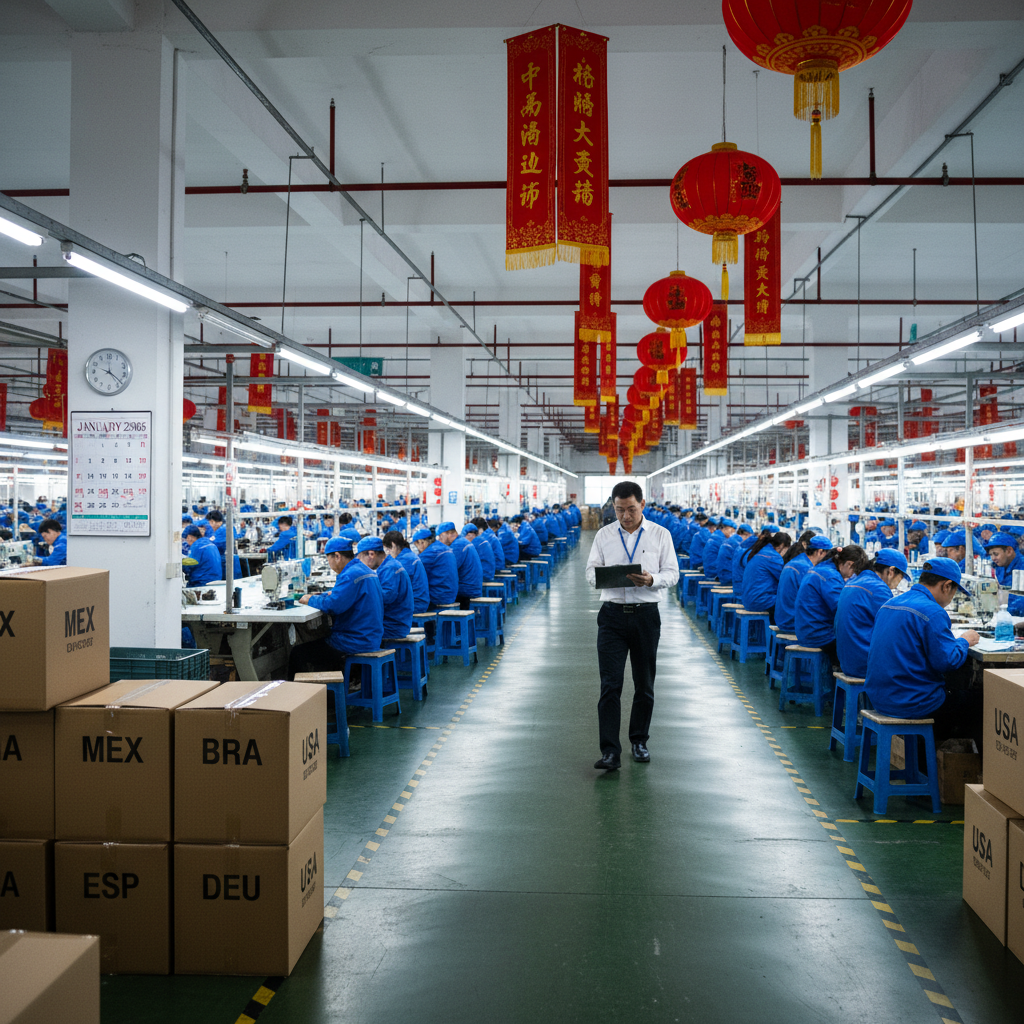
Every year, importers scramble to adjust orders around China’s longest holiday shutdown. If you’re sourcing products from China for delivery to Mexico, Brazil, Colombia, or Europe, understanding the Chinese New Year 2026 production calendar determines whether your containers arrive on time or sit idle for three weeks. Factory closures typically span 14 to 21 days, but production slowdowns start weeks earlier and recovery extends weeks after official reopenings.
Chinese New Year (Spring Festival) falls on January 29, 2026. Most factories close from January 26 through February 8, though some remain shuttered until February 15 depending on location and industry. According to MDIC Brazil (2025), Brazil-China trade volume reached $157 billion in 2025, with CNY delays affecting 22% of shipments. Mexican imports from China grew 17% in 2025 per Mexican SAT, requiring earlier planning for 2026. Working with a trusted China sourcing agent helps you navigate these disruptions with accurate factory schedules and backup supplier networks.
Chinese New Year 2026 Production Calendar: Critical Dates
The 2026 Spring Festival officially runs from January 29 through February 4, but manufacturing impact extends far beyond these seven days. Production capacity drops 40-60% starting mid-January as workers return to hometowns early. Post-holiday recovery is equally slow, with full capacity typically not restored until late February.
Official Holiday Period
January 29, 2026 marks the Lunar New Year, with the official public holiday spanning January 29 to February 4 (7 days). However, most factories extend closures to 10-14 days, reopening between February 5-8 for office staff and February 8-12 for production lines. Factories in Guangdong Province (Shenzhen, Dongguan, Foshan) typically close January 24-26 and reopen February 6-8. Zhejiang Province manufacturers (Yiwu, Ningbo, Wenzhou) shut down January 26-28 and restart February 8-10.
Pre-Holiday Slowdown Timeline
Production efficiency deteriorates three weeks before closure. By January 5, 2026, many factories stop accepting new orders for pre-CNY delivery. Worker absenteeism climbs 15-25% from January 10-20 as employees take early leave. Quality control becomes inconsistent during this period. Rush orders placed after January 1 face 30-50% premium charges and higher defect rates.
Post-Holiday Recovery Schedule
Factories don’t return to full capacity immediately. Week one (February 9-15): 40-50% staffing as workers trickle back. Week two (February 16-22): 60-75% capacity with training for new hires. Week three (February 23-March 1): 80-90% capacity, still managing order backlogs. Full 100% capacity typically resumes by March 2-8, 2026. According to Yiwu Trading Company (2026), sourcing agent bookings for Canton Fair 2026 Phase 1 rose 25% from 2025 levels, indicating stronger pre-CNY planning among professional buyers.
Order Placement Deadlines for the Chinese New Year 2026 Production Calendar
Missing these deadlines means your goods sit in production queues until March. Calculate backward from your required delivery date, accounting for manufacturing lead time, Chinese customs clearance (3-5 days), ocean freight duration, and destination customs processing.
Sea Freight to Latin America
For Mexico (Manzanillo, Veracruz): 18-25 days transit time. Place orders by November 25, 2025 for standard products (15-day production). For custom manufacturing (30-45 days), order by October 20, 2025. Brazil (Santos, Rio): 35-42 days transit. Order standard goods by November 10, 2025; custom products by October 1, 2025. Colombia (Cartagena, Buenaventura): 28-35 days transit. Deadline November 15, 2025 for standard items.
These timelines assume your quality inspection and container loading happen without delays. Add 7-10 buffer days for any customized packaging, labeling, or compliance documentation required by Latin American customs authorities.
Sea Freight to Europe
Spain (Valencia, Barcelona): 32-38 days. Order by November 12, 2025 for standard goods. Germany (Hamburg): 35-40 days. Place orders by November 8, 2025. France (Le Havre): 34-39 days. Deadline November 10, 2025. UK (Felixstowe, Southampton): 30-36 days. Order by November 13, 2025.
European importers should factor in additional time for CE marking verification, REACH compliance documentation, and any product-specific certifications required before customs clearance.
Air Freight Emergency Options
Air freight to Mexico City takes 5-7 days, to São Paulo 8-10 days, to Madrid 6-8 days. Last possible order date for air shipment: January 12, 2026 for goods with 5-day production time. However, air freight rates spike 200-300% from January 10-25 as desperate buyers compete for limited cargo space. Expect $8-12 per kilogram versus the normal $4-6 rate.
Factory Shutdown Variations by Chinese New Year 2026 Production Calendar Region
Not all Chinese manufacturing hubs follow identical schedules. Regional differences stem from local government mandates, workforce demographics, and industry concentration.
Guangdong Province Manufacturing Belt
Shenzhen electronics factories: Close January 24, reopen February 7-9. Dongguan apparel and toy manufacturers: Shut January 25, restart February 8-10. Foshan furniture producers: Close January 26, reopen February 9-12. Guangdong employs millions of migrant workers from inland provinces who travel 1,000-2,000 kilometers home, extending their absence. Our Foshan warehouse processes consolidated shipments year-round, but even we see 60% reduced throughput from January 20 through February 15.
Zhejiang Province (Yiwu Market Hub)
Yiwu small commodities market: Officially closes January 26, but 70% of stalls shut by January 23. Reopening is staggered, with only 40% operational by February 10 and full market activity resuming February 18-20. Ningbo port-adjacent factories: Close January 27, reopen February 9-11. These facilities prioritize export orders and often maintain skeleton crews during CNY for urgent shipments. According to Mintec (2026), Chinese tapioca starch imports increased 12% year-over-year in Q1 2026 ahead of CNY inventory build-up, demonstrating how Chinese buyers themselves stockpile before the holiday.
Fujian and Jiangsu Provinces
Fujian (Xiamen, Quanzhou) footwear and stone product factories: Close January 27-29, reopen February 10-13. Jiangsu (Suzhou, Nanjing) textile and chemical plants: Shut January 26-28, restart February 8-11. These provinces have slightly shorter closures due to higher proportions of local workers who don’t travel far for the holiday.
Product Category Impact on Chinese New Year 2026 Production Calendar
Different industries experience varying degrees of CNY disruption based on production complexity, raw material dependencies, and workforce skill requirements.
Apparel and Textiles
Garment factories face the longest recovery periods. Sewing operators are predominantly young women who often don’t return after CNY, forcing factories to recruit and train replacements. Expect 25-35% workforce turnover post-holiday. Pre-CNY order cutoff: December 1, 2025 for spring/summer collections. Post-CNY production resumes at 50% capacity February 16, reaching 85% by March 1. Fabric mills close earlier (January 22-24) and reopen later (February 12-15) than cut-and-sew facilities.
Electronics and Components
Shenzhen electronics manufacturers maintain tighter schedules due to higher wages and more skilled labor. Pre-CNY cutoff: December 15, 2025 for complex PCB assemblies; January 5, 2026 for simple consumer electronics. Post-CNY recovery is faster, with 70% capacity by February 12 and full production by February 20. However, component shortages can delay projects if upstream suppliers (chip foundries, connector manufacturers) experience longer shutdowns.
Furniture and Home Goods
Furniture production in Foshan involves multiple stages (wood processing, upholstery, finishing, packaging) that each shut down independently. Order deadline: November 20, 2025 for container-load furniture shipments. Post-CNY, wood processing resumes first (February 9-10), but final assembly doesn’t reach full capacity until February 25-28 due to upholsterers returning late. According to Chemtrade Asia (2026), Thailand FOB tapioca starch prices reached $503 per metric ton in April 2026 due to CNY-driven Chinese demand, showing how the holiday ripples through Asian supply chains beyond China’s borders.
Logistics and Shipping Considerations for Chinese New Year 2026
Factory closures are only part of the equation. Port congestion, trucker shortages, and customs delays compound during CNY periods.
Port Operations and Container Availability
Major Chinese ports (Shanghai, Ningbo, Shenzhen, Yantian) operate on reduced schedules January 29-February 4 but don’t fully close. However, container drayage (trucking goods from factory to port) becomes extremely difficult January 22-February 10 as truck drivers return home. Book containers by January 10, 2026 to guarantee space on pre-CNY vessels. Shipping lines reduce sailings by 30-40% during CNY week, creating a vessel shortage that persists through February.
Container rates spike 15-25% for sailings departing January 15-28. A 40-foot container to Mexico that normally costs $3,200-3,800 jumps to $4,000-4,500 during peak demand. Rates normalize by late February but remain 10% elevated through March as carriers recover from schedule disruptions.
Customs Clearance Timing
Chinese customs offices operate with skeleton staff January 29-February 4, processing only urgent shipments. Export declarations submitted January 26-28 face 5-7 day delays versus the normal 1-2 days. Goods requiring inspection (food, cosmetics, electronics) should complete customs procedures by January 22 to avoid being stuck in the queue until February 5-6. Your freight and shipping partner should submit all documentation by January 20 to ensure smooth processing.
Post-CNY Shipping Bottlenecks
The real shipping crisis occurs mid-February when factories simultaneously rush to ship accumulated orders. Port congestion at Ningbo and Shanghai peaks February 18-March 5. Container waiting times at terminal gates extend from 2-3 hours to 8-12 hours. Vessel schedule reliability drops to 45-50% (meaning half of ships depart late) versus 65-70% normal reliability. Air freight capacity remains constrained through February 28 as passenger flights (which carry belly cargo) operate reduced schedules.
Strategic Planning for Chinese New Year 2026 Production Calendar
Experienced importers don’t just react to CNY, they plan inventory strategies that minimize disruption and even capitalize on the holiday dynamics.
Inventory Build-Up Strategy
Calculate your sales velocity from February through April and order sufficient stock by November 2025 to cover this period plus a 20% safety buffer. For products with 60-day lead times, this means placing orders in September-October 2025. According to China Customs (2026), Chinese import demand amplified Thai export prices by 8-10% during the 2026 pre-CNY procurement cycle, demonstrating how Chinese buyers themselves stockpile before the holiday.
Warehouse space becomes premium in December-January as everyone stockpiles. If you use warehouse consolidation services, reserve space by November 15, 2025. Our Yiwu warehouse typically reaches 85% capacity by January 10 as clients store goods for post-CNY shipping.
Dual-Sourcing and Backup Suppliers
Maintain relationships with at least two suppliers per critical product category, preferably in different provinces. If your primary Guangdong supplier closes January 24, a Jiangsu backup might operate until January 28, giving you four extra production days. Some factories offer premium