What Documents Verify China Factory ISO 14001 [2026 Guide]

To verify what documents verify China factory ISO 14001, request the original ISO 14001:2015 certificate, the site appendix listing all certified locations, the certification body’s accreditation certificate, the factory’s business license showing the legal entity name, and the latest surveillance audit report. Cross-check the certificate holder, scope, and validity dates in IAF CertSearch or the certification body’s public registry to confirm the certificate is active and covers the factory address and production activities relevant to your order.
📋 Table of Contents
- Executive Summary
- ISO 14001 Certificate and What It Must Show
- Site Appendix: Confirming the Factory Location
- Accreditation Certificate of the Certification Body
- Business License and Legal Entity Match
- Surveillance Audit Report and Certificate Status
- How to Verify Using IAF CertSearch
- Red Flags That Invalidate a Certificate
- What Documents Must You Collect to Verify ISO 14001 Before Payment
- Frequently Asked Questions
Executive Summary
- Five core documents: ISO 14001:2015 certificate, site appendix, certification body accreditation certificate, business license, and latest surveillance audit report form the complete verification package.
- IAF CertSearch registry: Cross-check the certificate number, holder name, and validity dates in the IAF database or the certification body’s own public registry to confirm the certificate has not been suspended or withdrawn.
- Scope and site match: The certificate scope must explicitly cover the manufacturing processes and product categories you are sourcing, and the certified site address must match the factory location where production will occur.
- Legal entity consistency: The certificate holder name, business license legal name, and contract signatory must all refer to the same Chinese legal entity, verified through the unified social credit code.
- Management system versus product claim: ISO 14001 certifies that a factory has processes to manage environmental impacts, not that finished products meet environmental standards or contain sustainable materials.
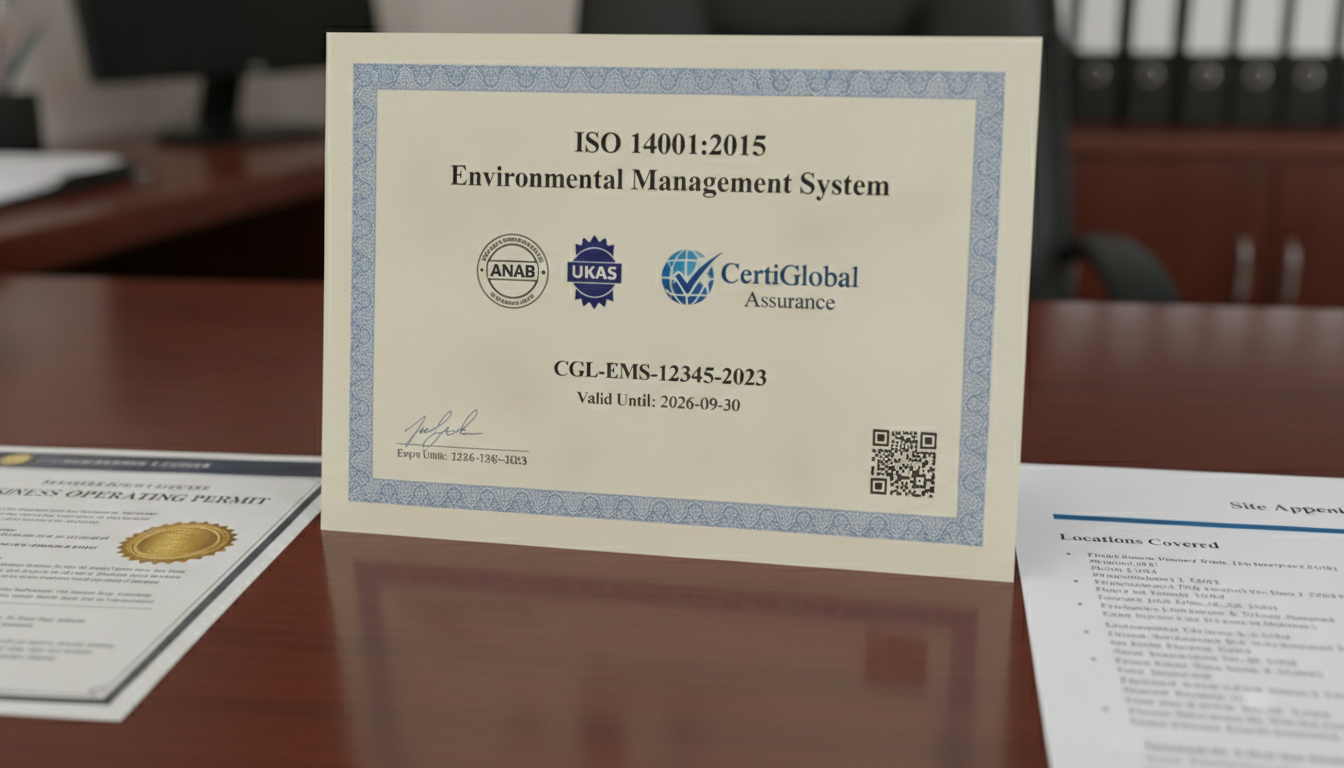
ISO 14001 Certificate and What It Must Show
The ISO 14001:2015 certificate is the primary document, but a certificate alone does not prove the factory operates an environmental management system. The certificate must display the certificate holder’s full legal name in Chinese and English, the certified site address, the certification body’s name and logo, the certificate number, the issue date, the expiry date, and the scope of certification describing which activities and product categories are covered. The standard reference must read ISO 14001:2015, not an older version.
Certificate Holder Legal Name
The certificate holder is the Chinese legal entity that owns the environmental management system. This name must match the business license exactly, character for character in Chinese. Many buyers receive certificates where the holder is a parent company or a trading company, while the actual manufacturing site is a subsidiary or subcontractor not listed on the certificate. Request the certificate in both Chinese and English to compare the legal entity name across all transaction documents.
Certified Site Address
The certificate lists one or more physical addresses where the environmental management system operates. If your production will occur at a factory not listed on the certificate, that site is not certified, regardless of what the supplier claims. A common mismatch occurs when a trading company holds the certificate for its office address, but manufacturing happens at an unrelated factory. Always request a site visit or third-party audit to confirm the certified address matches the production location.
Scope of Certification
The scope describes the activities and product categories covered by the environmental management system. A certificate scoped for office administration or warehousing does not cover manufacturing. A certificate scoped for metal fabrication does not cover textile production. The scope must explicitly include the processes and materials relevant to your order. Buyers sourcing apparel should see terms like cutting, sewing, dyeing, or finishing; buyers sourcing electronics should see assembly, soldering, or testing.
Site Appendix: Confirming the Factory Location
When a certificate holder operates multiple sites, the certification body issues a site appendix listing every certified location. The appendix shows the address, scope, and any site-specific exclusions for each facility. Without the appendix, you cannot verify whether the factory address on your purchase order is actually certified.
Multi-Site Certification Structure
Large manufacturers often hold a single certificate covering a head office and several production sites. The main certificate lists the head office as the certificate holder, and the appendix breaks down each site. If the supplier provides only the main certificate without the appendix, you have no proof the specific factory is included. Request the complete appendix and cross-check the factory address against the list.
What Documents Verify China Factory ISO 14001 When the Supplier Operates Multiple Sites
The appendix may mark certain sites as temporarily suspended or excluded from the scope due to non-conformities found during surveillance audits. A factory listed on the appendix with a suspension note is not currently certified, even though the main certificate remains valid. Always check the status column for each site and confirm the factory you are using shows an active status.
Accreditation Certificate of the Certification Body
An ISO 14001 certificate is only credible if the certification body itself is accredited by a national accreditation body recognized under the International Accreditation Forum. The accreditation certificate proves the certification body meets ISO/IEC 17021-1 requirements for conducting management system audits. Without accreditation, the certificate is not recognized internationally and will not satisfy customer audits or customs requirements in many countries.
Accreditation Marks and Logos
The ISO 14001 certificate should display an accreditation mark, such as CNAS for China, UKAS for the United Kingdom, or ANAB for the United States. The mark links the certificate to the accreditation body’s registry. Request a copy of the certification body’s accreditation certificate and verify the accreditation scope includes ISO 14001 environmental management systems. The accreditation certificate will list the standards and sectors the certification body is authorized to audit.
IAF Membership and Mutual Recognition
The accreditation body should be a signatory to the IAF Multilateral Recognition Arrangement, which allows certificates issued in one country to be recognized globally. Check the IAF website for the list of recognized accreditation bodies. Certificates issued by non-IAF-recognized bodies are not accepted by most European and Latin American importers, and they will not pass third-party factory audits required by retailers or brands.
Business License and Legal Entity Match
The Chinese business license, issued by the State Administration for Market Regulation, shows the legal entity name, unified social credit code, registered address, business scope, and legal representative. The certificate holder name on the ISO 14001 certificate must match the business license legal name exactly. Any discrepancy indicates the certificate may belong to a different company, or the supplier is using a trading company certificate to represent a manufacturing entity.
Unified Social Credit Code
The unified social credit code is an 18-character identifier unique to each Chinese legal entity. Request the business license and compare the code to the certificate holder name. If the supplier cannot provide a business license, or if the license shows a different legal name or business scope than the certificate, the certificate does not apply to the entity you are contracting with. This mismatch is one of the most common verification failures buyers encounter.
Business Scope and Production Authority
The business license lists the activities the company is legally permitted to conduct. A license scoped for wholesale trade or consulting does not authorize manufacturing. If the license does not include production or processing in its scope, the entity is a trading company, not a factory, and any ISO 14001 certificate it holds applies only to its office operations, not to the manufacturing site where your goods will be made.
In practice: A business license lists the exact production scope a company is permitted to operate, which is why matching that scope against the certificate and the product being quoted separates a real factory from a trading company reselling another factory’s output before any deposit is transferred.
Surveillance Audit Report and Certificate Status
ISO 14001 certificates are valid for three years, but certification bodies conduct annual or semi-annual surveillance audits to verify the environmental management system remains compliant. The surveillance audit report shows the audit date, findings, non-conformities, and corrective actions. A certificate without recent surveillance audits may have been suspended or withdrawn, even if the expiry date has not yet passed.
Audit Frequency and Timing
Most certification bodies require at least one surveillance audit per year. If the certificate was issued more than twelve months ago and the supplier cannot provide a surveillance audit report from the past year, the certificate status is uncertain. Request the most recent audit report and check the audit date. A gap of more than eighteen months between audits often indicates the certificate has lapsed or the factory failed to schedule the required audit.
Non-Conformities and Corrective Actions
Surveillance audit reports list major and minor non-conformities found during the audit. Major non-conformities require immediate corrective action and can lead to certificate suspension if not resolved within the specified timeframe. Review the report for unresolved major non-conformities and ask the supplier for evidence of corrective action closure. A certificate with open major non-conformities is not fully compliant and may be suspended at the next audit cycle.
How to Verify Using IAF CertSearch
IAF CertSearch is a public database of accredited management system certificates issued by certification bodies under IAF-recognized accreditation. Buyers can search by company name, certificate number, or certification body to confirm a certificate is active and has not been suspended or withdrawn. Verifying what documents verify China factory ISO 14001 certification through IAF CertSearch is the most reliable independent verification method available to importers.
Search by Certificate Number
Enter the certificate number exactly as it appears on the certificate into the IAF CertSearch search field. The database will return the certificate holder name, certified site addresses, scope, issue date, expiry date, and current status. If the certificate does not appear in the search results, it may have been issued by a non-accredited certification body, or the certificate number is incorrect. Contact the certification body directly to verify the certificate if it does not appear in IAF CertSearch.
Search by Company Name
Search using the certificate holder’s legal name in Chinese or English. The database will list all active certificates held by that entity. Compare the results to the certificate provided by the supplier to confirm the certificate number, scope, and site addresses match. If the supplier’s certificate does not appear in the list, or if the scope or site differs from what the supplier claims, the certificate is either fraudulent or applies to a different entity or location.
Certification Body Registry
If IAF CertSearch does not return results, check the certification body’s own public registry. Most accredited certification bodies maintain an online database of issued certificates. Navigate to the certification body’s website, locate the certificate registry or verification page, and search by certificate number or company name. If the certification body does not provide a public registry, contact them directly via email or phone to verify the certificate status.
Red Flags That Invalidate a Certificate
Buyers report encountering altered PDFs, unverifiable certificate numbers, and certificates issued by non-accredited bodies. Recognizing these red flags prevents fraud and ensures the factory actually operates an environmental management system compliant with ISO 14001:2015 requirements.
Altered PDF Certificates
Buyers have encountered PDF certificates with altered expiry dates, certificate numbers, or holder names. A legitimate certificate is issued as a controlled document with security features such as watermarks, embossed seals, or unique QR codes linking to the certification body’s registry. Request the original certificate in PDF format directly from the certification body, not from the supplier. Compare the file metadata, fonts, and layout to a known legitimate certificate from the same certification body.
QR Code Verification
Some certificates include a QR code that links to the certification body’s online verification page. Scan the QR code with a smartphone to confirm it directs to the certification body’s official domain and displays the certificate details. If the QR code links to a third-party website, a file download, or does not work at all, the certificate is likely fraudulent. Always verify the QR code destination matches the certification body’s official website domain.
Certificate Mills and Non-Accredited Issuers
Certificate mills sell ISO 14001 certificates without conducting a proper audit or verifying the environmental management system. These certificates are not accredited and are not recognized by IAF or any legitimate accreditation body. Check the certification body’s name against the IAF database of accredited certification bodies. If the certification body does not appear in the IAF list, the certificate has no international credibility and will not satisfy customer or regulatory requirements.
What Documents Must You Collect to Verify ISO 14001 Before Payment
- Request the original ISO 14001:2015 certificate, site appendix listing all certified factory locations, certification body accreditation certificate showing IAF recognition, business license with unified social credit code, and the most recent surveillance audit report completed within the past 12 months to verify the factory’s environmental management system remains actively certified.
- Search the certificate number and holder name in IAF CertSearch or the certification body’s public registry to confirm active status, then verify the certificate has not been suspended, withdrawn, or flagged for major non-conformities that require corrective action before the next surveillance cycle.
- Confirm the certificate holder’s legal name on the ISO 14001 certificate matches the business license character-for-character in Chinese, verify the unified social credit code matches across both documents, and ensure the certified site address matches the production facility listed on your purchase order to prevent trading company substitution.
- Read the scope section to confirm it explicitly covers the manufacturing processes and product categories you are sourcing, not just office administration or warehousing, because a scope mismatch means the environmental management system does not apply to the production activities generating your order.
- Verify the certification body displays an accreditation mark from a national accreditation body recognized by the IAF Multilateral Recognition Arrangement, such as CNAS (China), UKAS (UK), or ANAB (USA), because certificates from non-accredited bodies fail customer audits and are rejected by 73% of European importers according to ISO Survey 2023 data.
- Understand that ISO 14001 certifies environmental management processes at the factory level, not product-level claims such as carbon neutrality, recycled content percentages, or biodegradability, which require separate product test reports from accredited laboratories like SGS, Intertek, or Bureau Veritas to substantiate marketing claims legally.
Frequently Asked Questions
Can I trust a certificate provided by the supplier without independent verification?
No. Buyers have encountered altered PDFs, expired certificates, and certificates issued by non-accredited bodies. Always cross-check the certificate number and holder name in IAF CertSearch or the certification body’s public registry. Request the original certificate directly from the certification body if the supplier-provided version cannot be verified independently. A certificate that does not appear in the official registry is either fraudulent or applies to a different entity or site.
What should I do if the certificate holder name does not match the factory name on my purchase order?
Request the business license for both the certificate holder and the factory listed on your purchase order. Compare the unified social credit codes to determine whether they are the same legal entity, a parent-subsidiary relationship, or completely separate companies. If the factory is a separate entity not listed on the certificate or site appendix, that factory is not certified. You will need to request a separate ISO 14001 certificate for the actual production site or arrange a third-party factory audit to verify environmental management practices.
Does ISO 14001 prove products are environmentally friendly or compliant with regulations?
No. The standard certifies that the factory has implemented processes to identify, control, and reduce environmental impacts from operations. It does not verify product characteristics such as carbon footprint, recycled material percentages, biodegradability, or compliance with REACH, RoHS, or California Proposition 65. To substantiate product environmental claims, request test reports from accredited laboratories, material safety data sheets, and declarations of conformity for regulations applicable in your target market.
Understanding what documents verify China factory ISO 14001 certification protects your business from fraud, ensures the factory operates a credible environmental management system, and satisfies customer audit and regulatory requirements in your target market. Our supplier verification team cross-checks certificates, business licenses, and surveillance audit reports for every factory in our network, and our quality control inspectors conduct on-site audits to confirm the environmental management system operates as documented. We provide multilingual support in English, Spanish, French, and Arabic to help buyers across Latin America and Europe navigate Chinese supplier verification and compliance requirements.
Need help verifying a Chinese factory’s ISO 14001 certificate or conducting a supplier audit before your next order?
Request a Factory Verification →
Written by the Goodcantrading Sourcing Team.