Wholesale Ceramic Mugs from China for Retailers [2026 Guide]
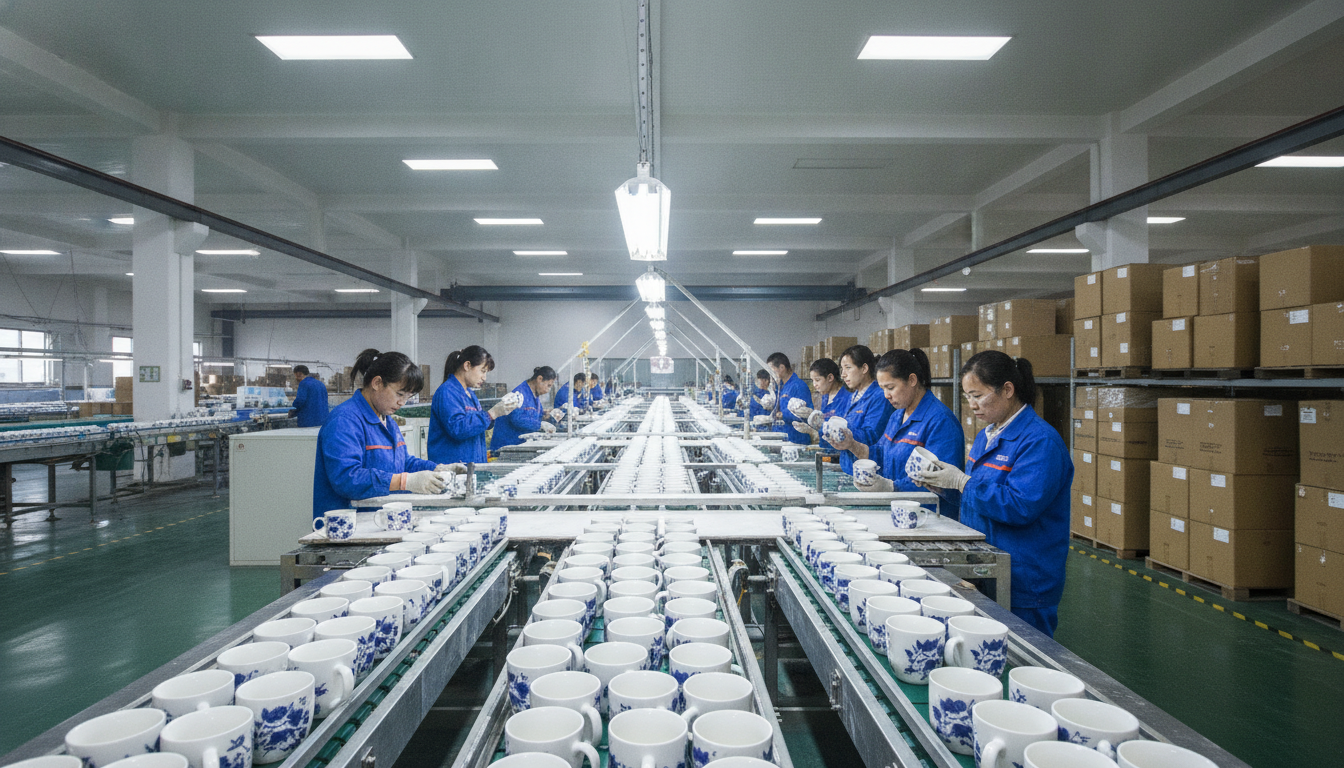
Retailers sourcing wholesale ceramic mugs from China for retailers work with factories offering MOQs between 500 and 3,000 units, unit costs ranging from $0.30 to $2.50 depending on specification, and production lead times of 25 to 45 days. The key variables are material grade (stoneware, porcelain, bone china), decoration method (screen printing, decal transfer, sublimation coating), and compliance certification for food-contact safety in your destination market.
📋 Table of Contents
- Executive Summary
- What MOQ and Pricing Should Retailers Expect?
- Which Ceramic Material Type Fits Your Market?
- How Do Decoration Methods Affect Cost and Lead Time?
- What Compliance Certifications Do You Need?
- How Do You Verify a Ceramic Mug Factory Before Ordering?
- What Are the True Landed Costs by Destination?
- What Should Retailers Remember When Sourcing Ceramic Mugs from China?
- Frequently Asked Questions
Executive Summary
- MOQ and unit cost: Most ceramic mug factories set MOQs between 500 and 3,000 units per design, with FOB unit costs from $0.30 for basic white stoneware to $2.50 for bone china with multi-color decal decoration.
- Material choice: Stoneware dominates retail because it balances durability, dishwasher safety, and price; porcelain suits premium positioning; bone china adds translucency but raises breakage risk in transit.
- Decoration lead time: Screen printing requires 3 to 5 additional production days, decal transfer 7 to 10 days, and sublimation coating 5 to 8 days beyond base manufacturing schedules.
- Compliance gate: EU markets require migration testing for lead and cadmium under Regulation 1935/2004 and REACH; Brazil mandates ANVISA registration; Mexico enforces NOM-020-SCFI labeling.
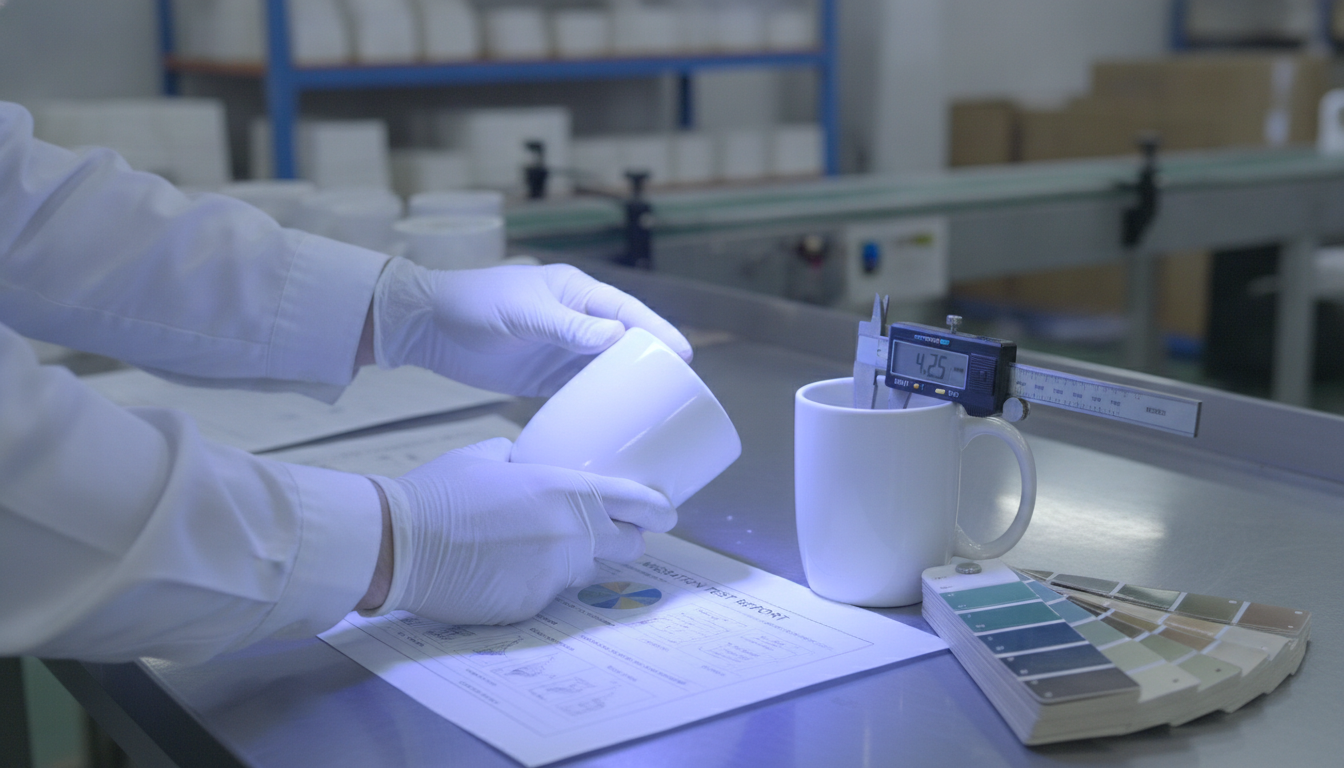
- Factory verification: A business licence scope check, production-floor visit, and third-party quality audit separate real manufacturers from trading companies reselling stock.
What MOQ and Pricing Should Retailers Expect?
Minimum order quantities for wholesale ceramic mugs from China for retailers depend on whether you order stock designs or custom decoration. Stock white mugs carry MOQs as low as 500 units, while custom logo printing typically requires 1,000 to 3,000 units per design to justify setup costs.
Stock vs. Custom Pricing
Stock designs ship faster and cost less because factories produce them in continuous runs. Custom decoration adds setup fees for screen plates, decal films, or sublimation transfers, which factories amortize across the order volume.
Volume Discounts and Payment Terms
Factories reduce unit prices by 8 to 15 percent when order volumes exceed 5,000 units. Standard payment terms are 30 percent deposit on order confirmation and 70 percent balance before shipment. Some suppliers extend 90 to 120 day open account terms to established buyers with verified trading history, though conditions are negotiated per order.
Which Ceramic Material Type Fits Your Market?
Retailers choose between stoneware, porcelain, and bone china based on retail price positioning, breakage tolerance, and dishwasher durability. Each material carries distinct manufacturing costs and quality risks.
Stoneware
Stoneware accounts for the majority of retail ceramic mugs because it withstands thermal shock, survives dishwasher cycles, and costs less to produce than porcelain. Firing temperatures reach 1,200 to 1,280 degrees Celsius, creating a dense, non-porous body. Stoneware mugs weigh more than porcelain, which increases freight costs but reduces breakage in transit.
Porcelain
Porcelain fires at 1,300 to 1,400 degrees Celsius, producing a harder, whiter, and more translucent finish than stoneware. Retailers position porcelain mugs at premium price points, but the material chips more easily during packing and shipping. Porcelain mugs require thicker carton padding and individual bubble wrapping to meet acceptable breakage rates below 2 percent.
Bone China
Bone china incorporates bone ash into the clay body, creating exceptional translucency and a warm ivory tone. It costs 40 to 60 percent more than porcelain and carries the highest breakage risk. Retailers selling bone china mugs typically add breakage allowances of 3 to 5 percent to order quantities and use double-wall cartons with foam inserts.
How Do Decoration Methods Affect Cost and Lead Time?
Decoration method determines both the visual complexity you can achieve and the production schedule when sourcing wholesale ceramic mugs from China for retailers. Screen printing, decal transfer, and sublimation coating each suit different design requirements and order volumes.
Screen Printing
Screen printing applies ceramic ink directly to the mug surface through a mesh stencil, then fires the piece to bond the ink to the glaze. This method handles solid colors and simple graphics efficiently, with setup taking 2 to 3 days and production extending timelines by 3 to 5 days. Screen printing costs less than decal transfer but cannot reproduce photographic detail or gradients.
Decal Transfer
Decal transfer prints the design onto special paper, then applies the paper to the mug and fires it to transfer the image. This method reproduces full-color artwork, gradients, and fine detail. Setup requires decal film production, which takes 5 to 7 days, and application extends schedules by 7 to 10 days. Decal transfer costs 30 to 50 percent more than screen printing but delivers photographic quality.
Sublimation Coating
Sublimation coating applies a polymer layer to the mug surface, allowing heat-press transfer of dye-sublimation prints. Factories produce sublimation-coated blanks in bulk, so retailers can order pre-coated stock and apply custom designs locally or through a trusted China sourcing agent who consolidates coating and printing. Production timelines increase by 5 to 8 days when coating is included. Sublimation suits short runs and variable-data printing but the coating wears faster than fired ceramic ink.
What Compliance Certifications Do You Need?
Food-contact regulations vary by destination market. Retailers importing wholesale ceramic mugs from China for retailers into the EU, Latin America, or North America must verify that glaze formulations and firing processes meet migration limits for lead and cadmium.
EU Food-Contact Rules
The EU enforces Regulation 1935/2004, which requires that ceramic articles intended for food contact do not transfer constituents to food in quantities that endanger human health. Migration testing measures lead and cadmium release under acidic conditions. Factories provide test reports from accredited labs showing compliance with the limits: 0.5 mg/L lead and 0.25 mg/L cadmium for flatware, with stricter limits for items used by children.
REACH Substance Restrictions
REACH Annex XVII restricts cadmium in plastic and coatings but does not set a separate limit for ceramic glaze beyond the food-contact migration standard. Retailers must confirm that any decorative coatings or handles made from polymer materials comply with REACH substance restrictions.
Brazil ANVISA Registration
Brazil requires ANVISA registration for food-contact materials. The factory or importer submits technical documentation, including migration test reports and manufacturing process descriptions, to ANVISA before the first shipment. Registration timelines range from 60 to 120 days, so retailers planning Brazil market entry should initiate the process before placing production orders.
Mexico NOM-020-SCFI Labeling
Mexico enforces NOM-020-SCFI, which mandates Spanish-language labeling showing product name, material composition, importer details, and country of origin. Labels must be permanent and legible. Retailers can apply stickers or request that factories fire labels directly onto the mug base during production.
How Do You Verify a Ceramic Mug Factory Before Ordering?
Retailers face fraud risk when suppliers present themselves as manufacturers but operate as trading companies reselling stock from undisclosed factories. Verification steps separate real production facilities from intermediaries and reduce supply-chain risk for wholesale ceramic mugs from China for retailers.
Business Licence Scope Check
Every Chinese company holds a business licence issued by the local Administration for Market Regulation. The licence lists the exact business scope the company is permitted to conduct. A factory authorized to produce ceramic tableware will have that activity listed explicitly. A trading company’s licence will state wholesale, import, or export services but not manufacturing. Requesting a copy of the business licence and cross-checking the scope against the product category being quoted catches trading companies posing as factories.
Production Floor Visit
A factory visit confirms that kilns, glazing lines, and decoration equipment exist and operate. Retailers or their sourcing agents should inspect raw material storage, observe a production run, and verify that the factory name on the business licence matches the signage at the facility. Trading companies either refuse factory visits or arrange tours at partner facilities they do not own.
Third-Party Quality Audit
Independent inspection firms conduct factory audits covering production capacity, quality control procedures, worker safety, and environmental compliance. An audit report provides objective evidence of manufacturing capability and flags risks such as subcontracting, inadequate testing equipment, or non-compliant waste disposal. Our supplier management process includes factory audits across the Yiwu and Guangdong ceramics clusters.
Sample Production and Bulk Consistency
Factories that produce samples in-house but subcontract bulk orders deliver inconsistent quality. Retailers should request samples from the same production line that will fulfill the bulk order and verify batch consistency through pre-shipment inspection. Glaze color, handle attachment strength, and base finish are common drift points between sample and bulk production.
What Are the True Landed Costs by Destination?
FOB unit price represents only part of the total cost. Retailers must calculate freight, import duties, VAT, customs brokerage, and port handling to determine landed cost per unit and retail margin viability.
Freight Costs by Destination
Sea freight from Ningbo or Shanghai to major Latin American and European ports varies by container type and seasonal demand. A 20-foot container holds approximately 15,000 to 18,000 ceramic mugs depending on packing density. Freight rates fluctuate, but typical ranges help retailers model costs.
- China to Mexico (Manzanillo or Veracruz): $1,200 to $1,800 per 20-foot container, transit time 18 to 25 days.
- China to Colombia (Cartagena or Buenaventura): $1,500 to $2,200 per 20-foot container, transit time 22 to 30 days.
- China to Brazil (Santos): $1,800 to $2,600 per 20-foot container, transit time 28 to 35 days.
- China to Europe (Rotterdam or Hamburg): $1,400 to $2,000 per 20-foot container, transit time 30 to 40 days.
Import Duties and VAT
Ceramic mugs fall under HS code 6912 (ceramic tableware and kitchenware). Import duty rates and VAT percentages differ by country.
Landed Cost Example
A retailer importing 10,000 stoneware mugs with one-color screen printing to Mexico calculates landed cost as follows: FOB unit cost $0.50, total FOB $5,000. Freight to Manzanillo $1,500. Import duty 18 percent on CIF value ($5,000 + $1,500 = $6,500), duty $1,170. VAT 16 percent on CIF plus duty ($6,500 + $1,170 = $7,670), VAT $1,227. Brokerage and port fees $300. Total landed cost $10,197, or $1.02 per unit. The retailer’s cost doubles from FOB to landed, which must be factored into retail pricing and margin calculations.
Breakage Allowance and Inventory Planning
Ceramic mugs experience breakage during transit and warehousing. Retailers add 2 to 5 percent breakage allowance to order quantities depending on material type and packing quality. Stoneware typically sees 1 to 2 percent breakage, porcelain 2 to 3 percent, and bone china 3 to 5 percent. Our quality control team conducts carton drop testing and packing inspections to minimize in-transit damage.
What Should Retailers Remember When Sourcing Ceramic Mugs from China?
- Guangdong and Fujian ceramic mug factories set MOQs between 500 and 3,000 units per design, with FOB costs from $0.30 for stock white stoneware to $2.50 for bone china with multi-color decal decoration.
- Stoneware withstands dishwasher cycles at 1,200 to 1,280 degrees Celsius firing temperature, balancing cost and durability for mainstream retail positioning.
- Decoration methods extend production schedules: screen printing by 3 to 5 days, decal transfer by 7 to 10 days, and sublimation coating by 5 to 8 days beyond base manufacturing timelines.
- EU Regulation 1935/2004 sets lead migration limits at 0.5 mg/L and cadmium at 0.25 mg/L, requiring accredited lab testing before first shipment to European markets.
- Business licence scope verification, production floor inspection, and third-party factory audits confirm manufacturing capability and identify trading companies reselling undisclosed factory stock.
- Landed cost calculation must include freight ($1,200 to $2,600 per 20-foot container), import duty (10 to 20 percent), VAT (16 to 20 percent), and brokerage fees ($250 to $600) to determine true per-unit cost and retail margin viability.
Frequently Asked Questions
Can I order ceramic mugs with my logo in quantities below 1,000 units?
Some factories accept custom logo orders starting at 500 units, but setup fees remain the same as higher-volume orders, which raises per-unit cost. Retailers ordering below 1,000 units should consider stock white mugs with post-import labeling or sublimation-coated blanks that allow local heat-press decoration without factory setup fees.
How do I confirm that glaze formulations meet food-contact safety standards?
Request migration test reports from accredited labs showing lead and cadmium release levels under acidic conditions. The factory should provide reports for each glaze color used in your order. Reports must be recent, typically within the past 12 months, and issued by labs recognized in your destination market. Independent quality control services can arrange testing if factory reports are unavailable or outdated.
What packing method reduces breakage during ocean freight?
Individual bubble wrapping combined with divider inserts inside five-layer corrugated cartons reduces breakage to below 2 percent for stoneware and porcelain. Bone china requires double-wall cartons with foam corner protectors. Carton drop testing from 80 cm height simulates handling conditions and identifies packing weaknesses before shipment. Retailers should specify packing requirements in the purchase order and verify compliance during pre-shipment inspection.
Ready to source wholesale ceramic mugs from China for retailers with full factory verification, compliance support, and transparent landed-cost calculation?
Request a Supplier Audit →
Written by the Goodcantrading Sourcing Team.