How to Source Bamboo Products from China Suppliers [2026 Guide]
![How to Source Bamboo Products from China Suppliers [2026 Guide]](https://goodcantrading.com/wp-content/uploads/2026/09/featured-how-to-source-bamboo-products-from-china-suppliers.png)
To source bamboo products from China suppliers, start by verifying the factory’s business licence scope matches the product category, request FSC or BSCI certifications with valid numbers, order pre-production samples to check finish quality and dimensions, and arrange third-party inspection before shipment to catch defects early.
📋 Table of Contents
- Executive Summary
- Why Bamboo Products from China?
- How Do You Verify Factory Legitimacy Before Ordering?
- What Certifications Do Bamboo Products Need for Import?
- How to Order Samples and Check Quality Before Bulk Production
- What MOQ, Lead Time, and Incoterms to Expect
- How to Manage Production and Inspection
- Traceability and EUDR Compliance for EU Buyers
- Key Takeaways
- FAQ
Executive Summary
- Factory vs trader: Check the business licence scope to confirm the supplier manufactures bamboo products, not just resells them, which prevents quality control gaps.
- Certification verification: Request FSC, BSCI, or food-contact test reports with certificate numbers you can verify online before placing a deposit.
- Sample inspection: Order pre-production samples to check for splinters, rough edges, odor, and dimensional consistency before committing to bulk orders.
- Third-party QC: Arrange during-production and pre-shipment inspection to catch defects, packaging errors, and labeling mistakes while correction is still possible.
- Traceability for EU: EU buyers must collect chain-of-custody documents, harvest location GPS coordinates, and supplier declarations to meet EUDR due-diligence requirements.
Why Bamboo Products from China?
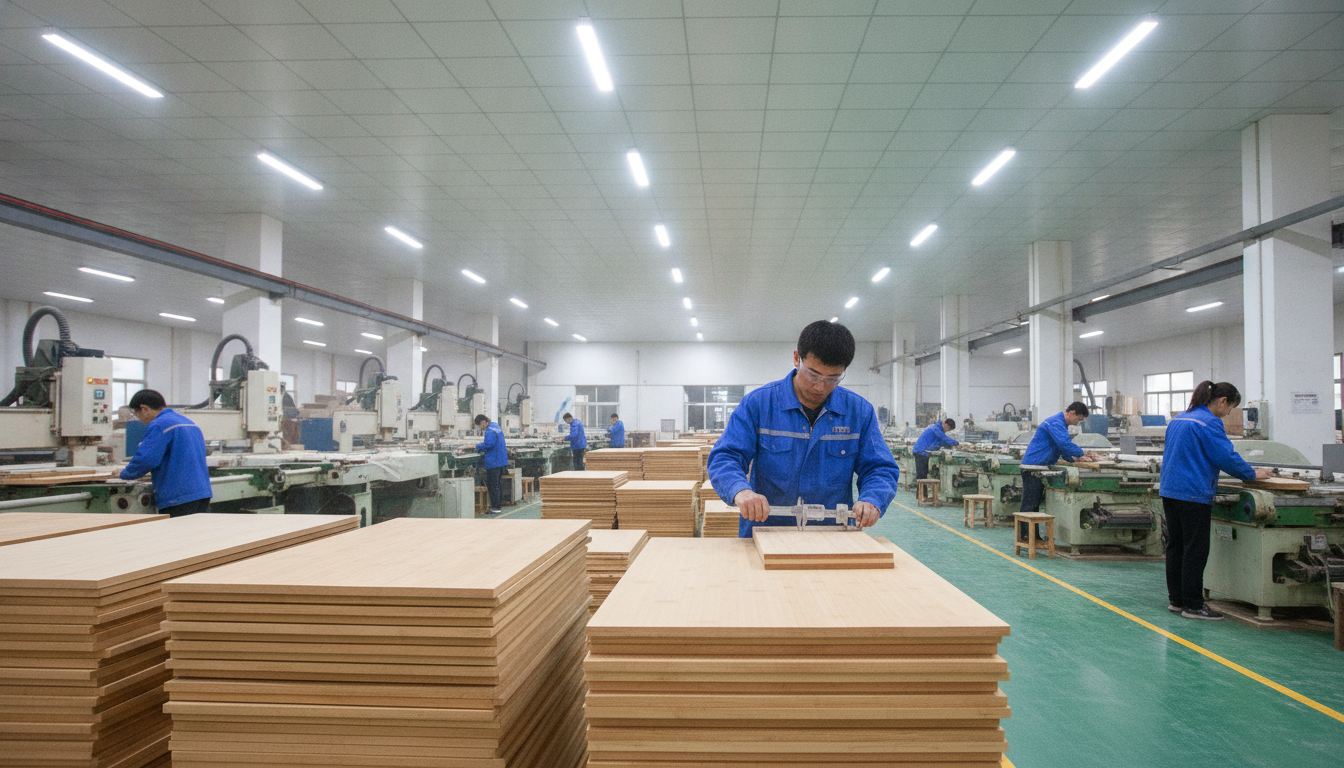
China produces bamboo kitchenware, furniture, flooring, textiles, and disposable tableware at scale because the country grows over 500 bamboo species across southern provinces. Zhejiang, Fujian, Jiangxi, and Hunan host integrated supply chains where raw bamboo is harvested, processed, and finished within the same region, which keeps lead times short and costs competitive.
Cost Advantage
Bamboo product pricing in China reflects vertically integrated manufacturing. A factory that controls bamboo plantation access, carbonization kilns, CNC cutting, and finishing can offer lower unit costs than suppliers who purchase semi-finished components from multiple vendors. Buyers report that direct factory pricing for bamboo cutting boards, utensils, and organizers sits below marketplace listings when MOQ is met.
Production Capacity
Large bamboo factories in Zhejiang run 24-hour shifts during peak season, processing thousands of units daily. Smaller workshops in Fujian specialize in handcrafted items with lower MOQ but longer lead times. Capacity varies by product type: machine-pressed bamboo flooring has higher throughput than hand-assembled furniture frames.
Export Infrastructure
Ningbo, Shanghai, and Xiamen ports handle bamboo product exports with established freight forwarders, fumigation services, and phytosanitary inspection stations. Factories near these ports can consolidate shipments, arrange container loading, and complete customs documentation faster than inland suppliers who must truck goods to the coast.
How Do You Verify Factory Legitimacy Before Ordering?
Buyers report that some bamboo sellers present themselves as factories but operate as trading companies, which creates quality control gaps when the actual manufacturer is hidden. Verification starts with the business licence, which lists the exact production scope the company is legally registered to perform.
Business Licence Scope Check
Request a copy of the supplier’s business licence (营业执照) and check the business scope section (经营范围). A real bamboo factory will list manufacturing activities such as bamboo product processing, wood product manufacturing, or furniture production. A trading company licence shows wholesale, import-export agency, or sales consulting, which means they do not control the production line.
Cross-reference the registered address on the licence with the factory address the supplier provides. If the two do not match, ask for an explanation. A legitimate factory can show lease agreements or property certificates for the production site.
Factory Audit
A physical or video factory audit confirms the supplier operates the machinery and employs the workers. During the audit, check for:
- Raw material storage: Bamboo poles, boards, or strips stacked in a dedicated warehouse, not purchased finished goods waiting for resale.
- Processing equipment: Carbonization ovens, CNC routers, sanding machines, and finishing booths that match the product type you plan to order.
- Worker activity: Staff operating machines, assembling components, or applying lacquer, not just packing pre-made items into cartons.
- Quality control station: A designated area where inspectors measure dimensions, check surface finish, and test product strength before packing.
Our Yiwu and Guangzhou sourcing desks arrange factory audits for bamboo suppliers, verifying business licence scope, production capacity, and quality control systems before buyers commit to deposits. trusted China sourcing agent teams can also cross-check supplier claims against local business registries.
Online Verification
Use the National Enterprise Credit Information Publicity System (国家企业信用信息公示系统) to verify the supplier’s registration status, legal representative, and any administrative penalties. Enter the company name or unified social credit code from the business licence. The system shows registration date, capital, business scope, and whether the company has outstanding legal disputes.
What Certifications Do Bamboo Products Need for Import?
Certification requirements depend on the product type and destination market. Bamboo kitchenware, food-contact items, and children’s products face stricter testing than decorative or structural goods. Buyers complain that suppliers claim eco-friendly or certified materials but cannot quickly provide valid certificate numbers or test reports.
FSC Certification for Bamboo
Forest Stewardship Council (FSC) certification confirms the bamboo was harvested from responsibly managed forests. FSC applies to bamboo because the plant is classified as a forest product under international trade rules. An FSC Chain of Custody (CoC) certificate allows the factory to label finished products with the FSC logo and claim traceability.
Request the supplier’s FSC CoC certificate number and verify it on the FSC database at info.fsc.org. The certificate shows the factory name, certificate holder, scope of products covered, and expiration date. If the supplier claims FSC but cannot provide a certificate number, the claim is unverifiable.
Food-Contact Compliance
Bamboo cutting boards, utensils, bowls, and straws that touch food must pass migration testing. EU buyers need compliance with EU Regulation 1935/2004 and national food-contact laws. US buyers need FDA compliance under 21 CFR Part 170-189. Test reports check for heavy metals, formaldehyde, and primary aromatic amines that can migrate from bamboo or adhesive into food.
Ask the supplier for a test report from an accredited lab (SGS, Intertek, TÜV) that covers the exact product and finish you plan to order. The report should be dated within the past 12 months and list the specific test methods used (EN 1186 for EU, FDA 21 CFR for US). Generic test reports that do not match your product specifications are not valid proof of compliance.
BSCI and Social Compliance
Business Social Compliance Initiative (BSCI) audits cover labor practices, working hours, and safety conditions. EU buyers and large retailers often require BSCI or equivalent audits (SMETA, SA8000) before approving a supplier. Request the supplier’s latest BSCI audit report and check the score. A BSCI rating of C or better indicates acceptable compliance, while D or E ratings signal serious issues that need corrective action.
How to Order Samples and Check Quality Before Bulk Production
Buyers report that samples often look acceptable but bulk orders arrive with splinters, rough finishing, odor, or inconsistent dimensions. Sample inspection catches these issues before production scales up.
Pre-Production Sample Request
Ask the supplier to send a pre-production sample made from the exact materials, finish, and production method planned for the bulk order. Specify the bamboo species (Moso, Tonkin, or other), carbonization level (natural or carbonized), adhesive type (food-safe PVA or formaldehyde-free), and surface finish (oil, lacquer, or wax). A sample pulled from existing stock may not match the production batch.
Pay for samples and shipping. Free samples are often lower-quality stock items, not representative of what the factory will produce for your order. Sample cost is typically refunded when the bulk order is placed.
Quality Inspection Checklist
When the sample arrives, check the following points:
- Surface finish: Run your hand across the bamboo surface. Any splinters, rough patches, or uneven sanding indicate poor quality control. Food-contact items must be smooth enough that no fibers catch on skin.
- Dimensional accuracy: Measure length, width, and thickness with calipers. Compare against the specs you provided. Tolerance should be within ±1mm for precision items like cutting boards or flooring planks.
- Odor test: Smell the product. A strong chemical smell suggests excess formaldehyde or uncured adhesive. Natural bamboo has a mild, woody scent. Carbonized bamboo smells slightly toasted but not acrid.
- Moisture content: Use a moisture meter if available. Bamboo products should have 8-12% moisture content for stability. Higher moisture causes warping after shipment, especially in dry climates.
- Adhesive joints: Check glue lines in laminated bamboo products. Gaps, misalignment, or visible glue squeeze-out indicate poor assembly. Press on joints to test bond strength.
- Packaging: Inspect how the sample is packed. Adequate cushioning, protective film, and carton strength prevent damage during international shipping. If the sample arrives damaged, the bulk order will face the same risk.
Sample Approval Process
Document your inspection findings with photos and measurements. Send feedback to the supplier, specifying any changes needed. Request a revised sample if the first one does not meet your standards. Do not approve the sample until every quality point is resolved. Once you approve, the factory will replicate that sample for the bulk order, so approval locks in the quality baseline.
Our quality control team can inspect samples at our Yiwu office before they ship to you, catching defects early and reducing the need for multiple sample rounds.
What MOQ, Lead Time, and Incoterms to Expect
Minimum order quantity, production lead time, and Incoterms vary by product complexity and factory size. Buyers struggle when suppliers do not clearly explain these terms upfront, which makes quote comparisons misleading.
Typical MOQ Ranges
Bamboo kitchenware and utensils often have MOQ of 500-1,000 pieces per SKU. Furniture and larger items may require 100-300 pieces. Custom designs, laser engraving, or branded packaging increase MOQ because setup costs must be amortized across more units. Stock items with no customization can have lower MOQ, sometimes 200-300 pieces, but the factory will not adjust specs.
Production Lead Time
Standard bamboo products take 20-30 days from deposit to production completion. Custom items with new molds, tooling, or finish formulations add 10-15 days for sampling and approval. Peak season (September to December, ahead of Western holiday demand) extends lead times by 5-10 days due to factory capacity constraints.
Factor in additional time for pre-shipment inspection (2-3 days), container loading (1-2 days), and port clearance (2-4 days). Total time from deposit to goods leaving China is typically 30-45 days for standard orders.
Incoterms and Pricing Clarity
Request quotes under multiple Incoterms to compare total landed cost. Common options:
- FOB (Free on Board): Factory delivers goods to the departure port and loads the container. Buyer arranges and pays for ocean freight, insurance, and destination customs clearance. FOB gives you control over the freight forwarder and shipping schedule.
- CIF (Cost, Insurance, Freight): Factory arranges ocean freight and insurance to the destination port. Buyer handles customs clearance and inland delivery. CIF simplifies logistics but the factory chooses the freight forwarder, which may not offer the best rate.
- DDP (Delivered Duty Paid): Factory handles everything including destination customs duties and delivery to your warehouse. DDP is convenient but expensive, and you lose visibility into freight and duty costs.
Ask the supplier to break down the quote: unit price, packaging cost, inland freight to port, and any inspection or documentation fees. A single all-in price hides where costs accumulate, making it hard to negotiate or compare suppliers.
How to Manage Production and Inspection
Production monitoring and third-party inspection catch defects, packaging errors, and labeling mistakes while correction is still possible. Buyers who skip inspection often discover problems only after the container arrives, when fixing issues is expensive or impossible.
During-Production Inspection
Schedule an inspection when 30-50% of the order is completed. The inspector checks raw materials, work-in-progress units, and the production environment. This early check confirms the factory is using the approved bamboo grade, adhesive, and finish. If defects appear, production can be paused and corrected before the full batch is finished.
During-production inspection also verifies the factory is following the production timeline. Delays discovered mid-production give you time to adjust shipping plans or negotiate expedited completion.
Pre-Shipment Inspection
Arrange a final inspection when 100% of the order is finished and at least 80% is packed. The inspector randomly selects cartons, unpacks units, and checks against your approved sample and specification sheet. Inspection covers:
- Quantity verification: Count total cartons and confirm the quantity matches the purchase order.
- Workmanship: Check surface finish, dimensional accuracy, and assembly quality on a random sample (typically 10% of units, following AQL 2.5 standard).
- Packaging: Verify inner packaging (poly bags, protective film) and outer carton strength. Check that carton markings match your shipping marks and destination labels.
- Labeling and documentation: Confirm product labels, barcodes, and user manuals are correct and match your brand requirements.
The inspector provides a detailed report with photos, measurements, and a pass/fail recommendation. If the inspection fails, negotiate with the factory to rework defective units or offer a discount. Do not authorize shipment until issues are resolved.
Our supplier management service includes production monitoring and third-party inspection coordination, ensuring quality standards are met before goods leave the factory.
Lab Testing for Compliance
If your market requires test reports (food-contact migration, formaldehyde emission, heavy metals), arrange lab testing on samples from the finished batch. Pull samples during the pre-shipment inspection and send them to an accredited lab. Testing takes 5-10 days, so plan this into your production timeline. Do not ship the order until test results confirm compliance.
Traceability and EUDR Compliance for EU Buyers
EU buyers sourcing bamboo products must collect traceability and due-diligence documentation to comply with the EU Deforestation Regulation (EUDR), which took effect in 2024. Buyers worry that suppliers cannot provide enough documentation for customs and sustainability compliance.
Chain of Custody Documentation
Request a chain-of-custody document that traces the bamboo from harvest location to the factory. The document should include:
- Harvest location: GPS coordinates or administrative region (province, county, village) where the bamboo was grown.
- Harvest date: Month and year the bamboo was cut.
- Supplier declaration: A signed statement from the factory confirming the bamboo was legally harvested and does not originate from deforested land.
- FSC or PEFC certificate: If the bamboo is certified, the CoC certificate number and scope.
EUDR requires that bamboo products entering the EU are deforestation-free, meaning the land was not deforested after December 31, 2020. The supplier must provide evidence that the harvest area was forested before that date, typically through satellite imagery, land-use certificates, or third-party verification.
Due Diligence Statement
EU importers must submit a due-diligence statement to customs, declaring that the bamboo products comply with EUDR. The statement includes product description, quantity, country of harvest, GPS coordinates, and the supplier’s traceability documents. Customs may request supporting evidence, so keep all documents accessible.
Supplier Capability Assessment
Not all bamboo suppliers can provide EUDR-compliant documentation. Small factories that source bamboo from multiple traders or informal harvesters may lack traceability. When sourcing for the EU market, prioritize suppliers with FSC CoC certification, established raw material procurement records, and experience exporting to EU buyers. Ask the supplier to provide a sample traceability package before placing the order, so you can verify their capability.
Our team assists EU buyers with EUDR compliance by verifying supplier traceability documents, coordinating with FSC-certified factories, and preparing due-diligence statements for customs submission.
Key Takeaways
- Factory verification: A business licence that lists manufacturing in its scope confirms the supplier controls production, while a licence showing only wholesale or consulting signals a trading company that cannot guarantee quality.
- Certification validation: Request FSC CoC certificate numbers and food-contact test reports from accredited labs, then verify them online before paying any deposit.
- Sample inspection discipline: Approve pre-production samples only after checking surface finish, dimensional accuracy, odor, and packaging, because approval locks in the quality baseline for the bulk order.
- Third-party inspection timing: Schedule during-production inspection at 30-50% completion and pre-shipment inspection at 100% completion to catch defects while correction is still possible.
- EUDR traceability for EU buyers: Collect GPS coordinates of bamboo harvest locations, supplier declarations, and chain-of-custody documents to meet EU Deforestation Regulation due-diligence requirements.
- Incoterms clarity: Request quotes under FOB, CIF, and DDP terms with itemized cost breakdowns to compare total landed cost and maintain control over freight forwarder selection.
FAQ
How do I verify a bamboo supplier’s FSC certificate is valid?
Visit info.fsc.org and enter the certificate number the supplier provides. The FSC database shows the certificate holder name, validity dates, and scope of products covered. If the supplier’s name does not match the certificate holder, they are reselling certified products without their own CoC certificate, which means you cannot use the FSC logo on your finished goods. Always request the certificate PDF and cross-check the details against the online database before placing an order.
What is the difference between natural and carbonized bamboo, and does it affect compliance?
Natural bamboo retains its light tan color and is processed without high-temperature treatment. Carbonized bamboo is heated to darken the color and increase hardness, which also reduces moisture content and makes the material more stable. Carbonization does not affect food-contact compliance as long as no additional chemicals are applied, but it can slightly reduce the bamboo’s strength. Specify which type you need based on your product’s aesthetic and performance requirements, and request test reports that match the processing method.
Can I negotiate MOQ down if I order multiple SKUs from the same factory?
Factories often reduce per-SKU MOQ when the total order value is high enough to justify setup costs. For example, a factory with 1,000-piece MOQ per SKU might accept 500 pieces each if you order four SKUs in one shipment. The key is total production volume and whether the SKUs share common components or processing steps. Present your multi-SKU plan upfront and ask the supplier to propose a combined MOQ structure. Ordering from the same factory also simplifies quality control and consolidation, which can offset the higher total piece count.
Ready to source bamboo products with verified factories, transparent pricing, and compliance documentation?
Request a free supplier audit →
Written by the Goodcantrading Sourcing Team.