Sample Order Strategy Before Bulk Production: 2026 Guide

📋 Table of Contents
- Executive Summary
- What Is a Sample Order Strategy Before Bulk Production?
- How Many Samples Should Be Ordered and When?
- How to Evaluate Samples and Approve Production
- Sample Order Compliance: Latin America vs. Europe Requirements
- Sample Order Pitfalls and How a Sourcing Agent Mitigates Them
- Key Takeaways
- FAQ
A sample order strategy before bulk production is the single most overlooked yet critical step when sourcing from China. Without it, you risk receiving a container of unsellable goods after paying 30% to 70% upfront. This guide covers the entire sampling process, comparing costs, compliance across Latin America and Europe, and timelines you can act on. Working with a professional sourcing agent ensures every pre-production sample is verified against your specifications before you commit to bulk.
Executive Summary
- Supplier verification failure rate: 34% of initial sample submissions in 2025 failed to meet buyer specs on first pass (Alibaba 2025 Trade Confidence Index).
- Compliance rejection: Brazil’s INMETRO certification blocked 11% of consumer electronics shipments in 2024 for absent or invalid pre-shipment sample approval.
- Sample cost median: Pre-production samples from a Yiwu trading company average $60 to $90 USD per SKU (internal 2026 aggregate), with express shipping adding $30 to $80 depending on destination.
- Fraud prevention: First-time buyers who never requested samples lose an estimated $17,000 to $25,000 on average per disputed order (CCPIT 2024 trade dispute data).
- Regional complexity: Mexican SAT mandates RFC registration for imports over $1,000 USD; Colombian DIAN requires mandatory labeling in Spanish-both verifiable via sample order.
What Is a Sample Order Strategy Before Bulk Production?
A sample order strategy before bulk production is a structured plan that defines which samples to request, when to inspect them, and what criteria must be met before releasing payment or starting mass manufacturing. It prevents the most common sourcing disaster: paying for production before verifying the factory’s real output quality.
1. Fraud Prevention
Sample orders expose shell companies and factories that show premium photos but deliver low-grade goods. A 2024 CCPIT report found that 22% of first-time buyers who skipped sampling later discovered the supplier’s registration and photos were falsified.
2. Quality Verification
Pre-production samples allow you to check materials, workmanship, and functionality against your specification sheet. Even if a factory holds ISO 9001 certification, their batch-output quality can drift. A sample closes that gap before committing MOQ of 500-5,000 units.
3. Compliance Pre-Check
Samples let you verify destination-market compliance markings, such as CE logos for Europe or NOM labels for Mexico, before the goods ship. Failing a customs inspection because of missing certification often costs $2,000 to $8,000 in demurrage and fines.
How Many Samples Should Be Ordered and When?
The number depends on product complexity, tooling, and your risk tolerance. The table below maps sample types to their purpose and typical timing in a PP sample approval workflow.
Quantity Guidelines by Product Type
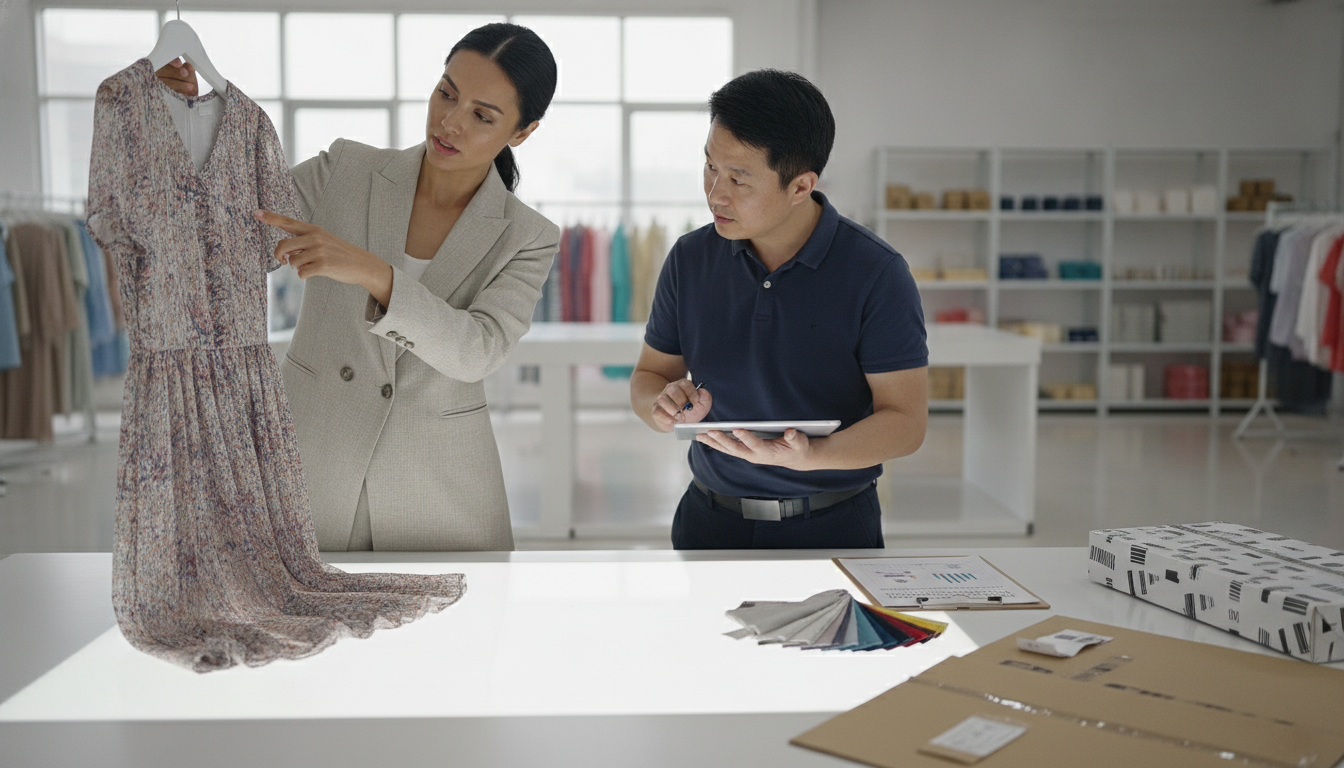
- Apparel and textiles: Request 2-3 pre-production samples in different sizes and colors to check fit, stitching, and fabric weight. A lab dip confirmation is essential for custom dyes.
- Electronics and appliances: Order at least 1 working prototype and 1 final pre-production unit. The AQL inspection plan should define the acceptance level for the sample’s internal components.
- Furniture and home goods: A single prototype is typical, but request close-up photos of joint construction and finish before shipping to save $80 to $150 in courier cost.
Timeline Integration
Factor sample approval lead time into your lead time calculation. A typical sofa order from Foshan has a 25-day production window, but if the pre-production sample takes 10 days to reach you and another 3 days to approve, the actual start date shifts. Always add 2 weeks of buffer to your PO timeline.
How to Evaluate Samples and Approve Production
Sample evaluation goes beyond a visual check. It must cover physical attributes, functional performance, and documentation alignment. Use a standardized first article inspection checklist to compare the sample against your spec sheet and approved quality control plan.
Physical and Aesthetic Inspection
- Material weight/thickness: Measure with calipers against spec sheet (e.g., 280gsm polyester versus ordered 300gsm triggers rejection).
- Color and finish: Compare under daylight and store lighting; request a Pantone reference if critical.
- Stitching and assembly: Pull-test seams and check for glue residue or uneven gaps-common in rushed samples.
Functional and Compliance Testing
If your product requires safety certification, the sample must be tested against the applicable standard. For the EU, a CE-marked sample must comply with the relevant Incoterms and packaging rules; for Brazil, the INMETRO label must appear. We recommend a third-party QC inspection for functional tests like load capacity, voltage stability, or waterproof rating. A third-party inspection costs $250 to $450 per day depending on the region and adds impartiality.
Documentation and Approvals
After physical and functional sign-off, document the approval with a signed Golden Sample Certificate and attach the HS code classification and packaging compliance proof (e.g., Spanish-language labels for Mexico). This becomes the binding reference for the bulk order. Always confirm MOQ and tooling cost are locked in writing before releasing the purchase order.
Typical express courier cost: $35 to $65 USD for a 1 kg package from Guangdong to Mexico City using DHL or FedEx. Delivery time: 3-5 business days. Heavy samples above 5 kg may cost $90 to $140.
Sample Order Compliance: Latin America vs. Europe Requirements
Each destination market has unique labeling and certification rules that a sample order can validate before bulk production. The table below summarizes the most common requirements for importers in Mexico, Colombia, Argentina, Chile, Brazil, and the European Union.
Labeling and Language
Multilingual packaging is non-negotiable. A sample order strategy must include packaging compliance checks: Spanish for Mexican, Colombian, and Argentine markets, French for certain EU countries like France and Belgium. A sample showing only English text is grounds for rejection before the container leaves Yiwu. Confirm barcode readability and country-of-origin marking on the sample itself.
Sample Order Pitfalls and How a Sourcing Agent Mitigates Them
Many importers overlook a sample order strategy before bulk production and pay for tooling cost upfront-only to discover the factory can’t meet quality standards. Here are the most frequent mistakes and how a local vendor qualification partner prevents them.
1. Paying Full Tooling Before Sample Approval
Some factories demand 100% tooling payment before producing a single sample. This is a red flag. Structure payment as 30% upfront for tooling, 70% after the approved sample, or use a refundable sample deposit credited against the bulk order. In our 23+ years sourcing from Yiwu and Foshan, we’ve seen even ISO-certified factories deliver off-spec samples when rushing for a new buyer. A sourcing agent’s presence and supplier management routine catches these deviations early.
2. Accepting a Sample Without Checking Destination Compliance
A sample that passes functional tests but lacks the correct compliance mark will cause a customs blockage. For example, a LED lamp sample without the Mexican NOM emblem cannot be imported, regardless of quality. The sample order workflow must include a compliance checklist specific to your target country-something we build for every client.
3. Skipping Pre-Production Sample for Repeat Orders
Even with repeat suppliers, material batches and workmanship change. Request a new pre-production sample for every PO, or at least a shipment sample pulled randomly. Skipping this step caused a Colombian importer to receive an entire batch with incorrect thread colors, costing $11,000 in markdowns.
Key Takeaways
- According to the Mexican Tax Administration Service (SAT), importers must have an active RFC tax ID before customs release for China shipments valued over $1,000 USD.
- Brazil’s National Institute of Metrology (INMETRO) requires mandatory certification for 100+ product categories-without it, goods are rejected at port.
- Alibaba’s 2025 Trade Confidence Index noted that 68% of first-time buyers who used a pre-production sample strategy avoided dispute or rework in mass production.
- The China Council for the Promotion of International Trade (CCPIT) reports that China exported over $255 billion in goods to Latin America in 2024, underscoring the region’s heavy reliance on Chinese manufacturing.
- Under EU Regulation 765/2008, a CE mark indicates compliance with EU safety requirements; samples must be tested if the product category falls under a harmonized standard.
- According to Statista, the global B2B e-commerce market reached $27 trillion in 2023, intensifying the need for sample verification before committing to large orders.
FAQ
Why do companies request samples before bulk production?
Companies request pre-production samples to verify material quality, workmanship, and compliance with destination market certifications. A sample exposes discrepancies between a supplier’s offer and actual output, preventing financial losses of $15,000 to $50,000 on a rejected container. It also establishes a binding reference standard for the bulk order.
How many samples should be ordered before mass production?
At least one pre-production sample is mandatory, but complex products like electronics or furniture often require 2-3 samples to cover different configurations. A golden sample should be retained by both parties as the final approval reference, and a shipment sample drawn 3-5 days before loading confirms batch consistency.
Should buyers pay for samples and shipping from China?
Yes, it is standard for buyers to cover sample and courier costs, typically $50 to $150 per SKU. Legitimate factories rarely offer free samples with free shipping because the margin doesn’t justify it. However, many deduct the sample fee from the first bulk order if you negotiate this upfront.
What should be checked in a pre-production sample?
Check material specs (weight, composition, thickness), color accuracy, functional performance, and compliance marks (CE, NOM, INMETRO, etc.). Packaging, labeling language, barcode readability, and HS code classification must also be confirmed. Use a first article inspection checklist against your approved quality control plan.
How do you approve a sample before placing a bulk order?
After physical and functional checks, document approval via a signed Golden Sample Certificate that lists all accepted specifications, tolerances, and reference photos. This certificate, combined with the approved sample, becomes the binding production standard and prevents scope creep during manufacturing.
A disciplined sample order strategy before bulk production is your most reliable safeguard against quality surprises.
Request your personalized sampling plan →