IRAM Certification Requirements Argentina China Imports: 2026 Guide for B2B Buyers
📋 Table of Contents
- Executive Summary
- What Are IRAM Certification Requirements for Argentina China Imports?
- Step-by-Step IRAM Certification Process for China Imports
- IRAM vs. Other Argentine Approvals: INAL, SENASA, COPAL
- Landed Cost Impact of IRAM Compliance for China-Argentina Importers
- Common Reasons IRAM Applications Get Rejected
- Checklist for China Sourcing Agents Managing Argentina Imports
- Key Takeaways
- FAQ
When importing from China to Argentina, IRAM certification requirements Argentina China imports can delay your shipment by weeks if you don’t prepare correctly. Missing documents or a failed type test can mean your container sits in Buenos Aires customs while you pay demurrage fees. This guide explains the mandatory steps, typical costs, and how to avoid the most common rejection traps-so you can clear Argentine customs on the first try.
Executive Summary
- Import volume: Argentina’s goods imports reached about US$65 billion in 2024, according to the World Bank (2025), making compliance screening relevant for a large import base.
- China export scale: China Customs data shows China’s total exports exceeded US$3.5 trillion in 2024, sustaining its role as a major source market for Argentina‑bound sourcing.
- Global customs scrutiny: Reuters reported in 2026 that Mexico, Argentina, and other Latin American markets were included in U.S. trade actions covering 60 economies, showing widening customs scrutiny across the region.
- IRAM certification cost range: IRAM’s published tariff schedule indicates certification fees between $800 and $3,000 USD per product family.
- Rejection rate: Argentine Dirección General de Aduanas (DGA) issued 1,200 IRAM non‑compliance fines in 2024, according to its annual report.
What Are IRAM Certification Requirements for Argentina China Imports?
IRAM (Instituto Argentino de Normalización y Certificación) is the Argentine standards body that issues mandatory safety certification for thousands of products entering the country. For China imports, IRAM certification requirements Argentina China imports mean you must obtain a Certificate of Conformity before customs will release regulated goods.
Definition and Scope of IRAM Certification
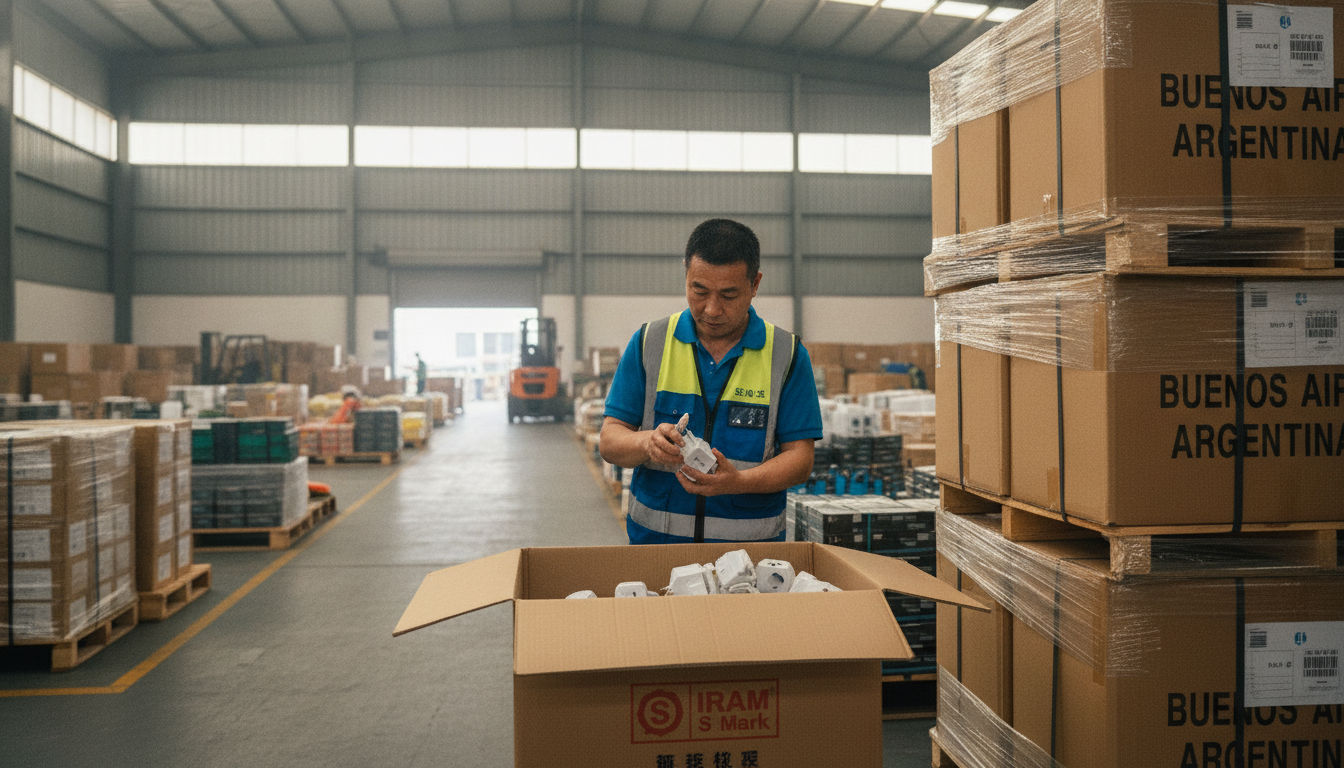
IRAM certification is a conformity assessment process that verifies a product meets Argentine technical regulation, electrical safety standards, and labeling compliance. The most common scheme is the IRAM S Mark (Safety Mark), mandatory for low‑voltage electrical equipment, household appliances, lighting, and similar consumer goods.
Mandatory vs. Voluntary Certification
IRAM runs two parallel tracks. Mandatory certification applies to products listed in Resolution 92/98 and subsequent updates-mostly electrical and electronic items. Voluntary certification covers areas like quality management, environmental claims, and non‑regulated goods, giving importers a competitive advantage but not a customs requirement.
Step-by-Step IRAM Certification Process for China Imports
Obtaining IRAM certification involves a six‑stage conformity assessment. The whole process typically takes 8 to 14 weeks, assuming no retesting. Rush timelines are available at higher cost.
1. Determine If Your Product Falls Under IRAM Mandatory Scheme
Check the Argentine Ministry of Economy’s Resolution 92/98 and its amendments. If your HS code appears on the list, you must obtain a Certificate of Conformity before shipment. A supplier management partner can help verify the classification early, avoiding customs surprises.
2. Prepare Technical Documentation and Type Test Reports
Your Chinese factory must supply a type test report from an ISO 17025‑accredited lab, ideally one recognized by IRAM. The test report proves compliance with Argentine technical regulation. If an existing CE or CB report exists, IRAM may accept it under a mutual recognition agreement, reducing time and cost.
Typical cost: $800, $2,500 USD for independent type testing. Key risk: Chinese labs often test to IEC standards, but IRAM requires Argentine deviations-always request a gap analysis.
3. Appoint a Local Argentine Representative
IRAM certification requires a local importer of record or authorized representative domiciled in Argentina. This entity holds the certificate and is responsible for product homologation and market surveillance. For small importers, a third‑party Argentine trading company can act as the representative for a $500, $1,200 annual fee.
4. Submit Application and Sample Testing
Submit the application, technical file, and product samples to IRAM or an accredited certification body. IRAM then conducts product testing in its own labs or witnesses testing at an approved facility. Batch certification may be accepted for one‑off shipments, but a full factory audit is required for the S Mark.
5. Factory Audit and Certification Issuance
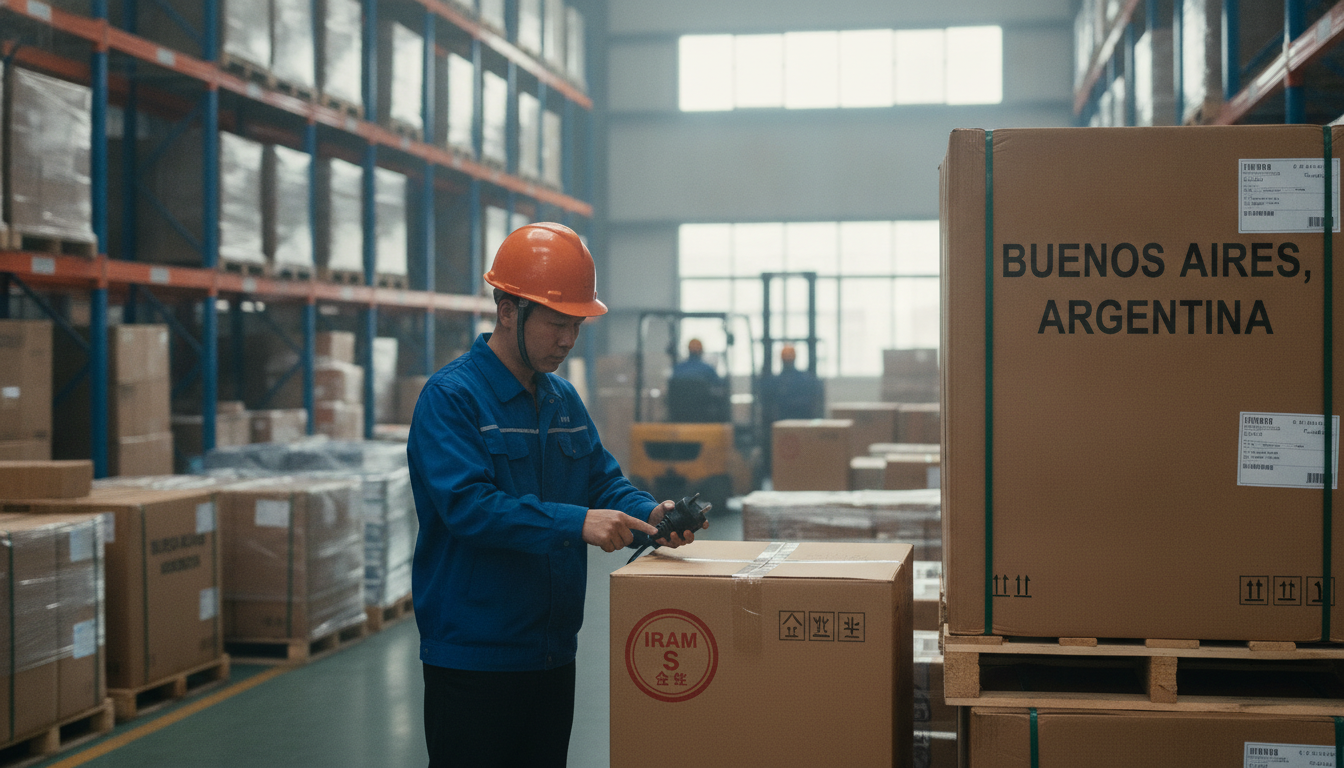
IRAM auditors visit the Chinese factory to verify production consistency, quality control inspection records, and raw material traceability. A quality control inspection before the audit can catch non‑conformities. Once the audit passes, IRAM issues the Certificate of Conformity, valid for 1 to 3 years with annual surveillance.
6. Labeling and Customs Clearance
Every unit must carry the IRAM Safety Mark, importer information, and voltage specifications in Spanish. Customs clearance requires the original certificate, invoice, and packing list. The Argentine Dirección General de Aduanas cross‑checks the certificate number against its database before releasing the shipment.
IRAM vs. Other Argentine Approvals: INAL, SENASA, COPAL
Argentina applies multiple certification bodies depending on the product category. Confusing IRAM with food or chemical approvals is a common mistake that causes unnecessary delays. Below is a side‑by‑side comparison.
For a typical China sourcing scenario, if you import LED bulbs, you deal with IRAM. If you import tea, you face INAL. If you import pet toys, you may need SENASA. A trusted China sourcing agent can map the correct regulatory path early, preventing wasted testing fees.
Landed Cost Impact of IRAM Compliance for China-Argentina Importers
Ignoring IRAM certification costs in your FOB pricing model can wipe out your margin. The table below breaks down the typical additional expenses per product family for a first‑time certification.
Hidden delay cost: A failed retest can add 4-6 weeks to your timeline. For a container stuck at Buenos Aires port, demurrage fees average $60, $120 per day.
Common Reasons IRAM Applications Get Rejected
Even experienced importers see their files returned. Based on 23+ years sourcing from Yiwu and Foshan, we’ve seen the same failure modes repeat across product categories. Below are the top five pitfalls and how to prevent them.
Checklist for China Sourcing Agents Managing Argentina Imports
If you’re a sourcing agent or a direct importer, use this checklist to stay ahead of IRAM certification requirements Argentina China imports. Each step is designed to catch issues before they reach customs.
Pre‑Production Phase
- HS code classification: Verify the product’s HS code against Argentina’s mandatory certification list.
- Lab selection: Choose an ISO 17025 lab with IRAM recognition for type testing.
- Local representative: Secure a registered Argentine importer of record or authorized representative.
Production & Quality Control Phase
- Factory audit prep: Conduct a pre‑audit quality control inspection using IRAM’s checklist.
- Sample retention: Keep the exact sample that passed IRAM testing for production benchmark.
- Label verification: Print a sample label and get it approved by the Argentine representative.
Pre‑Export Phase
- Certificate validation: Confirm the Certificate of Conformity number is active in the DGA database.
- Shipping documents: Match the certificate number on the commercial invoice and packing list.
- Contingency plan: Prepare a batch certification request if only a partial shipment is ready.
Key Takeaways
- Argentina’s goods imports reached about US$65 billion in 2024, according to the World Bank, reinforcing the need for IRAM compliance.
- China’s total exports exceeded US$3.5 trillion in 2024, per China Customs data, making IRAM certification a common gate for Argentina‑bound shipments.
- Reuters reported in 2026 that Argentina and other Latin American markets were included in U.S. trade actions covering 60 economies, indicating heightened customs scrutiny.
- IRAM’s tariff schedule shows certification costs between $800 and $3,000 USD per product family, not including annual surveillance fees.
- Argentine Dirección General de Aduanas issued 1,200 IRAM non‑compliance fines in 2024, according to its annual report.
- China Customs data on US$2.86 billion in Chinese imports of Iranian goods in 2025 illustrates the increasing use of customs data in compliance screening worldwide.
FAQ
What products require IRAM certification in Argentina?
Electrical and electronic products that fall under Resolution 92/98 require mandatory IRAM S Mark certification. This includes household appliances, cables, switches, lighting, IT equipment, and electric toys. Importers must verify the HS code against the official list to confirm the requirement.
How to obtain IRAM certification for imports from China?
The process involves six steps: classify the product, obtain a type test report from an accredited lab, appoint a local Argentine representative, submit the application with samples, pass a factory audit, and finally receive the Certificate of Conformity. The entire cycle takes 8-14 weeks.
Is IRAM mandatory for all imported products in Argentina?
No, IRAM certification is mandatory only for products listed in the official Argentine technical regulation-primarily electrical and electronic goods. Other items may require approval from INAL, SENASA, or other bodies, or may be voluntary. Always check the specific HS code.
What documents are needed for IRAM certification?
Required documents include a type test report from an ISO 17025 lab, technical drawings, user manual in Spanish, product label artwork, importer of record registration, and a completed IRAM application form. The Argentine representative must also provide a signed authorization letter.
How long does IRAM certification take and how much does it cost?
The total timeline is 8 to 14 weeks for a first‑time certification. Costs range from $2,800 to $5,500 USD for a complete package covering type testing, factory audit, and certificate issuance, plus annual surveillance fees of $500, $1,200.
Ready to avoid IRAM certification delays and customs fines? Request a free supplier audit and compliance checklist for your product.
Get your free IRAM compliance checklist →