Import Export Logistics: End-to-End Process Guide [2026]
![Import Export Logistics: End-to-End Process Guide [2026]](https://goodcantrading.com/wp-content/uploads/2026/10/featured-import-export-logistics.png)
Import export logistics is the end-to-end process of moving goods from a supplier’s factory to your warehouse or customer, covering supplier preparation, export customs clearance, international freight, destination customs entry, duties and taxes, and final delivery. The workflow involves commercial documentation (invoice, packing list, bill of lading), freight-mode selection (sea, air, rail, or multimodal), customs-broker coordination, and landed-cost planning to avoid demurrage, detention, and unexpected fees at destination.
📋 Table of Contents
- Executive Summary
- Supplier Preparation and Cargo-Ready Date
- Export Customs Clearance and Documentation
- Freight Mode Selection and Booking
- International Transport and Tracking
- Destination Customs Entry, Duties, and Taxes
- Final Delivery and Demurrage Prevention
- Landed Cost Planning and Incoterms
- What Are the Critical Steps to Avoid Import Delays and Hidden Costs?
- Frequently Asked Questions
Executive Summary
- End-to-end workflow: Import export logistics begins when the supplier confirms production completion and cargo-ready date, then moves through export clearance, freight booking, main carriage, destination customs entry, duty and tax payment, and final inland delivery to your warehouse or customer.
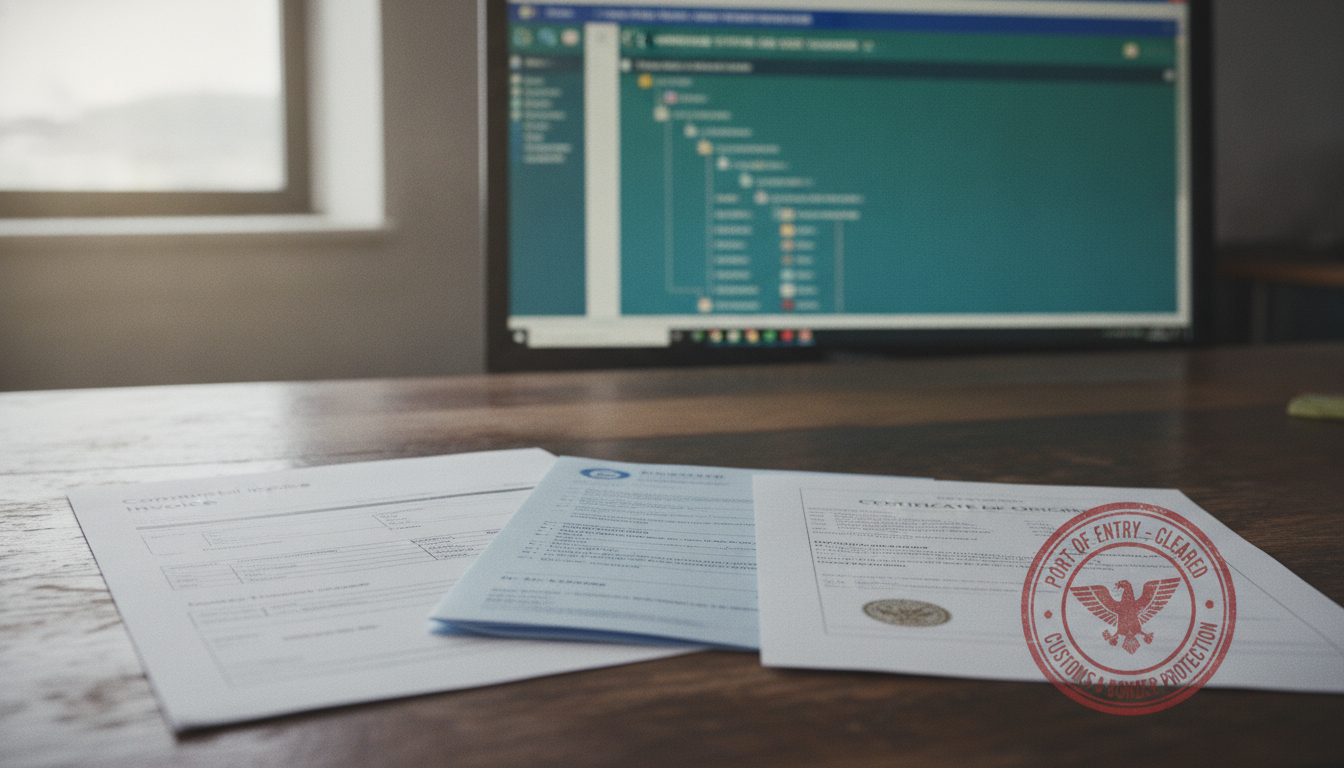
- Documentation requirements: Sea and air shipments need a commercial invoice, packing list, transport document (bill of lading or air waybill), certificate of origin, and product-specific certificates to pass export and import customs inspections.
- Freight-mode trade-offs: Sea freight offers the lowest per-kilogram cost for bulk shipments but requires longer transit and port-dwell time, while air freight reduces transit to 3 to 7 days at three to five times the cost, and rail freight connects China to Europe in 16 to 20 days.
- Customs and duty obligations: The importer of record is responsible for filing the customs entry, paying import duties and VAT or IVA, and ensuring compliance with destination-country product regulations, labeling rules, and tax-identifier registration.
- Landed-cost visibility: Total landed cost itemizes origin charges, international freight, insurance, customs value, import duties, VAT or IVA, destination terminal handling, customs-broker fees, inland delivery, and any demurrage or detention charges to prevent budget overruns.
Supplier Preparation and Cargo-Ready Date
The import export logistics process starts when the supplier notifies you that production is complete and cargo is ready for pickup. This cargo-ready date triggers the freight-booking window and determines when export customs clearance can begin. Delays at this stage cascade through the entire timeline, so confirming the supplier’s packing, labeling, and palletization standards before production ends prevents last-minute rework.
Production Sign-Off and Pre-Shipment Inspection
A pre-shipment inspection verifies that finished goods match the approved sample, purchase-order specifications, and packing requirements before the supplier loads the container or palletizes the air-freight shipment. Inspectors check product quality, carton labeling, inner-pack configuration, gross and net weights, and pallet stability. Catching a labeling error or a short-ship at the factory is faster and cheaper than discovering it after the container arrives at destination and customs holds the shipment for missing compliance marks.
Packing List and Carton Marking
The packing list itemizes every carton by SKU, quantity, dimensions, and weight, and must reconcile exactly with the commercial invoice line items. Customs officers and warehouse receivers use the packing list to verify cargo contents without opening every carton. Carton marking includes the consignee name, destination port, PO number, and any required country-of-origin labels. Missing or inconsistent marks delay customs clearance and warehouse receipt.
Supplier Consolidation and Container Loading
When you source from multiple suppliers in the same region, consolidating shipments into a single container reduces per-unit freight cost and simplifies customs entry. Our Yiwu warehouse receives goods from verified factories across Zhejiang, Guangdong, and Fujian, reconciles packing lists, palletizes mixed SKUs, and coordinates a single container pickup, so you pay one set of destination charges instead of separate LCL fees for each supplier.
In practice: A packing list that omits carton dimensions forces the customs broker to physically measure every carton to calculate volumetric weight for duty assessment, adding two days to clearance and triggering demurrage charges because your container cannot leave the terminal on time.
Export Customs Clearance and Documentation
Export customs clearance in China requires the supplier or freight forwarder to file an export declaration with China Customs, declaring the HS code, FOB value, destination country, and export license if applicable. The declaration generates an export permit that allows the container to leave the port. Incorrect HS classification or missing certificates of origin delay the shipment and can trigger fines.
Commercial Invoice and HS Code Classification
The commercial invoice lists every SKU, unit price, total FOB value, payment terms, and Incoterm. Customs authorities at both origin and destination use this invoice to calculate duties and verify that the declared value matches the actual transaction. The HS code (Harmonized System code) is a six-to-ten-digit tariff classification that determines the duty rate, import restrictions, and required certificates. Misclassifying a product to lower the duty rate is fraud and results in penalties, shipment seizure, and importer blacklisting.
Certificate of Origin and Preferential Tariffs
A certificate of origin (CO) states where the goods were manufactured and is required to claim preferential tariff treatment under free-trade agreements. For example, a CO issued by China Customs allows Mexican importers to apply reduced duty rates under the Asia-Pacific Trade Agreement (APTA) for eligible product categories. The CO must be requested before the shipment leaves China; retroactive issuance is not accepted by most customs authorities.
Product-Specific Certificates and Compliance Documents
Certain product categories require additional certificates before export clearance is granted. Electrical goods need a CCC certificate (China Compulsory Certification) for domestic sale and may require CE marking for European Union entry. Food products need a health certificate from China’s General Administration of Customs. Textiles may need a fiber-content declaration. Wooden pallets and crates need ISPM-15 heat-treatment stamps to prevent pest transfer. Missing certificates halt the shipment at the port of loading.
Freight Mode Selection and Booking
Choosing between sea, air, rail, or multimodal transport depends on cargo volume, urgency, destination infrastructure, and budget. Sea freight is the default for bulk orders, air freight suits time-sensitive or low-volume shipments, and rail freight offers a middle option for China-to-Europe routes. Each mode has distinct cost structures, transit times, and terminal-handling requirements that shape overall import export logistics planning.
Sea Freight: FCL and LCL
Full-container-load (FCL) shipping books an entire 20-foot or 40-foot container for your cargo alone, offering the lowest per-kilogram cost for shipments that fill at least half a container. Less-than-container-load (LCL) consolidates your pallets with other importers’ cargo in a shared container, charging by cubic meter or weight. LCL adds consolidation and deconsolidation fees at origin and destination, and transit time is longer because the container waits for enough cargo to fill. Sea freight from China to Mexico takes 18 to 25 days to Manzanillo or Veracruz, and 28 to 35 days to European ports like Rotterdam or Hamburg.
Air Freight: Speed and Cost Trade-Off
Air freight delivers cargo in 3 to 7 days from China to major Latin American and European airports, making it suitable for urgent restocks, high-value low-weight items, and seasonal peaks. Freight cost is calculated by chargeable weight, the greater of actual weight or volumetric weight (length × width × height ÷ 6000 for air). A shipment of lightweight bulky goods, such as pillows or lampshades, pays volumetric weight, which can be three to five times the actual weight. Air freight also incurs airport handling fees, security surcharges, and fuel surcharges that fluctuate with oil prices.
Rail Freight: China-to-Europe Middle Ground
Rail freight via the China-Europe Railway Express (also called the New Silk Road or Belt and Road rail network) connects Chinese cities like Yiwu, Chengdu, and Chongqing to European terminals in Duisburg, Madrid, and Warsaw in 16 to 20 days. Rail cost sits between sea and air, offering a balanced option for import export logistics when urgency and budget both matter. Infrastructure limitations mean rail is not yet a mainstream option for Latin America.
Multimodal and Last-Mile Coordination
Multimodal transport combines two or more freight modes under a single contract, such as truck pickup from the factory, rail to the port, sea freight to destination, and truck delivery to the final warehouse. A multimodal bill of lading covers the entire journey, and the freight forwarder coordinates handoffs between carriers. Last-mile delivery from the destination port or airport to your warehouse or customer address is often the most expensive per-kilometer segment, so consolidating shipments and scheduling deliveries during off-peak hours reduces cost.
International Transport and Tracking
Once the container or air-freight shipment leaves China, tracking visibility depends on the carrier’s systems and the freight forwarder’s updates. Sea-freight tracking shows vessel departure, transshipment stops, and estimated arrival at the destination port. Air-freight tracking updates at each airport hub. Effective import export logistics coordination requires real-time visibility to plan warehouse staffing and customs-broker handoffs without delays.
Bill of Lading and Air Waybill
The bill of lading (B/L) for sea freight and the air waybill (AWB) for air freight are the primary transport documents. The B/L is a title document, meaning the consignee must present the original B/L to the shipping line to release the cargo at destination. A telex release or express B/L allows electronic release without a physical document, speeding up the process. The AWB is a non-negotiable receipt that proves the air carrier accepted the cargo and lists the consignee and delivery address.
Transshipment and Port Congestion
Many China-to-Latin-America sea routes include a transshipment stop at a hub port like Busan, Singapore, or Los Angeles, where cargo is transferred from a large transoceanic vessel to a smaller feeder vessel. Each transshipment adds 3 to 7 days to total transit time and introduces a risk of missed connections if the feeder vessel departs before the main vessel arrives. Port congestion at major gateways, especially during peak shipping seasons or labor disputes, can delay vessel berthing and container discharge by several days.
Insurance and Cargo Liability
Cargo insurance covers loss or damage during international transport and is typically purchased as a percentage of the cargo value, often 0.3% to 0.5% for general merchandise. The insurance policy should cover the full landed value (FOB value plus freight plus insurance) to ensure you can replace the goods if the shipment is lost. Carrier liability is limited by international conventions (Hague-Visby Rules for sea, Montreal Convention for air) and does not cover the full cargo value, so relying on carrier liability alone leaves you underinsured.
Destination Customs Entry, Duties, and Taxes
When the shipment arrives at the destination port or airport, the importer of record (IOR) is responsible for filing the customs entry, paying import duties and VAT or IVA, and ensuring the goods comply with local product regulations. The customs broker prepares the entry documents, submits them to the customs authority, and coordinates duty payment and cargo release. Importers in Mexico, Colombia, Argentina, Chile, Brazil, Spain, and France each face country-specific requirements for tax registration, customs systems, and compliance certificates.
Importer of Record and Tax Identifier Registration
The importer of record is the legal entity responsible for the shipment and must be registered with the destination country’s customs authority. In Mexico, importers need an RFC (Registro Federal de Contribuyentes) tax ID and must register in the Padrón de Importadores. In Brazil, importers need a CNPJ (Cadastro Nacional da Pessoa Jurídica) and must use the SISCOMEX system for customs declarations. In the European Union, importers need an EORI (Economic Operators Registration and Identification) number and a VAT registration in the country of import. First-time importers often underestimate the time required to obtain these registrations, which can take several weeks.
Customs Valuation and Duty Calculation
Customs valuation determines the taxable base for import duties and VAT or IVA. Most countries use the transaction value (the price actually paid or payable for the goods) as the customs value, adjusted for freight, insurance, and any assists (tooling, molds, or materials supplied by the buyer). The duty rate is determined by the HS code and the country of origin. For example, a product classified under HS code 6204.62 (women’s trousers, of cotton) entering Mexico from China may face a 15% to 20% duty rate, while the same product entering under a preferential trade agreement may qualify for a reduced rate or zero duty. Undervaluing the shipment to lower duties is customs fraud and triggers penalties, shipment seizure, and loss of import privileges.
VAT, IVA, and Other Taxes
Value-added tax (VAT in Europe) or impuesto al valor agregado (IVA in Latin America) is charged on the sum of the customs value plus duties. VAT rates in the European Union range from 19% to 27% depending on the member state and product category. IVA rates in Latin America range from 12% in Colombia to 21% in Argentina. Some countries impose additional taxes: Brazil charges PIS and COFINS federal taxes on top of import duty and ICMS state tax, and Argentina applies a statistical tax and an advance VAT. These taxes are paid at the time of customs clearance and are often the largest component of the landed cost.
Product Compliance and Labeling Requirements
Many product categories require compliance certificates or pre-import approvals before customs will release the shipment. Electrical goods entering the European Union need CE marking and a Declaration of Conformity. Toys need EN 71 safety testing. Food products need health certificates and ingredient labeling in the local language. Mexico requires NOM certificates for electrical goods, textiles, and certain consumer products. Brazil requires INMETRO certification for a wide range of products. Missing certificates delay clearance and may require the shipment to be re-exported or destroyed.
Final Delivery and Demurrage Prevention
After customs releases the shipment, the container or pallets move from the port or airport terminal to your warehouse or final delivery address. Coordinating this final-mile delivery requires scheduling a trucking company, ensuring the warehouse has a loading dock and forklift, and confirming that someone will be present to receive and sign for the cargo. Delays at this stage trigger demurrage and detention charges that accumulate daily and can quickly exceed the original import export logistics budget.
Demurrage and Detention Charges
Demurrage is a fee charged by the port or terminal when a container remains on terminal property beyond the free time allowed, typically 3 to 7 days after vessel discharge. Detention is a fee charged by the shipping line when the container is picked up from the terminal but not returned empty within the free time allowed, typically 7 to 14 days. Both fees start low and escalate rapidly, often doubling every few days. A container that sits at the terminal for two weeks can accumulate demurrage charges equal to the original freight cost.
Drayage and Inland Delivery
Drayage is the short-distance trucking from the port or airport terminal to your warehouse or a container freight station (CFS) where the container is unloaded. Drayage rates vary by distance, fuel prices, and local trucking availability. Scheduling drayage during peak hours or to a congested urban area increases cost. For LCL shipments, the freight forwarder deconsolidates the container at a CFS and delivers your pallets separately, adding handling fees and time.
Warehouse Receipt and Damage Claims
When the cargo arrives at your warehouse, inspect the cartons for damage, verify the packing list against the physical count, and note any discrepancies on the delivery receipt before signing. Damage claims must be filed with the carrier or insurance company within a short window, often 24 to 72 hours for visible damage and 7 to 14 days for concealed damage. Signing a clean delivery receipt without inspection forfeits your right to claim.
Landed Cost Planning and Incoterms
Landed cost is the total cost to get the goods from the supplier’s factory to your warehouse, including product cost, origin charges, international freight, insurance, customs duties, VAT or IVA, destination fees, and inland delivery. Accurate landed-cost planning prevents budget overruns and allows you to price your products competitively. Incoterms (International Commercial Terms) define which party pays for each segment of the journey and where risk transfers from seller to buyer.
Common Incoterms for China Imports
FOB (Free On Board) means the supplier delivers the goods on board the vessel at the port of loading, and the buyer pays international freight, insurance, and all destination costs. EXW (Ex Works) means the buyer picks up the goods at the supplier’s factory and pays all transport and export costs. DDP (Delivered Duty Paid) means the supplier delivers the goods to the buyer’s warehouse and pays all costs including import duties and taxes. Most China imports use FOB because it gives the buyer control over freight booking and customs clearance, while EXW is rare because it requires the buyer to handle export clearance in China, which is difficult for foreign importers.
Landed-Cost Model Components
Your landed-cost model must itemize every charge from factory to warehouse. Origin charges include inland trucking from the factory to the port, export customs clearance, terminal handling at the port of loading, and documentation fees. International freight is the sea, air, or rail cost from China to the destination port or airport. Insurance covers cargo loss or damage during transport. Customs value is the FOB price plus freight and insurance. Import duty is calculated as a percentage of the customs value based on the HS code. VAT or IVA is calculated on the sum of customs value plus duty. Destination charges include terminal handling, customs-broker fees, drayage, and inland delivery. Demurrage and detention are contingency costs that should be budgeted even if you plan to avoid them.
Freight-Forwarder and Customs-Broker Fees
Freight forwarders charge a service fee for booking the shipment, preparing export documents, and coordinating pickup and delivery. This fee is often a flat rate per shipment or a percentage of the freight cost. Customs brokers charge a fee for preparing the customs entry, submitting it to the customs authority, and coordinating duty payment and cargo release. Broker fees vary by country and shipment complexity, typically ranging from a flat fee per entry to a percentage of the customs value. Buyers report frustration when freight quotes omit broker fees, destination terminal handling, or inland delivery, leaving them surprised by charges that appear after the shipment arrives.
Transparency in quotations: Our freight-and-shipping coordination provides itemized quotations that separately list origin pickup, export clearance, international freight, destination terminal handling, customs-broker fees, and inland delivery, so you see the full landed cost before committing to the shipment.
What Are the Critical Steps to Avoid Import Delays and Hidden Costs?
Successful import export logistics planning requires validating supplier readiness before booking freight, ensuring complete documentation at every handoff, selecting the freight mode that balances cost and transit time, registering as importer of record in your destination country, building an itemized landed-cost model that accounts for every charge from factory to warehouse, and scheduling final delivery within the free time allowed by the terminal. Buyers who skip these steps face demurrage charges, customs holds, budget overruns, and inventory delays. The following checklist summarizes critical actions that prevent the most common and costly mistakes.
- Cargo-ready verification: Confirm that your supplier has completed packing, labeling, and palletization to your specifications before booking freight, because post-load rework delays the entire shipment and causes missed vessel departures that add 7 to 14 days to transit (World Bank Logistics Performance Index 2023).
- Documentation completeness: Verify that your shipment includes the commercial invoice, packing list, bill of lading or air waybill, certificate of origin, and product compliance certificates (CE, NOM, INMETRO) at least 48 hours before the cargo leaves the factory, because missing documents cause customs holds that last 5 to 10 days on average (WTO Trade Facilitation Agreement 2023).
- Freight-mode selection: Choose sea freight for bulk orders above 10 cubic meters where transit time of 18 to 35 days is acceptable, air freight for urgent shipments under 500 kilograms where 3 to 7 days justifies the 300% to 500% cost premium, and rail freight for China-to-Europe routes where 16 to 20 days balances cost and speed (Freightos Baltic Index 2024).
- Importer-of-record registration: Complete your tax identifier registration (RFC in Mexico, CNPJ in Brazil, EORI in the EU) and customs authority enrollment at least 30 days before your first shipment arrives, because retroactive applications are rejected and cause clearance delays of 10 to 21 days (OECD Trade Facilitation Indicators 2023).
- Landed-cost itemization: Calculate total delivered cost by summing FOB product cost, origin trucking, export clearance, international freight, cargo insurance (0.3% to 0.5% of FOB), customs value adjustment, import duty (5% to 30% by HS code), VAT or IVA (12% to 27%), terminal handling, broker fees ($150 to $500 per entry), and inland delivery to avoid budget shortfalls of 15% to 40% reported by first-time importers (Deloitte Global Trade Survey 2023).
- Demurrage prevention: Schedule drayage pickup and warehouse delivery within the 3 to 7 day free time allowed after vessel discharge to avoid demurrage charges that start at $75 per day and escalate to $150 to $300 per day after 7 days (Container xChange Demurrage and Detention Report 2024).
Frequently Asked Questions
What is the difference between a freight forwarder and a customs broker?
A freight forwarder arranges international transport by booking cargo space with shipping lines or air carriers, preparing export documents, and coordinating pickup and delivery, but does not file customs entries or pay duties. A customs broker files the import entry with the destination customs authority, calculates and pays duties and taxes on behalf of the importer, and ensures compliance with local regulations. Many freight forwarders partner with customs brokers to offer end-to-end import export logistics service, but the two roles require different licenses and expertise.
How do Incoterms affect who pays for freight and customs?
Incoterms define the point at which cost and risk transfer from seller to buyer in import export logistics transactions. Under FOB (Free On Board), the supplier pays to load the goods onto the vessel at the origin port, and the buyer pays international freight, insurance, and all destination costs including customs duties and inland delivery. Under DDP (Delivered Duty Paid), the supplier pays all costs including international freight, import duties, and delivery to the buyer’s warehouse, so the buyer receives the goods with no additional charges. Choosing the wrong Incoterm can leave you responsible for costs you did not budget for.
What happens if my shipment is missing a required certificate at customs?
If a required compliance certificate, such as a CE mark for electrical goods entering the EU or a NOM certificate for products entering Mexico, is missing when the shipment arrives at customs, the customs authority will hold the shipment and issue a notice of deficiency. You must then obtain the certificate, which can take weeks or months depending on the product and testing requirements, or arrange to re-export or destroy the goods. During the hold period, demurrage and storage charges accumulate daily, and you cannot sell or use the inventory, disrupting your import export logistics timeline and cash flow.
Import export logistics requires coordinating supplier readiness, export clearance, freight booking, customs entry, duty payment, and final delivery across multiple parties and jurisdictions. Buyers who plan the full landed cost, verify documentation completeness before the shipment leaves China, and schedule drayage within the free time allowed avoid the most common delays and unexpected fees. Working with a trusted China sourcing agent that handles supplier verification, quality inspection, consolidation, and freight coordination reduces the operational burden and ensures that every step from factory to warehouse is executed correctly.
Need help coordinating your next China import from supplier verification through customs clearance and final delivery?
Request a Freight and Landed-Cost Quote →
Written by the Goodcantrading Sourcing Team.