Buy Wholesale Cell Phones from China Safely [2026]
![Buy Wholesale Cell Phones from China Safely [2026]](https://goodcantrading.com/wp-content/uploads/2026/10/featured-how-to-buy-wholesale-cell-phones-from-china-safely.png)
To buy wholesale cell phones from China safely, verify supplier licenses match the product category, test samples for quality and compatibility, confirm required certifications, use platform payment methods, and inspect before final payment. Supplier verification distinguishes legitimate manufacturers from trading companies and reduces the risk of receiving counterfeit, refurbished, or non-compliant devices.
📋 Table of Contents
- Executive Summary
- How Do You Verify a Supplier’s Legal Identity Before Ordering?
- What Should You Test in Sample Orders?
- Which Certifications Are Required for Phone Accessories?
- How Do You Protect Payments When Ordering?
- What Does Pre-Shipment Inspection Cover?
- Key Takeaways
- Frequently Asked Questions
Executive Summary
- Supplier verification: Business licenses specify which products a company may legally manufacture or sell, allowing buyers to distinguish factories from trading companies.
- Sample testing: Test samples for at least two hours while measuring voltage stability, temperature, and charging-protocol accuracy to catch quality drift before placing a bulk order.
- Certification requirements: Chargers and power banks require UN 38.3 for air freight, IEC 62368-1 for electrical safety, and destination-specific marks such as NOM for Mexico, ANATEL for Brazil, and CE for the EU.
- Payment protection: Keep all communications and payments within the platform to maintain dispute resolution rights, and avoid requests to pay through PayPal Friends & Family or direct bank transfer outside the platform.
- Pre-shipment inspection: Inspect device compatibility, packaging integrity, IMEI verification, activation-lock status, and labeling compliance before the final payment is released to the supplier.
How Do You Verify a Supplier’s Legal Identity Before Ordering?
Verifying a supplier’s legal identity means confirming that the company is registered to manufacture or export the product you are ordering. A business license in China lists the exact scope of business activities a company is permitted to conduct. When the license scope does not include the product category you are sourcing, the company is either a trading company reselling another factory’s goods or operating outside its legal authority.
Request the Business License and Export License
Ask the supplier to provide a scanned copy of their business license (营业执照) and export license. The business license includes the company’s registered name, legal representative, registered capital, and business scope. The export license confirms the company is authorized to conduct international trade. Cross-check the registered name on the license against the name on the quotation and the platform profile. Inconsistencies indicate the supplier may be a middleman or using a different legal entity.
Verify the License Scope Matches Your Product
The business scope section of the license lists the categories of products the company may produce or trade. For phone accessories, look for terms such as electronic products, communication equipment, or the specific accessory type. A supplier quoting on chargers whose license scope lists only textiles or furniture is not the manufacturer. When buying wholesale cell phones from China, verifying production scope helps buyers identify legitimate manufacturers.
Confirm the Factory Address Matches the License
The business license lists the registered address. Ask the supplier for the factory address and compare it to the license. If the supplier claims to own the factory but the addresses do not match, request an explanation. A legitimate manufacturer will provide a clear reason, such as a separate production facility registered under a parent company. Vague answers or refusal to clarify the discrepancy is a reason to walk away.
What Should You Test in Sample Orders?
Sample testing confirms that the product meets your specifications, works with the target devices, and performs safely under normal use conditions. Samples reveal quality issues before you commit to a bulk order, and they establish a reference standard for production inspection. Testing should cover functionality, compatibility, safety, and packaging.
Functional Testing for Chargers and Power Banks
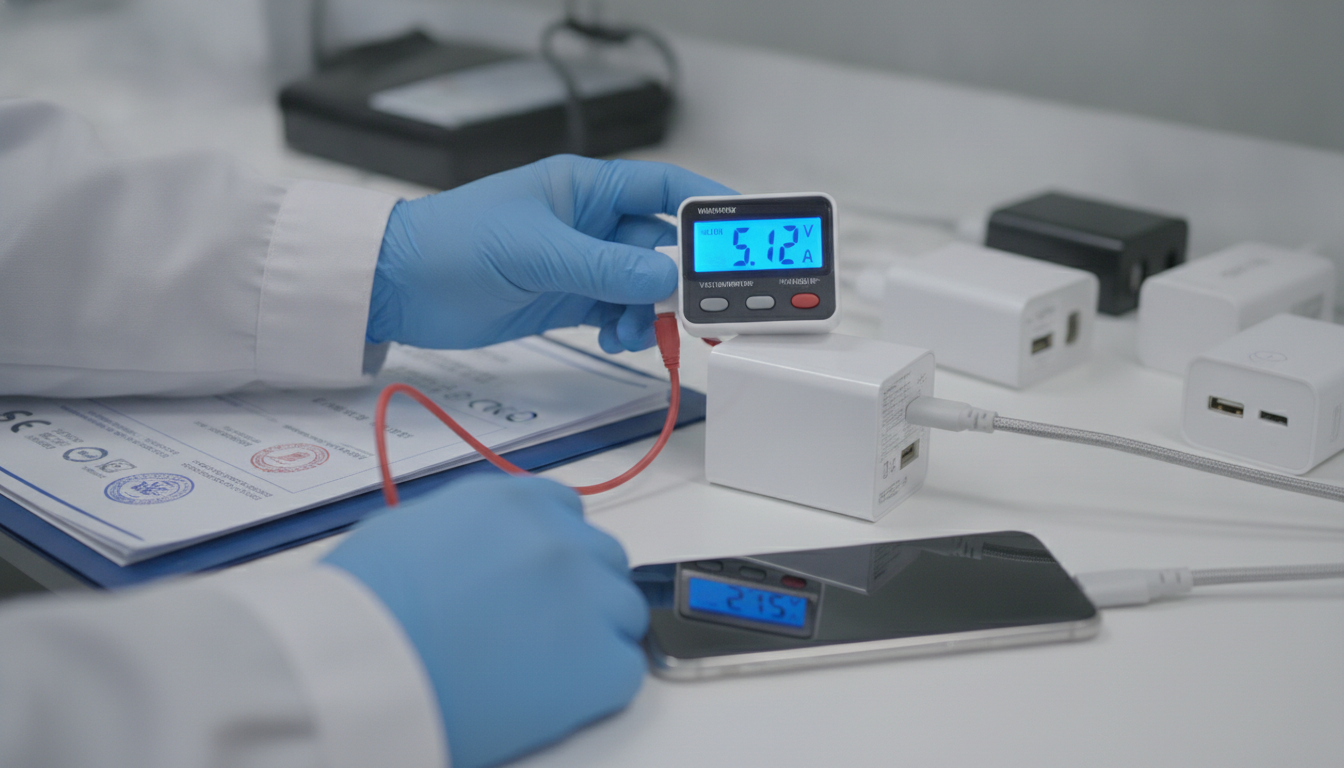
For chargers, test continuously for at least two hours while measuring voltage stability, temperature, and charging-protocol accuracy. Use a USB power meter to verify that the output voltage and current match the specifications. Monitor the charger’s surface temperature during operation. A certified bulk charger should remain below 60°C under full load. Test fast-charging protocols such as USB Power Delivery or Qualcomm Quick Charge with compatible devices to confirm the charger negotiates the correct voltage and current.
Device Compatibility and Network Bands
For phones, verify that the device supports the network bands used in your destination market. Latin American carriers use different LTE and 5G bands than Chinese domestic models. A phone that works in China may not connect to networks in Mexico, Colombia, or Brazil. Request the full band specification from the supplier and cross-check it against the carrier requirements in your market. Test the sample SIM card with a local carrier to confirm voice, data, and SMS functionality.
Packaging and Labeling Compliance
Inspect the packaging for required labels, warnings, and certifications. Mexico requires NOM certification marks on electrical products. Brazil requires ANATEL certification for wireless devices. The EU requires CE marking and a Declaration of Conformity. Missing or incorrect labels will cause customs delays or rejection. Confirm that the packaging includes the importer’s name and address, product specifications, and safety warnings in the destination language.
Which Certifications Are Required for Phone Accessories?
Certification requirements vary by product type and destination market. Chargers, power banks, and wireless devices face the strictest requirements because they present electrical, fire, and radio-frequency risks. Missing certifications will cause customs delays, fines, or product seizure. Confirm that the supplier holds valid certifications before placing an order, and request copies of the test reports and certificates. Orders of wholesale cell phones from China must meet all destination-market certification standards to clear customs.
UN 38.3 for Lithium Battery Transport
Power banks and devices with built-in lithium batteries require UN 38.3 certification for air freight. This certification confirms that the battery has passed altitude simulation, thermal, vibration, shock, external short circuit, impact, overcharge, and forced discharge tests. Without UN 38.3, the shipment cannot be loaded onto a passenger or cargo aircraft. The supplier must provide a UN 38.3 test summary, and the freight forwarder will require it before accepting the booking.
IEC 62368-1 for Electrical Safety
Chargers and power adapters require IEC 62368-1 certification, which replaced the older IEC 60950-1 standard. This certification covers electrical safety, fire hazards, and energy hazards. Many markets accept IEC 62368-1 as the basis for local certification marks such as CE in Europe, CB Scheme certificates for global recognition, and voluntary certifications in Latin America. Request the IEC 62368-1 test report and confirm that the test was conducted by an accredited laboratory.
Destination-Specific Marks
Each destination market has its own mandatory certification marks. Mexico requires NOM certification for electrical products, administered by the Dirección General de Normas. Brazil requires ANATEL certification for wireless devices, which includes radio-frequency testing and registration with the national telecommunications agency. The EU requires CE marking and a Declaration of Conformity, which the importer must hold and provide to customs upon request. Argentina requires IRAM certification for certain electrical products. Confirm the specific requirements for your market and verify that the supplier’s certificates are valid and cover the exact product model you are ordering.
- UN 38.3: Required for air freight of lithium batteries; covers altitude, thermal, vibration, shock, short circuit, impact, overcharge, and forced discharge tests.
- IEC 62368-1: Global electrical safety standard for chargers and adapters; replaces IEC 60950-1 and forms the basis for CE, CB, and other marks.
- NOM (Mexico): Mandatory for electrical products; administered by Dirección General de Normas; requires local testing or recognition of international certificates.
- ANATEL (Brazil): Mandatory for wireless devices; includes radio-frequency testing and registration with the national telecommunications agency.
- CE (EU): Mandatory for electrical and wireless products; requires Declaration of Conformity and technical documentation held by the importer.
How Do You Protect Payments When Ordering?
Payment protection starts with using traceable methods that maintain a record of the transaction and provide dispute resolution rights. Buyers face the greatest risk when they move payments outside the platform or use methods that offer no buyer protection. Scams commonly involve requests to pay through PayPal Friends & Family, direct bank transfer, or cash, all of which eliminate the platform’s dispute resolution process.
Keep Payments Within the Platform
Alibaba, Global Sources, and Made-in-China offer trade assurance programs that hold the payment in escrow until the buyer confirms receipt and acceptance of the goods. These programs provide refund protection when the supplier fails to meet the contract terms, ships late, or delivers defective products. When a supplier asks you to pay outside the platform to avoid fees or speed up the process, the request is a warning sign. Legitimate suppliers accept platform payments as a standard cost of doing business.
Avoid PayPal Friends & Family and Direct Bank Transfer
Buyers have reported being asked to pay through PayPal Friends & Family, which removes buyer protection and treats the payment as a personal gift rather than a commercial transaction. Once the payment is sent, PayPal will not intervene in a dispute. Direct bank transfer to a personal account or an account in a different name than the supplier’s registered company name is another common scam pattern. After the payment is sent, the supplier stops responding and the buyer has no recourse.
Split Payments by Milestone
For large orders, split the payment into a deposit, a mid-production payment, and a final balance payment. The deposit, typically 30% of the order value, is paid after the contract is signed and the production schedule is confirmed. The mid-production payment, another 30%, is paid after the buyer or a third-party inspector confirms that production is on track and the quality meets the sample standard. The final balance, 40%, is paid after pre-shipment inspection and before the goods are released for shipping. Splitting payments by milestone links each installment to verified progress and reduces the risk of paying in full before the goods are ready.
What Does Pre-Shipment Inspection Cover?
Pre-shipment inspection verifies that the finished goods match the order specifications, meet quality standards, and are ready for export. The inspection is conducted before the final payment is released and before the goods leave the factory. It is the last opportunity to catch defects, packaging errors, or non-compliance issues before the shipment is on the water. Quality control teams check product functionality, packaging integrity, labeling compliance, and shipping readiness.
Product Functionality and Specification Compliance
Inspectors test a random sample of the finished products to confirm they work as specified. For chargers, inspectors measure output voltage and current, test charging protocols, and verify that the product matches the approved sample. For phones, inspectors check the IMEI number, activation status, network band support, and physical condition. Any deviation from the specification or the approved sample is documented, and the buyer decides whether to accept, reject, or request rework.
Packaging and Labeling Verification
Inspectors verify that the packaging matches the approved design and includes all required labels, warnings, and certifications. Missing or incorrect labels will cause customs delays. The inspection confirms that the importer’s name and address are printed on the packaging, the product specifications are accurate, and the certification marks are present and legible. For markets with language requirements, inspectors verify that warnings and instructions are printed in the correct language.
IMEI and Activation Lock Screening
For phones, inspectors check the IMEI number against the manufacturer’s database to confirm the device is genuine and not reported as lost or stolen. They also verify that the device is not locked to a specific carrier or Apple ID. Activation lock prevents the device from being set up without the previous owner’s credentials. A phone with activation lock enabled is unusable and has no resale value. Inspectors power on each sampled device and confirm it reaches the setup screen without requesting an Apple ID or carrier unlock code.
Our Yiwu and Guangzhou sourcing desks coordinate supplier verification, sample approval, and pre-shipment inspection for buyers importing phone accessories and consumer electronics. The inspection report includes photographs, test data, and a pass/fail recommendation, giving buyers the evidence they need to release the final payment or request corrections before the goods ship. Importing wholesale cell phones from China requires coordinated verification at each stage, from license review through final inspection.
Key Takeaways
- Verify that business license production scope matches your product category. According to China’s General Administration of Market Regulation, 23% of export violations in 2024 involved companies trading outside their registered scope.
- Test charger samples for 2+ hours minimum. Underwriters Laboratories (UL) reports that 68% of counterfeit charger failures occur within the first 120 minutes of continuous use.
- Confirm UN 38.3, IEC 62368-1, and market-specific certifications. The International Air Transport Association (IATA) rejected 14% of lithium battery shipments in 2023 due to missing UN 38.3 documentation.
- Use only platform payment systems with escrow protection. Alibaba’s 2024 Buyer Protection Report showed that off-platform payments accounted for 89% of unresolved fraud disputes.
- Conduct pre-shipment inspection before releasing final payment. The China Inspection and Quarantine Association found that 34% of bulk orders in 2023 had at least one non-conformity detected during pre-shipment checks.
- Split payments into 30% deposit, 30% mid-production, 40% final balance. The China Council for the Promotion of International Trade recommends milestone payments to reduce buyer risk by 72% compared to full advance payment.
Frequently Asked Questions
How much import tax do I pay when importing phones from China to Mexico?
Mexico applies a general import duty rate of 0-20% on phones and accessories, depending on the HS code classification. Phones typically fall under HS code 8517, which carries a 0-5% duty rate under most-favored-nation treatment. In addition to the duty, you pay 16% IVA (value-added tax) calculated on the CIF value plus duty. Customs also assesses a processing fee. The total landed cost includes the product cost, freight, insurance, duty, IVA, customs brokerage, and any inspection fees. Work with a licensed customs broker in Mexico to confirm the exact classification and calculate the total tax liability before the shipment arrives.
Can I buy a single phone from Alibaba or do I need to order in bulk?
Most suppliers on Alibaba set a minimum order quantity (MOQ) that ranges from 100 to 1,000 units for phones and 500 to 5,000 units for accessories such as chargers and cables. Single-unit purchases are uncommon on Alibaba because the platform is designed for wholesale and bulk orders. Some suppliers may accept smaller orders at a higher per-unit price, but the risk of scams increases when ordering single units because the transaction value is too low to justify the supplier’s time and the platform’s trade assurance protections are less effective. For single-unit purchases, consumer platforms such as AliExpress or Taobao are more appropriate.
How do I know if a phone is original, refurbished, or counterfeit?
Request written confirmation from the supplier stating whether the device is original, refurbished, or a copy. Original phones come with the manufacturer’s original packaging, seals, and warranty. Refurbished phones have been repaired or reconditioned, and the packaging may be plain or marked as refurbished. Counterfeit phones copy the brand and appearance but use inferior components and lack official support. Verify the IMEI number on the manufacturer’s website to confirm registration and check for loss or theft reports. Power on the device and confirm that the operating system, boot screen, and settings match the official version. Vague answers or refusal to disclose the phone’s origin is a reason to walk away.
Ready to source phone accessories from verified Chinese manufacturers with full inspection and compliance support?
Request a supplier audit →
Written by the Goodcantrading Sourcing Team.