Low MOQ Candle Suppliers China for Shopify Stores [2026 Guide]
![Low MOQ Candle Suppliers China for Shopify Stores [2026 Guide]](https://goodcantrading.com/wp-content/uploads/2026/10/featured-low-moq-candle-suppliers-china-for-shopify-stores.png)
Low MOQ candle suppliers China for Shopify stores offer minimums ranging from 1 piece for catalog items to 20-500 pieces for custom orders, according to current marketplace data. Suppliers in Guangdong, Zhejiang, and Fujian provinces produce soy, paraffin, beeswax, and coconut wax candles with private-label and OEM options suitable for direct-to-consumer brands testing product-market fit before committing to bulk inventory.
📋 Table of Contents
- Executive Summary
- What MOQ Thresholds Do China Candle Suppliers Actually Offer?
- Which Candle Types and Formats Work Best for Low-MOQ Orders?
- How Do You Verify a Candle Supplier Before Placing a Test Order?
- What Compliance and Safety Standards Apply to Candle Imports?
- How to Structure Your First Low-MOQ Candle Order for Shopify
- Key Takeaways
- Frequently Asked Questions
Executive Summary
- MOQ landscape: Current China marketplace listings show candle MOQs as low as 1-5 pieces for catalog items, 20-50 pieces for custom luxury formats, and 100-1,250 pieces for bulk votive or tealight orders.
- Supplier concentration: Guangdong, Zhejiang, and Fujian provinces host the majority of export-ready candle factories, with Yiwu serving as a key consolidation hub for small-batch Shopify orders.
- Verification priority: A supplier’s business licence scope must explicitly cover candle production; trading companies often quote lower MOQs but add hidden markup and lack direct factory control.
- Compliance gate: EU markets require EN 15494 compliance for scented candles, while Mexico and Brazil enforce labeling and flammability standards that vary by candle type and wax composition.
- Sample-to-bulk risk: Scent throw, burn time, and wick centering frequently drift between approved samples and production runs when no third-party inspection monitors the bulk order.
What MOQ Thresholds Do China Candle Suppliers Actually Offer?
China candle suppliers segment MOQ by product complexity and customization level. Catalog items with standard wax blends and existing molds start at 1-5 pieces on current marketplace pages, while custom scent formulations, private-label packaging, and bespoke jar designs push minimums to 20-500 pieces depending on tooling requirements.
Catalog and Ready-Made Candles
Some low-MOQ candle offers on current marketplace pages show as low as 1 piece, including custom or premium candle formats (Accio, 2026). These listings typically cover tealights, votives, and pillar candles in standard dimensions where the supplier maintains inventory or runs continuous production for multiple buyers. Shopify store owners testing a new scent or format benefit from single-unit orders that eliminate upfront inventory risk, though per-piece pricing runs 30-50% higher than bulk rates.
Custom and Private-Label Orders
Current marketplace candle listings show 20-piece and 50-piece MOQ options for custom luxury candles (Accio, 2026). These thresholds apply when the buyer specifies a proprietary scent blend, custom label artwork, or a jar shape requiring new mold production. Suppliers amortize tooling costs across the initial order, so MOQ negotiation hinges on whether the buyer commits to repeat orders or accepts a one-time mold fee that lowers the per-unit price on subsequent runs.
Bulk and High-Volume Formats
Some China candle product pages still list 100-piece, 300-piece, 500-piece, and 1,000-piece MOQ bands, indicating the market is not uniformly low-MOQ (Made-in-China, 2026). Votive and tealight candles, which require minimal customization and ship in compact cartons, often carry higher minimums because factories optimize production efficiency by running large batches. Marketplace candle offers include 1,250-box MOQ for certain votive candle listings (Made-in-China, 2026), a threshold that suits wholesalers and retail chains but exceeds the cash-flow capacity of most Shopify stores launching their first candle SKU.
Low-MOQ candle listings on current China sourcing pages start at 1 to 5 pieces for some catalog items, while many factory offers still cluster around 20 to 500 pieces (Accio, 2026). Shopify store owners balancing inventory risk against unit economics should request a tiered quote showing per-piece pricing at 20, 50, 100, and 300 units, then model landed cost including shipping, customs duty, and payment-processing fees to identify the break-even order size for their target retail margin.
Which Candle Types and Formats Work Best for Low-MOQ Orders?
Candle formats that minimize tooling investment and existing supplier molds deliver the lowest MOQs and fastest sampling timelines. Jar candles, tealights, and pillar candles in standard dimensions allow Shopify stores to test market demand without committing capital to custom mold production or proprietary wax formulations.
Soy and Paraffin Wax Blends
Soy wax candles appeal to eco-conscious buyers and command premium retail pricing, but pure soy formulations require precise temperature control during pouring to prevent frosting and sinkholes. Suppliers offering low MOQs often propose soy-paraffin blends that improve surface finish and scent throw while maintaining a natural-wax marketing angle. Paraffin candles deliver consistent burn performance and accept a wider range of fragrance oils, making them the default choice for suppliers willing to accept 20-50 piece minimums on custom scents.
Beeswax and Coconut Wax Premium Options
Beeswax and coconut wax candles target the luxury and wellness segments, with retail prices 40-70% above paraffin equivalents. These waxes cost more per kilogram and require specialized pouring techniques, so suppliers typically enforce 50-300 piece MOQs to justify setup time. Shopify stores positioning candles as artisan or zero-waste products find that beeswax’s natural honey scent and coconut wax’s clean burn justify the higher minimum, provided the brand story and packaging design support the premium price point.
Tealight, Votive, and Pillar Formats
Tealights and votives ship in compact cartons and require no custom packaging beyond a printed sleeve, making them attractive for suppliers willing to accept 50-100 piece orders. Pillar candles in standard diameters (2-inch, 3-inch, 4-inch) use existing molds and allow scent customization without tooling investment. Jar candles offer the widest branding surface and the highest perceived value, but glass sourcing and label application add 7-14 days to production lead time and push MOQs to 100-300 pieces when the buyer specifies a proprietary jar shape.
Scent Throw and Burn Time Considerations
Scent throw measures how far a candle’s fragrance disperses when burning, with cold throw (unlit) and hot throw (lit) both influencing buyer satisfaction. Suppliers calculate fragrance oil dosage as a percentage of total wax weight, typically 6-10% for soy and 8-12% for paraffin. Burn time depends on wax type, wick diameter, and jar geometry; a poorly matched wick causes tunneling (wax remains on jar sides) or mushrooming (carbon buildup on wick tip). Shopify stores ordering custom scents should request a burn test report showing wick performance across the full candle height before approving bulk production.
How Do You Verify a Candle Supplier Before Placing a Test Order?
Supplier verification for low MOQ candle suppliers China for Shopify stores starts with confirming the entity’s legal production scope and physical factory location. Trading companies frequently list lower MOQs than factories because they aggregate orders across multiple buyers, but they add 15-30% markup and lack direct control over production quality or lead times.
Business Licence and Production Scope Check
A Chinese business licence states the exact production scope the entity is legally permitted to operate. Candle manufacturing requires a scope entry covering wax products, fragrance blending, or home décor items. Supplier management processes cross-reference the licence scope against the quoted product category to confirm the entity is a factory rather than a trading company reselling another manufacturer’s output. Trading companies often present themselves as factories to capture the buyer’s margin, but their business licence will list commercial trade or import-export services instead of production.
Factory Audit and Production Capacity
A factory audit verifies physical production equipment, raw material storage, and quality-control infrastructure. Candle factories require wax melting tanks, fragrance blending stations, pouring lines, and curing racks; a facility lacking any of these components is likely a trading company or a small workshop subcontracting production. Our Yiwu and Guangzhou sourcing desks conduct on-site audits that photograph equipment serial numbers, measure warehouse dimensions, and interview production managers to confirm daily output capacity matches the quoted lead time.
Sample Quality and Consistency Testing
Sample candles reveal wax finish, scent accuracy, wick centering, and burn performance before the buyer commits to a bulk order. Shopify store owners should burn the sample for at least four hours to check for tunneling, soot emission, and scent throw consistency. A second sample from the same supplier, ordered two weeks after the first, tests production consistency and flags suppliers who send hand-finished samples that do not represent bulk quality. Quality control protocols document wick type, wax temperature at pour, and fragrance oil batch number so bulk production replicates the approved sample.
Payment Terms and Deposit Structure
Suppliers offering 30% deposit and 70% balance before shipment follow standard export practice. Requests for 100% advance payment or payment to a personal account rather than a company account signal elevated fraud risk. Buyers report discovering that some suppliers demand full payment upfront, then delay production or ship substandard goods because the buyer has no financial remaining. A trusted China sourcing agent holds the deposit in escrow or structures milestone payments tied to pre-production approval, mid-production inspection, and final QC sign-off.
What Compliance and Safety Standards Apply to Candle Imports?
Candle imports into the EU, Mexico, Brazil, and Argentina face country-specific flammability, labeling, and chemical-composition regulations. Non-compliant candles trigger customs holds, fines, or destruction orders, so Shopify stores must confirm supplier adherence to target-market standards before placing a bulk order.
EU EN 15494 and REACH Compliance
The European Union enforces EN 15494 for scented candles, covering flame height, self-extinguishing behavior, and labeling requirements. REACH (Registration, Evaluation, Authorisation, and Restriction of Chemicals) restricts certain fragrance compounds and requires suppliers to provide a declaration of conformity listing all chemical constituents. Candles containing prohibited phthalates or allergens above threshold levels cannot enter EU markets. Suppliers must provide test reports from an accredited laboratory showing compliance with EN 15494 flame-spread limits and REACH substance restrictions.
Mexico NOM Standards and Labeling
Mexico’s Secretaría de Economía enforces NOM-050-SCFI labeling requirements for candles, mandating Spanish-language labels that state product name, net weight, manufacturer details, country of origin, and safety warnings. Candles marketed as scented or aromatherapy products may require additional health-claim substantiation. Importers must register with the Mexican customs authority (SAT) and provide a certificate of origin to qualify for USMCA duty preferences if the candles meet regional value-content thresholds.
Brazil INMETRO and Flammability Testing
Brazil’s INMETRO (Instituto Nacional de Metrologia, Qualidade e Tecnologia) requires flammability testing and product registration for candles classified as consumer goods. Importers submit test reports demonstrating compliance with Brazilian safety standards, including wick burn rate and wax drip behavior. Portuguese-language labels must include manufacturer identification, batch number, and safety instructions. Non-compliant shipments face storage fees, re-export costs, or destruction, so Shopify stores targeting the Brazilian market should request INMETRO test reports during the sampling phase.
Argentina IRAM and Import Documentation
Argentina’s IRAM (Instituto Argentino de Normalización y Certificación) publishes voluntary standards for candle safety, but customs authorities enforce labeling and import-license requirements that vary by product category. Scented candles containing essential oils may require phytosanitary certificates if the oils are plant-derived. Spanish-language labels, commercial invoices, and certificates of origin must accompany every shipment. Importers should consult a customs broker familiar with Argentina’s SIRA (Sistema Integral de Registro de Autorizaciones) import-authorization process to avoid clearance delays.
How to Structure Your First Low-MOQ Candle Order for Shopify
Structuring a low-MOQ candle order for a Shopify store requires balancing inventory risk, landed cost per unit, and production lead time. A well-planned first order tests market demand without tying up capital in unsold stock or triggering cash-flow strain from slow-moving SKUs.
Order Quantity and SKU Mix
Shopify stores launching a candle line should order 50-100 units per SKU to qualify for factory pricing while maintaining flexibility to pivot based on early sales data. Ordering a single SKU in higher quantity lowers per-unit cost but increases risk if the scent or format underperforms. Ordering three SKUs at 30-50 units each spreads risk and provides A/B testing data on customer preferences, though per-unit pricing rises 10-20% compared to a single-SKU order of 150 units.
Sampling and Pre-Production Approval
Pre-production samples confirm that the supplier replicates the approved prototype before bulk manufacturing begins. Shopify store owners should burn the pre-production sample for a full cycle to verify wick performance, scent throw, and wax finish match the original sample. Changes between the prototype and pre-production sample indicate process drift or material substitution, both of which require immediate correction before the factory pours the bulk order.
Production Monitoring and Inspection
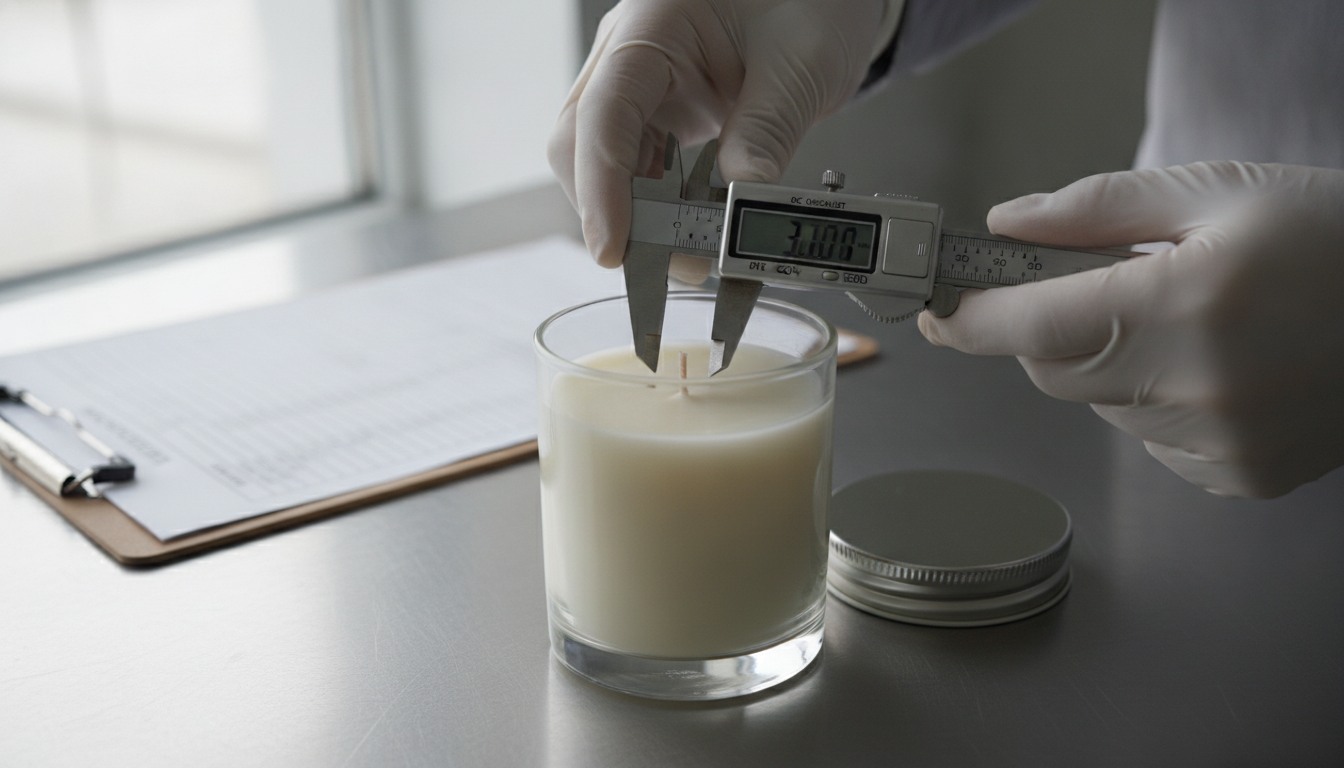
During-production inspection catches quality issues while the factory can still correct them, avoiding the costly scenario where an entire batch arrives defective and the buyer has no recourse. Inspectors photograph wax color, measure wick centering with calipers, and test fragrance intensity against the approved sample. Final random inspection before shipment verifies that packaging, labeling, and carton counts match the purchase order. Quality control services document findings with timestamped photos and issue a pass/fail report that the buyer reviews before authorizing the balance payment.
Shipping and Consolidation for Small Orders
Low-MOQ candle orders often fall below the minimum weight for cost-effective ocean freight, making air freight or consolidated sea shipment the practical options. Air freight delivers candles to Mexico in 5-8 days and to Europe in 7-12 days, but costs $4-8 per kilogram compared to $0.50-1.50 per kilogram for ocean freight. Warehouse and consolidation services combine multiple small orders into a single container, splitting ocean freight costs across buyers and reducing per-unit shipping expense by 40-60% compared to air freight.
Landed Cost Calculation and Margin Planning
Landed cost includes factory price, shipping, customs duty, import taxes, and payment-processing fees. A candle quoted at $2.50 FOB China incurs $0.80-1.20 in air freight, 8-15% in customs duty depending on destination country, and 3-5% in payment fees, bringing total landed cost to $3.80-4.50 per unit. Shopify stores targeting 3x retail markup need to price the candle at $11-14 to cover landed cost, platform fees, marketing spend, and profit margin. Stores unable to command that retail price should negotiate lower factory pricing, increase order quantity to reduce per-unit shipping cost, or select a simpler candle format with lower production cost.
Key Takeaways
- MOQ verification: Current marketplace data shows China candle MOQs starting at 1-5 pieces for catalog items and 20-500 pieces for custom orders, but trading companies often quote lower minimums by aggregating orders and adding hidden markup.
- Supplier legal scope: A Chinese business licence explicitly states the production categories the entity may manufacture; candle suppliers whose licence lists only commercial trade or import-export services are trading companies, not factories.
- Compliance documentation: EU EN 15494 test reports, Mexico NOM-050-SCFI Spanish labels, Brazil INMETRO flammability certificates, and Argentina SIRA import authorizations must be secured during the sampling phase to avoid customs holds.
- Sample-to-bulk consistency: Scent throw, wick centering, and wax finish frequently drift between approved samples and bulk production when no third-party inspection monitors the manufacturing process.
- Landed cost modeling: Air freight adds $4-8 per kilogram to candle shipments, while consolidated ocean freight reduces per-unit shipping cost by 40-60% for orders that meet minimum container-load thresholds.
- Order structure for testing: Shopify stores should order 50-100 units per SKU to balance factory pricing against inventory risk, then use early sales data to identify winning scents before scaling to 300-500 unit reorders.
Frequently Asked Questions
Can I private label candles from China for my Shopify store?
Private labeling candles from China requires the supplier to apply your brand name, logo, and custom label design to the finished product. Most suppliers accept private-label orders at 50-300 piece minimums, with the exact threshold depending on whether you provide print-ready artwork or require design services. The supplier should provide a digital proof showing label placement, color accuracy, and barcode readability before printing the full batch. Private-label candles must still meet destination-market compliance standards, so request test reports and certificates of conformity that list your brand name as the importer of record.
How long does it take to produce a low-MOQ candle order in China?
Production lead time for low-MOQ candle orders ranges from 10 to 30 days depending on wax type, customization level, and factory workload. Catalog candles using standard molds and existing scents ship in 10-15 days, while custom scent formulation, new mold production, or bespoke packaging extends lead time to 20-30 days. Add 5-8 days for air freight to Mexico or 7-12 days to Europe, or 25-35 days for ocean freight. Shopify stores planning a product launch should request a detailed production timeline showing mold preparation, pouring, curing, labeling, and QC inspection milestones to avoid stockouts or delayed campaign launches.
What certifications should I request from a China candle supplier?
Request an EN 15494 test report if selling in the EU, showing flame height, self-extinguishing behavior, and compliance with REACH chemical restrictions. For Mexico, confirm the supplier can provide a certificate of origin and apply NOM-050-SCFI compliant Spanish labels. Brazil requires INMETRO flammability test reports and product registration documentation. Argentina may require phytosanitary certificates for candles containing plant-derived essential oils. Additionally, request the supplier’s business licence, factory audit report, and a declaration of conformity listing all raw materials and fragrance compounds used in the candle formulation.
Ready to source low-MOQ candles from verified China suppliers for your Shopify store?
Request a supplier audit and quote →
Written by the Goodcantrading Sourcing Team.