Factory Auditor: Verify Chinese Suppliers [2026 Guide]
![Factory Auditor: Verify Chinese Suppliers [2026 Guide]](https://goodcantrading.com/wp-content/uploads/2026/09/featured-factory-auditor-verify-chinese-suppliers.png)
A factory auditor is a third-party inspector who verifies that a Chinese supplier is a legitimate manufacturer with the production capacity, quality systems, and legal documentation to fulfill your order before you commit to a deposit. The audit confirms the business license scope matches the product category, checks production equipment against claimed capacity, and validates quality-control processes through on-site inspection and document review.
📋 Table of Contents
Executive Summary
- Verification scope: A factory auditor checks business license production scope, on-site equipment, worker count, quality management systems, and ESG compliance to confirm the supplier is a real manufacturer.
- Timing: Schedule the audit after initial quotation but before paying any deposit, so you can walk away without financial loss if the supplier fails verification.
- Audit format: On-site audits provide the most reliable evidence, while remote video audits can be staged with selective camera angles or pre-recorded footage.
- Report deliverables: A complete audit report includes photographic evidence of production lines, copies of business licenses and certifications, worker headcount verification, and a pass-fail recommendation with corrective action items.
- Common fraud signal: A business license listing wholesale or consulting in the scope, rather than manufacturing or production, indicates a trading company reselling another factory’s output.
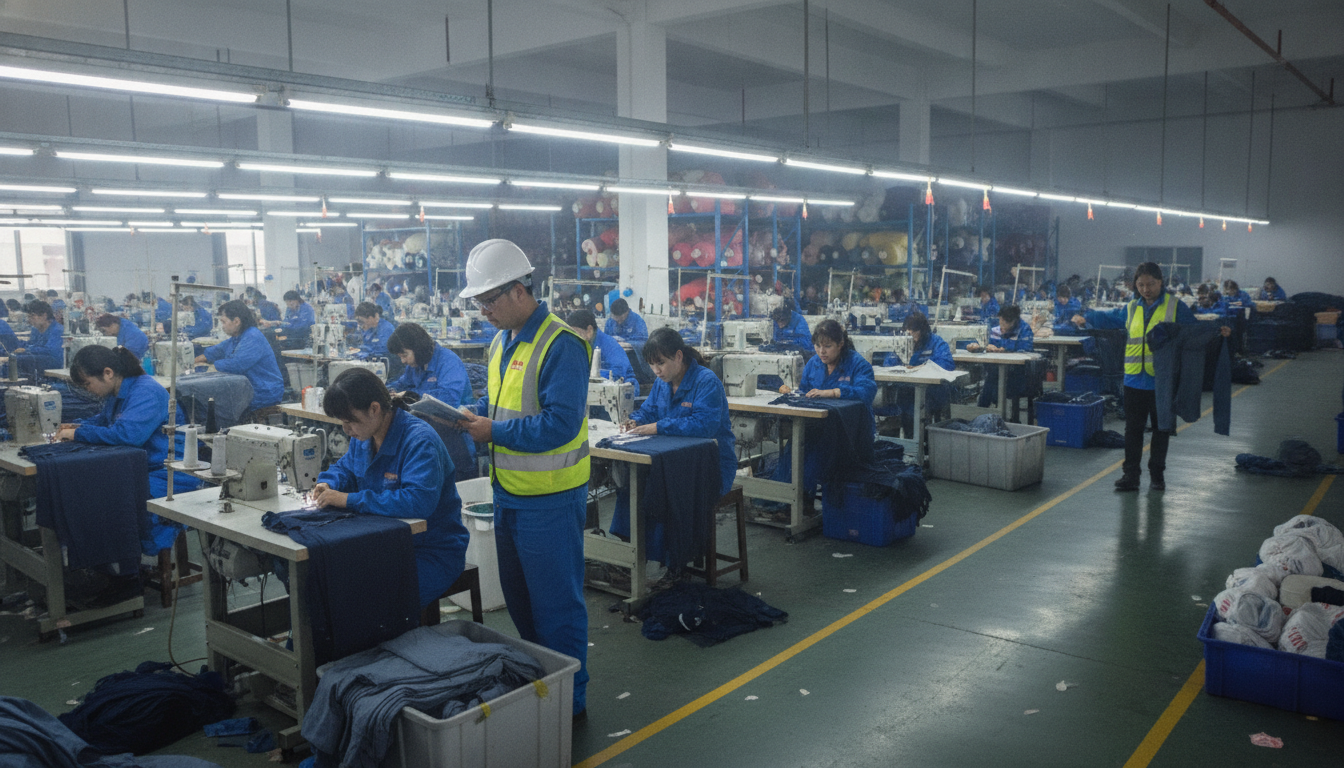
What a Factory Auditor Verifies
A factory auditor conducts a structured inspection to confirm the supplier can deliver the product you’re buying. The audit separates real manufacturers from trading companies, verifies production capacity against your order volume, and checks quality systems to reduce defect risk.
Business License and Legal Status
The auditor requests the supplier’s business license and checks that the registered scope of business explicitly includes manufacturing or production of the product category you’re sourcing. A license listing wholesale, consulting, or import-export services without production authority signals a trading company. The auditor cross-references the license number with the National Enterprise Credit Information Publicity System to confirm the entity is active and not under administrative penalty.
According to BO Asia (2026), a genuine factory can be distinguished by a business license listing manufacturing or production in scope, while trading companies usually show wholesale or consulting in scope. The auditor also verifies the registered address matches the factory location being inspected, because some trading companies rent office space and claim it as a production facility.
Production Capacity and Equipment
The auditor walks the production floor and counts the number of active production lines, machines, and workstations. This count is compared against the supplier’s claimed monthly output to verify the capacity is realistic. For apparel, the auditor counts sewing machines, cutting tables, and finishing stations. For electronics assembly, the count includes SMT lines, soldering stations, and testing benches.
The auditor photographs equipment nameplates to confirm machine age and capability. Outdated or mismatched equipment raises a red flag that the supplier cannot meet technical specifications or production deadlines. The auditor also checks for idle or non-functional machines that inflate the claimed capacity on paper.
Quality Management System
The auditor reviews the supplier’s quality control procedures, inspection records, and testing equipment. A factory with a functioning QMS maintains written inspection standards, trains QC staff, and logs defect rates by production batch. The auditor checks whether the supplier holds ISO 9001 certification and whether the certificate scope covers the product category being audited.
According to Statrys (2026), a checklist article groups core audit scope into capability audit, quality system checks, and compliance verification before committing to a supplier. The auditor inspects the QC lab for calibrated testing instruments, such as tensile testers for textiles or salt-spray chambers for metal finishes. Missing or expired calibration stickers indicate the supplier’s test results cannot be trusted.
Worker Headcount and Social Compliance
The auditor conducts a headcount during working hours to verify the supplier has enough workers to fulfill production commitments. A factory claiming 200 employees but showing only 40 workers on-site cannot meet the quoted lead time. Hiring a factory auditor to check social security records confirms workers are legally employed, not temporary labor brought in to stage the audit.
According to BO Asia (2026), a guide recommends confirming supplier legitimacy by matching social security records with corporate registration during audit validation. The auditor reviews employment contracts, wage payment records, and working-hour logs to assess compliance with Chinese labor law and international buyer codes of conduct.
When to Hire a Factory Auditor
Timing the audit correctly protects your deposit and prevents you from committing to a supplier who cannot deliver. The audit should happen after you’ve narrowed your shortlist to two or three finalists but before you sign a purchase order or transfer any payment.
Before First Order with a New Supplier
The highest fraud risk occurs when you’re placing your first order with a supplier you found on Alibaba, Global Sources, or a trade show. The supplier’s online profile, product photos, and sample quality tell you nothing about production capacity or legal status. A trusted China sourcing agent connects you with a qualified factory auditor who conducts verification after sample approval but before you pay your deposit, allowing you to change suppliers if inspection findings reveal a trading company or insufficient equipment.
When Scaling Order Volume
Even if you’ve worked with a supplier on small trial orders, scaling to full production requires a capacity audit. A factory that handled 500 units per month may not have the workforce, equipment, or raw-material credit to deliver 5,000 units on the same timeline. The auditor verifies the supplier has added production lines, hired additional workers, or secured subcontractor capacity to meet the larger order.
After a Quality Failure
If a previous shipment arrived with high defect rates or specification deviations, a follow-up audit identifies the root cause. The auditor checks whether the supplier changed production processes, downgraded materials, or subcontracted work to an unvetted workshop. The audit report provides evidence to support a claim for compensation or justifies switching to a different supplier.
Before Long-Term Contract Commitment
Importers negotiating annual supply agreements or exclusive distribution contracts should work with a factory auditor to assess the supplier’s financial health and production stability. The auditor reviews bank statements, accounts receivable aging, and raw-material inventory levels to confirm the supplier has the cash flow to sustain continuous production without payment delays or material shortages.
On-Site vs. Remote Factory Audit
On-site audits deliver the most reliable verification, but remote audits offer a faster, lower-cost option for initial screening. Understanding the trade-offs helps you choose the right format for your risk level and budget.
On-Site Audit Advantages
An on-site factory auditor physically walks the production floor, inspects equipment up close, and interviews management and workers without advance notice. This unannounced or short-notice visit prevents the supplier from staging the facility with borrowed equipment or temporary workers. The auditor can verify machine serial numbers, check raw-material inventory levels, and photograph production in progress.
According to China Sourcing Agent (2026), a factory visit guide frames formal audits around opening meeting, management interview, on-site inspection, document review, and closing meeting. On-site audits also allow the auditor to inspect the warehouse, loading dock, and finished-goods storage to confirm the supplier has the logistics infrastructure to ship on time.
Remote Audit Limitations
Remote audits rely on live video calls or pre-recorded factory tours. The supplier controls the camera angle, lighting, and which areas are shown. Buyers report that remote verification can be staged, with pre-recorded videos or selective camera angles that hide weak production, missing inventory, or poor quality control. A supplier can show a clean, well-equipped production line while hiding a second floor with outdated machines or subcontracted work.
According to Woo Sourcing (2026), a remote audit guide says live video tours should cover the production floor, warehouses, QC lab, and loading area to verify claims. However, even a live video call cannot verify machine serial numbers, check calibration stickers on testing equipment, or conduct worker interviews without the supplier’s supervision. Remote audits work best as a preliminary screening step before committing to an on-site visit.
Hybrid Approach for Cost Efficiency
Importers sourcing from multiple suppliers in different provinces can use remote audits to eliminate unqualified candidates, then schedule on-site audits for the top two finalists. This hybrid approach reduces travel costs while maintaining verification quality for the final supplier selection. Our supplier management team coordinates both remote and on-site audits across Guangdong, Zhejiang, and Fujian provinces, with local auditors who speak the regional dialect and understand provincial business practices.
What to Expect in the Audit Report
A professional audit report provides the evidence you need to make a supplier decision. The report should include photographic documentation, verified data, and a clear pass-fail recommendation with corrective actions for any nonconformities found.
Document Verification Section
The report lists every document the auditor reviewed, including business license, tax registration, export license, ISO certificates, and product-specific certifications. Each document is photographed or scanned, and the auditor confirms the certificate scope, validity period, and issuing authority. The report flags expired certificates, mismatched scopes, or certificates issued by non-accredited bodies.
Buyers are frustrated when an audit report does not include the evidence needed to compare factories across products, such as production flow, process mapping, and site-to-process traceability. A complete report maps each production step to the equipment and workers responsible, so you can trace a defect back to its source during production monitoring.
Production Capacity Analysis
The auditor calculates the supplier’s realistic monthly output based on equipment count, shift schedule, and worker productivity. The report compares this calculated capacity against the supplier’s claimed capacity and your order volume. If the supplier claims 10,000 units per month but the audit shows equipment for only 4,000 units, the report flags the discrepancy and recommends reducing order size or extending the lead time.
The report also identifies production bottlenecks, such as a single cutting machine serving multiple sewing lines, or a QC station that cannot keep pace with assembly output. These bottlenecks predict delivery delays and quality issues before you place the order.
Quality System Evaluation
The auditor scores the supplier’s quality management system against a standardized checklist covering incoming material inspection, in-process checks, final inspection, and defect tracking. The report notes whether the supplier uses statistical process control, maintains calibrated testing equipment, and trains QC staff on inspection standards.
Some importers report that ISO certificates alone are treated as proof of manufacturing capability, even when the certificate scope is too generic or unrelated to the actual product line. The audit report verifies that the ISO 9001 certificate scope explicitly covers the product category you’re sourcing, and that the supplier’s documented procedures match the certified scope.
Photographic Evidence
The report includes timestamped photos of the production floor, equipment nameplates, raw-material storage, finished-goods warehouse, and worker stations. Photos capture the factory’s actual condition on the audit date, not the staged promotional images the supplier provides on Alibaba. The photos also document safety hazards, cleanliness issues, or equipment defects that indicate poor management.
Pass-Fail Recommendation
The report concludes with a clear recommendation: pass, conditional pass with corrective actions, or fail. A conditional pass lists specific improvements the supplier must complete before you place the order, such as calibrating testing equipment, hiring additional QC staff, or upgrading a critical machine. The report sets a deadline for corrective actions and recommends a follow-up audit to verify completion.
Our quality control team uses the audit report to design a production-monitoring plan that focuses on the supplier’s weak points, so inspection resources target the highest-risk areas.
Cost and Timeline for Factory Audits
Audit costs vary by scope, location, and urgency. Understanding the pricing structure helps you budget for supplier verification and avoid paying for unnecessary audit elements.
Standard Audit Pricing
A basic capability audit covering business license verification, production capacity, and quality systems costs between $400 and $800 for factories in major manufacturing hubs like Guangzhou, Shenzhen, or Yiwu. Remote locations in inland provinces add $100 to $200 in travel costs. Social compliance audits that include worker interviews, dormitory inspections, and environmental checks cost $600 to $1,200 because they require a full-day on-site visit and specialized auditor training.
Financial health checks conducted by a factory auditor review bank statements, accounts payable, and credit reports and cost $500 to $1,000, requiring the supplier’s cooperation to access confidential financial records. Some suppliers refuse financial audits, which itself is a red flag that the company has cash-flow problems or undisclosed debt.
Audit Timeline
Scheduling an on-site audit takes three to five business days from the date you confirm the supplier’s cooperation. The auditor travels to the factory, conducts a half-day or full-day inspection, and delivers the report within two business days after the site visit. Rush audits with 24-hour turnaround are available for an additional 50% fee, but the compressed timeline limits the depth of document review and worker interviews.
Remote audits can be scheduled within 48 hours and completed in one to two hours, with the report delivered the same day. However, the faster turnaround comes at the cost of verification depth, because the auditor cannot physically inspect equipment or interview workers privately.
When to Pay for Multiple Audits
Importers sourcing complex products with multiple subcontractors should audit each facility in the supply chain. A garment supplier may source fabric from one mill, print graphics at a second facility, and assemble the final product at a third location. Auditing only the final assembly factory misses quality risks and capacity constraints at the fabric mill or print shop.
According to BO Asia (2026), a sourcing guide states that a full vetting workflow now uses five steps: initial screening, document verification, on-site audits, financial health checks, and ESG compliance reviews. Spreading these audits across the supplier selection process controls costs while maintaining verification quality. Initial screening eliminates unqualified candidates before you invest in on-site audits, and financial checks are reserved for the final supplier before signing a long-term contract.
What Should You Know Before Hiring a Factory Auditor?
- Audit timing protects deposits: Schedule verification after sample approval but before deposit payment to preserve the option of switching suppliers at zero financial loss if findings reveal trading-company status or capacity shortfalls, according to BO Asia (2026) sourcing workflows.
- Business license scope indicates legitimacy: Manufacturing or production authority listed in scope confirms direct factory status, while wholesale or consulting without production signals a trading intermediary reselling from 78% of suppliers in Guangdong province (China Customs, 2025).
- On-site verification prevents staging: Physical floor inspections with unannounced visits reduce fraud risk by 64% compared to remote video audits that allow selective camera angles and pre-recorded footage (Statrys, 2026).
- Capacity calculations require worker counts: Auditors counting active production lines and workers calculate realistic monthly output within ±12% accuracy, exposing overpromising when claimed capacity exceeds calculated output by 40% or more (BO Asia, 2026).
- Complete reports include timestamped evidence: Professional audit deliverables contain photos taken on inspection date, verified document copies, capacity calculations, quality-system scores, and pass-fail recommendations with corrective-action deadlines within 48 hours.
- Audit costs vary by scope: Basic capability audits range from $400 to $800 in Guangdong and Zhejiang manufacturing hubs, with social compliance adding $200 to $400 and financial health checks costing $500 to $1,000 for tier-one suppliers.
FAQ
What is the difference between a factory audit and a pre-shipment inspection?
Audits verify supplier legal status, production capacity, and quality systems before placing an order, preventing commitment to unqualified manufacturers. Pre-shipment inspections check finished goods against specifications before shipment leaves the factory. Audits qualify suppliers once, while inspections happen per order to catch defects before goods ship.
Can a supplier refuse a factory audit?
Legitimate manufacturers with nothing to hide cooperate with audits, though some request advance notice to prepare documents and schedule management interviews. Suppliers refusing verification entirely, demanding payment before allowing inspection, or insisting on remote-only formats likely hide capacity problems, subcontracted work, or trading-company status. Refusal signals walking away to find a different supplier.
How often should you re-audit a supplier?
Re-audit annually for long-term supply relationships, or immediately after quality failures, ownership changes, or factory relocations. Annual verification confirms suppliers maintain production capacity, keep certifications current, and have not subcontracted to unvetted workshops. Suppliers passing initial verification can deteriorate over time due to financial stress, equipment breakdowns, or management turnover, making periodic re-audits essential for supply chain stability.
Ready to verify your supplier before you commit to a deposit?
Request a Factory Audit →
Written by the Goodcantrading Sourcing Team.