How to Source LED Lights from China: A 2026 Guide for US Importers
📋 Table of Contents
- Executive Summary
- Why Source LED Lights from China
- Key LED Manufacturing Regions in China
- How to Source LED Lights from China: Step-by-Step
- Understanding LED Technical Specifications and Certifications
- US Import Compliance: Tariffs, Duties, and Required Certifications
- Quality Control and Inspection Protocol
- Production and Shipping Timeline
- FAQ
Every year, US importers lose thousands of dollars on LED shipments that fail UL certification, arrive with dead-on-arrival drivers, or get stuck in customs because the supplier misdeclared the HTS code. Understanding how to source LED lights from china means more than finding a low price, it’s about building a supply chain that keeps you compliant with CBP, FCC, and big-box retailer requirements.
Executive Summary
- US LED import value: $4.8 billion in 2024, with 62% originating from China according to US Census Bureau trade data.
- 25% Section 301 tariff still applies to most LED luminaires under HTS 9405.40.8400, unless a valid exclusion or country-of-origin shift is proven per US Customs and Border Protection.
- Supplier verification deficit: A 2024 QIMA quality survey found that 38% of US importers skipped factory audits, leading to a 1.7x higher defect rate on first shipments.
- UL certification cost: Expect $8,000, $15,000 to get a new LED product UL-listed, a hard requirement for Amazon and major retailers.
- Production lead time: Typically 30, 45 days for standard OEM LED orders plus 25, 35 days ocean freight to Los Angeles, per Freightos 2026 transit averages.
Why Source LED Lights from China
China controls over 70% of global LED component production. The supply chain density in cities like Zhongshan and Shenzhen means you can source everything from LED chips to aluminum heat sinks within a 50-mile radius, reducing logistical overhead.
Cost Advantage
A standard 2x2ft LED panel light that costs $18 from a Chinese factory sells for $65, $85 on Amazon US (2026 retail data). Even after adding 25% tariff, shipping, and Amazon referral fees, a typical gross margin remains above 35%. No other manufacturing region delivers this price-to-margin ratio for LED lighting.
Manufacturing Expertise
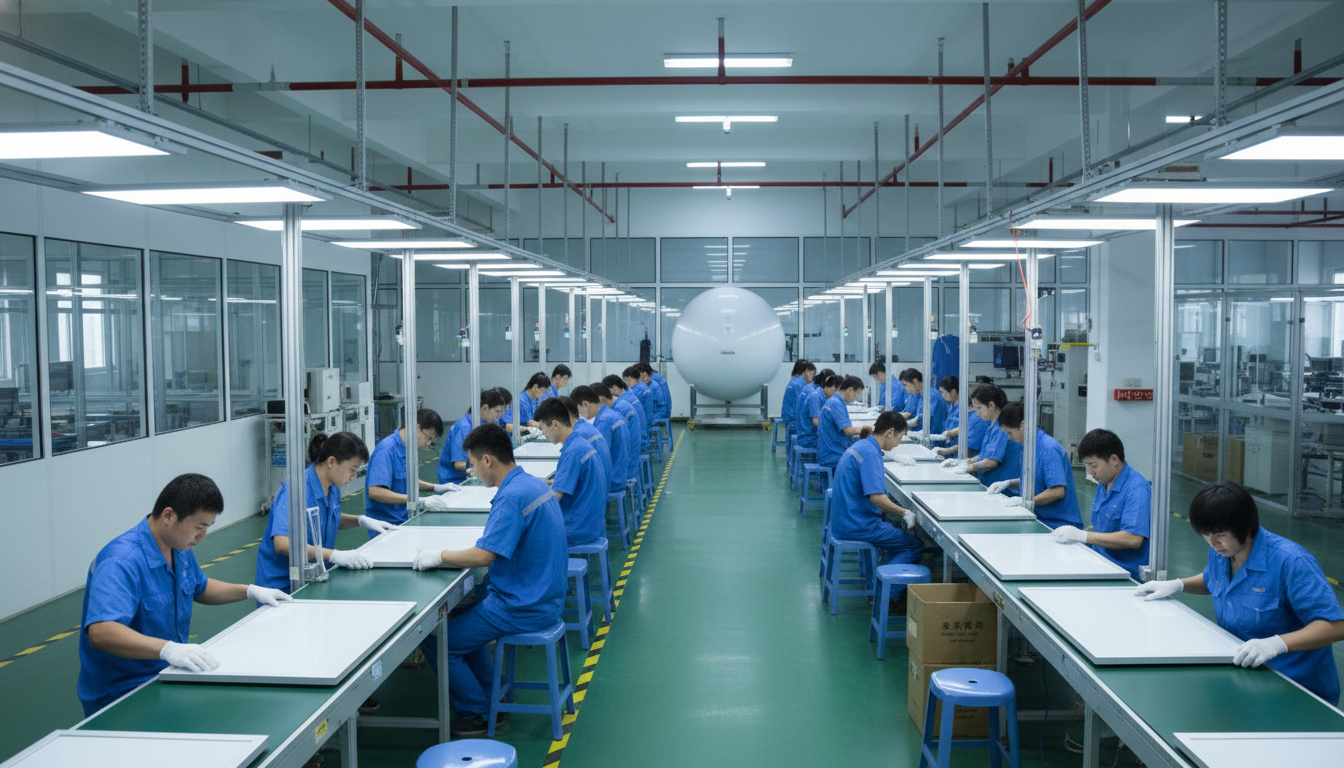
Factories in the Pearl River Delta have been mass-producing LEDs for over 15 years. They hold certifications like ISO 9001, UL, ETL, and have third-party lab relationships with TÜV Rheinland and SGS. Many can produce IES files and LM-80 test reports in-house. This infrastructure is not replicable quickly in other markets.
Key LED Manufacturing Regions in China
Not every Chinese province produces LED lights. Focusing your supplier search on the following clusters will filter out trading companies that buy from these regions and mark up prices.
How to Source LED Lights from China: Step-by-Step
This phased approach reduces risk at each stage. Start rigorous, and you won’t pay for shortcuts later.
Phase 1: Lock Down Your BOM and Certification Requirements
Before contacting any supplier, write a Bill of Materials (BOM) that specifies LED chip brand (Epistar, Samsung, Bridgelux), driver brand (Mean Well, Sosen), CCT (3000K, 4000K, 5000K), CRI (>80 or >90), IP rating, and the exact UL standard you need (UL 1598, UL 8750, etc.). This document becomes your supplier’s technical bible and prevents substitution of cheaper components.
Phase 2: Shortlist Factories, Not Trading Companies
Use Alibaba’s Verified Supplier filter, then cross-check company registration on the China National Accreditation Service (CNAS) website. Ask for factory address and look it up on Baidu Maps satellite view. A legitimate LED factory will show dormitories, a loading dock, and nearby component shops. A residential address or a virtual office in Shenzhen signals a shell company.
Phase 3: Conduct a Factory Audit Before You Pay
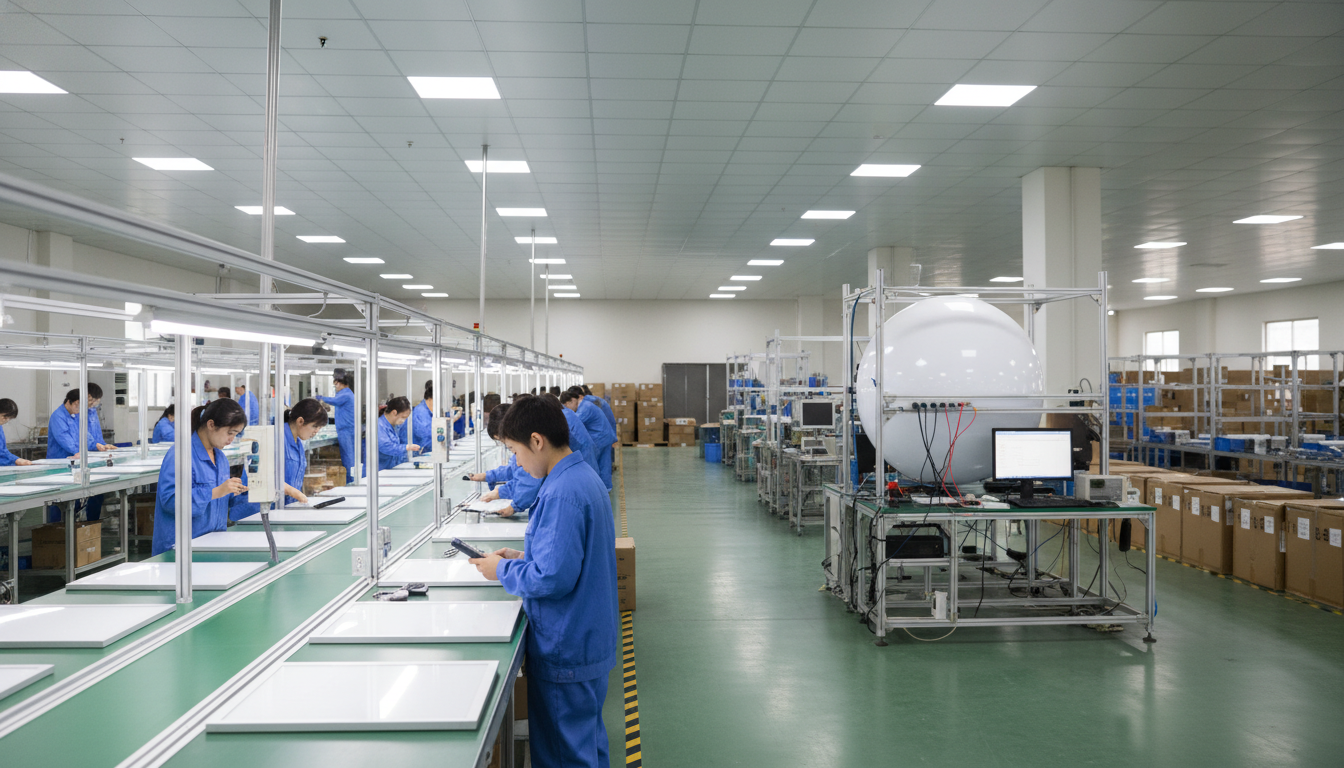
Hire a third-party inspection agency like QIMA or SGS to audit the production line. The audit must verify ISO 9001 validity, check calibration records of integrating spheres and photometric equipment, and confirm that the workforce is not seasonal. In our 23+ years sourcing from Yiwu and Foshan, we’ve seen factories pass paper audits but fail on-site when light meters were uncalibrated.
Phase 4: Negotiate Payment Terms with Protections
Structure payment as 30% T/T deposit, 70% against B/L copy. Never pay 100% upfront. Use a sample order first: 50 units produced under pre-production conditions and tested by a US certified lab (like Intertek). Only then release full production.
Understanding LED Technical Specifications and Certifications
Knowing the basics of LM-80, L70 lifetime, and driver efficiency lets you spot inflated claims. A supplier claiming 100,000-hour life without an LM-80 report is guessing. The L70 metric defines the hours until light output drops to 70% of initial lumens; real L70 for mid-range LEDs rarely exceeds 50,000 hours.
Photometric Testing and IES Files
Any LED luminaire sold in the US should have an IES file, the industry-standard digital file containing luminous intensity distribution data. Architects and lighting designers won’t specify your product without it. Ask the factory to provide the IES file produced by an accredited lab; a file generated by their in-house goniophotometer is acceptable only if the device is NVLAP-calibrated.
Surge Protection and IP Rating
Outdoor LED fixtures must meet IP65 or higher and include surge protection of at least 4kV for areas with unstable grid power. Confirm the rating by requesting a copy of the IP test certificate from a lab like TÜV. A supplier that sells you an IP65 floodlight without a gasket inspection record is a liability.
US Import Compliance: Tariffs, Duties, and Required Certifications
Clearing LED lights through US Customs requires more than the correct HTS code. Missing a single mandatory label can result in CBP detaining your container at the port.
Section 301 Tariffs and HTS Classification
Under the current Section 301 list (as of 2026), most complete LED luminaires fall under HTS 9405.40.8400 and are subject to a 25% tariff. LED strip lights (HTS 9405.40.8000) also face 25%. Component parts like bare LED chips or PCBs may qualify for a lower rate under Chapter 85. Classify correctly, every 1% misclassification on a $80,000 shipment costs an extra $800 plus potential penalties.
Typical landed cost: $12, $18 per LED panel at the factory gate becomes $22, $32 after 25% tariff, freight, and customs broker fees. Time to clear: 3, 5 days in standard US ports.
Mandatory Certifications for the US Market
Note that CE marking and RoHS compliance are European standards and do not substitute for UL or FCC requirements in the US. A factory that offers only CE test reports cannot legally get your product past a US customs audit.
Quality Control and Inspection Protocol
A well-written purchase order means nothing without physical verification. Applying the AQL (Acceptable Quality Limit) sampling method is the minimum.
Pre-Production Inspection
Before raw material cutting, inspect the LED chips, driver components, and aluminum housing. Confirm the chip brand matches your BOM. This single check catches 20% of non-conformities before a single dollar is spent on assembly.
During Production (DUPRO) Inspection
When 20, 30% of the order is packed, visit the line or send an inspector. Verify lumen output with a calibrated integrating sphere, check CCT consistency across 10 randomly selected units, and measure flicker index. A deviation of more than 3 delta-uv from target is a reject criterion.
Pre-Shipment Container Loading Check
In the final 24 hours, inspect the finished goods to AQL Level II (normal inspection). If the defect count exceeds the acceptable number per your sampling table, reject the entire lot. Do not ship and hope the customer won’t notice. Amazon’s return algorithm detects quality drops within 30 days and suppresses listings.
In practice: A California-based Amazon seller importing 5,000 LED downlights from Zhongshan hired an on-site loading inspector who discovered that 312 units had mismatched driver wattage. The seller withheld final payment and avoided an estimated $22,000 in returns and negative reviews.
Production and Shipping Timeline
Planning your timeline from purchase order to Amazon warehouse is non-negotiable. A late shipment in Q4 means missing the holiday buying season.
- Week 1, 2: Sample approval and laboratory testing (UL, FCC, IES).
- Week 3, 8: Production of 3,000, 10,000 units. DUPRO inspection at Week 6.
- Week 9, 11: Ocean freight departure from Shenzhen or Ningbo to Los Angeles/Long Beach. Transit time 25, 35 days.
- Week 12, 14: Customs clearance and trucking to Amazon FBA or your 3PL warehouse.
Air freight emergency option: $4.50, $6.80 per kg (2026 spot rates) with 7, 10 days door-to-door for urgent restocks. Use sparingly for margins above 50%.
FAQ
How much does it cost to source LED lights from China?
Unit costs for standard LED panels range from $8 to $25 FOB, depending on specifications. MOQs typically start at 500 units. Factor in 25% Section 301 tariff, $2,000, $4,000 in customs brokerage, and $800, $1,200 for third-party inspection. Total landed cost can be 60, 80% above the ex-factory price.
What certifications do I need to sell LED lights in the US?
UL 1598 or UL 8750 for safety, FCC Part 15 for electromagnetic compliance, and DLC or Energy Star for rebates. Without a UL mark, Amazon may refuse listing creation or suspend the ASIN. CE or RoHS alone are not accepted by US authorities.
How do I avoid scams when sourcing LED lights from China?
Verify the supplier’s business license, visit the factory or hire a third-party audit, and never pay 100% upfront. Request LM-80 and IES files. Use a sourcing agent like Goodcantrading to conduct on-site verification and manage payments through a secure process.
What is the typical lead time for LED lights from China?
OEM production takes 30, 45 days. Adding 25, 35 days ocean freight to the US West Coast and 3, 5 days for customs, total lead time is 60, 85 days. Air freight reduces transit to 7, 10 days but costs 4, 6x more per kilogram.
Do I need a sourcing agent for LED lights from China?
A sourcing agent handles supplier vetting, negotiation, quality inspection, and logistics. For first-time importers or orders above $20,000, an agent based in China reduces financial risk. Goodcantrading pre-screens factories, manages BOM compliance, and ensures UL documentation aligns with US import requirements.
Key Takeaways
- US Census Bureau data shows $4.8 billion in LED lighting imports in 2024, with China supplying 62% of that total.
- US Customs and Border Protection (CBP) enforces a 25% Section 301 tariff on most LED luminaires under HTS 9405.40.8400 as of 2026.
- A 2024 QIMA survey found that skipping factory audits increases first-shipment defect rates by 1.7x for US importers.
- UL and FCC certifications are non-negotiable for Amazon US; CE marking does not substitute for UL per Amazon Policy (2026 update).
- Freightos 2026 data indicates ocean transit times from Shenzhen to Los Angeles average 25 days, not including port congestion.
- The DesignLights Consortium (DLC) qualified products list is required by 80% of US utility rebate programs for commercial LED lighting.
Ready to source your first LED shipment with factory-audited suppliers and UL-ready documentation?
Book a free supplier verification call →