Chinese New Year 2027 Order Deadline Calculator [2026 Guide]
![Chinese New Year 2027 Order Deadline Calculator [2026 Guide]](https://goodcantrading.com/wp-content/uploads/2026/07/featured-chinese-new-year-2027-order-deadline-calculator.png)
📋 Table of Contents
You need your inventory to arrive before Chinese New Year 2027, but calculating the exact order deadline feels like guessing. Factory closures, vessel space scarcity, and production slot saturation create a three-week blackout window that catches unprepared buyers every year. Using a chinese new year 2027 order deadline calculator approach means working backward from February 6, 2027, through production cycles, inspection windows, and shipping lead times to find your real cutoff date.
Most buyers discover too late that standard six-week lead times balloon to ten or twelve weeks during pre-CNY capacity crunches. A trusted China sourcing agent tracks these shifting timelines daily, securing production slots in July that vanish by November.
Executive Summary
- CNY 2027 date: February 6, 2027, triggering a 2-4 week factory closure across China according to Epic Sourcing (2025)
- Pre-holiday blackout: 3-4 weeks before CNY, production slot saturation and vessel space booking create shipment delays according to Epic Sourcing (2025)
- A-item safety stock: 10-12 weeks of inventory required for supply-critical products; B-items need 6-8 weeks; C-items need 4 weeks according to Lineup (2026)
- Standard product cutoff: Orders for 6-week lead time products must be placed October to early November 2026 to complete by mid-January 2027 according to New Buying Agent (2026)
- Communication timing advantage: Companies reaching suppliers in July 2026 secure production slots unavailable by November due to pre-season capacity scarcity according to Lineup (2026)
CNY 2027 Date and Blackout Window
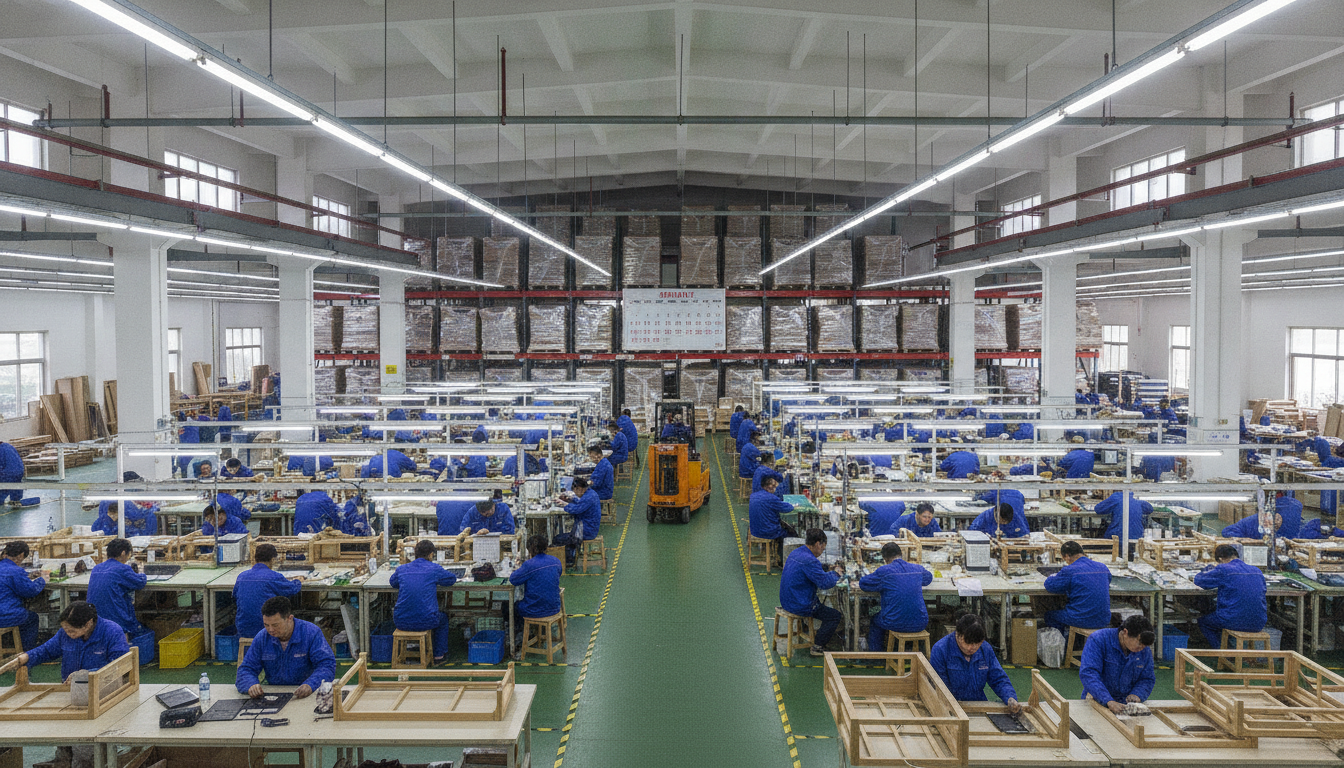
Chinese New Year 2027 falls on February 6, the first day of the Year of the Goat. Factories across Guangdong, Zhejiang, Jiangsu, and Fujian provinces close for the official seven-day holiday, but most manufacturing operations extend shutdowns to two or three weeks to allow migrant workers time to travel home and return.
Factory Closure Duration by Region
Closure length varies by province and industry. Guangdong furniture manufacturers typically close for 18-21 days. Zhejiang textile mills near our Jinhua base shut for 14-18 days. Electronics assembly plants in Shenzhen often reopen faster, around 10-14 days, because their workforce is younger and more locally concentrated.
Pre-CNY Shipment Blackout
The real deadline crunch starts three to four weeks before February 6. According to Epic Sourcing (2025), Chinese factories close for 2-4 weeks during CNY, causing production slot saturation 6-8 weeks before the holiday. Freight forwarders prioritize existing clients for vessel space bookings. Port congestion at Ningbo, Shanghai, and Shenzhen peaks in mid-January as exporters rush final shipments.
Buyers placing orders in late December 2026 face two compounding risks: factories may accept the order but delay production start until after CNY reopening, and even if production completes on time, securing container space becomes difficult after January 15, 2027.
Post-CNY Ramp-Up Lag
Factories do not return to full capacity the day they reopen. Worker return rates vary. Some employees change jobs over the holiday or stay home longer. Production lines need one to two weeks to reach normal output levels. Quality control becomes inconsistent during the first week as teams shake off rust.
Orders placed immediately after CNY reopening typically see lead times stretch 20-30% longer than normal. A product that usually takes six weeks might require eight weeks in March 2027.
Backward Timeline Calculation Method
A functional chinese new year 2027 order deadline calculator works backward from your required delivery date, adding buffer days at each stage. Start with February 6, 2027, and subtract each phase in reverse order.
Step 1: Define Your Required Delivery Date
If you need inventory in your warehouse by February 1, 2027, that becomes your anchor date. For Amazon FBA sellers, add three to five days for Amazon receiving delays. For retail buyers restocking stores, add your internal distribution time.
Step 2: Subtract International Shipping Duration
Sea freight from China to major ports varies by destination:
- Mexico (Manzanillo, Veracruz): 18-24 days from Ningbo or Shanghai
- Colombia (Cartagena, Buenaventura): 28-35 days via Panama Canal
- Brazil (Santos, Rio de Janeiro): 32-40 days
- Spain (Valencia, Barcelona): 28-32 days
- France (Le Havre, Marseille): 30-35 days
Add five to seven days for customs clearance and port congestion buffer. Air freight cuts transit to 5-8 days but costs 4-6 times more and has strict weight limits.
Step 3: Subtract Production and QC Time
Standard production cycles by category:
- Apparel (basic styles, existing molds): 25-35 days
- Furniture (wood, upholstered): 40-55 days
- Home goods (ceramics, textiles): 30-40 days
- Bags and luggage: 35-45 days
- Electronics (assembly only): 20-30 days
Add three to five days for pre-shipment inspection. Our quality control team schedules inspections when production reaches 80% completion, catching defects before final packing.
Step 4: Subtract Sampling and Approval Cycle
First-time orders require sample approval before mass production starts. Sample production takes 7-12 days. International courier delivery adds 4-6 days. Buyer review and revision requests add another 5-10 days. Total sampling cycle: 16-28 days.
Repeat orders skip this phase unless you change specifications.
Step 5: Add CNY Blackout Buffer
Subtract an additional 21-28 days from your calculated order date to avoid the pre-CNY capacity crunch. According to Lineup (2026), orders requiring pre-CNY production and shipment must be confirmed with suppliers by January 10, 2027 at the latest.
Worked Example: Mexico Apparel Order
Target delivery: February 1, 2027 (warehouse receipt in Mexico City)
- Subtract sea freight + customs: 24 days + 6 days = January 2, 2027 (vessel departure)
- Subtract production + QC: 30 days + 4 days = November 29, 2026 (production start)
- Subtract sampling cycle: 20 days = November 9, 2026 (sample approval)
- Subtract CNY buffer: 25 days = October 15, 2026 (order placement deadline)
This buyer needs to place the order by mid-October 2026 to receive inventory before CNY 2027 disrupts the supply chain.
Safety Stock Tiers by Product Priority
Not every SKU deserves the same inventory cushion. According to Lineup (2026), A-items (supply-critical) require 10-12 weeks of safety stock; B-items require 6-8 weeks; C-items need 4 weeks. Classify your products by revenue contribution and supply risk.
A-Items: High Revenue, High Risk
These are your top 20% of SKUs generating 80% of revenue. Stockouts directly hurt cash flow. Examples: best-selling furniture lines, signature apparel styles, hero products for retail displays.
Order 10-12 weeks of inventory by late October 2026. This covers the CNY closure, post-holiday ramp-up lag, and unexpected production delays. For tooling-required products (custom molds, dies, embroidery plates), add another two weeks to the timeline.
B-Items: Moderate Revenue, Moderate Risk
Mid-tier products that sell consistently but do not drive the majority of revenue. Examples: secondary color variants, seasonal accessories, complementary home goods.
Order 6-8 weeks of inventory by mid-November 2026. You can tolerate short stockouts without major revenue loss, but you want inventory available by late February when factories return to normal capacity.
C-Items: Low Revenue, Low Risk
Slow movers, niche SKUs, or test products. Examples: experimental designs, low-demand sizes, regional-specific items.
Order 4 weeks of inventory by early December 2026, or skip CNY ordering entirely and wait for post-holiday production. Stockouts on these items rarely affect overall business performance.
Adjusting for Product Complexity
Custom OEM orders with new tooling require longer lead times. A furniture piece with proprietary hardware might need 55-65 days instead of the standard 40-50. Embroidered apparel adds 10-15 days for digitizing artwork and producing embroidery plates.
Our supplier management process flags these complexity factors during the quotation stage, preventing last-minute timeline surprises.
Currency Fluctuation Impact
Ordering early in July or August 2026 locks in current exchange rates. Waiting until November exposes you to currency risk. The Mexican peso, Colombian peso, and Argentine peso all experience volatility in Q4. A 5-8% currency swing between July and November can erase your negotiated factory discount.
European buyers face similar risk with EUR/CNY fluctuations, though the euro tends to be more stable than Latin American currencies.
Early Communication Advantage
According to Lineup (2026), companies communicating in July still secure production slots unavailable by November due to pre-season capacity scarcity. Factories allocate production schedules on a first-confirmed, first-served basis. Large buyers with annual contracts get priority, but smaller importers who confirm orders in July or August often secure better slots than November buyers placing larger orders.
July vs. November Order Placement
Reaching out to suppliers in July 2026 provides four key advantages:
- Production slot availability: Factories have open capacity in their October-December schedule
- Negotiation leverage: Suppliers offer better pricing to fill future slots early
- Sampling time: You have 12-16 weeks to iterate on samples without rushing
- Backup options: If your first-choice factory is fully booked, you have time to vet alternatives
Waiting until November 2026 creates the opposite scenario. Factories are at 90-95% capacity for pre-CNY production. Pricing becomes less flexible because demand exceeds supply. Sample approval must happen in days, not weeks. If your preferred supplier is fully booked, finding and vetting a backup factory in three weeks is nearly impossible.
Vessel Space Booking Timeline
Ocean freight operates on similar capacity constraints. Freight forwarders allocate container space to clients with confirmed bookings. Booking vessel space in October or early November for mid-January departure is straightforward. Booking in late December for the same departure date often requires premium rates or acceptance of less favorable sailing schedules.
In practice: A Colombian home goods importer contacted us in July 2026 for a February delivery target, secured production slots at a Zhejiang factory that was 100% booked by October, and saved 12% on unit costs through early negotiation
Factory Reopening Confirmation
Even if you miss the pre-CNY window, early communication helps post-holiday planning. Contact suppliers in late January 2027 to confirm their exact reopening date and worker return rate. Some factories reopen February 20 but do not reach full capacity until March 1. Knowing this in advance lets you adjust your March and April inventory plans.
Alternative Sourcing Strategies During CNY Blackout
When Chinese production is unavailable, buyers have three fallback options: air freight pivot, second-sourcing from non-China suppliers, or accepting the stockout and planning promotions around it.
Air Freight for Critical Items
Air freight from China to Mexico City costs $4.50-$6.80 per kilogram versus $0.80-$1.20 per kilogram for sea freight. Transit time drops from 24 days to 6 days. This makes sense for high-value, low-weight A-items where stockout cost exceeds the freight premium.
Examples of air-freight-suitable products: jewelry, small electronics, cosmetics, high-margin apparel accessories. Poor candidates: furniture, bulk home goods, heavy hardware.
Vietnam, India, Bangladesh Sourcing
Vietnam factories do not observe Chinese New Year. Tet (Vietnamese New Year) falls on the same lunar calendar date but factory closures are shorter, typically 7-10 days. India and Bangladesh operate on different holiday calendars entirely.
Sourcing from these countries during CNY provides continuous supply but introduces new challenges:
- Longer lead times: Vietnam furniture production averages 50-60 days versus 40-50 in China
- Higher MOQs: Many Vietnam and India factories target larger buyers, with MOQs 30-50% higher than comparable Chinese suppliers
- Quality variability: China’s manufacturing infrastructure is more mature; expect more QC issues in alternative markets
- Logistics complexity: Fewer direct shipping routes from Vietnam to Latin America compared to China
Our Yiwu and Foshan teams maintain relationships with Vietnam and India suppliers for exactly this scenario. We handle the cross-border coordination so you do not need to manage multiple sourcing agents.
Planned Stockout Strategy
Some buyers intentionally accept stockouts on C-items during February and March, using the gap to run clearance promotions on existing inventory or shift marketing focus to non-China-sourced products.
This works when your product mix includes items from multiple supply chains. An apparel importer might source basics from China and premium lines from Turkey or Portugal. During CNY, they promote the premium lines and let basic inventory run low.
Warehouse Consolidation to Extend Inventory
Our warehouse consolidation service in Yiwu lets you order from multiple suppliers in October and November, hold the goods in our facility, and ship consolidated containers in early January. This extends your effective order deadline by two to three weeks because you are not waiting for the last supplier to finish production before booking the vessel.
Consolidation also reduces per-unit shipping costs. Five separate LCL shipments cost 20-30% more than one consolidated FCL container.
Key Takeaways
- Chinese New Year 2027 falls on February 6, triggering 2-4 week factory closures and a 3-4 week pre-holiday shipment blackout according to Epic Sourcing (2025).
- A-items require 10-12 weeks of safety stock with order deadlines in late October 2026; B-items need 6-8 weeks with mid-November deadlines; C-items need 4 weeks or can skip pre-CNY ordering according to Lineup (2026).
- Standard products with 6-week lead times must be ordered by October to early November 2026 to complete production and ship by mid-January 2027 according to New Buying Agent (2026).
- Companies reaching suppliers in July 2026 secure production slots that become unavailable by November due to pre-season capacity scarcity according to Lineup (2026).
- Orders requiring pre-CNY production and shipment must be confirmed with suppliers by January 10, 2027 at the latest to avoid the blackout window according to Lineup (2026).
- Sea freight from China to Mexico takes 18-24 days, to Colombia 28-35 days, to Brazil 32-40 days, and to Spain or France 28-35 days, requiring early booking to secure vessel space before mid-January congestion.
FAQ
When is Chinese New Year 2027?
Chinese New Year 2027 falls on February 6, marking the first day of the Year of the Goat. Factories across China close for the official seven-day holiday, but most extend shutdowns to 14-21 days to allow workers time to travel home and return. Production capacity does not return to normal until late February or early March 2027.
What is the latest order deadline for Chinese New Year 2027?
For standard products with six-week lead times, the latest order deadline is early November 2026 to complete production by mid-January 2027. Custom or tooling-required products need orders placed by mid-October 2026. Orders confirmed after January 10, 2027 will not ship before the CNY blackout window and must wait for post-holiday production resumption in late February.
How many weeks before Chinese New Year should I stop ordering from China?
Stop placing new orders 8-10 weeks before Chinese New Year to ensure production completes and goods ship before the blackout. For CNY 2027 on February 6, this means stopping new orders by early December 2026. Orders placed after this date face high risk of production delays, vessel space scarcity, and port congestion that push delivery into March 2027.
Do Chinese factories close for Chinese New Year and how long?
Yes, Chinese factories close for 2-4 weeks during Chinese New Year. The official holiday is seven days, but most manufacturers extend closures to 14-21 days depending on region and industry. Guangdong furniture factories typically close 18-21 days, Zhejiang textile mills 14-18 days, and Shenzhen electronics plants 10-14 days. Factories do not return to full production capacity immediately upon reopening.
How to calculate safety stock for Chinese New Year 2027?
Calculate safety stock by product tier: A-items (high revenue, supply-critical) need 10-12 weeks of inventory, B-items (moderate revenue) need 6-8 weeks, and C-items (low revenue, low risk) need 4 weeks or can skip pre-CNY ordering. Multiply your average weekly sales by the safety stock duration, then add 15-20% buffer for post-CNY ramp-up delays when factories return to normal capacity.
Calculate your exact CNY 2027 order deadline and secure production slots before November capacity fills.
Get Your Custom Timeline →
Written by Michael Ye, Senior Sourcing Manager at Goodcantrading, 15 years in China sourcing and QC.