How to Verify a China Sourcing Agent Is Legitimate [2026]
![How to Verify a China Sourcing Agent Is Legitimate [2026]](https://goodcantrading.com/wp-content/uploads/2026/08/featured-how-to-verify-china-sourcing-agent-is-legitimate.png)
To verify a China sourcing agent is legitimate, check their Unified Social Credit Code (USCC) on China’s National Enterprise Credit Information Publicity System, request live factory video calls, ask for 2-3 verifiable overseas client references, and review a written contract that includes factory disclosure, inspection rights, and payment milestones tied to deliverables.
📋 Table of Contents
- Key Takeaways
- How Do You Check a Sourcing Agent’s Business License?
- How Do You Verify Physical Presence and Real Operations?
- What Client References Should You Request?
- What Contract Terms Prove Legitimacy?
- What Are the Red Flags That Signal a Fake Agent?
- What Is the Step-by-Step Verification Workflow?
- FAQ
Key Takeaways
- China’s official corporate registry uses an 18-character Unified Social Credit Code (USCC) to identify registered companies, and this code can be verified on the National Enterprise Credit Information Publicity System.
- Due diligence guidance commonly recommends verifying at least four core items: active status, business scope, registered address, and abnormal-operation history.
- A practical buyer checklist often includes 12 verification points, with checks for factory audits, quality control evidence, landed cost, and written contract protections.
- Buyer guidance frequently recommends asking for 2-3 direct overseas references before trusting a sourcing agent.
- Verification guidance stresses comparing company documents with the official registry and confirming that the address and name match exactly.
How Do You Check a Sourcing Agent’s Business License?
Start by requesting the agent’s full registered company name and their 18-character Unified Social Credit Code (USCC). A legitimate China sourcing agent will provide both within 24 hours. The USCC is the primary identifier for all registered Chinese companies and appears on the business license, official contracts, and tax documents.
Access the National Enterprise Credit Information Publicity System
Visit https://www.gsxt.gov.cn, China’s official corporate registry. Enter the company name or USCC in the search field. The system returns the company profile, including registration date, legal representative, registered capital, business scope, and abnormal-operation records. According to the National Enterprise Credit Information Publicity System (2026), a legitimate China company profile can be cross-checked against business scope, legal representative, and abnormal-operation records in the registry.
Verify Four Core Registry Fields
According to Tianwen Wangluo (2026), due diligence guidance commonly recommends verifying at least 4 core items: active status, business scope, registered address, and abnormal-operation history. Check that the company status shows “active” or “operating,” not “cancelled” or “revoked.” Confirm the business scope includes import-export trade, sourcing services, or supply-chain management. Match the registered address on the license with the address the agent provided in email or on their website. Review the abnormal-operation section for any outstanding legal disputes, tax violations, or regulatory penalties.
Cross-Check the Official Company Seal
Request a scanned copy of the agent’s official company seal (公章) on a quotation or contract draft. The seal must include the exact registered company name in Chinese characters, matching the registry entry. Mismatched names or generic seals without registration numbers indicate the agent operates without legal authority or uses a shell company structure.
How Do You Verify Physical Presence and Real Operations?
A registered business license confirms legal existence but does not prove the agent has staff, warehouse space, or factory relationships. Many buyers discover that agents present polished marketing materials yet lack the operational capacity to manage orders, conduct inspections, or resolve production issues.
Request a Live Video Office Tour
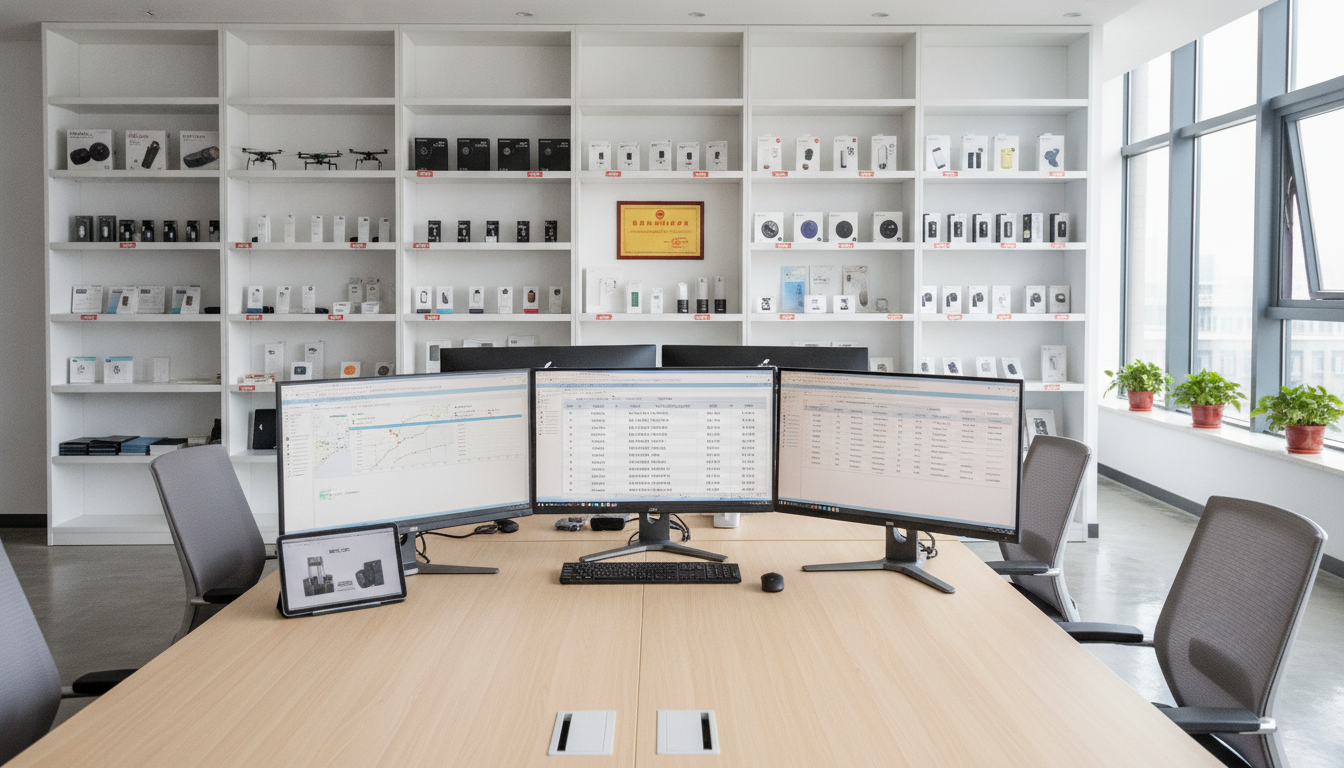
Schedule a video call and ask the agent to show their office in real time. Look for desks with staff actively working, shelves with product samples, computers displaying supplier databases or order-tracking software, and wall-mounted business licenses or certifications. A legitimate China sourcing agent will accommodate this request within 48 hours. Refusal or repeated delays suggest the agent operates from a residential address or co-working space without dedicated sourcing infrastructure.
Verify Warehouse and Consolidation Facilities
Ask whether the agent operates a consolidation warehouse or partners with a third-party logistics provider. Request the warehouse address and photos showing racking systems, labeled inventory, and packing stations. Agents without warehouse access cannot consolidate shipments from multiple factories, leading to higher freight costs and longer lead times for buyers ordering diverse product categories.
Confirm On-the-Ground Factory Access
Request the agent’s factory audit reports from the past 90 days, including photos of production lines, quality-control checkpoints, and raw-material storage areas. A sourcing agent with genuine factory relationships will provide audit documentation showing visit dates, factory names, and specific findings. Agents who rely solely on supplier-provided photos or refuse to disclose factory identities often act as middlemen without direct supplier access, adding cost layers and reducing transparency.
What Client References Should You Request?
According to I Home China Buy (2026), buyer guidance frequently recommends asking for 2-3 direct overseas references before trusting a sourcing agent. References validate the agent’s track record, communication reliability, and ability to resolve disputes.
Ask for Verifiable Overseas Buyer Contacts
Request the names, companies, and contact details (email or LinkedIn profile) of 2-3 clients in your target market or product category. Specify that you need references from buyers who completed orders within the past 12 months. Contact each reference directly and ask about order accuracy, inspection quality, response time during production delays, and whether the agent disclosed factory names and pricing breakdowns.
Check Public Reviews and Third-Party Platforms
Search the agent’s company name on Google, Trustpilot, and LinkedIn. Look for client testimonials that include specific order details, product categories, and shipment destinations. Generic praise without concrete examples often signals fabricated reviews. Cross-reference the agent’s claimed client list with public case studies or blog posts on their website. Legitimate agents publish detailed project summaries with anonymized buyer scenarios, shipment volumes, and problem-solving examples.
Request Evidence of Multilingual Support
If you operate in Latin America or Europe, confirm the agent provides native-language support in Spanish, French, or Portuguese. Ask for sample contracts, quotations, and inspection reports in your language. Agents who rely on machine translation for commercial documents introduce errors in pricing terms, payment milestones, and quality specifications, leading to disputes during order execution.
What Contract Terms Prove Legitimacy?
A written contract separates professional sourcing agents from opportunistic intermediaries. The contract defines responsibilities, payment terms, inspection rights, and dispute-resolution mechanisms.
Factory Disclosure and Non-Circumvention Clause
The contract must state whether the agent will disclose factory names and contact details after the first order or keep supplier identities confidential. A non-circumvention clause prevents buyers from bypassing the agent after the introduction, but the clause should expire after 12-24 months or a defined order volume. Agents who refuse to disclose factories under any terms often lack direct supplier relationships and source through other middlemen.
Payment Milestones Tied to Deliverables
Legitimate agents structure payments in stages: a deposit after sample approval, a production payment after pre-production inspection, and a balance payment after final quality control and before shipment. Agents who demand full payment upfront or refuse to link payments to inspection milestones expose buyers to fraud risk. The contract should specify that payments are refundable if the agent fails to deliver samples, meet quality standards, or arrange shipment within the agreed lead time.
Inspection Rights and Third-Party Verification
The contract must grant buyers the right to hire independent third-party inspection companies (such as SGS, Bureau Veritas, or TÜV) at any production stage. Agents who discourage independent inspection or insist on using their in-house QC team without external oversight often hide quality defects or substitute materials. According to Eboxman (2026), a practical buyer checklist often includes 12 verification points, with checks for factory audits, quality control evidence, landed cost, and written contract protections.
Landed Cost Breakdown and Transparency
Request a detailed quotation that separates factory price, agent commission, domestic freight, export documentation fees, international shipping, and destination customs duties. Vague quotations that bundle all costs into a single per-unit price make it impossible to compare agents or identify hidden markups. A transparent agent provides a line-item breakdown and explains how each cost component is calculated.
What Are the Red Flags That Signal a Fake Agent?
Certain behaviors consistently appear in fraud cases and signal that an agent lacks legitimacy, operational capacity, or ethical standards.
Refusal to Provide Registration Documents
Agents who delay, deflect, or refuse to share their business license, USCC, or registered address within 48 hours of the request operate without legal authority or use a shell company structure. Legitimate agents provide registration documents as a standard part of the onboarding process.
Pressure to Pay Before Sample Approval
Buyers report that some agents push payment before sample approval and become defensive when asked for written proof or records. Professional agents send samples for buyer approval before requesting any deposit. Agents who demand payment to “secure the factory slot” or “lock in the price” before the buyer inspects a physical sample often disappear after receiving funds.
Vague Quotations Without Specifications
A common frustration among importers is vague quotations that omit material specifications, packaging details, minimum order quantity (MOQ), lead time, and shipping terms. Quotations that list only a per-unit price without defining Incoterms (FOB, CIF, DDP) or shipment method (sea, air, express) make cost comparison impossible and hide markup layers.
Reluctance to Disclose Factory Identity
Buyers say some agents hide the factory identity and only give polished photos, making it impossible to know whether the supplier is real or just a middleman. Agents who refuse to share factory names, addresses, or audit reports even after signing a non-circumvention agreement often lack direct supplier access and source through other intermediaries, adding cost and reducing quality control.
No Physical Office or Warehouse Verification
Forum discussions repeatedly warn that fake credibility can look convincing online, but the agent disappears when asked for registration proof or a live factory walk-through. Agents who operate from residential addresses, co-working spaces, or virtual offices cannot provide the warehouse consolidation, inventory management, or on-the-ground factory oversight that professional sourcing requires.
What Is the Step-by-Step Verification Workflow?
A structured verification workflow separates agent legitimacy checks from factory verification and ensures buyers collect evidence at each stage before committing funds.
Stage 1: Document Collection and Registry Verification
Request the agent’s business license, USCC, and registered address within the first email exchange. Verify the USCC on China’s National Enterprise Credit Information Publicity System and confirm the company status is active, the business scope includes sourcing or trade services, and no abnormal-operation records appear. Save a screenshot of the registry entry with the search date visible.
Stage 2: Physical Presence and Operational Capacity
Schedule a video call and ask the agent to show their office, warehouse, or consolidation facility in real time. Record the call (with permission) and note whether the agent has staff, product samples, and sourcing infrastructure. Request photos of the warehouse showing racking systems, labeled inventory, and packing stations. Agents without physical facilities cannot manage multi-supplier orders or provide quality-control oversight.
Stage 3: Reference Validation and Public Review Check
Ask for 2-3 client references from buyers in your region or product category who completed orders within the past year. Contact each reference via email or LinkedIn and ask specific questions about order accuracy, inspection quality, and dispute resolution. Search the agent’s company name on Google, Trustpilot, and LinkedIn for independent reviews. Cross-reference claimed client lists with public case studies on the agent’s website.
Stage 4: Contract Negotiation and Payment Structure
Review the contract for factory disclosure terms, payment milestones tied to inspection checkpoints, and the right to hire third-party inspectors. Confirm the quotation includes a line-item breakdown of factory price, agent commission, freight, and export fees. Refuse contracts that demand full payment upfront or prohibit independent quality control. A professional supplier management process includes written agreements that protect both parties and define clear deliverables at each stage.
Stage 5: Sample Order and Factory Audit
Request a sample before paying any deposit. Inspect the sample for material quality, workmanship, and compliance with your specifications. If the sample meets standards, pay the deposit and request a pre-production meeting with the factory via video call. Ask the agent to arrange a live factory tour showing production lines, raw-material storage, and quality-control stations. Agents who refuse factory access or provide only supplier-provided photos often lack direct relationships and cannot guarantee production capacity or quality standards.
Stage 6: Independent Inspection and Shipment Verification
Hire a third-party inspection company to conduct a during-production inspection and a final pre-shipment inspection. Review the inspection report for defect rates, material compliance, and packaging accuracy. Confirm the agent provides export documents (commercial invoice, packing list, bill of lading) with factory names, product descriptions, and declared values matching your order. Agents who alter documents or refuse to share factory details on export paperwork often engage in customs fraud or tax evasion schemes that expose buyers to legal risk in the destination country.
In practice: A Colombian apparel importer avoided a $28,000 loss by requesting a live factory video call before paying the deposit, discovering the agent operated from a residential apartment with no staff or warehouse
FAQ
Can I verify a China sourcing agent without visiting China in person?
Yes, you can verify a China sourcing agent remotely by checking their Unified Social Credit Code on the National Enterprise Credit Information Publicity System, requesting a live video office tour, contacting 2-3 overseas client references, and hiring a third-party inspection company to audit the factory before production. Remote verification is standard practice for buyers in Latin America and Europe who cannot travel to China for initial due diligence. Professional agents accommodate video calls, share registration documents within 48 hours, and provide verifiable references from recent clients.
What is the difference between verifying a sourcing agent and verifying a factory?
Verifying a sourcing agent confirms the agent has legal registration, physical office space, client references, and transparent contract terms. Verifying a factory confirms the supplier has production capacity, quality-control systems, export licenses, and compliance certifications for your product category. Both verification steps are necessary because a legitimate agent may still connect you with an unqualified factory, and a certified factory may work with fraudulent agents who misrepresent pricing or alter export documents. Complete due diligence requires checking the agent’s business license and operational capacity, then auditing the factory’s production lines, material sourcing, and export documentation.
How much should I pay a sourcing agent, and when?
Professional sourcing agents typically charge a commission of 3-8% of the order value, structured in milestone-based payments: a small deposit after sample approval, a production payment after pre-production inspection, and a final payment after quality control and before shipment. Avoid agents who demand full payment upfront or refuse to link payments to inspection checkpoints. Transparent agents provide a written quotation that separates factory price, agent commission, domestic freight, export fees, and international shipping, allowing you to verify each cost component and compare pricing across multiple agents. Payment terms should be defined in a signed contract that includes refund provisions if the agent fails to deliver samples, meet quality standards, or arrange shipment within the agreed lead time.
Protect your business from sourcing fraud and quality failures.
Request a Free Agent Verification Checklist →
Written by Michael Ye, Senior Sourcing Manager at Goodcantrading, 15 years in China sourcing and QC.