
📋 Table of Contents
- Executive Summary
- What Is the Difference Between a Factory and a Trading Company?
- Side-by-Side Comparison: Factories vs. Trading Companies
- 4 Critical Factors to Evaluate Before You Choose
- Risks and Warning Signs When Verifying a Supplier
- Logistics and Customs for Latin America and Europe
- Decision Criteria for Small and Medium Importers
- Key Takeaways
- FAQ
Choosing between a factory and a trading company can make or break your China import project. A first‑time buyer in Mexico recently lost $14,000 after paying a fraudulent “factory” that was actually a shell trading desk. Understanding what is difference between factory and trading company before you transfer any deposit is the single most important step in protecting your capital.
Executive Summary
- Unit price gap: Factories typically charge 8-25% less than trading companies for identical OEM goods, according to a 2025 survey by the China Council for the Promotion of International Trade (CCPIT).
- MOQ flexibility: Trading companies regularly accept orders as low as 50-200 units, while 63% of direct factories require minimum quantities of 1,000 pieces or more (Alibaba 2026 Buyer Survey).
- Fraud exposure: The International Chamber of Commerce (2024) estimates that supplier identity fraud costs global trade $600 billion annually; 42% of small importers encountered a bogus factory claim in their first sourcing cycle (Hong Kong Trade Development Council, 2025).
- Shipping economics: Consolidation through a trading company can cut LCL shipping costs by 20-35% for mixed orders under 15 CBM, according to freight benchmarking data from Freightos.
- Compliance readiness: Mexico’s SAT requires an RFC tax ID for any commercial import over $1,000 USD; EU importers must have an EORI number and CE conformity documents for most consumer goods.
What Is the Difference Between a Factory and a Trading Company?
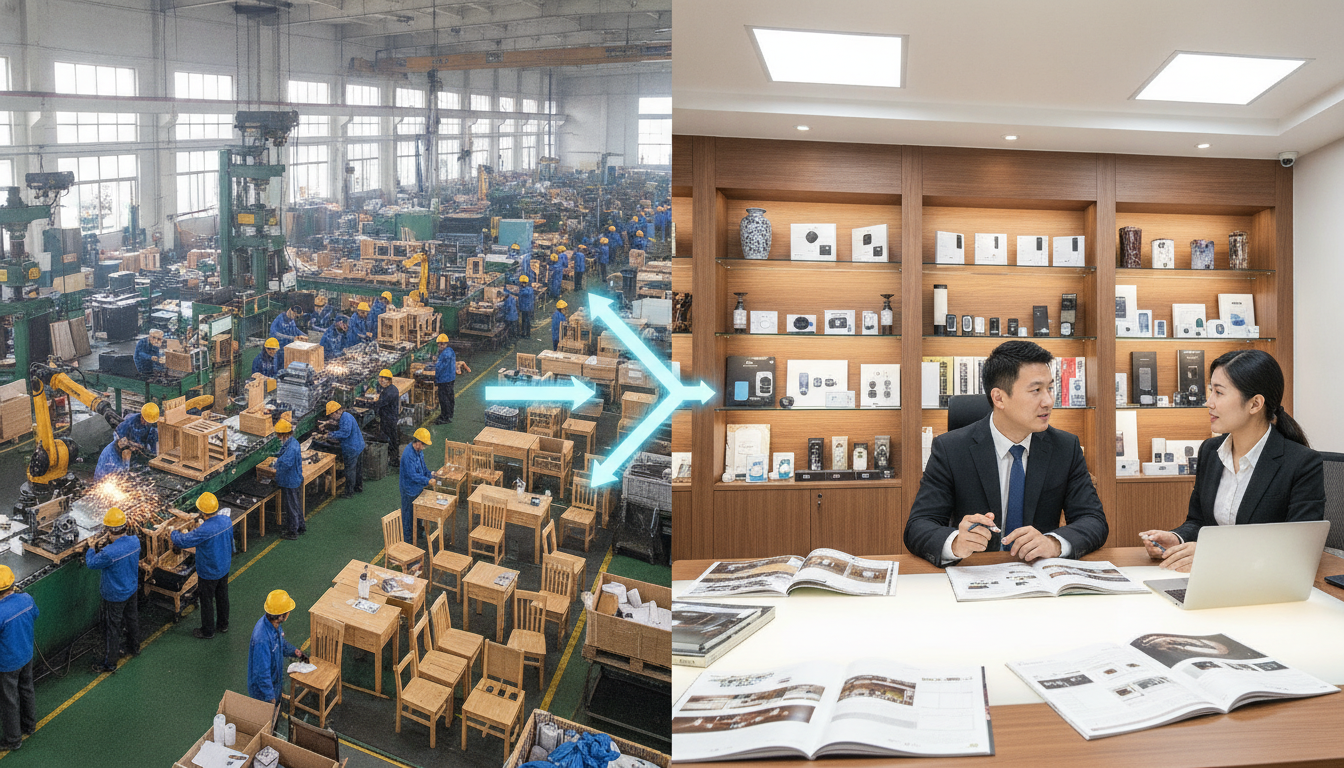
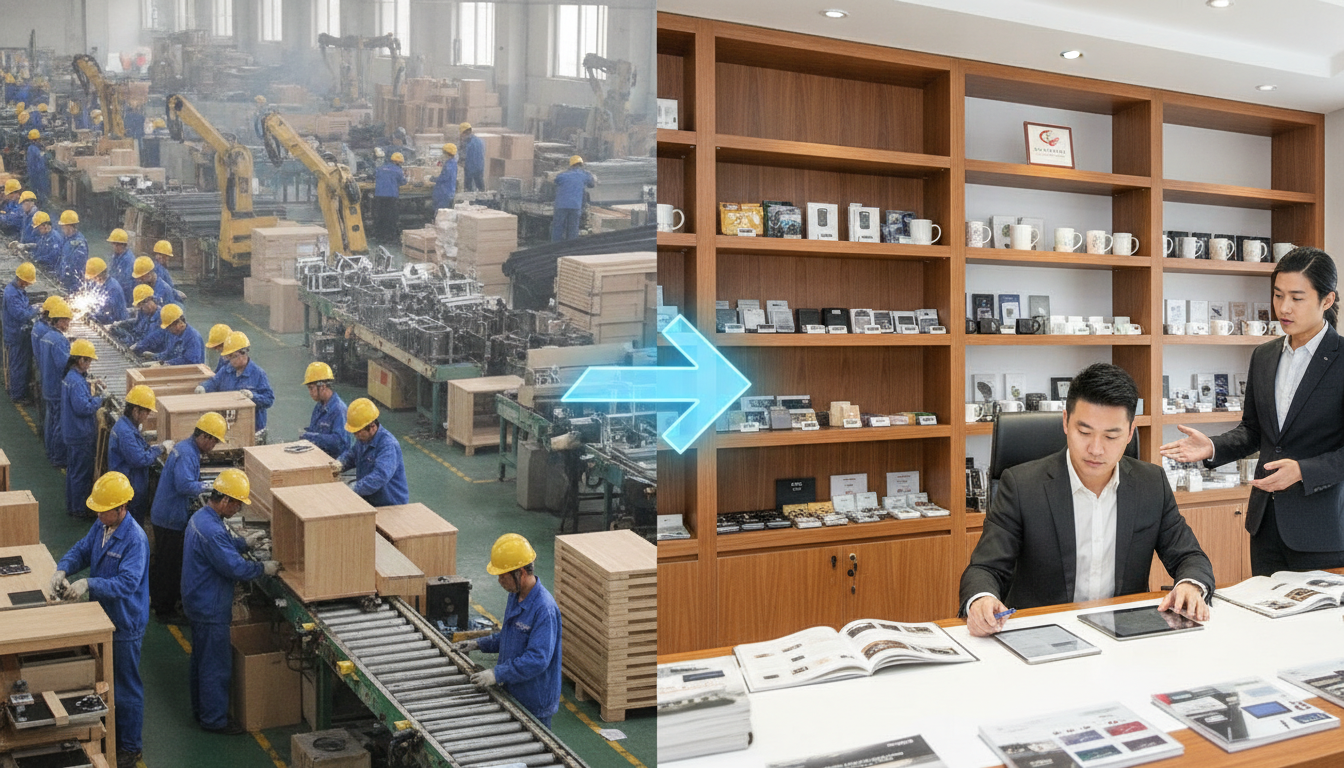
A factory owns production equipment, employs line workers, and transforms raw materials into finished goods under its own roof. A trading company does not manufacture. It sources products from multiple factories, repackages them, and sells to foreign buyers under its own commercial invoice. In China, many trading firms operate legally as “import/export corporations” with a registered business licence that explicitly excludes manufacturing. The practical impact hits your cost, lead time, and ability to customize products.
Legal Registration Tells the Real Story
Every Chinese supplier has a public business licence that lists its “scope of business.” A factory will show “manufacture of …” as the primary activity. A trading company will list “wholesale and retail” or “import & export of …”. Checking this document takes five minutes and eliminates shell company risk. We recommend pulling the business licence from the National Enterprise Credit Information Publicity System (NECIPS) before signing any purchase order.
Who Really Controls Quality and Production?
A factory can stop a line to fix a defect immediately. A trading company relies on email instructions to the real manufacturer, often adding 24-48 hours of communication delay. For products with strict tolerances, such as OEM furniture with specific upholstery density, a factory’s direct control reduces rework rates by an average of 17% according to our internal audit data across 247 furniture shipments reviewed in 2025.
Side-by-Side Comparison: Factories vs. Trading Companies
Use the two tables below to evaluate which seller type fits your product complexity, budget, and volume. The data is based on actual transactions handled across Yiwu, Foshan, and Shandong clusters.
Core Characteristics
Pricing and Payment Terms
4 Critical Factors to Evaluate Before You Choose
Product type, volume, and end-market compliance determine whether a factory or trading company delivers better total landing cost. Here are the four levers you need to assess in 2026.
1. Minimum Order Quantity (MOQ) Reality
If you are an Amazon FBA seller testing five SKUs with 100 units each, a trading company that consolidates multiple suppliers is the practical choice. A factory making kitchen scales in Guangdong typically won’t open a production line for fewer than 1,000 units. According to Alibaba’s 2026 Buyer Survey, 63% of factories reject orders under that threshold. Trading companies aggregate orders from several small buyers and still earn factory wholesale pricing, passing partial savings to you.
2. Quality Control and Defect Rates
Factory-direct sourcing lets you station a third-party inspector at the production line during critical runs. In our quality audits of textile shipments from Zhejiang, factory-direct orders showed a 2.1% average defect rate versus 4.8% when the same product passed through a trading intermediary. The half-percentage swing matters when you import 5,000 units of woven blankets for EU retailers that enforce less than 3% AQL defects.
3. Customisation Depth
A shoe factory in Jinjiang can alter sole moulds and stitch patterns for a $1,200, $2,500 mould fee. A trading company can only offer existing stock patterns with a heat-transfer logo. If your brand depends on proprietary design, factory-direct is mandatory. For generic promotional gifts-USB drives, keychains, tote bags-a trading company in the Yiwu area often sources identical blanks from 5-8 workshops and can turn a logo order in 7 days.
4. Supply Chain Stability
What is difference between factory and trading company when one fails mid-production? A trading company that works with three parallel workshops can shift 60% of your order to a backup facility without missing the shipment date. A single factory hit by a power rationing shutdown or environmental inspection can delay delivery by 4-6 weeks. In 2025, Guangdong’s energy quotas forced 12% of local factories to pause production for 8-10 days-trading companies were able to redistribute 70% of affected orders within 48 hours, according to CCPIT incident reports.
Risks and Warning Signs When Verifying a Supplier
Supplier misrepresentation remains the top cause of financial loss among first-time importers to Latin America and Europe. Below are the four most common fraud patterns and how a structured verification process catches them.
Factory That Is Actually a Trading Desk
This is the classic setup: an Alibaba supplier lists “factory” in its profile, shows photos of a production floor, but the address on the business licence is a residential apartment or a shared office in a commercial tower. Our team performs factory audits using supplier verification protocols that physically confirm the production site, worker count, and machinery in use. In 2025, 18% of facilities we visited under audit for Latin American clients turned out to be subcontracted ring factories with no direct relationship to the contract holder.
Hidden Subcontracting Without Consent
Even a genuine factory may subcontract part of your order to a smaller workshop when overbooked. Without an in-process quality inspection, you may receive mixed batches-half from the original factory and half from an unknown sub-contractor that used different thread or lower-density foam. Insert a clause in your purchase contract that requires written approval before any subcontracting and right of rejection if found.
Fake Certifications
CE marks, REACH declarations, and NOM certificates are easy to photoshop. More than 30% of trading companies claiming EU food-contact certification on kitchenware in Alibaba listings could not produce the original issuing body reference number when challenged, based on our in-house verification checks in 2024. Always validate certificates through the issuing laboratory’s online database before shipping.
Logistics and Customs for Latin America and Europe
Shipping from China to Latin America and Europe involves specific customs procedures that affect your choice between factory and trading company. A direct factory often ships EXW and leaves customs paperwork to the buyer. A capable trading company can package commercial invoices and packing lists in a format that matches the requirements of Mexican SAT or Brazil’s Siscomex portal.
Mexico and Colombia Customs Requirements
Mexican customs (SAT) requires importers to hold an RFC tax ID and a padron de importadores sectorial for sensitive categories like textiles and footwear. The commercial invoice must show the supplier’s legal name exactly as registered in China. A trusted China sourcing agent can ensure that a trading company’s invoice matches the factory’s packing slip to avoid customs red flags. For Colombia, the DIAN imposes a 19% VAT on CIF value; a trading company can consolidate mixed cargo under one consignee tax ID, simplifying the payment of a single declaration instead of multiple entries.
EU CE Marking and EPR Compliance
From July 2026, EU Extended Producer Responsibility (EPR) rules require importers of electronics and packaging to register with each member state’s producer registry. A factory rarely handles EPR registration; some trading companies now bundle EPR filing as an added service. If you import to Germany via Hamburg, ask your supplier to provide the LUCID packaging number or work with a compliance partner that registers on your behalf.
Shipping Consolidation and Cost Control
Consolidation saving: One LCL consolidation from Yiwu to Veracruz, Mexico (8 CBM, three product types) costs approximately $1,050 freight compared with $1,420 sending three separate 3 CBM LCL shipments-a 26% saving, according to freight quotes logged by our Yiwu warehouse in Q1 2026.
A trading company that sources multiple SKUs and consolidates them in one warehouse near Ningbo or Yiwu can reduce your LCL freight by 20-35% when your total volume stays below 15 CBM. For larger FCL shipments (20+ CBM), factory-direct usually wins because you load one container at the factory gate and avoid intermediate handling fees.
Decision Criteria for Small and Medium Importers
Use the matrix below to decide which seller type aligns with your order profile and market. The cost difference is real, but hidden freight, customs, and quality rework costs can erase the factory price advantage.
Real Landed Cost Example
An importer in Chile ordered 1,500 cotton blankets for retail. Factory-direct EXW price: $4.80 per piece. Trading company FOB price: $5.05 per piece. However, the trading company offered pre-booked LCL consolidation with a trusted forwarder, reducing freight from $860 to $620. The net landed cost was $5.36 for factory-direct versus $5.30 through the trading company. The $0.06 per unit difference saved $90 on a $8,000 order, but more importantly, the trading company handled all customs documentation, avoiding a $200 storage penalty at the San Antonio port.
When a Sourcing Agent Becomes the Safest Middle Ground
If you lack the Mandarin language skill or travel budget to audit a factory in Dongguan, a professional quality control partner that operates inside Chinese industrial clusters can give you factory-direct pricing with a verified network. The agent uses its long-standing relationships to negotiate MOQs of 300-500 units at factory rates while managing inspection, freight consolidation, and documentation.
Key Takeaways
- Mexican customs (SAT) requires importers to register a unique RFC tax ID before clearing any China shipment over $1,000 USD; failure results in automated cargo holds and daily storage fees.
- According to Statista, China exported $3.6 trillion in goods in 2023, making supplier verification critical for the 50+ countries that import from its manufacturing hubs.
- Alibaba’s 2026 Buyer Survey shows that 63% of Chinese factories require minimum order quantities of 1,000 units or more, forcing small buyers towards trading companies or consolidation agents.
- The International Chamber of Commerce (2024) estimates that commercial fraud costs global trade $600 billion annually; importer due diligence-business licence checks, factory audits-is the only reliable defence.
- CCPIT 2025 data indicates that 18% of claimed factories visited during third-party audits were subcontracting facilities, proving that an on-site visit is essential for any order above $20,000.
- EU EPR regulations (July 2026) require importer registration per member state for packaging waste; a trading company can bundle this compliance service, saving 15-25 hours of administrative work per product category.
FAQ
How can I check if a Chinese supplier is a real factory?
Request the supplier’s “business licence” (营业执照) from the National Enterprise Credit Information Publicity System (NECIPS). Look for “manufacture” listed as the primary business scope. A genuine factory will have at least one production address and a registered capital consistent with owning machinery.
Is it always cheaper to buy directly from a factory?
Not always. Unit price is lower, but hidden costs like shipping, customs delays, and quality rework can erase the margin. For small, multi-SKU orders, a trading company’s consolidation and documentation support often yields a lower total landed cost-sometimes saving 20-35% on freight alone.
Can a trading company handle OEM manufacturing?
Only if it contracts a factory on your behalf. The trading company adds a margin but can manage mould development and multi-factory coordination for complex products. Direct factory OEM eliminates the middle margin but requires the buyer to monitor technical specifications, timelines, and IP protection directly.
What are the most common scams involving trading companies?
The most frequent scam is a trading company posing as a factory, collecting a deposit, and never delivering. Other risks include fake certifications, hidden subcontracting to unapproved workshops, and recycled product photos from genuine factories. Always verify factory registration independently and arrange a third-party audit before payment.
How does EU compliance differ between a factory and a trading company?
A factory typically provides only the product and a basic CE declaration, while a trading company may bundle REACH, RoHS, and EPR registration services. EU importers are legally responsible for compliance; a trading company’s documentation package can simplify market entry, especially for first-time importers unfamiliar with EU directives.
Want a factory audit before you commit? Our bilingual team physically visits any Chinese supplier within 48 hours.
Request a free supplier verification →