📋 Table of Contents
Choosing between Yiwu and Guangzhou for sourcing can determine your entire import budget and supplier reliability. The yiwu vs guangzhou sourcing decision impacts minimum order quantities, product selection, quality control access, and shipping timelines. Most buyers waste weeks visiting the wrong city because they misunderstand each market’s core strengths.
This guide compares both cities across product types, cost structures, MOQ requirements, logistics infrastructure, and fraud risk factors. You’ll see actual numbers from 23 years of export operations serving buyers in Mexico, Colombia, Brazil, Argentina, Chile, and Europe.
Executive Summary
- Yiwu Market Scale: 75,000+ booths across five districts covering small commodities, accessories, home decor, party supplies, and seasonal goods with MOQs starting at 500 units per SKU.
- Guangzhou Manufacturing Hub: Concentrates electronics in Tianhe district, apparel in Baiyun, leather goods in Huadu, and furniture in adjacent Foshan, with MOQs typically 1,000-3,000 units for customized production.
- Cost Differential: Yiwu commodity prices run 8-15% lower than Guangzhou for identical small goods categories, but Guangzhou offers 12-20% savings on bulk electronics and furniture due to factory proximity.
- Shipping Timeline: Yiwu to Latin America averages 28-35 days via Ningbo port (120 km), while Guangzhou uses Nansha port (60 km) with 26-32 day transit to Mexico and Colombia.
- Supplier Density: Yiwu hosts 200,000+ registered traders and agents, Guangzhou maintains 150,000+ manufacturers and wholesalers, according to China Customs District Export Registration data from 2025.
Yiwu vs Guangzhou Sourcing Overview
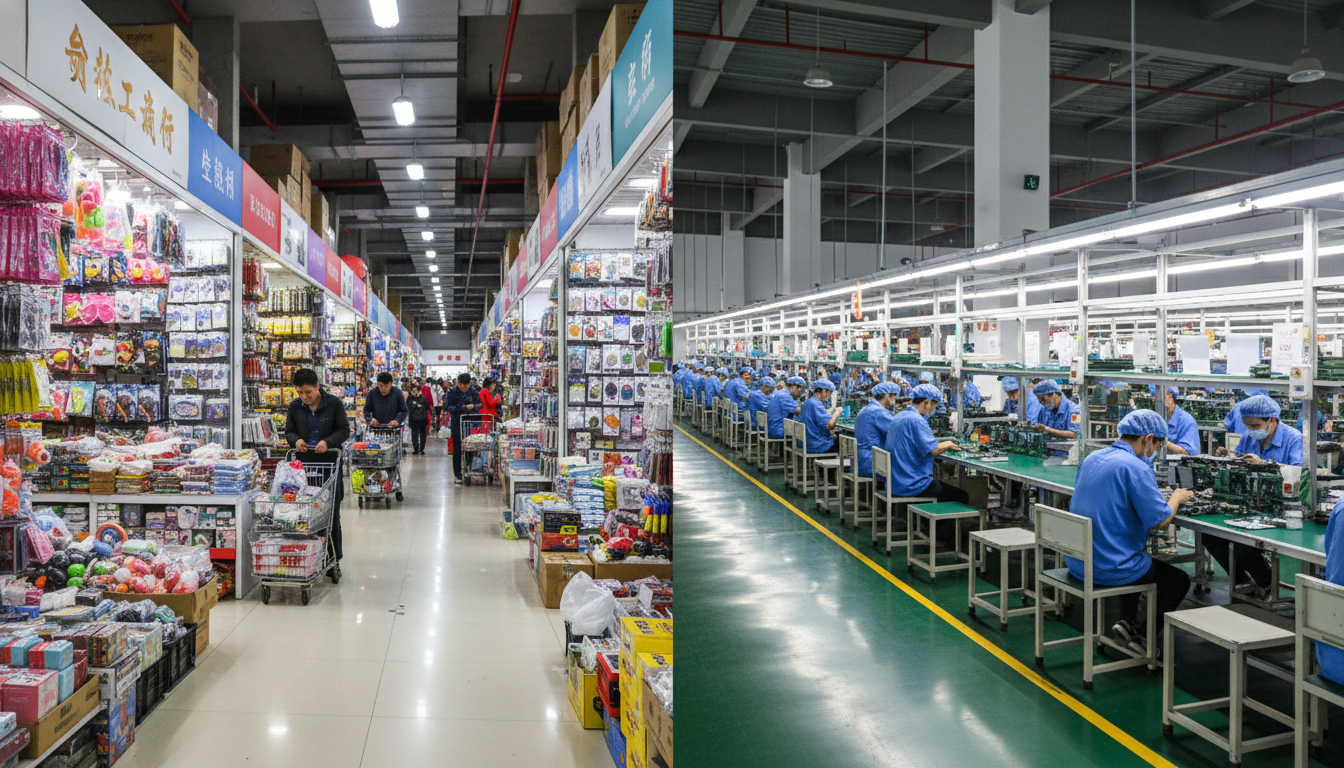
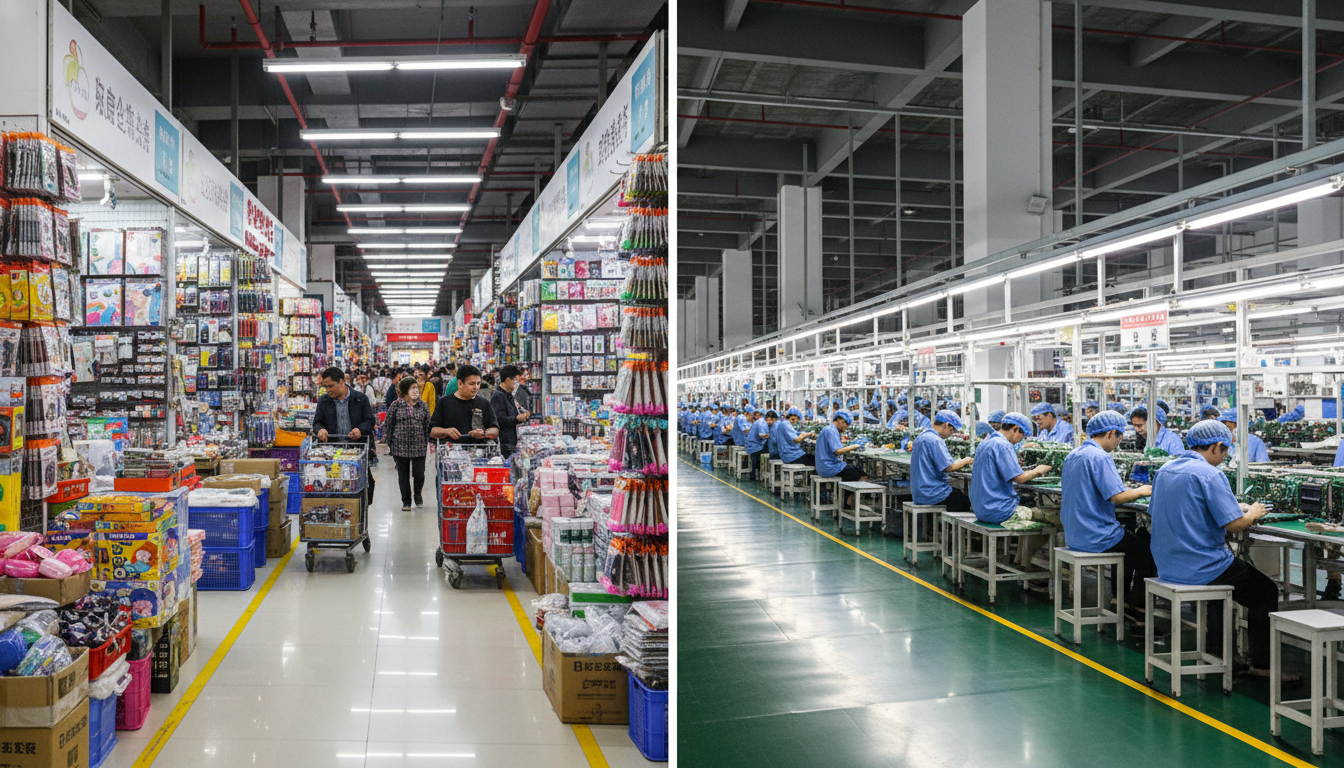
The yiwu vs guangzhou sourcing comparison starts with understanding each city’s fundamental market structure. Yiwu operates as the world’s largest small commodity wholesale market, while Guangzhou functions as a diversified manufacturing and trading center with deeper factory integration.
Yiwu Market Structure
Yiwu International Trade City spans 5.5 million square meters across five interconnected districts. Each district specializes in product verticals: District 1 covers jewelry, flowers, and toys; District 2 handles bags, hardware, and tools; District 3 focuses on cosmetics, stationery, and sports goods; District 4 stocks socks, underwear, and textiles; District 5 manages home textiles and bedding.
Most Yiwu booths represent trading companies sourcing from 50-200 km radius factories in Zhejiang province. You negotiate with middlemen who consolidate orders from multiple buyers. This structure enables low MOQs but adds 6-12% markup compared to direct factory pricing.
Guangzhou Manufacturing Ecosystem
Guangzhou concentrates production facilities within city limits and surrounding Pearl River Delta cities. The Baiyun leather market connects 3,000+ bag and belt factories. Tianhe electronics markets link to Shenzhen component suppliers 120 km away. Haizhu wholesale districts serve as showrooms for Guangdong garment factories.
Guangzhou suppliers typically operate their own production lines or maintain exclusive factory partnerships. You source closer to the manufacturing source, gaining better customization control and quality oversight. MOQs run higher because you’re placing production orders, not buying existing stock.
Geographic and Logistics Context
Yiwu sits in central Zhejiang province, 300 km south of Shanghai, with direct rail connections to Europe via the Yiwu-Madrid freight train. The city positions itself as a consolidation hub for small-lot buyers shipping mixed containers. Working with a trusted China sourcing agent based in the region streamlines booth negotiations and quality checks across multiple districts.
Guangzhou anchors the Pearl River Delta manufacturing belt, adjacent to Hong Kong (130 km) and Shenzhen (120 km). The city offers direct access to component suppliers, packaging factories, and shipping infrastructure. Buyers sourcing electronics, furniture, or apparel benefit from same-region factory audits and faster sample iterations.
Product Categories by City
Product specialization drives the yiwu vs guangzhou sourcing choice more than any other factor. Each city dominates specific categories where supplier density, component access, and production expertise concentrate.
Yiwu Product Strengths
Yiwu excels in small commodities with high SKU variety and frequent design turnover. The market structure supports buyers needing 50-200 different items in small quantities rather than large volumes of single products.
- Jewelry and accessories: Fashion jewelry, hair accessories, scarves, belts, sunglasses with 500-1,000 unit MOQs and $0.30-$3.50 per piece wholesale pricing.
- Home decor and seasonal goods: Christmas ornaments, artificial flowers, picture frames, candles, party supplies starting at 500 units per design.
- Toys and gifts: Plush toys, educational toys, novelty items, promotional products with extensive customization options for logos and packaging.
- Stationery and office supplies: Pens, notebooks, desk organizers, art supplies, school supplies with MOQs of 500-2,000 units depending on customization.
- Small electronics: USB cables, phone cases, Bluetooth speakers, LED lights, power banks at 1,000-3,000 unit minimums.
Yiwu suppliers maintain ready stock for standard items, enabling 3-7 day order fulfillment for non-customized goods. Customization adds 15-25 days for logo printing, color changes, or packaging modifications.
Guangzhou Product Strengths
Guangzhou concentrates on categories requiring manufacturing infrastructure, technical expertise, or multi-component assembly. The city’s factory network supports complex production and quality control needs.
- Electronics and appliances: Smartphones, tablets, smart home devices, kitchen appliances, audio equipment with 1,000-5,000 unit MOQs and strict certification requirements.
- Apparel and textiles: Garments, activewear, denim, fashion clothing with 500-2,000 pieces per style per color, fabric sourcing from local mills.
- Leather goods: Handbags, wallets, belts, luggage with 300-1,000 units per SKU, genuine and synthetic leather options, hardware customization.
- Furniture: Home furniture, office furniture, outdoor furniture primarily from adjacent Foshan city with 50-200 unit container minimums.
- Beauty and personal care: Cosmetics, skincare, hair care products with 3,000-10,000 unit MOQs due to formulation and packaging complexity.
Guangzhou production timelines run 30-60 days for customized orders after sample approval. Buyers gain access to quality control services at factory level, including pre-production inspections, during-production monitoring, and pre-shipment final checks.
MOQ and Cost Comparison
Minimum order quantities and pricing structures differ substantially between Yiwu and Guangzhou, directly impacting your working capital requirements and inventory risk.
Yiwu MOQ and Pricing
Yiwu trading companies stock inventory and accept smaller orders because they consolidate multiple buyers’ orders to meet factory minimums. This flexibility costs 6-12% more than direct factory pricing but reduces your per-SKU financial commitment.
Typical Yiwu MOQ: 500-1,000 units per SKU for stock items, 1,000-2,000 units for customized products. Price premium: 8-15% above factory direct pricing.
Example pricing from our Yiwu warehouse operations: Fashion jewelry wholesales at $0.80-$2.50 per piece for 1,000-unit orders. The same items direct from Zhejiang factories cost $0.65-$2.10 at 5,000-unit minimums. You pay the premium to access variety without committing $50,000+ per container.
Yiwu suppliers quote FOB Ningbo pricing, adding $120-$180 per cubic meter for inland trucking from Yiwu to port. Total logistics from booth to Ningbo port averages 5-7 days including consolidation time.
Guangzhou MOQ and Pricing
Guangzhou factories set MOQs based on production efficiency, raw material minimums, and setup costs. Electronics require larger batches due to component procurement. Apparel MOQs vary by fabric type and color count. Furniture orders typically fill partial or full containers.
Typical Guangzhou MOQ: 1,000-3,000 units for apparel and bags, 2,000-5,000 units for electronics, 50-200 units for furniture. Price advantage: 5-12% below Yiwu for manufactured goods.
Example pricing: Bluetooth speakers with custom branding cost $8.50-$12.00 per unit FOB Guangzhou at 2,000-unit orders. Yiwu traders quote $9.80-$13.50 for the same specs at 1,000 units. The Guangzhou advantage grows with order size: 5,000-unit orders drop to $7.20-$10.50 per unit.
Guangzhou factories quote FOB Nansha or Huangpu port pricing. Inland trucking runs $80-$150 per cubic meter with 2-4 day transit. Proximity to ports reduces logistics costs and damage risk compared to Yiwu.
Cost Breakdown Analysis
Total landed cost includes product price, inland freight, ocean freight, customs duties, and working capital carrying costs. The yiwu vs guangzhou sourcing decision shifts based on order volume and product mix.
Yiwu makes sense when testing 20-50 SKUs with $15,000-$30,000 budgets. Guangzhou wins when scaling proven products to 5,000+ units per SKU with $50,000+ orders. Many buyers start in Yiwu for market testing, then shift to Guangzhou factories after validating demand.
Payment Terms and Cash Flow
Yiwu traders typically require 30% deposit and 70% balance before shipment. Some accept smaller 20% deposits for repeat buyers. Payment terms remain rigid because traders operate on thin margins.
Guangzhou factories offer more flexibility: 30% deposit, 40% at production midpoint, 30% before shipment. Established relationships can negotiate 60-day payment terms after building trust over 3-5 orders. This improves cash flow for buyers managing multiple product lines.
Logistics and Shipping Considerations
Port access, container consolidation options, and shipping schedules create practical differences between Yiwu and Guangzhou that affect delivery timelines and freight costs.
Yiwu Logistics Infrastructure
Yiwu exports through Ningbo port, 120 km east of the city. Ningbo ranks as China’s third-largest container port with weekly sailings to Latin America and Europe. The Yiwu-Ningbo logistics corridor handles 8 million TEUs annually serving the Zhejiang manufacturing region.
Most Yiwu buyers ship LCL (less than container load) because they source multiple product categories in small quantities. Our warehouse and consolidation facility in Yiwu receives goods from 30-80 different suppliers per buyer, inspects and repacks items, then consolidates into shared containers.
- LCL consolidation time: 5-8 days to collect all suppliers’ goods, complete inspections, and repack for shipping.
- Ningbo to Mexico: 28-32 days ocean transit to Manzanillo or Veracruz ports.
- Ningbo to Colombia: 30-35 days to Cartagena or Buenaventura.
- Ningbo to Europe: 32-38 days to Rotterdam, Hamburg, or Valencia.
Yiwu also operates the Yiwu-Madrid railway, the world’s longest freight train route at 13,000 km. Rail transit takes 18-21 days to Europe, faster than ocean but costs 40-60% more. This option suits time-sensitive shipments of high-value small goods.
Guangzhou Logistics Infrastructure
Guangzhou exports through Nansha and Huangpu ports, both within 60 km of the city center. The Pearl River Delta port cluster (including Shenzhen and Hong Kong) handles 80 million TEUs annually, offering the most frequent sailing schedules globally.
Guangzhou buyers more commonly ship FCL (full container load) because factory orders fill 20-foot or 40-foot containers. Electronics and furniture naturally consolidate to container quantities. This reduces per-unit freight costs and eliminates shared-container damage risks.
- FCL loading time: 2-4 days from factory to port, including customs documentation.
- Nansha to Mexico: 26-30 days ocean transit to Manzanillo, Lazaro Cardenas, or Veracruz.
- Nansha to Colombia: 28-33 days to Cartagena or Buenaventura.
- Nansha to Europe: 30-36 days to major European ports.
Guangzhou’s proximity to Hong Kong provides alternative routing for urgent shipments or buyers with Hong Kong banking relationships. Air freight from Guangzhou Baiyun International Airport reaches Mexico City in 3-5 days and European capitals in 2-4 days, though costs run 6-8 times ocean rates.
Customs and Documentation
Both cities provide experienced freight forwarders and customs brokers. Yiwu specializes in small-value commercial shipments with simplified documentation. Guangzhou handles complex electronics certifications, textile quotas, and furniture phytosanitary requirements.
Latin American buyers face specific documentation requirements. Mexican importers need RFC tax ID registration, pedimento customs forms, and IMMEX program compliance for certain categories. Colombian buyers must navigate DIAN customs procedures and obtain import licenses for electronics. Argentine importers deal with AFIP registration and SIRA authorization systems.
Working with experienced freight and shipping partners in each city ensures proper documentation, correct HS code classification, and duty optimization. Errors in customs paperwork cause 15-45 day delays and penalty fees of $500-$3,000 per shipment.
Supplier Verification in Each City
Fraud risk and supplier verification challenges differ between Yiwu’s trading market and Guangzhou’s factory environment. Understanding these risks protects your deposits and ensures product quality.
Yiwu Verification Challenges
Yiwu’s 75,000 booths include legitimate traders, factory representatives, and opportunistic middlemen. The market’s low barriers to entry attract some unscrupulous operators who collect deposits without delivering goods or ship substandard products after showing quality samples.
Common Yiwu fraud patterns we’ve documented over 23 years:
- Sample bait-and-switch: Traders show factory-quality samples but ship inferior goods from different suppliers after receiving payment.
- Fake booth operations: Short-term booth renters collect deposits from multiple buyers, then disappear after 2-3 months.
- Inflated pricing: Inexperienced buyers pay 25-40% above market rates because they lack price benchmarking across multiple suppliers.
- Unauthorized subcontracting: Traders accept orders beyond their capacity, then subcontract to unknown factories without buyer knowledge.
Essential verification steps for Yiwu suppliers include business license verification, booth lease confirmation, factory visit to actual production source, reference checks with previous buyers, and payment through secure escrow or letter of credit for first orders.
In practice: A Colombian buyer avoided $18,000 loss by requesting our team verify a Yiwu trader’s factory source before 30% deposit, discovering the trader had no actual factory relationship
Guangzhou Verification Challenges
Guangzhou factories present different verification challenges. Many operate legitimate production but exaggerate capacity, certifications, or export experience. Some showrooms represent multiple factories without clear disclosure, creating confusion about actual manufacturer identity.
Common Guangzhou verification issues:
- Capacity misrepresentation: Factories claim 50,000 monthly capacity but actually produce 8,000-12,000 units, causing delivery delays.
- Fake certifications: Suppliers display copied CE, FCC, or RoHS certificates that don’t match their actual products or company registration.
- Showroom confusion: Trading companies operate showrooms displaying products from 10-15 factories without clarifying they don’t manufacture anything.
- Quality inconsistency: Factories produce excellent samples with experienced workers, then use temporary labor for bulk orders, degrading quality.
Guangzhou verification requires factory audits confirming production equipment matches claimed capacity, worker count verification during factory visits, certification document authentication through issuing bodies, and during-production inspections to ensure sample quality carries through to bulk production.
محترف supplier management services conduct these verifications systematically. Our team performs 800+ factory audits annually across Guangzhou, Foshan, and surrounding Pearl River Delta cities, identifying red flags that cost buyers $20,000-$150,000 in failed orders.
Verification Cost and Timeline
Proper supplier verification costs $300-$800 per supplier depending on audit depth. Basic verification (business license, export license, booth/factory address confirmation) takes 2-3 days. Comprehensive audits (factory visit, capacity assessment, quality system review, financial stability check) require 5-7 days.
This investment prevents losses that average $23,000 per fraud incident according to our client data from 2,000+ sourcing projects. First-time buyers in both Yiwu and Guangzhou should budget $2,000-$5,000 for verification across 5-8 potential suppliers before committing to orders.
Which City Fits Your Business Model
The optimal yiwu vs guangzhou sourcing choice depends on your product mix, order volume, budget constraints, and business stage. Most successful importers use both cities strategically for different product categories.
Choose Yiwu When
Yiwu suits buyers who need product variety over production scale. The market excels at serving businesses testing multiple product lines or operating with limited working capital.
- Testing new products: You’re validating market demand for 20-50 SKUs before committing to large production runs.
- Small order budgets: Your initial import budget sits at $10,000-$30,000, requiring low MOQs across multiple categories.
- Gift and novelty items: You source seasonal goods, promotional products, or trend-driven items with short lifecycle.
- Mixed container loads: You need 30-80 different products from various categories in one shipment.
- Quick turnaround: You require 7-14 day order fulfillment for stock items without customization.
Yiwu works particularly well for Amazon FBA sellers testing products, retail store buyers adding variety to existing inventory, and first-time importers learning the China sourcing process with manageable financial risk. Our Yiwu market navigation service helps buyers efficiently cover 75,000 booths across five districts in 3-5 days.
Choose Guangzhou When
Guangzhou serves buyers ready to scale proven products through factory partnerships. The city’s manufacturing infrastructure supports customization, quality control, and volume production.
- Scaling proven products: You’ve validated market demand and need 3,000-10,000 units per SKU at lower unit costs.
- Customization requirements: You need OEM/ODM production with custom specifications, branding, packaging, or formulations.
- Quality control access: You require factory-level inspections during production, not just pre-shipment checks.
- Electronics or technical products: You source items requiring certifications, component sourcing, or technical specifications.
- Brand building: You’re developing proprietary products with intellectual property protection needs.
Guangzhou benefits established importers with proven sales channels, private label brands requiring factory partnerships, and businesses with $50,000+ per-order budgets. The city’s factory density enables efficient quality control and production monitoring across multiple suppliers.
Hybrid Sourcing Strategy
Many sophisticated buyers use both cities strategically. Start with Yiwu for market testing and variety sourcing, then transition successful products to Guangzhou factories for volume production and cost optimization.
Example hybrid approach: Source 30 accessory SKUs from Yiwu at 500-1,000 units each to test market response. After 3-6 months, identify the top 5 performers. Move those winners to Guangzhou factories at 3,000-5,000 unit orders, reducing unit costs by 15-25%. Continue using Yiwu for new product testing and low-volume specialty items.
In practice: A Mexican retailer started with $15,000 Yiwu orders testing 40 home decor SKUs, scaled top 8 products to Guangzhou at 5,000 units each, reducing costs from $3.20 to $2.40 per unit while maintaining Yiwu for seasonal items
Key Takeaways
- Yiwu International Trade City operates 75,000 booths across five specialized districts with MOQs starting at 500 units per SKU, according to Yiwu Market Administration data from 2025.
- Guangzhou maintains 150,000 registered manufacturers and wholesalers concentrated in electronics, apparel, leather goods, and furniture with typical MOQs of 1,000-3,000 units, per China Customs District Export Registration statistics.
- Yiwu commodity pricing runs 8-15% above direct factory costs but enables mixed-container sourcing with $15,000-$30,000 budgets, while Guangzhou factory direct pricing offers 5-12% savings at $50,000+ order volumes.
- Ningbo port (120 km from Yiwu) provides 28-32 day ocean transit to Mexico and 30-35 days to Colombia, compared to Nansha port’s (30-60 km from Guangzhou) 26-30 day Mexico transit and 28-33 day Colombia delivery.
- Professional supplier verification costs $300-$800 per supplier and prevents fraud losses averaging $23,000 per incident based on 2,000+ sourcing projects documented in our client database.
- Hybrid sourcing strategies using Yiwu for product testing at 500-1,000 units then scaling winners to Guangzhou factories at 3,000-5,000 units reduce unit costs by 15-25% while maintaining product variety.
FAQ
What are the main differences between Yiwu and Guangzhou for sourcing?
Yiwu operates as a trading market with 75,000 booths selling small commodities, accessories, home decor, and seasonal goods with MOQs of 500-1,000 units. Guangzhou functions as a manufacturing hub with direct factory access for electronics, apparel, furniture, and leather goods requiring 1,000-5,000 unit minimums. Yiwu suits buyers needing variety in small quantities, while Guangzhou serves buyers scaling proven products through factory partnerships with customization capabilities.
Which city offers lower prices for China sourcing?
Pricing depends on product category and order volume. Yiwu commodity prices run 8-15% higher than direct factory costs because you’re buying through traders, but enable small-quantity orders. Guangzhou factory direct pricing offers 5-12% savings on manufactured goods like electronics, apparel, and furniture at volumes of 3,000+ units. For mixed-category orders under $30,000, Yiwu provides better total value. For single-product orders exceeding $50,000, Guangzhou delivers lower unit costs.
How do MOQ requirements compare between Yiwu and Guangzhou?
Yiwu traders accept 500-1,000 units per SKU for stock items and 1,000-2,000 units for customized products because they consolidate multiple buyers’ orders. Guangzhou factories require 1,000-3,000 units for apparel and bags, 2,000-5,000 units for electronics, and 50-200 units for furniture based on production efficiency and material minimums. Yiwu’s lower MOQs suit product testing and variety sourcing, while Guangzhou’s higher minimums support volume production and cost optimization.
What are shipping times from Yiwu vs Guangzhou to Latin America?
Yiwu ships through Ningbo port (120 km distance) with 28-32 day ocean transit to Mexico and 30-35 days to Colombia, plus 5-8 days for LCL consolidation. Guangzhou exports via Nansha port (30-60 km) with 26-30 day Mexico transit and 28-33 day Colombia delivery, plus 2-4 days FCL loading time. Total door-to-port timeline runs 35-42 days from Yiwu versus 30-36 days from Guangzhou for Latin American destinations.
Should I visit Yiwu or Guangzhou for my first sourcing trip?
Visit Yiwu if you’re sourcing small commodities, accessories, home decor, toys, or gifts across 20+ SKUs with limited budget. The market’s booth density enables efficient comparison shopping in 3-5 days. Choose Guangzhou if you’re sourcing electronics, apparel, furniture, or leather goods requiring factory audits, technical specifications, or customization. Most first-time importers benefit from Yiwu’s lower financial risk and product variety, then expand to Guangzhou factories after validating market demand for specific products.
Ready to source from Yiwu or Guangzhou with expert verification and quality control?
Request Your Free Supplier Audit →