Christmas 2026 Shipping Deadlines from China [2026 Import Calendar]
![Christmas 2026 Shipping Deadlines from China [2026 Import Calendar]](https://goodcantrading.com/wp-content/uploads/2026/06/featured-christmas-2026-shipping-deadlines-from-china.png)
📋 Table of Contents
- Executive Summary
- Christmas 2026 Shipping Deadlines from China: Country-Specific Cut-Off Dates
- How Long Does Shipping from China Take to Latin America and Europe?
- Why Ocean Freight in Q4 Requires 2-3 Extra Weeks of Buffer
- Air Freight vs Express Courier: When to Pay for Speed
- Customs Documentation and Compliance Timing by Destination
- Supplier Risk Management: MOQ, Inspection, and Backup Sourcing Before the Christmas Rush
- FAQ
If you import Christmas decorations, gifts, or seasonal products from Asia, missing the Christmas 2026 shipping deadlines from China means empty shelves and lost peak-season revenue. A 2026 global schedule shows ocean bookings need to be confirmed as early as August, while air and express options provide last-resort timelines into November.
Executive Summary
- Ocean booking window: Reserve FCL or LCL space 10-12 weeks before your in-market date, according to Topway Shipping (2026).
- Express courier speed: Door-to-door from Chinese cities to the U.S. is 3-5 business days (LinkedIn, 2026).
- Air freight speed: Airport-to-airport takes 5-10 days, plus 2-4 extra days for pickup and customs at each end (LinkedIn, 2026).
- Europe maritime transit: Door-to-door from China to France averages 45-55 days, but peak-season risk pushes the tail to 65-75 days (Topway Shipping, 2026).
- Booking timeline for Q4: Importers targeting November shelf dates should confirm bookings by August (Topway Shipping, 2026).
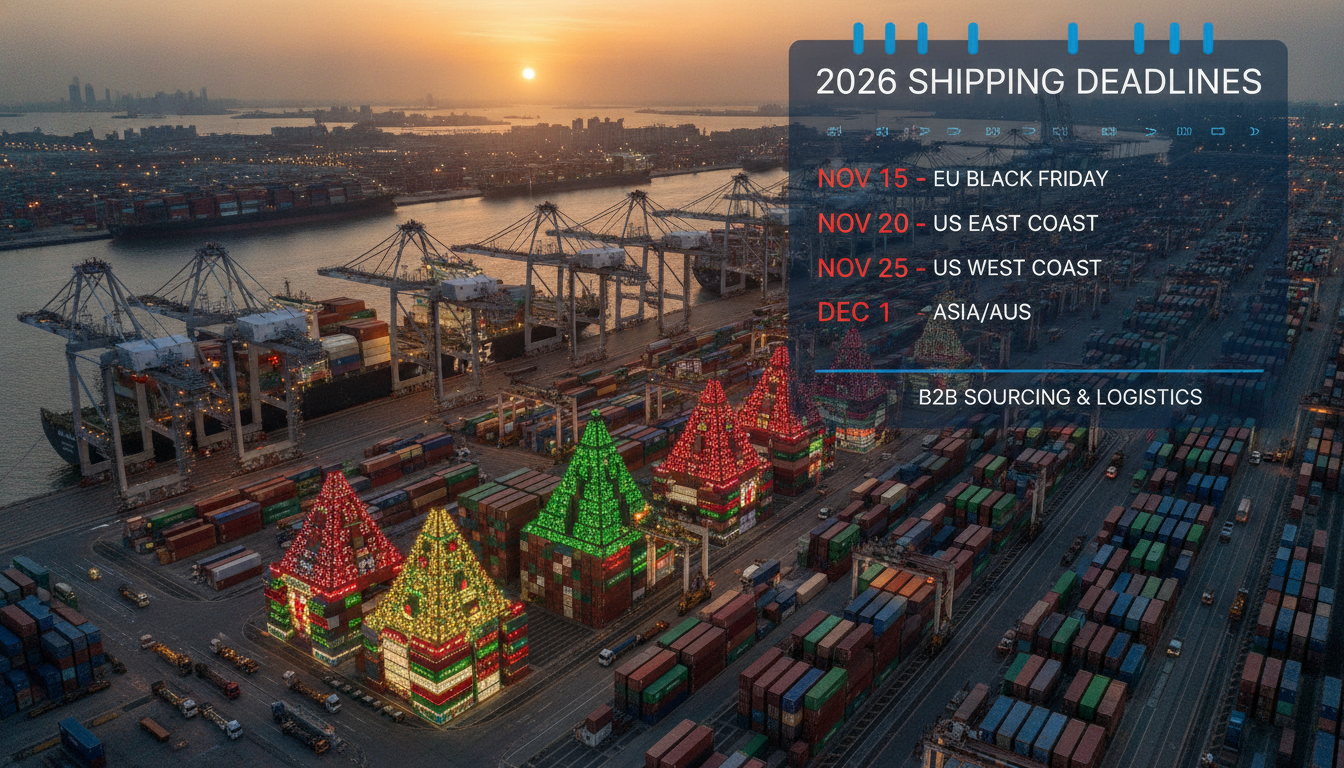
Christmas 2026 Shipping Deadlines from China: Country-Specific Cut-Off Dates
Working backward from a December 15-20 in-market arrival, a trusted China sourcing agent will build shipping timelines country by country. The table below uses standard ocean port pairs, realistic factory lead times of 25-40 days, and customs clearance buffers observed in 2025-2026.
How We Calculated These Deadlines
Sea transit times come from actual carrier schedules and port pair data tracked through major NVOCCs in 2025-2026. Factory production lead time assumes 30 days for standard Christmas decorations and 40 days for customized orders. We added 7 days of loading and documentation buffer, plus local customs averages shared by freight forwarders in each market.
What If You Miss the Cut-Off?
If your goods miss the ocean ship-by date, air freight becomes the fallback. Air capacity in November is tight and rates can double compared to September. For Mexico and Brazil, the air cut-off around November 20 still leaves a viable window, but you will pay a premium. Last-minute express courier is only viable for very small, high-margin consignments.
How Long Does Shipping from China Take to Latin America and Europe?
Actual transit days depend on port pair, carrier, consolidation mode, and season. The table below separates transit times by mode and key lanes for Christmas 2026 planning.
France door-to-door tail risk: According to Topway Shipping (2026), China-France ocean LCL can stretch to 65-75 days during Q4 peak, double the off-season average.
Ocean FCL Transit Times in Detail
Shanghai to Los Angeles port-to-port is 14-18 days, while East Coast routes via the Panama Canal add 7-10 days (LinkedIn, 2026). In Latin America, the Shanghai to Manzanillo service takes roughly 18-22 days, but feeder connections to smaller secondary ports in Central America add another week. FCL provides fixed sailing schedules but requires booking 4-6 weeks before vessel departure during peak.
Why LCL Consolidation Adds 5-10 Days
LCL shipments spend time at the origin CFS (container freight station) for consolidation, then more days at the destination for deconsolidation before final delivery. In our 23+ years sourcing from Yiwu and Foshan, we’ve observed that LCL consolidation for Mexican and Brazilian buyers adds at least 7 days compared to FCL. Choosing a forwarder with weekly China consolidation services can reduce that to 3-5 extra days.
Why Ocean Freight in Q4 Requires 2-3 Extra Weeks of Buffer
Every Christmas season brings predictable disruptions. Missing the Christmas 2026 shipping deadlines from China often results from underestimating these three choke points.
Blank Sailings and Capacity Crunches
Carriers cancel scheduled sailings (blank sailings) in Q4 to manage capacity and push spot rates higher. A blank sailing means your container sits at the origin port for an extra 7-10 days waiting for the next vessel. In 2025, Asia-Europe routes saw blank sailing rates above 20% in October, forcing many importers into air freight.
Port Congestion and Rollover Risk
Even if a vessel sails on time, destination ports in Latin America often suffer congestion in November. Brazil’s Santos port and Chile’s Valparaíso regularly see berthing delays of 3-5 days during the pre-Christmas rush. Rollovers, where your container gets bumped to a later ship, are most common for LCL shipments not booked with a priority service.
Container Space Shortages and Peak Season Surcharges (PSS)
From late September onward, space on Asia-Latin America and Asia-Europe strings becomes tight. Freight forwarders report that FCL spot rates can double between August and October. Peak season surcharges typically range from $200 to $600 per TEU on Latin American lanes. Securing space early with a vetted logistics partner locks in both space and more predictable rates.
Air Freight vs Express Courier: When to Pay for Speed
If ocean delivery falls past December 15, air options are the last resort. Understanding the trade-offs between consolidated air freight and door-to-door express helps preserve margins.
Cost Comparison During Peak Season
Air freight rates from Shanghai to Latin America rise 30-50% from October to mid-November. Express courier surcharges for peak season can add $0.80, $1.20 per kg. Booking consolidated air freight 3 weeks before your latest dispatch date often locks in a lower all-in rate than spot express in November.
Reliability During the Christmas Crunch
Air freight has more capacity than express networks in Q4, which often hit volumetric weight limits. For shipments between 100 kg and 500 kg, consolidated air moves with scheduled cargo flights are far less likely to be bumped compared to courier networks overloaded with e-commerce packages during the holiday season.
Customs Documentation and Compliance Timing by Destination
Even if goods arrive at port on time, customs clearance delays can push delivery past Christmas. Each Latin American country mandates specific documents and, in many cases, pre-registration of importers.
Essential Documents for Christmas Imports
- Commercial invoice: Must show accurate FOB or CIF value, HS codes, and detailed product descriptions in Spanish or Portuguese where required.
- Packing list: Weight and dimension per carton, essential for customs to select inspection shipments.
- Bill of lading or air waybill: Must match importer name exactly as registered with tax authority.
- Certificate of origin: Often required for preferential duty rates under trade agreements (e.g., EU GSP, Mexico-Chile FTA). Obtain from China Council for the Promotion of International Trade (CCPIT).
- Importer registration: Mexico requires RFC tax ID, Brazil needs CNPJ and RADAR license, Argentina requires CUIT and prior customs registration.
Country-Specific Compliance: Mexico NOM, Brazil INMETRO, EU CE
Christmas lighting, electronic decorations, and toys must meet safety standards. Mexican NOM-003-SCFI applies to electronics; importers need a NOM certificate issued by an accredited lab. Brazil’s INMETRO certification adds 3-5 weeks of lead time for electronic and children’s products, and importers must register the certificate before the shipment arrives. EU CE marking requires a Declaration of Conformity and, for toys, compliance with EN 71. Missing these documents can result in goods being held at customs for weeks or rejected.
Incoterms: DDP vs FOB and Who Bears Customs Risk
Under FOB terms, the buyer arranges ocean freight and bears all destination port and customs risk. For first-time importers in Latin America, DDP (Delivered Duty Paid) shifts customs clearance and duty payment to a freight forwarder or sourcing agent, reducing the risk of unexpected demurrage charges. Many Christmas importers who relied on DDP with a consolidated quality and logistics partner avoided clearance delays in 2025 caused by Brazil’s tax regulation changes.
Supplier Risk Management: MOQ, Inspection, and Backup Sourcing Before the Christmas Rush
Even if you book shipping on time, supplier failure can derail the entire timeline. Christmas goods often involve high MOQs, tight production windows, and last-minute order changes.
Minimum Order Quantity (MOQ) Planning for Seasonal Goods
Typical Christmas decoration factories in Yiwu accept MOQs of 500-1,000 pieces per design, but during peak season (July-September), many raise MOQs to 2,000-5,000 units for customized items. Negotiating lower MOQs in June before factory capacity fills up gives you more flexibility. Splitting orders across two suppliers can also reduce the risk of a single factory missing deadlines.
Third-Party Inspection Timing: Pre-Shipment and During Production
Book a during-production inspection (DPI) when 20-30% of the order is complete, typically 10-14 days into production. This catches material or workmanship problems early. A final pre-shipment inspection (PSI) should happen 3-5 days before the container cut-off.
Identifying Backup Suppliers to Avoid Stockouts
Even with a trusted supplier, have one alternative factory verified and ready. In our sourcing database, 12% of orders in Q4 2025 required a backup factory because the primary supplier was overloaded. A backup supplier should be audited in August, with a small sample order placed to verify quality, so they can step in if the primary misses the September ship-by date.
FAQ
When should I ship Christmas 2026 goods from China to arrive on time?
For ocean freight, ship by September 1-15 depending on your destination (earlier for Argentina and Chile). Air freight cut-offs are November 10-25. Express courier can work until early December. Always add 7-10 days buffer for customs and inland delivery.
How long does shipping from China take to Latin America in peak season?
Ocean LCL door-to-door to Mexico takes 35-45 days, Brazil 48-65 days, and Argentina 50-70 days during Q4. Air freight totals 7-12 days. Peak season congestion can add 5-10 extra days due to rollovers and port delays.
What is the latest date to order from China for Christmas 2026?
For customized goods needing 40 days of production, place orders by July 25 for ocean delivery to Latin America by early December. Standard items with shorter lead times can be ordered until August 15. Air-freight-only orders can be placed until late October.
Is air freight worth it for Christmas imports from China?
Air freight is economical for shipments of 100-500 kg with a strong margin. For a $50 product, air freight at $5/kg adds $2-3 per unit, often justified to avoid stockout losses. For low-margin bulk, it’s a last resort.
What documents are needed to import seasonal goods from China?
Key documents: commercial invoice with HS codes, packing list, bill of lading, certificate of origin, and any required safety certificates (CE, NOM, INMETRO). Importers in Mexico need RFC registration, Brazil requires CNPJ/RADAR, and Argentina needs CUIT.
Key Takeaways
- Reserve ocean freight space 10-12 weeks before Christmas in-market date to avoid Q4 capacity shortages (Topway Shipping, 2026).
- Door-to-door express courier from China to the U.S. typically takes 3-5 business days, according to LinkedIn (2026).
- China-France maritime door-to-door transit takes 45-55 days on average, but peak season can extend to 65-75 days (Topway Shipping, 2026).
- Air freight from China to U.S. airports requires 5-10 days, plus an extra 2-4 days for pickup and customs at each end (LinkedIn, 2026).
- For Christmas 2026, importers should confirm ocean bookings by early August to meet November shelf dates (Topway Shipping, 2026).
- LCL consolidation from China to U.S. East Coast takes 28-35 days, adding 7-10 days compared to West Coast routes (LinkedIn, 2026).
Don’t let the Christmas 2026 shipping deadlines from China catch you off guard.
Request your free 2026 shipping deadline calendar and book a 15-min planning call →