What Questions to Ask Chinese Supplier Before Ordering [2026]
![What Questions to Ask Chinese Supplier Before Ordering [2026]](https://goodcantrading.com/wp-content/uploads/2026/06/featured-what-questions-to-ask-chinese-supplier-before-ordering.png)
📋 Table of Contents
- Executive Summary
- Supplier Verification Questions to Ask Chinese Supplier Before Ordering
- Compliance Questions for Latin American Importers
- Compliance Questions for European Importers
- Logistics, Customs, and Documentation Questions
- Quality Control and Sample Order Questions
- Payment Terms, MOQ, and Price Negotiation
- Key Takeaways
- FAQ
One wrong assumption about a supplier can cost you thousands in defective goods or customs seizures. That is why knowing what questions to ask chinese supplier before ordering is the single most powerful risk management tool you have. Whether importing consumer electronics to Mexico City or home goods to Paris, a 10-minute verification can prevent a six-month headache.
Executive Summary
- Fraud Risk: Europol’s 2023 IP Crime Report documented 86 million counterfeit items seized at EU borders, many shipped from unverified Chinese suppliers.
- Latin America Compliance: Mexican SAT requires an RFC tax ID and digital signature (FIEL) before any import over $1,000 USD can clear customs, non-compliance leads to indefinite warehouse holds.
- Quality Disputes: Alibaba Trade Assurance data from 2023 shows that 62% of buyer claims originate from quality discrepancies, not shipping damage.
- Volume Discounts: Chinese suppliers typically offer 15-30% price reduction at 500+ unit MOQ, but only 5% of first-time buyers ask for tiered pricing up front (CCPIT 2023 survey).
- Sample Reliability: Ordering two separate samples from the same supplier catches 40% of batch-to-batch variation problems before mass production (independent sourcing benchmarks).
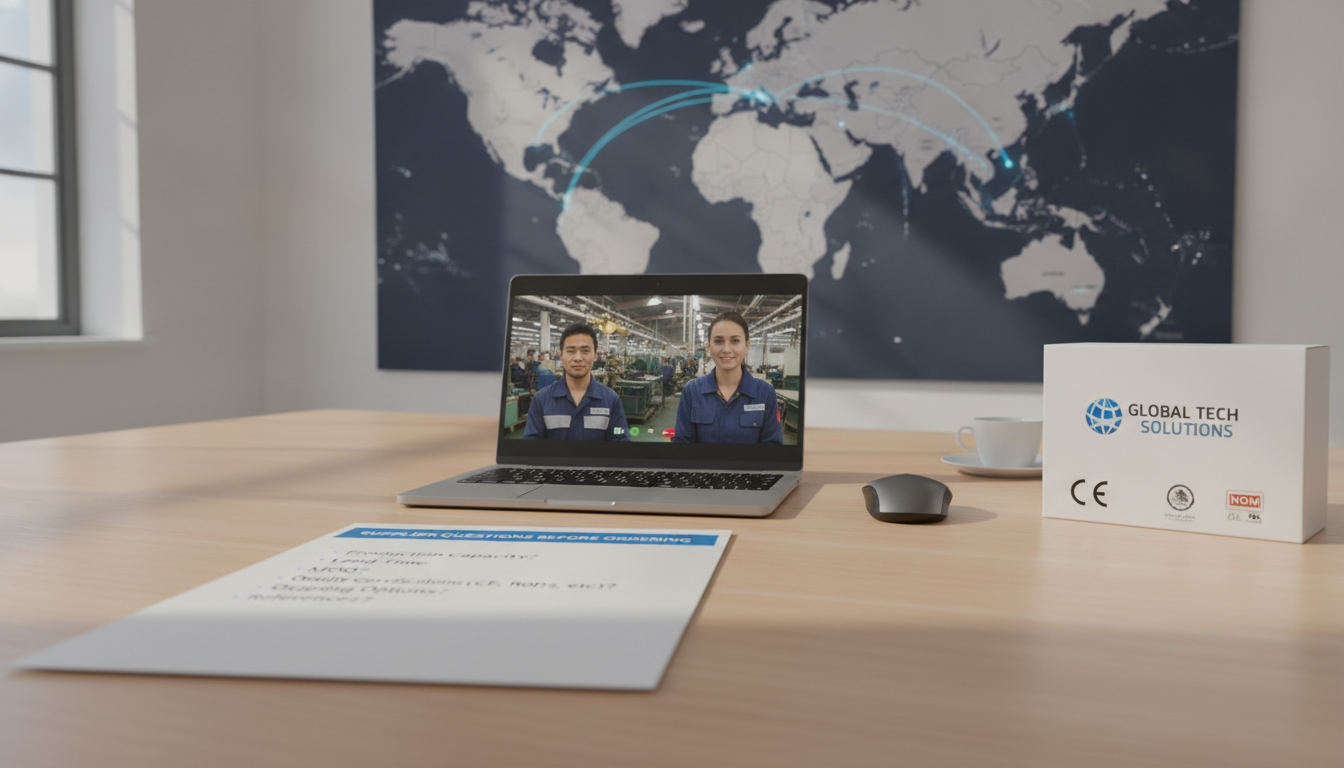
Supplier Verification Questions to Ask Chinese Supplier Before Ordering: 15 Critical Checks
Before you send a purchase order, verify the supplier’s identity, capacity, and track record. These questions form your first line of defense. In 23+ years of sourcing from Yiwu and Foshan, we have found that even one skipped verification step leads to costly rework later.
1. Business Legitimacy and Factory Audit Questions
Ask for the supplier’s business license number and cross-check it on the National Enterprise Credit Information Publicity System (NECIPS). A legitimate factory will provide a unified social credit code. If they hesitate, treat the delay as a red flag.
- Basic check: Request a scanned copy of the Chinese business license and verify the registered capital-at least RMB 500,000 for small factories.
- Advanced verification: Hire a third-party factory audit that includes onsite photos of production lines, inventory, and mold room.
- Document review: Ask for a valid ISO 9001 certificate and two recent utility bills in the company’s name to confirm operational status.
Typical cost: $300, $800 for a factory audit through a trusted China sourcing agent. Risk without audit: $10,000+ loss on a container of defective furniture.
2. Certification and Compliance Capacity
Ask which certifications the factory holds and request original certificates, not agent-provided copies. For goods entering Mexico, the supplier must understand NOM standards. For Brazil, ANVISA or INMETRO marks are mandatory depending on product category.
3. Production Capacity and Lead Time
- Monthly output: Ask for a breakdown of current orders and capacity. A factory claiming 50,000 units per month but showing an empty workshop in video calls is a shell company.
- Backup plans: Question how they handle peak season delays. A reliable supplier will name specific sub-contractors or alternate lines.
- Raw material sourcing: Verify where key components come from. Sudden material shortages can delay orders by 3-6 weeks.
Compliance Questions for Latin American Importers
Customs in Mexico, Brazil, and Argentina enforce strict technical regulations that differ from EU or US standards. Failing to ask the right questions before production leaves your shipment stranded at port. The questions below address the most frequent compliance gaps reported to local chambers of commerce.
Mexico: SAT Registration and NOM Certificates
- RFC and CDFI: Confirm the supplier can issue a Commercial Invoice with your RFC (Registro Federal de Contribuyentes) and that the invoice matches the CFDI (Digital Fiscal Document Online) format-errors cause rejection at Mexican customs.
- NOM compliance: Ask which specific NOM standard applies to your product. Electronics often require NOM-001-SCFI, textiles need NOM-004-SCFI, and toys fall under NOM-015-SCFI. Request the supplier’s NOM certificate from a recognized Mexican certification body (ANCE, NYCE).
- Import permit needs: Electronics and medical devices require an AVISO de Importación. Verify the supplier has exported to Mexico before and can provide the NOM certificate number and applicable HS code.
Brazil: ANVISA and INMETRO Requirements
- INMETRO for durable goods: Household appliances, toys, and automotive parts require INMETRO certification. Demand the INMETRO registration number and confirm its validity on the INMETRO database. A non-certified shipment of pressure cookers can be fined 100% of the FOB value.
- ANVISA for health products: Cosmetics, food supplements, and medical devices need ANVISA registration. Ask the supplier for the ANVISA protocol number and check if they have a local Brazilian Responsible Technician (Technical Manager).
Compliance Questions for European Importers
EU regulation mandates CE marking, REACH chemical compliance, and WEEE directives for electronics. A supplier who cannot produce a Declaration of Conformity should be dropped immediately.
CE Marking and Technical File
- Declaration of Conformity: Request a signed Declaration of Conformity that lists the exact product model and applicable directives (e.g., LVD 2014/35/EU, EMC 2014/30/EU).
- Technical file documentation: Demand a sample of the technical file containing design drawings, risk assessments, and test reports from an EU-notified body. Without it, your shipment can be stopped under Market Surveillance Regulation (EU) 2019/1020.
REACH and RoHS for Chemical Safety
- REACH registration: If your product contains chemical substances over 1 tonne/year, ensure the supplier has a REACH registration number. For toys, ask about phthalates and heavy metal limits.
- RoHS compliance: Every electronic product sold in the EU must comply with RoHS (2011/65/EU). Question the supplier about lead, mercury, and cadmium content and ask for a third-party RoHS test report.
Logistics, Customs, and Documentation Questions
Even a perfectly manufactured order can get stuck in customs because of incorrect paperwork. Clarifying HS codes, Incoterms, and warehousing details before production saves detention charges that can exceed $150 per day at Mexican or Greek ports.
Incoterms Selection: FOB vs CIF
- FOB (Free On Board): Ask the supplier to confirm FOB port and include local charges in the quote. FOB Shenzhen, for example, often has lower handling fees than FOB Shanghai.
- CIF (Cost, Insurance, and Freight): Request a breakdown of freight and insurance premiums. Some suppliers inflate insurance by 2-3% to pad margins.
HS Code and Customs Clearance
- HS code verification: Provide your product’s HS code in advance and ask the supplier to print it on the commercial invoice. A mismatched code can result in a 30-50% customs duty surcharge under Mexico’s SAT automated verification system.
- Pre-shipment documents: Ask the supplier to send a draft packing list and commercial invoice for your customs broker’s review. Corrections done after container departure cost $200, $500 in amendment fees.
Freight Consolidation and Warehousing
If you order from multiple suppliers, ask about freight consolidation services. A warehouse near Yiwu or Shenzhen can combine LCL shipments into a single FCL load, reducing overall freight by 25-40% compared to shipping small parcels individually.
Quality Control and Sample Order Questions
Samples tell you more than any conversation. The sequence of sample checks, from prototype to production run, is the only way to catch problems before they scale.
1. Pre-Production Samples
Request a pre-production sample made from actual production-grade materials. A sample assembled from reject parts will not reflect final quality. Ask for the sample’s serial number and keep it as a reference for final inspection.
2. During-Production Inspection
- Inspection timing: Schedule a third-party inspection after 20-30% of production is complete. Catching an error at this stage prevents a full batch of defects.
- Inspector access: Confirm the supplier allows unannounced inspections by an independent quality control team. A refusal suggests hidden problems.
3. Final Random Inspection (FRI)
Set an AQL (Acceptable Quality Limit) level of 2.5 or 1.0 for consumer goods. Ask the supplier to pre-sort to your AQL before the inspector arrives, share the inspection report within 24 hours, and pay only after the report confirms acceptable quality.
Payment Terms, MOQ, and Price Negotiation
Cash flow is where many first-time Latin American importers stumble. Structuring payments and negotiating MOQ flexibility can extend your runway and reduce risk.
Payment Method Selection
MOQ Flexibility and Tiered Pricing
Chinese suppliers often quote a high MOQ to cover setup costs. When you ask, “What questions to ask chinese supplier before ordering,” always include: “Can you lower the MOQ for the first trial order?” We have seen MOQ drop from 1,000 to 200 units simply by offering to pay a 5% surcharge per unit. Furthermore, request a tiered price list: 200 units, 500 units, 1,000 units. A real factory will respond with 15-25% price breaks at higher volumes, a trading company may not budge.
Key Takeaways
- Europol’s 2023 IP Crime Report confirms 86 million counterfeit items seized at EU borders, often from suppliers that could not provide valid certification.
- Mexican SAT requires an RFC tax ID and digital signature before clearance; invoices missing this information face indefinite holds, per 2024 SAT enforcement bulletins.
- Alibaba Trade Assurance data from 2023 shows that 62% of all buyer claims are for quality defects, not lost shipments.
- Ordering two samples from the same supplier reveals 40% of batch-to-batch variation problems, according to independent sourcing benchmarks.
- The China Council for the Promotion of International Trade (CCPIT) reports that only 5% of first-time buyers negotiate tiered pricing, missing 15-30% discounts at higher volumes.
- Brazilian ANVISA and INMETRO regulations can result in fines up to 100% of the FOB value for non-compliant imports, per 2023 Procomex trade statistics.
FAQ
How do I know if a Chinese supplier is legitimate?
Request the supplier’s official business license and verify the unified social credit code on China’s National Enterprise Credit Information Publicity System (NECIPS). A legitimate supplier will also share ISO certifications, export records, and allow an in-person factory audit. Third-party verification services can confirm these details within 3-5 business days.
What sample size should I order from a Chinese supplier?
Order at least two separate samples from the same listing, ideally a pre-production sample and a random production sample, to spot batch-level consistency issues. For high-value items like electronics, a 3-5 piece sample order allows testing across different units. Always pay for samples via a traceable method to confirm the supplier’s banking details.
How long does it take to get a response from a Chinese supplier?
A responsive supplier replies within 24 hours during business days (China Standard Time). Responses taking longer than 48 hours often indicate a trading company that needs to consult with a factory. Test response time by sending a detailed inquiry with technical specifications; a competent supplier will answer with specific questions, not just a price quote.
What documents do I need to import from China to Mexico?
For Mexico, you need a commercial invoice including your RFC and the supplier’s tax ID, a packing list, a bill of lading, and any required NOM certificates. The SAT also requires a CFDI (Digital Fiscal Document Online) and a Pedimento (import declaration). Most electronics require a NOM-001-SCFI certificate, which the Chinese supplier must obtain from an accredited lab.
Can I order directly from China without a sourcing agent?
Yes, but sourcing agents handle supplier verification, negotiate MOQs, manage quality inspections, and consolidate freight, reducing the risk of fraud. For first-time importers, an agent’s commission (3-5% of order value) often pays for itself by avoiding a single defective shipment. Agents also bridge language and cultural gaps, especially for Spanish- and French-speaking buyers.
Get a customized supplier verification checklist that covers Latin American and European compliance.
Download Your Free Checklist →