How to Import from China to Mexico (2026 Guide)
📋 Table of Contents
Importers across Latin America are increasingly turning to China for manufactured goods, but navigating the process into Mexico requires specific compliance knowledge. This guide explains how to import from China to Mexico in four concrete steps, covering registration, supplier verification, shipping options, and customs clearance.
Executive Summary
- China’s import share: China supplies roughly one-fifth of Mexico’s merchandise imports, according to Mexican trade statistics (2025).
- Ocean freight costs: Asia-Latin America ocean rates remained well above pre-2020 levels in 2025, per Drewry tracking, making logistics a major cost factor.
- Mexican port volume: Key Pacific and Gulf ports handled over 6 million TEU annually as of 2025, per port authority data, confirming large scale containerized imports from Asia.
- Sourcing demand growth: Nearshoring FDI into Mexico reached record levels in 2025 (UNCTAD), increasing demand for imported machinery and components from China.
- Trade outlook: Global merchandise trade growth was around 2.7% for 2025 (WTO), affecting sourcing costs and lead times.
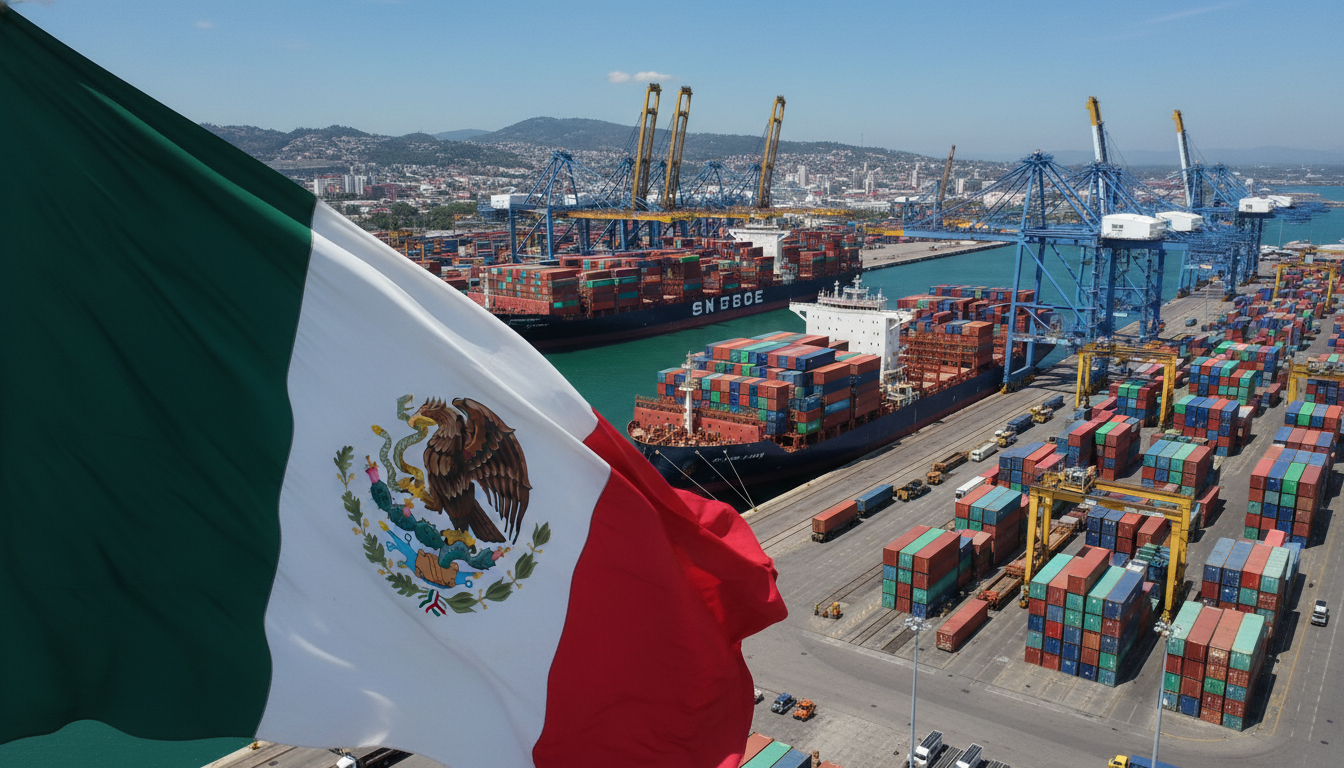
How to Import from China to Mexico: Step 1, Register with SAT
Every importer must first obtain a RFC (Registro Federal de Contribuyentes) tax ID from the Mexican tax authority SAT. Without an active RFC, customs will refuse entry to any commercial shipment. The registration process takes 2, 4 weeks if done correctly.
Required Documents for SAT Registration
Critical: Without an RFC, no commercial shipment clears Mexican customs. Registration takes 2, 4 weeks. Start this process before signing any supplier contract.
Common Pitfalls When Registering with SAT
- Wrong tax regime: Choose “General de Ley” for import activities, not “Régimen Simplificado de Confianza” (RESICO) which limits import value.
- Missing e-firma renewal: The e-firma expires after 2 years. Renew before submitting customs declarations.
- Incomplete address proof: SAT rejects utility bills older than 3 months or from non-owner addresses.
In practice: A Mexican buyer avoided $30K fraud by requesting our factory audit before payment
Step 2: Find and Verify Chinese Suppliers
Selecting a reliable manufacturer is the most critical decision in the import process. A trusted China sourcing agent with 23+ years in Yiwu and Foshan can verify supplier credentials, conduct in-person factory audits, and negotiate Incoterms.
Supplier Verification Checklist
- Business license check: Verify the supplier’s Chinese business license via the National Enterprise Credit Information Public System. Cross-check the registered address and scope.
- Factory audit: Request a third-party audit or send an agent to inspect real production capacity and quality control processes.
- Trade reference: Ask for recent export bills of lading or customs declarations to confirm they have shipped similar products to Latin America.
- Sample evaluation: Order pre-production samples and test for compliance with Mexican NOM standards (e.g., NOM-050 for electronics, NOM-004 for furniture).
Important: Fraud remains a real risk. In our 23+ years sourcing from Yiwu and Foshan, we’ve seen buyers lose deposits to shell companies that cannot deliver. Always verify the factory address via video call or on-site audit before any payment over $5,000.
Where to Find Suppliers
Professional supplier management reduces these risks. We handle audits, negotiate Incoterms, and monitor production to ensure your shipment meets Mexican NOM standards.
Step 3: Understand Shipping Methods and Costs
Choosing the right shipping method affects both cost and lead time. The how to import from China to Mexico process offers three main options, each suited to different product volumes and urgency.
Sea Freight (Full Container Load / Less than Container Load)
- Transit time: 22, 30 days from major Chinese ports (Shanghai, Ningbo, Shenzhen) to Manzanillo or Lázaro Cárdenas.
- Cost per CBM (LCL): $80, $130 per cubic meter as of early 2026, depending on lane and season.
- Best for: High-volume orders exceeding 5 CBM. Economical but requires longer planning.
Cost example: A 15 CBM order of furniture shipped from Yiwu to Manzanillo via LCL costs roughly $1,200, $1,800 in ocean freight (2026 rates).
الشحن الجوي
- Transit time: 3, 7 days from Chinese airports to Mexico City or Guadalajara.
- Cost per kg: $4.50, $7.50 per kg for general cargo.
- Best for: High-value, low-weight, or time-sensitive goods (electronics, samples, spare parts).
Express Courier (DHL / FedEx / UPS)
- Transit time: 2, 5 days door-to-door.
- Cost per kg: $8, $12 per kg for standard service.
- Best for: Samples, small parcels under 50 kg, or emergency replenishments.
Cost Comparison Table
Our freight and shipping service consolidates goods at our Yiwu warehouse and negotiates volume rates with carriers serving Manzanillo, Veracruz, and Mexico City airport.
Step 4: Manage Customs Clearance and Documentation
Mexican customs (SAT) requires specific documents for every commercial import. One missing document can delay your shipment for weeks, costing storage fees and potential penalties.
Mandatory Customs Documents
- Bill of Lading (B/L) or Airway Bill (AWB): Original document from carrier indicating consignee, cargo description, and destination.
- Commercial Invoice: Must include supplier and buyer details, HS code (6 digits), unit value, total value, and Incoterms. SAT reviews unit prices against reference values.
- Packing List: Detailed breakdown of each carton/package: weight, dimensions, and contents.
- Certificate of Origin: For preferential tariff treatment under FTAs (e.g., Chinese origin goods do not have a preferential agreement with Mexico; standard third-country duties apply).
- Import Declaration (Pedimento): Filed electronically by a registered customs agent (agente aduanal). Only an agent with a SAT-issued power of attorney can submit the pedimento.
Mexican NOM Compliance by Product Category
Important: You must hire a Mexican customs broker (agente aduanal) who holds a valid SAT patent. The broker reviews your invoice, assigns HS codes, calculates duties (typically 0, 25% ad valorem for Chinese goods), files the pedimento, and coordinates physical inspection if selected under the red channel system.
Expected duty rates: Most consumer goods from China face a general tariff of 5, 20% plus 16% VAT (IVA) and 0.8% Customs Processing Fee. Use a landed cost calculator to get accurate estimates before ordering.
If you want help navigating the entire import process, book a 15-minute sourcing call with our team. We speak English, Spanish, and French.
Key Takeaways
- China supplied roughly one-fifth of Mexico’s total merchandise imports in 2025, according to Mexican trade statistics.
- Asia-Latin America ocean freight rates remained well above pre-2020 baseline in 2025, as reported by Drewry.
- Mexican customs (SAT) requires every importer to obtain an RFC tax ID before clearing any commercial shipment.
- Standard sea LCL freight from Shanghai to Manzanillo costs $80, $130 per CBM as of early 2026.
- Nearshoring FDI into Mexico reached record levels in 2025 (UNCTAD), raising demand for imported Chinese machinery and components.
- A licensed Mexican customs broker (agente aduanal) must file the import declaration (pedimento) for every customs clearance.
FAQ
How do I import goods from China to Mexico?
Register with SAT for an RFC tax ID, find a verified Chinese supplier, negotiate Incoterms and shipping method, and hire a Mexican customs broker to file the pedimento. Expect 22, 30 days for sea freight from China to Mexican ports.
What documents are required to import from China to Mexico?
Required documents include bill of lading or airway bill, commercial invoice with HS codes, packing list, certificate of origin (if claiming preferential duty), and the import declaration (pedimento) filed by a customs broker.
How much does it cost to import from China to Mexico?
Costs vary by shipping method. Sea LCL costs $80, $130 per CBM, air freight $4.50, $7.50/kg, express $8, $12/kg. Add duties (5, 20% ad valorem for Chinese goods), 16% IVA, 0.8% customs fee, plus broker fees and inland freight.
How long does shipping from China to Mexico take?
Sea freight from Chinese ports to Mexican Pacific ports (Manzanillo, Lázaro Cárdenas) takes 22, 30 days. Air freight takes 3, 7 days. Express courier services deliver in 2, 5 days door-to-door.
Do I need a customs broker to import from China to Mexico?
Yes. Mexican law requires a licensed customs agent (agente aduanal) to file the import declaration (pedimento). The broker reviews documentation, assigns HS codes, calculates duties, and coordinates customs clearance.
Ready to start importing from China to Mexico? Get expert support with supplier verification, logistics, and customs compliance.
Book a Free Sourcing Consultation →