China Skincare Private Label Manufacturer Verification [2026 Guide]
![China Skincare Private Label Manufacturer Verification [2026 Guide]](https://goodcantrading.com/wp-content/uploads/2026/07/featured-china-skincare-private-label-manufacturer-verification.png)
📋 Table of Contents
- Executive Summary
- Why Verification Matters for Private Label Skincare
- Factory vs. Trading Company: How to Tell the Difference
- Mandatory Certifications and Licenses
- Third-Party Audit Process and What to Expect
- Quality Control Protocols for Private Label Production
- Export Compliance and Documentation Support
- Digital Verification Tools and Remote Audits
- Key Takeaways
- FAQ
Private label skincare imports from China carry significant fraud risk if you skip proper china skincare private label manufacturer verification. Shell companies pose as factories, certifications get forged, and quality control gaps lead to rejected shipments at customs. Buyers in Mexico, Colombia, Brazil, and across Europe face mounting pressure to prove supplier legitimacy before placing deposits.
the exact verification steps professional importers use to distinguish real manufacturers from trading companies, validate ISO 22716 and GMPC certificates, and conduct third-party audits that protect your investment.
Executive Summary
- EU export growth: Chinese cosmetic OEM exports to EU reached $4.2 billion in 2025, with 23% growth year-over-year, according to China Customs.
- Certification compliance: ISO 22716 certification compliance among Chinese cosmetic manufacturers rose to 79% in 2025, up from 62% in 2023, according to CCPIT (China Council for the Promotion of International Trade).
- Latin America audit gap: Only 31% of private label skincare buyers in Mexico and Brazil conduct on-site factory audits before initial orders, according to Statista.
- Colombia import surge: Private label skincare imports from China into Colombia increased by 35% in 2025, driven by rising local brand formation, according to Alibaba Trade Index.
- EU compliance risk: 42% of EU-based beauty brands using Chinese private label manufacturers cite verification fraud as a major compliance risk, according to Deloitte.
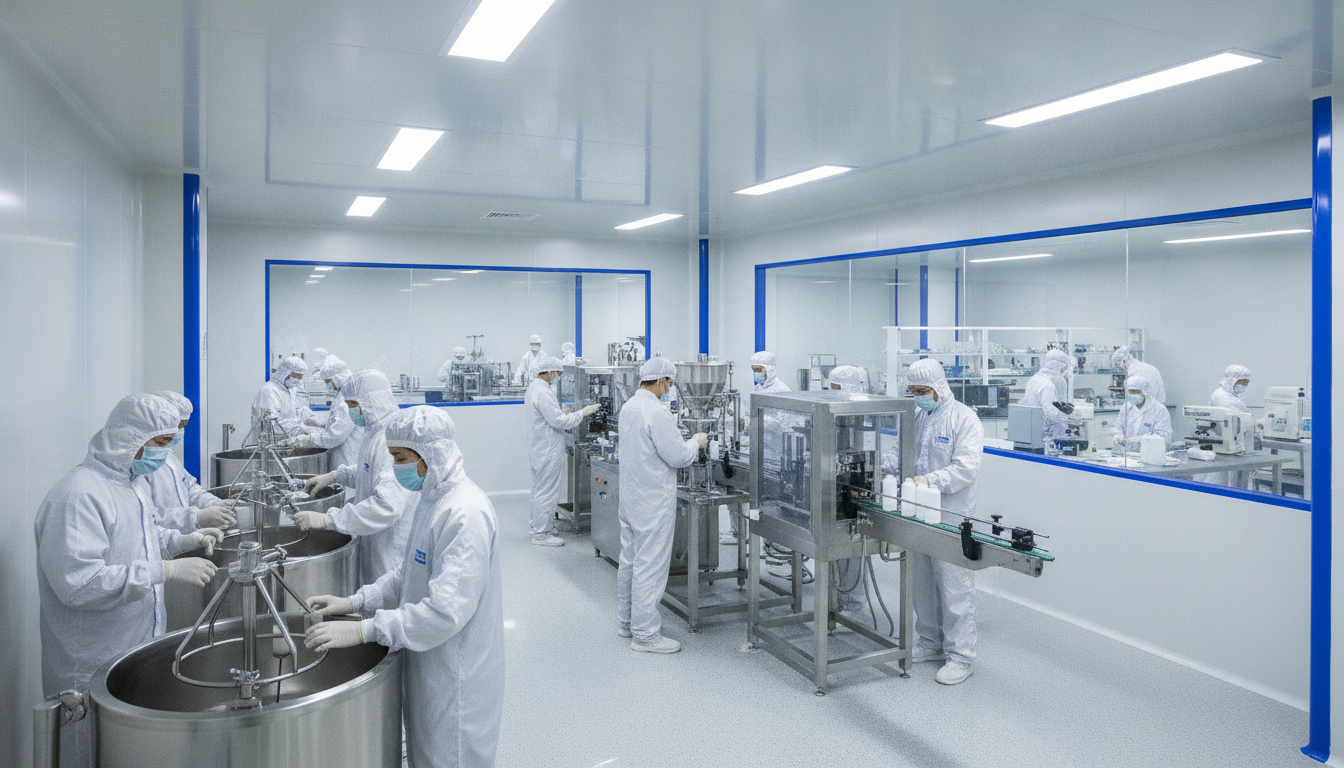
Why Verification Matters for Private Label Skincare
China skincare private label manufacturer verification prevents three costly scenarios: paying deposits to shell companies that vanish, receiving non-compliant formulas that fail customs clearance, and discovering your “factory” is a middleman marking up prices. A common complaint buyers raise is hidden commissions between factories and intermediaries, where the importer pays inflated prices without knowing the real factory cost.
Financial Risk Exposure
Deposits for private label skincare orders typically range from 30% to 50% of total order value. For a 10,000-unit order at $3.50 per unit, you risk losing $10,500 to $17,500 if the supplier disappears after payment. Trading companies often request higher deposits than direct factories because they need to secure their own supplier before fulfilling your order.
Regulatory Compliance Gaps
Mexico requires NOM-141-SSA1 compliance for cosmetic imports, Brazil demands ANVISA registration, and the EU enforces Cosmetics Regulation (EC) No 1223/2009. Unverified manufacturers may lack the documentation infrastructure to support these filings, leaving you unable to clear customs even after production completes. Our trusted China sourcing agent team has seen buyers lose entire shipments because the factory could not provide Certificate of Analysis (COA) or Material Safety Data Sheet (MSDS) documents in the required format.
Brand Reputation Damage
A single batch of contaminated skincare products can trigger recalls, legal liability, and permanent brand damage. Verification ensures the manufacturer operates cleanroom facilities that meet ISO 14644 standards and conducts microbiology testing on every batch. Without these controls, you cannot guarantee product safety to your end customers.
Factory vs. Trading Company: How to Tell the Difference
Trading companies present themselves as manufacturers to capture higher margins. Distinguishing real factories from intermediaries requires specific verification tactics that go beyond business license checks.
Video Tour Cross-Reference
Request a live video tour via WeChat or WhatsApp during production hours. The tour must show the full production line: raw material storage, mixing tanks, filling machines, packaging stations, and quality control lab. Cross-reference visible equipment serial numbers and facility layout against the factory’s business license address. A trading company will either refuse the video request, show a generic facility tour that does not match their registered address, or display a showroom instead of active production equipment.
Business License Address Verification
Obtain the manufacturer’s business license (营业执照) and verify the registered address matches the production facility. Use Baidu Maps or Google Earth to confirm the address corresponds to an industrial zone, not a residential building or office complex. Cross-check the business scope (经营范围) section of the license to ensure it includes “cosmetics manufacturing” (化妆品生产), not just “cosmetics sales” (化妆品销售).
Production Capacity Documentation
Ask for equipment purchase invoices, utility bills showing high electricity consumption consistent with manufacturing, and employee payroll records. Real factories can provide these documents within 48 hours. Trading companies cannot produce facility-specific proof because they do not own production equipment.
Mandatory Certifications and Licenses
China skincare private label manufacturer verification requires validating multiple certifications that prove regulatory compliance and manufacturing capability. Forged certificates circulate widely, so verification must go beyond reviewing PDF copies.
ISO 22716 (Good Manufacturing Practices for Cosmetics)
ISO 22716 certification demonstrates the manufacturer follows international GMP standards for cosmetic production. Request the certificate number and issuing body, then verify directly with the certification authority. Legitimate certificates include an expiration date, scope of certification (specific product categories), and accreditation body logo. Contact the issuing organization via their official website to confirm the certificate remains valid and was issued to the specific factory address you are evaluating.
GMPC (Good Manufacturing Practice Certificate)
GMPC certification is the U.S. equivalent of ISO 22716, required for exports to North American markets. The certificate must specify the manufacturing site address and product categories covered. Cross-reference the certificate against the FDA facility registration database if the manufacturer claims FDA registration. Many factories hold GMPC for specific product lines (creams, serums) but not others (makeup, sunscreen), so verify the scope matches your intended product category.
Chinese Cosmetics Production License
All cosmetic manufacturers in China must hold a Cosmetics Production License (化妆品生产许可证) issued by provincial drug administration authorities. The license displays a unique permit number, validity period, and approved product categories. Verify the license through the National Medical Products Administration (NMPA) public database at www.nmpa.gov.cn. Enter the license number to confirm it is active and matches the manufacturer’s registered business name.
Export-Specific Certifications
Depending on your target market, request additional certifications:
- ECOCERT or COSMOS: Required for organic cosmetic claims in EU markets; verify through the certifying body’s online registry.
- USDA Organic: Necessary for organic skincare sold in the United States; confirm via USDA Organic Integrity Database.
- BSCI (Business Social Compliance Initiative): Demonstrates ethical labor practices; request the audit report and verify the audit date is within the past 12 months.
In practice: A Colombian buyer discovered their manufacturer’s ISO 22716 certificate was forged after we contacted the issuing body directly, saving them from a $28,000 deposit to a fraudulent supplier.
Third-Party Audit Process and What to Expect
Third-party audits conducted by SGS, Intertek, or Bureau Veritas provide independent verification that the manufacturer operates legitimate production facilities and follows quality control protocols. These audits cost between $800 and $2,500 depending on audit scope and factory location.
Pre-Audit Preparation
Define the audit scope before engaging the inspection company. Specify whether you need a basic factory verification audit (confirms the facility exists and operates), a full GMP compliance audit (evaluates cleanroom standards, batch records, quality control procedures), or a social compliance audit (checks labor conditions, working hours, safety protocols). Provide the auditor with the manufacturer’s business license, production license, and any certifications they claim to hold.
On-Site Audit Components
A comprehensive factory audit for skincare manufacturers includes:
- Facility inspection: Auditor verifies the factory address matches business registration, measures production floor area, and photographs equipment serial numbers.
- Cleanroom assessment: Checks air filtration systems, particle count monitoring, and compliance with ISO 14644 cleanroom classification standards.
- Raw material verification: Reviews supplier contracts for key ingredients, inspects storage conditions (temperature control, segregation of incompatible materials), and checks COA documentation for recent batches.
- Production process review: Observes mixing, filling, and packaging operations; verifies batch record accuracy; confirms equipment calibration certificates are current.
- Quality control lab inspection: Evaluates testing equipment (pH meters, viscometers, microbiology incubators), reviews test methods against international standards, and checks lab technician qualifications.
- Document review: Examines production licenses, employee training records, customer complaint logs, and corrective action reports.
Audit Report Interpretation
The audit report categorizes findings into major non-conformances (critical issues that pose safety risks or indicate fraudulent operations), minor non-conformances (procedural gaps that do not immediately threaten product quality), and observations (improvement opportunities). Reject any manufacturer with major non-conformances related to facility legitimacy, certification validity, or contamination control. Minor non-conformances around documentation formatting or training record gaps can often be resolved before production starts.
Our quality control team coordinates third-party audits for clients who cannot travel to China, ensuring the audit scope covers all verification points relevant to their target market regulations.
Quality Control Protocols for Private Label Production
Verification extends beyond initial factory approval to ongoing quality control during production. Private label skincare requires batch-level testing and inspection at multiple production stages.
Raw Material Inspection
Before production begins, verify the manufacturer tests incoming raw materials against specifications. Request COA documents for key active ingredients (hyaluronic acid, vitamin C, retinol) showing purity percentages, microbial limits, and heavy metal content. Cross-check supplier names on COA documents against the manufacturer’s approved vendor list. Substitution of lower-grade ingredients is a common cost-cutting tactic that compromises product efficacy and safety.
Formula Verification and Stability Testing
Obtain the complete formula (INCI list with percentages) and verify it matches your product development agreement. Request stability testing data showing the formula remains stable under accelerated aging conditions (40°C, 75% relative humidity for 90 days). This testing predicts whether the product will separate, change color, or lose efficacy during its shelf life. Manufacturers should provide photographic evidence of stability samples at 0, 30, 60, and 90-day intervals.
In-Process Quality Checks
During production, the manufacturer should conduct in-process checks at each stage:
- Mixing phase: Verify batch weight, pH, viscosity, and color match specifications; take samples for microbiology testing.
- Filling phase: Check fill weight accuracy across multiple units; confirm no contamination from filling equipment.
- Packaging phase: Inspect label placement, lot number printing, and seal integrity; verify packaging materials match approved samples.
Final Product Testing
Before shipment, conduct final product testing that includes:
- Microbiology testing: Total aerobic microbial count, yeast and mold count, absence of pathogens (E. coli, Pseudomonas aeruginosa, Staphylococcus aureus).
- Physical testing: pH, viscosity, specific gravity, color matching against approved standard.
- Chemical testing: Active ingredient concentration, preservative system efficacy, heavy metal screening.
- Packaging integrity: Leak testing, drop testing, and compatibility testing between formula and container.
Request test reports from an independent lab, not just the manufacturer’s internal lab. Third-party testing costs $200 to $600 per batch but provides unbiased verification that the product meets specifications.
Export Compliance and Documentation Support
China skincare private label manufacturer verification must include the factory’s ability to provide export documentation that satisfies your target market’s import requirements. Incomplete or incorrect paperwork causes customs delays and additional fees.
Certificate of Analysis (COA)
The COA documents test results for the specific batch being shipped. It must include batch number, production date, test parameters, results, and pass/fail status for each test. Verify the COA is signed by the quality control manager and dated within 30 days of shipment. Some countries require COA documents to be notarized or certified by China’s Chamber of Commerce.
Material Safety Data Sheet (MSDS)
MSDS documents provide safety information for each ingredient and the finished product. They are required for customs clearance in most countries and must follow the Globally Harmonized System (GHS) format. Verify the MSDS includes all 16 required sections, is written in the destination country’s language (Spanish for Mexico and Colombia, Portuguese for Brazil, English for EU), and lists emergency contact information.
Free Sale Certificate
A Free Sale Certificate confirms the product is legally sold in China and meets Chinese cosmetic regulations. This document is often required for ANVISA registration in Brazil and ANV registration in Colombia. The certificate must be issued by CCPIT or a provincial chamber of commerce, stamped with their official seal, and apostilled if the destination country is a Hague Convention signatory.
Ingredient Declaration and INCI List
Provide a complete ingredient list using International Nomenclature of Cosmetic Ingredients (INCI) names, listed in descending order by weight percentage. EU regulations require the INCI list on product labels, while Mexico’s NOM-141 requires it on import documentation. Verify the manufacturer can provide this list in the required language and format.
Country-Specific Requirements
Different markets impose unique documentation requirements:
- Mexico: NOM-141-SSA1 compliance requires a sanitary license from COFEPRIS; the manufacturer must provide formulation details and stability data to support your license application.
- Brazil: ANVISA registration demands extensive toxicological data, good manufacturing practice certificates, and product safety reports; verify the manufacturer has experience supporting ANVISA filings.
- Colombia: ANV registration requires sanitary registration certificates and manufacturing authorization documents; the manufacturer must provide notarized copies of their production license.
- European Union: Cosmetics Regulation (EC) No 1223/2009 requires a Product Information File (PIF) containing safety assessments, manufacturing process descriptions, and efficacy claims substantiation; confirm the manufacturer can provide the technical data needed for your PIF.
Our supplier management service includes verification that manufacturers have the documentation infrastructure to support your specific market’s import requirements, preventing customs clearance delays.
Digital Verification Tools and Remote Audits
Travel restrictions and budget constraints make remote verification increasingly important. Digital tools enable thorough china skincare private label manufacturer verification without on-site visits.
Video Verification Protocols
Conduct live video inspections via WeChat, WhatsApp, or Zoom during production hours. Use a structured checklist:
- Exterior verification: Request the contact person to walk outside and show the building exterior, street address signage, and surrounding industrial area.
- Production floor tour: Ask them to walk through the entire production line from raw material storage to finished goods warehouse, pausing at each station to show equipment nameplates and serial numbers.
- Quality control lab: Show all testing equipment with close-up views of calibration stickers and recent test reports.
- Document verification: Request they display original certificates and licenses on camera, showing official seals and holograms that indicate authenticity.
License Validation Databases
Cross-check manufacturer claims against official government databases:
- NMPA database: Verify cosmetics production licenses and product registrations at www.nmpa.gov.cn (Chinese interface; use Google Translate).
- National Enterprise Credit Information Publicity System: Confirm business registration, legal representative, and registered capital at www.gsxt.gov.cn.
- Customs registration: Verify export license status through China Customs enterprise database.
Blockchain Traceability Systems
Some advanced manufacturers use blockchain-based traceability platforms that record raw material sourcing, production steps, and quality test results in an immutable ledger. Request access to the traceability dashboard for your batch, where you can verify ingredient origins, production timestamps, and test results. While blockchain adoption remains limited in the cosmetic manufacturing sector, it provides the highest level of transparency when available.
AI-Driven Document Verification
Third-party services use artificial intelligence to detect forged certificates by analyzing document formatting, seal authenticity, and issuing authority signatures. Upload scanned copies of the manufacturer’s ISO 22716, GMPC, and production license to these platforms for automated fraud detection. While not a replacement for direct verification with issuing bodies, AI tools provide a rapid initial screening that flags obvious forgeries.
In practice: A Mexican startup used our remote video verification protocol to audit five potential manufacturers in Guangzhou, identifying two trading companies and one factory with forged GMPC certification, before selecting a legitimate manufacturer that now produces their entire skincare line.
Key Takeaways
- Chinese cosmetic OEM exports to EU reached $4.2 billion in 2025, with 23% growth year-over-year, according to China Customs.
- ISO 22716 certification compliance among Chinese cosmetic manufacturers rose to 79% in 2025, up from 62% in 2023, according to CCPIT (China Council for the Promotion of International Trade).
- Only 31% of private label skincare buyers in Mexico and Brazil conduct on-site factory audits before initial orders, according to Statista.
- Private label skincare imports from China into Colombia increased by 35% in 2025, driven by rising local brand formation, according to Alibaba Trade Index.
- 42% of EU-based beauty brands using Chinese private label manufacturers cite verification fraud as a major compliance risk, according to Deloitte.
- 68% of private label cosmetic importers in Latin America report supply chain verification as their top barrier to market entry, according to McKinsey & Company.
FAQ
How to verify if a Chinese skincare manufacturer is a real factory or a trading company?
Request a live video tour showing the complete production line from raw material storage to packaging, and cross-reference the facility address against the business license. Real factories have business licenses listing “cosmetics manufacturing” in the scope section and can provide equipment purchase invoices, utility bills, and employee payroll records. Trading companies operate from office buildings, refuse video tours, or show generic showrooms instead of active production equipment.
What certifications are required for private label cosmetics exported from China to the EU?
EU-bound cosmetics require ISO 22716 (Good Manufacturing Practices) certification and compliance with Cosmetics Regulation (EC) No 1223/2009. The manufacturer must provide a Product Information File containing safety assessments, manufacturing process descriptions, and ingredient documentation. Additional certifications like ECOCERT or COSMOS are mandatory if you make organic claims. Verify all certificates directly with the issuing bodies using their online registries.
Can I trust ISO 22716 and GMPC certificates from Chinese cosmetic manufacturers?
Verify certificates directly with the issuing certification body rather than relying on PDF copies. Legitimate ISO 22716 and GMPC certificates include a unique certificate number, expiration date, specific manufacturing site address, and accreditation body logo. Contact the certification authority via their official website to confirm the certificate is valid and was issued to the factory you are evaluating. Forged certificates are common and can be detected through direct verification.
Do I need a third-party audit before ordering private label skincare from China?
Third-party audits by SGS, Intertek, or Bureau Veritas are strongly recommended for orders above $15,000 or when you cannot visit the factory in person. These audits cost between $800 and $2,500 and provide independent verification of facility legitimacy, cleanroom standards, quality control procedures, and certification validity. The audit report identifies major non-conformances that indicate fraud risk or safety issues, allowing you to reject unsuitable manufacturers before paying deposits.
How to check if a Chinese manufacturer has NMPA or FDA registration for export?
Verify NMPA registration by searching the manufacturer’s cosmetics production license number at www.nmpa.gov.cn in the public database. For FDA registration, request the manufacturer’s FDA facility registration number and verify it through the FDA’s online database. Note that FDA facility registration is voluntary for cosmetic manufacturers and does not indicate FDA approval of products. NMPA registration is mandatory for all Chinese cosmetic manufacturers and provides stronger verification of legitimacy.
Protect your private label investment with professional factory verification.
Request a Factory Audit →
Written by Michael Ye, Senior Sourcing Manager at Goodcantrading, 15 years in China sourcing and QC.